
An ISO 27001 corrective action plan is a written record that answers one audit finding with four things: what you fixed right now, why the problem happened, what you changed so it cannot happen again, and how you will prove the change worked. Auditors accept plans that show a systemic root cause, a named owner, a realistic date, attached evidence and a separate effectiveness check. They reject plans that only patch the symptom. This guide gives you the structure, a completed example and a way to budget the effort before the audit report lands.
TL;DR
- Every nonconformity needs two responses: a correction (fix this instance) and a corrective action (remove the cause), as Clause 10 of the standard requires.
- A plan that names “human error” as the root cause, or restates the finding as the cause, is the most common reason auditors send plans back.
- Include a named owner, a dated action, evidence of completion, a check on whether the same gap exists elsewhere, and a later effectiveness review.
- Your certification body sets the deadline for submitting the plan, so read the audit report closing section the day you receive it.
- Size the work before you commit: the number of findings, the controls involved and your security maturity decide the effort.
Table of Contents
- What the standard actually requires
- Correction versus corrective action
- Minor and major findings: what changes
- Build the plan in six steps
- A completed example
- Tailoring the plan to your size and sector
- How much effort to plan for
- Estimate the work before the audit does
- Our perspective
- FAQ
- Sources
What the standard actually requires
The requirement sits in the improvement clause of ISO/IEC 27001. In the 2013 text, when a nonconformity occurs the organization must react to it, control and correct it, evaluate whether the cause needs eliminating, implement the action, review its effectiveness and keep documented information. In the 2022 edition the same requirement is numbered Clause 10.2, and it adds the need to determine the causes and keep records of the actions and results.
A nonconformity is simply a requirement that is not met. It can be a missing record, a control that does not work as documented, or a process nobody follows. The standard does not call for a “corrective action plan” as a named document. In practice, the plan is the record that shows you did what the clause lists. Our guide to what auditors expect under Clause 10 walks through the clause line by line.
The 2022 edition was supplemented in February 2024 by an amendment. Standard Norge’s catalog record gives its publication date as 23 February 2024. The amendment added a climate-change point in the context clause, so it does not change how corrective action works. If you hold the 2022 edition, the process below applies as written.
Correction versus corrective action
This is the distinction that decides whether your plan passes.
- Correction deals with the instance. Three servers were missing patches, so you patch them.
- Corrective action deals with the cause. Servers were never enrolled in the patching tool, so you change the provisioning process so every new server is enrolled.
Both are expected for each finding. A plan that contains only the correction describes a repair, not a change to the management system, and the same finding tends to return at the next audit. That is how a minor nonconformity turns into a major one.
If you want a shorter process view, our walkthrough of five steps auditors accept for corrective action covers the same ground in checklist form.
Minor and major findings: what changes
Certification audits sort findings by severity. A major nonconformity means a requirement is not met in a way that puts the system’s intended results in doubt. A minor one is an isolated lapse. Lead-auditor training material explains that, under the certification body standard ISO/IEC 17021-1, the certification body must review the correction and the corrective action, including the cause analysis, before deciding on certification when a major finding is open. The same material stresses that the auditor does not perform the root cause analysis or prescribe the solution. That work is yours.
In the US flow, Stage 1 and Stage 2 audits each end with a closing meeting where nonconformities are communicated. You then develop and carry out corrective action plans, and the auditor reviews and validates them. The same guide notes that a first certificate runs three years with at least annual surveillance audits, so open findings often come back for review at a later visit.
Deadlines differ by certification body and severity. Your audit report states them, so take the date from that document, not from a blog. Treat the closing meeting as day one of the clock.
Build the plan in six steps

1. Describe the finding in the auditor’s terms
Copy the requirement or control reference and the evidence the auditor cited. If the finding says three of ten sampled servers lacked patches older than 60 days under Annex A control 8.8, write exactly that. Do not soften it or argue it in the description. A vague restatement makes every later field harder to defend.
2. Make the correction and date it
Fix the instance right away and record the date. Contain the consequences too: if an unpatched server held customer data, note what you checked to confirm nothing was exposed. This is the “react to it” part of the clause.
3. Find a root cause you can test
Use a simple technique. The 5 Whys asks “why” until you reach a cause you can act on. A fishbone diagram sorts causes into people, process, technology and environment. Depth should match severity: a brief analysis is enough for a low-risk, limited finding, while a complicated one needs the affected staff, process owners and management in the room, and when there are several root causes you must find all of them.
A root cause is good when it points to a process, a resource, a responsibility or training. Typical ISO 27001 causes are a responsibility nobody was assigned, a process that was never documented, a process that is documented but not followed, or a review on the wrong schedule. Lead-auditor guidance lists the weak answers auditors reject: “human error”, restating the nonconformity as the cause, a corrective action that is only a correction, and no check for similar problems elsewhere.
A quick test: if you removed the cause, would the problem have been prevented? If you cannot say yes, keep asking why.
4. Choose an action that changes the system
A corrective action should alter a procedure, a tool, a schedule, a role or a training requirement. “Remind staff” rarely qualifies. “Add patch-tool enrollment as a mandatory step in the server provisioning checklist and send a weekly reconciliation report to the infrastructure lead” does.
5. Assign an owner, a date and evidence
Name one person, not a team. Set a date you can meet, because a missed date in a plan you wrote yourself looks worse than a longer date you hit. Decide in advance what evidence will close the item: a signed attendance sheet, a changed policy with a version number, a screenshot of tool configuration, a log extract. Our guide to types of evidence for ISO 27001 audits shows which records auditors tend to ask for.
6. Schedule the effectiveness review separately
This is the field most often skipped. The review is a later check that the cause is gone and the finding has not recurred. A reasonable pattern is one quarter without recurrence for process findings, and shorter or longer depending on how often the process runs. Where the finding was significant, the ISMS lead or an independent reviewer should verify effectiveness, not the person who implemented the action. If the action failed, raise a new nonconformity that references the original.
A completed example
The table below is a worked example for a technical finding, based on the patching scenario above.
| Field | Entry |
|---|---|
| Finding | 3 of 10 sampled servers missing patches older than 60 days (Annex A 8.8) |
| Correction | All three servers patched; date recorded; logs reviewed for signs of compromise |
| Root cause | Servers added after the last asset inventory update were never enrolled in the automated patching tool |
| Scope check | Full reconciliation of asset inventory against patch-tool enrollment across all environments |
| Corrective action | Provisioning checklist now requires patch-tool enrollment; weekly reconciliation report goes to the infrastructure lead |
| Owner | Infrastructure lead |
| Target date | Within the window set in the audit report |
| Evidence | Updated checklist (version-controlled), first four weekly reports, enrollment screenshot |
| Effectiveness review | Three months of reconciliation reports reviewed by the ISMS manager, who did not implement the change |
The example follows the worked case in lead-auditor study material. Notice that the scope check and the effectiveness review are separate lines with their own evidence.
A non-technical example: supplier contracts
Not every finding is about servers. Suppose an auditor finds that several suppliers handling customer data have no security clauses. The correction is a standard security clause and signature from the highest-risk suppliers. The root cause might be that when the supplier security policy was introduced, nobody was assigned to review existing contracts. The corrective actions are a contract clause template, a review of all current supplier contracts, and a policy update requiring legacy contracts to be reviewed. If your suppliers include outsourced support or back-office teams, data security in BPO partnerships shows the kind of board-level controls that belong in that review.
For more finding types and how teams write them up, see our ISO 27001 non-conformity examples and the list of common audit failures.
Tailoring the plan to your size and sector
The six steps stay the same. What changes is the depth and who does the work.
Startups. You probably have one person wearing the ISMS hat. Keep each plan short, put the owner’s name on every action, and avoid actions that depend on headcount you do not have. A calendar reminder with a completion template is a legitimate corrective action if it fixes the cause, which was an unassigned responsibility. Independence for the effectiveness review can come from a different team member or a leader outside the process, as long as it is not the person who made the change.
Finance firms. Expect more findings to touch access control, supplier management and change management, because those are where your regulators and customers also look. Tie each corrective action to a record that serves both your ISO 27001 audit and any other examiner. Review cadence matters here: a quarterly access review that is documented but never run is a classic “documented but not followed” cause.
Mid-size and larger organizations. Complex findings may need a cross-functional group and a steering review. Feed the open actions into your management review so leadership sees them. Our management review agenda maps the Clause 9.3 inputs to the evidence you will need, including the status of nonconformities and corrective actions.
If your environment runs on a major cloud platform, mapping the controls to the platform’s settings shows where the gaps will appear before an auditor finds them. Our Azure mapping guide shows one way to do it.
How much effort to plan for
The effort depends on how many findings you receive, their severity and how many controls sit behind them. Most of the cost is internal staff time: investigating, changing procedures, collecting evidence and reviewing. Plans for a handful of minor findings are modest. A major finding that exposes a missing process, such as no supplier review at all, can consume weeks.
The cheapest way to keep corrective action small is to find the gaps before the certification body does. A readiness assessment against the control domains shows where findings are likely, so you can fix causes while they are still your own to schedule. Our audit stages guide explains what sampling at each stage looks like, and the auditor questions guide lists what to rehearse.
Estimate the work before the audit does
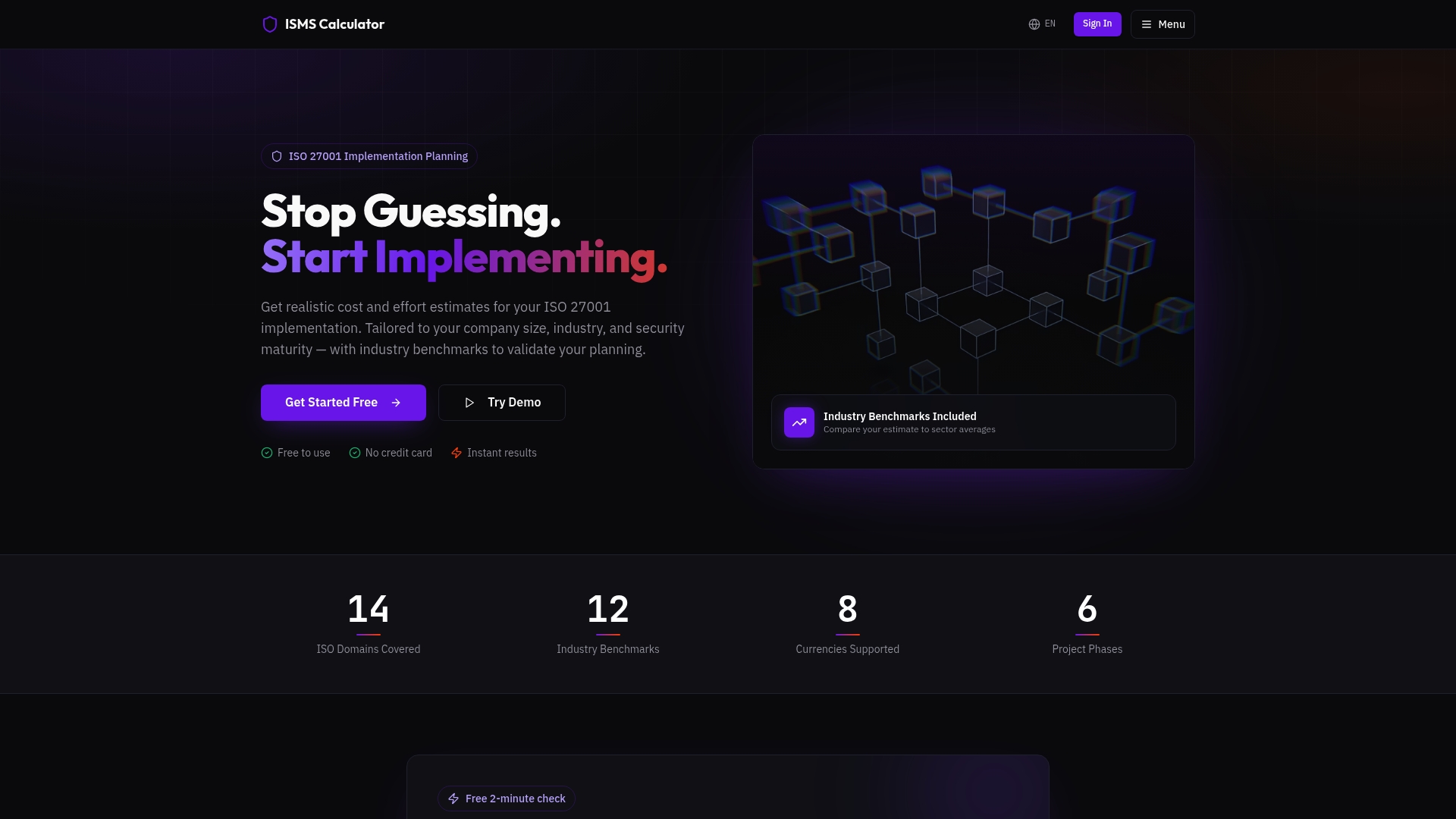
If you are budgeting a certification project, the corrective action effort is one line in a larger estimate. The ISO 27001 Cost Calculator at ISMS Calculator gives a real-time estimate based on your company size, industry and security maturity, with model reference comparisons to check your plan against that reference. The initial calculation needs no signup, and the assumptions are editable, so you can see what changes when you assume more or fewer findings.
The ISO 27001 Cost Calculator is where to start. The free 2-minute check gives an instant readiness view, and the ISO 27001 Readiness Assessment covers maturity across the four Annex A control themes. You can save and compare several estimates, build a Gantt-style timeline for the implementation phases, and export a PDF report to share with leadership. If you want outside help with the audit itself, you can also request an introduction to an independent ISO 27001 consultant.
The methodology behind the numbers is documented on our cost model methodology page, so you can trace how each figure is built.
Our perspective
Most corrective action plans fail for a boring reason: the team treats the audit report as a to-do list instead of a diagnosis. Each finding is a symptom of a gap in the management system, and the plan is only as good as the cause it names.
We build ISMS Calculator around that idea. An estimate should show its assumptions, let you change them and stay traceable, so that when a finding arrives you already know which domain it belongs to and how much effort it deserves. Our readiness check across the four Annex A control themes is designed to surface those gaps early, when you can schedule the fix rather than react to a deadline.
Our advice to compliance officers and IT managers is simple. Run the readiness check before the audit, keep your assumptions visible, and give every future finding an owner, a date and a review. Teams that plan this way spend less time defending plans and more time improving controls.
Martin
FAQ
Is a corrective action plan mandatory for ISO 27001?
The standard does not require a document with that name, but it does require you to react to each nonconformity, address its cause, review the effectiveness of the action and keep records. A corrective action plan is the usual way to hold those records in one place, and certification bodies expect to see it for each finding.
How long do I have to submit the plan?
Your certification body sets the deadline, and it can differ by severity. The date appears in the audit report or is given at the closing meeting. Read it immediately, and book the root cause session within the first few days so the plan does not wait until the final week.
What is the most common reason a plan is rejected?
A root cause that is really a restatement of the finding, or a vague “human error”. Plans are also rejected when the corrective action is only a correction, or when there is no effectiveness check and no look at whether the same problem exists elsewhere. Name a process, resource, responsibility or training gap and test it.
Who should verify that the action worked?
Someone other than the person who implemented it, ideally the ISMS lead or an independent reviewer. They confirm the action was done as described, that the evidence matches, and that the problem has not returned over a reasonable period, often one quarter. If it has returned, raise a new nonconformity that references the original.
Sources
- ISO/IEC 27001:2013 standard text
- Clause 10: Improvement, ISO 27001:2022 requirements
- ISO/IEC 27001:2022/Amd 1:2024, Standard Norge
- ISO/IEC 27001 overview
- Root cause analysis in action plans, ISO 27001 lead auditor
- Demystifying corrective action and root cause analysis, NQA webinar
- ISO 27001 step-by-step approach toward certification, BARR Advisory
- Data security in BPO partnerships