
Data classification is the process of organizing information assets by sensitivity, business value, and regulatory requirements so that an ISMS can apply proportionate security controls to each category. The role of data classification in ISMS frameworks is not peripheral. It is the mechanism that connects your risk register to real-world protection decisions. Without it, ISO 27001 Annex A.5.12, GDPR, and HIPAA compliance efforts rest on guesswork rather than documented evidence. This guide explains how classification works inside an ISMS, what levels you need, and how to avoid the operational traps that derail most implementations.
How does data classification support risk-based security control allocation?
ISO 27001 Annex A.5.12 mandates classification based on confidentiality, integrity, availability, and interested party requirements. This is the CIA triad applied directly to your asset inventory. Each dimension tells you something different: confidentiality determines who can access data, integrity determines how it must be protected from tampering, and availability determines how quickly it must be recoverable.
Classification translates those three dimensions into control decisions. A payroll database classified as Restricted triggers multi-factor authentication, encryption at rest, and quarterly access reviews. A public marketing brochure classified as Public requires none of those controls. The difference is not arbitrary. It reflects the actual risk exposure of each asset.

Without classification, organizations either over-protect low-risk data or under-protect critical information. Both outcomes waste resources or increase risk. Over-protection slows operations and drives up costs. Under-protection creates the conditions for a breach. Classification prevents both failure modes by giving asset owners a documented basis for control selection.
Under ISO 27001, asset owners carry direct responsibility for classifying the information they manage. This accountability structure matters. When a business unit owns the classification decision, the security team can enforce controls without becoming the bottleneck for every data handling question.
- Confidentiality controls: Encryption, access restrictions, and need-to-know policies tied to Confidential and Restricted tiers
- Integrity controls: Digital signatures, version control, and change logging for data where accuracy is critical
- Availability controls: Backup frequency, recovery time objectives, and redundancy requirements scaled to business criticality
- Interested party requirements: Contractual and regulatory obligations that elevate classification regardless of internal risk appetite
Pro Tip: Map each classification level directly to a named control set in your Statement of Applicability. This creates a traceable line from asset sensitivity to implemented control, which auditors and certification bodies expect to see.
What are common data classification levels and how do they shape ISMS policies?
Typical classification levels include Public, Internal Use, Confidential, and Restricted. Each tier carries distinct handling rules covering access, encryption, retention, and disposal. A four-tier scheme is the most widely adopted in ISO 27001 implementations because it provides enough granularity to differentiate protection requirements without creating the complexity that leads to inconsistent labeling.
The table below shows how each level maps to concrete handling requirements inside an ISMS.
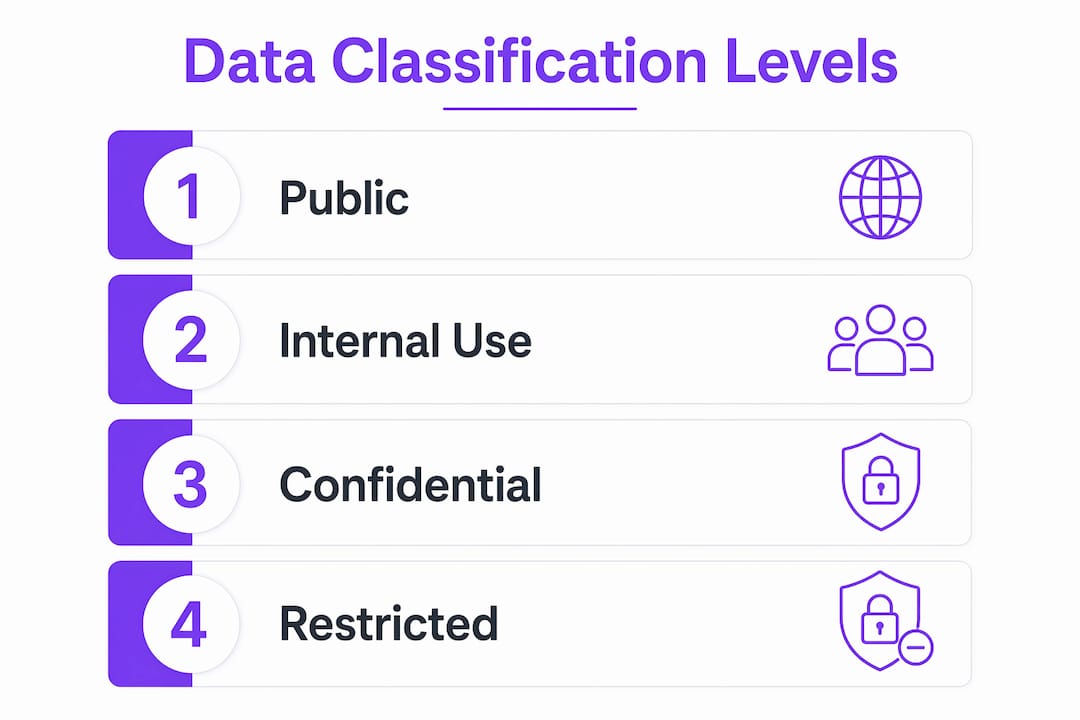
| Classification Level | Access Control | Encryption Required | Retention Policy | Disposal Method |
|---|---|---|---|---|
| Public | No restriction | No | Standard | Standard deletion |
| Internal Use | Employees only | In transit | Per policy | Secure deletion |
| Confidential | Role-based, need-to-know | At rest and in transit | Defined, audited | Certified destruction |
| Restricted | Strict, named individuals | At rest, in transit, in use | Legally mandated | Witnessed destruction |
Classification labels operationalize your policies. A policy that says “sensitive data must be encrypted” is unenforceable without a definition of sensitive. When you attach the label Confidential to a dataset, every downstream policy that references Confidential automatically applies. This is how classification turns abstract policy language into specific, auditable behavior.
The Restricted tier deserves particular attention. Data classified as Restricted typically includes personal health information under HIPAA, personal data under GDPR, and payment card data under PCI DSS. These categories carry legal obligations that exist independently of your internal risk appetite. Classification at this tier is not a judgment call. It is a compliance requirement.
Pro Tip: Avoid creating more than four tiers in your initial scheme. Organizations that start with six or seven levels consistently report labeling inconsistency within six months. Start simple, validate the scheme against your actual data inventory, then add granularity only where the risk evidence demands it.
How does classification enable compliance and audit readiness in an ISMS?
GDPR, HIPAA, and CCPA all require documented classification to demonstrate that you know where sensitive data resides and what protections are in place. This documentation is not a formality. It is the primary reference point during breach investigations and regulatory audits. Regulators do not accept verbal assurances. They review records.
Classification creates that record. When a data subject submits a GDPR access request, your classification metadata tells you exactly which systems hold their personal data. When a HIPAA auditor asks how you protect electronic protected health information, your classification policy and associated controls provide the answer. When a breach occurs, your classification records show which data categories were exposed and what controls were active at the time.
The compliance benefits of classification extend to ISO 27001 certification audits as well. Certification bodies assess whether your ISMS applies controls proportionate to risk. Classification is the documented evidence that proportionality exists. Without it, you cannot demonstrate that your control selection was deliberate rather than arbitrary.
Automated classification tools from vendors such as Microsoft Purview and Varonis accelerate this process by scanning repositories and applying labels based on content patterns. These tools reduce the manual burden of initial classification and support ongoing monitoring as data volumes grow.
- Audit trail: Classification records show which controls applied to which data at any point in time
- Breach response: Classified inventories identify affected data categories within hours rather than days
- Regulatory mapping: Classification tiers map directly to regulatory categories, simplifying compliance gap analysis
- Third-party risk: Classification labels inform data sharing agreements and vendor access controls
What operational challenges arise when implementing data classification?
Overclassification slows work processes; underclassification increases risk exposure. Both failures stem from the same root cause: human judgment variability. When employees classify data without clear criteria and training, the scheme degrades within months. This is the most common reason classification programs fail in practice.
The following best practices address the most persistent implementation challenges.
- Define classification criteria in writing. Criteria must be specific enough that two different employees classifying the same dataset reach the same conclusion. Vague criteria like “sensitive information” produce inconsistent results.
- Assign named asset owners. Every data asset needs a named individual responsible for its classification. Shared ownership means no ownership.
- Train all staff, not just IT. Business units create and handle the most sensitive data. Classification training must reach finance, HR, legal, and operations teams, not just the security function.
- Build declassification into the process. Data that was Confidential three years ago may be Public today. A classification scheme without scheduled reviews accumulates stale labels that distort your risk picture.
- Integrate classification with access control systems. Classification labels alone do not guarantee security. They must connect to your identity and access management platform, your data loss prevention tools, and your incident response playbooks.
- Pilot before full deployment. Test your scheme on a representative sample of data assets before rolling it out organization-wide. Pilots surface edge cases that policy documents miss.
The ISMS maturity assessment framework provides a structured way to evaluate where your classification program sits across all four ISO/IEC 27001:2022 control themes. Organizations that benchmark their classification maturity before full deployment consistently identify gaps that would otherwise surface during certification audits.
How does data classification integrate with data governance in an ISMS?
Data classification is foundational for compliance, security, and governance. Without it, organizations cannot effectively manage risk or comply with privacy laws. Classification is a subset of data governance, focused specifically on sensitivity and handling requirements. Governance covers the broader lifecycle: ownership, quality, lineage, and retention. Classification feeds into all of those dimensions by providing the sensitivity metadata that governance policies need to function.
A documented classification policy creates consistent understanding across security, IT, compliance, and business teams. That shared understanding is what makes governance work in practice. When every team applies the same labels and follows the same handling rules, policy enforcement becomes systematic rather than ad hoc.
Classification metadata also enables technical enforcement of governance policies. Retention schedules can trigger automatically based on classification labels. Data masking rules can apply to Confidential fields in development environments without manual intervention. Incident response playbooks can escalate automatically when Restricted data appears in an unexpected location.
- Retention enforcement: Classification labels trigger automated retention and deletion schedules
- Data masking: Sensitivity metadata drives masking rules in non-production environments
- Incident response: Classification schemes improve risk awareness and enable faster triage when anomalies involve high-sensitivity assets
- Access governance: Periodic access reviews prioritize Restricted and Confidential assets, focusing reviewer effort where risk is highest
Key takeaways
Effective data classification is the structural foundation of every ISMS, connecting risk assessment to control selection, compliance documentation, and governance enforcement across all data assets.
| Point | Details |
|---|---|
| Classification drives control selection | Map each classification tier to a named control set to create auditable, proportionate protection. |
| Four tiers cover most ISMS needs | Public, Internal Use, Confidential, and Restricted provide sufficient granularity without labeling complexity. |
| Compliance depends on documented classification | GDPR, HIPAA, and ISO 27001 auditors require records showing where sensitive data resides and what controls apply. |
| Labels require technical integration | Classification only protects data when connected to access control, DLP tools, and incident response systems. |
| Governance and classification reinforce each other | Classification metadata automates retention, masking, and access review processes across the ISMS. |
Why classification is the decision you cannot defer
Most ISMS implementations I have reviewed treat data classification as a late-stage task, something to finalize after policies are written and controls are selected. That sequence is backwards. Classification is the input that makes every other decision defensible.
When you select controls before classifying your data, you are guessing at proportionality. You might get lucky, but you cannot prove your choices were risk-based. Certification auditors notice this. More importantly, your own security team cannot prioritize effectively without knowing which assets matter most.
The automation trend is real and worth watching. Tools like Microsoft Purview now scan repositories at scale and apply labels based on content patterns. That capability reduces the manual burden significantly. But automation does not replace the policy work. You still need defined criteria, named owners, and a governance structure that keeps labels current as data evolves.
The organizations I have seen succeed with classification share one trait: they treat it as a risk management tool, not a compliance checkbox. They review labels quarterly, connect them to access control systems, and use classification data to prioritize their incident response efforts. That discipline is what separates a functioning ISMS from a document repository.
— Martin
Start your ISO 27001 classification assessment today
Understanding the theory of data classification is the first step. Knowing where your organization actually stands is what drives progress. Ismscalculator provides a structured ISO 27001 readiness assessment that evaluates your classification practices across all four ISO/IEC 27001:2022 control themes, benchmarks your maturity against model reference values, and identifies the specific gaps that need attention before certification.
If you need hands-on support, the Ismscalculator independent consultant directory connects you with ISO 27001 implementers and lead auditors who specialize in classification policy design and ISMS deployment. For a quick baseline, the 2-minute readiness check gives you an immediate picture of your current classification posture at no cost.
FAQ
What is the role of data classification in an ISMS?
Data classification organizes information assets by sensitivity and business requirements so that an ISMS can apply proportionate security controls to each category. ISO 27001 Annex A.5.12 requires this classification based on confidentiality, integrity, and availability criteria.
How many classification levels does an ISMS need?
Most ISMS implementations use four levels: Public, Internal Use, Confidential, and Restricted. Fewer than four levels reduces granularity; more than four increases labeling inconsistency without proportionate security benefit.
Does data classification satisfy GDPR and HIPAA requirements?
Documented classification is a primary compliance reference under GDPR, HIPAA, and CCPA, demonstrating that you know where sensitive data resides and what controls protect it. It does not replace other required controls but provides the evidence base auditors and regulators expect.
What happens if classification labels are not integrated with technical controls?
Classification labels alone do not enforce protection. Without integration with access control systems, data loss prevention tools, and incident response playbooks, labels serve only a governance function and leave data exposed to technical threats.
Who is responsible for data classification in an ISMS?
ISO 27001 assigns classification responsibility to named asset owners within each business unit. Security teams define the criteria and policy; asset owners apply labels to the data they manage and review classifications on a scheduled basis.