
ISO 27001 asset classification is the structured process of identifying, categorizing, and labeling information assets based on their sensitivity, value, and regulatory requirements within an Information Security Management System (ISMS). The ISO 27001:2022 standard makes this process mandatory through Annex A controls 5.9, 5.12, and 5.13, which together govern inventory, classification schemes, and labeling procedures. Without a working classification system, your organization cannot apply proportionate security controls, and auditors will notice. Asset classification is not a one-time exercise. It is the operational foundation that determines how every piece of information your organization holds gets protected.
What are the key ISO 27001 controls for asset classification?
ISO 27001:2022 Annex A contains three controls that directly govern asset classification, and each one has distinct compliance requirements. Understanding them separately prevents the common mistake of treating classification as a single task.
Control 5.9 requires organizations to maintain a documented inventory of all information and associated assets, with a named owner assigned to each entry. Ownership is mandatory per the 2022 revision, and unowned assets are among the most common audit findings. The inventory must cover hardware, software, data, services, and people where relevant.

Control 5.12 requires a formal classification scheme that assigns every information asset a category based on its value, sensitivity, and legal or regulatory obligations. The scheme must be documented, approved, and consistently applied across the organization. Auditors check whether the scheme exists on paper and whether staff actually use it.
Control 5.13 addresses labeling. Classification labels must be supplemented by enforced handling rules that specify how each tier is stored, transmitted, encrypted, and destroyed. A label without a corresponding policy is an audit failure waiting to happen.
These three controls became firm audit requirements after the October 2025 transition deadline for organizations migrating from ISO 27001:2013 to the 2022 version. If your organization has not yet updated its documentation to reflect controls 5.9, 5.12, and 5.13 by name, that gap will appear in your next surveillance audit.
Pro Tip: Map each control to a named policy owner in your ISMS documentation. Auditors look for accountability at the control level, not just at the asset level.
Review the full scope of Annex A controls to see how asset classification connects to access control, cryptography, and supplier management requirements.
How are assets commonly classified under ISO 27001?
ISO 27001:2022 requires organizations to classify information assets using tiers that reflect their value, criticality, and sensitivity. The most widely adopted scheme uses four levels.
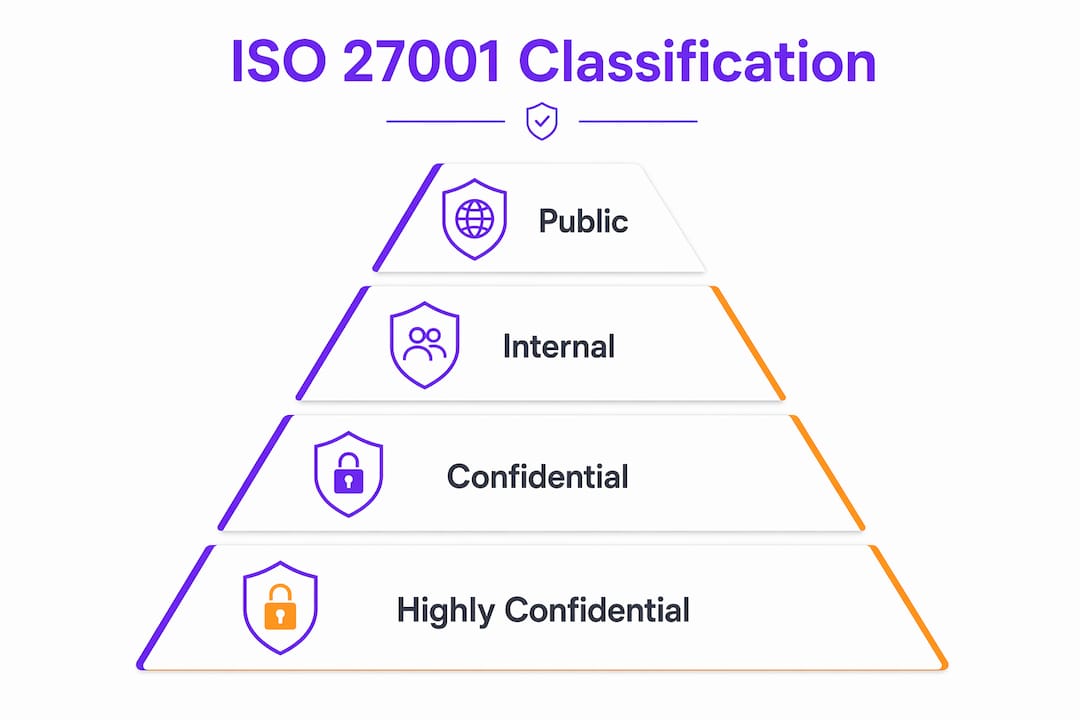
| Classification tier | Typical examples | Minimum handling requirement |
|---|---|---|
| Public | Marketing materials, published reports | No restriction on distribution |
| Internal | Internal memos, process documents | Share within organization only |
| Confidential | Customer data, contracts, HR records | Encrypt in transit and at rest |
| Highly Confidential | Trade secrets, regulated health data, financial records | Strict access control, audit logging, secure destruction |
The four-tier model maps directly to the CIA triad: Confidentiality, Integrity, and Availability. A “Highly Confidential” asset demands strong confidentiality controls, high integrity verification, and guaranteed availability through redundancy. A “Public” asset may need only basic integrity checks to prevent unauthorized modification.
Three criteria drive classification decisions in practice:
- Business value: What would the loss or exposure of this asset cost the organization financially or reputationally?
- Sensitivity: Does the asset contain personal data, intellectual property, or regulated information under laws such as GDPR or HIPAA?
- Criticality: Would the unavailability of this asset disrupt operations or breach contractual obligations?
Classification levels must be reviewed when assets change. A contract that starts as “Internal” becomes “Confidential” the moment it contains pricing or personal data. Static classification schemes that never get updated are a known audit risk.
Pro Tip: Assign classification at the point of creation, not retrospectively. Build classification prompts into document templates, email systems, and file-sharing platforms so staff classify assets before they save or send them.
What practical methods support effective asset inventory and classification?
The most common reason asset classification fails audits is not a flawed scheme. It is a stale register. An asset register treated as a point-in-time spreadsheet fails audits because organizational change outpaces manual updates within months.
Effective asset classification and inventory maintenance requires a different approach. Here is a practical sequence that works for most compliance teams:
-
Integrate inventory into IT workflows. Tie asset registration to onboarding, provisioning, and change management processes. When a new server is provisioned or a SaaS application is purchased, the asset register updates automatically. Active maintenance through IT processes creates a living inventory that meets ISO/IEC 27002:2022 expectations.
-
Assign a named individual owner to every asset. Ownership assigned to a team or department creates accountability gaps. Assigning responsibility to a named individual rather than a group is the standard that auditors check. That person is accountable for the asset’s classification, handling, and lifecycle decisions.
-
Deploy Data Security Posture Management (DSPM) tools for cloud environments. Cloud and SaaS environments generate assets faster than any manual process can track. DSPM tools automate discovery and classification of assets in cloud environments, supporting accuracy in ways that spreadsheets cannot match.
-
Link classification tiers to documented handling rules. Every classification level must have a corresponding policy that specifies storage requirements, transmission controls, encryption standards, and destruction procedures. Classification without handling rules is incomplete under controls 5.12 and 5.13.
-
Schedule quarterly classification reviews. Assets change in sensitivity over time. A quarterly review cycle, tied to your ISMS internal audit schedule, catches reclassification needs before auditors do.
Pro Tip: Use your asset inventory role in the ISMS to drive classification reviews. When the inventory is live and owned, reviews become a workflow task rather than a project.
Grouping controls by operational capability rather than Annex A number helps teams maintain clarity and accountability beyond initial certification. Organize your asset management work around who does what, not just which control number applies.
What audit risks should you watch for in ISO 27001 asset classification?
Audit failures in asset classification follow predictable patterns. Knowing them in advance lets you fix the gaps before an auditor finds them.
-
Outdated registers. Manual asset inventories drift quickly due to organizational changes, and a register that has not been updated in six months is a red flag in any audit. Auditors cross-reference the register against live systems and will find discrepancies.
-
Unowned assets. Any asset without a named individual owner is an automatic finding under control 5.9. Auditors specifically look for this because unowned assets indicate that no one is accountable for their security.
-
Labels without enforcement. Labels without clear policies and procedures risk audit failures even when a classification scheme exists on paper. If your “Confidential” label does not trigger encryption requirements in practice, the scheme is decorative.
-
Inconsistent classification. When different teams apply the same classification scheme differently, auditors see a governance failure. A customer contract classified as “Internal” by one team and “Confidential” by another signals that training and oversight are missing.
-
Shadow IT and cloud sprawl. Assets that exist outside the formal inventory because they were acquired without IT involvement are invisible to your classification scheme. DSPM tools and procurement controls are the primary defenses here.
The most common ISO 27001 implementation mistakes include treating asset classification as a documentation exercise rather than an operational discipline. Organizations that pass audits consistently treat their asset register as a live operational tool, not a compliance artifact.
Integrate asset management with your IT Asset Management (ITAM) program if one exists. ITAM and ISMS asset registers that run in parallel without synchronization create exactly the kind of inconsistency that auditors flag.
Key Takeaways
Effective ISO 27001 asset classification requires active inventory maintenance, named individual ownership, enforced handling rules, and integration with operational IT workflows to pass audits and sustain compliance.
| Point | Details |
|---|---|
| Three controls govern classification | Controls 5.9, 5.12, and 5.13 cover inventory, classification schemes, and labeling with handling rules. |
| Four-tier scheme is standard | Public, Internal, Confidential, and Highly Confidential are the most widely adopted classification levels. |
| Named ownership is mandatory | Every asset must have a named individual owner; team-level ownership creates audit findings. |
| Labels require enforced policies | A classification label without a corresponding handling policy fails controls 5.12 and 5.13. |
| Active registers beat static spreadsheets | Integrating inventory updates into IT workflows prevents the drift that causes audit failures. |
Why asset classification is where most ISMS programs quietly fail
Asset classification looks straightforward on paper. Four tiers, a spreadsheet, some labels. In practice, the gap between a classification scheme that exists and one that actually works is where most ISMS programs quietly fall apart.
What I have seen consistently is that organizations invest heavily in building the initial asset register and then treat it as done. Six months later, three new SaaS tools are in production, two servers have been decommissioned, and the register reflects none of it. The classification scheme is technically in place, but it no longer describes reality. That is not a classification problem. It is an ownership and process problem.
The fix is not more documentation. It is operational integration. When asset registration becomes part of how your IT team provisions systems and onboards vendors, the register stays current without anyone having to run a quarterly “update the spreadsheet” project. Classification follows naturally when it is built into the workflow rather than bolted on afterward.
The other thing I would push back on is the instinct to classify everything at the highest tier to be safe. Over-classification creates real operational friction. Staff start ignoring labels because everything is “Confidential,” and the scheme loses meaning. Calibrate your tiers to reflect actual risk, and your handling rules will be followed.
Automation through DSPM tools has changed what is possible for cloud-heavy environments. If your organization runs significant workloads in AWS, Azure, or Google Cloud, manual classification is not a realistic option at scale. The organizations getting this right are the ones that treat DSPM output as the authoritative source for cloud asset classification and feed it directly into their ISMS register.
— Martin
How Ismscalculator supports your ISO 27001 asset classification work
Asset classification is one piece of a larger ISO 27001 implementation, and getting the scope and effort right from the start saves significant time and cost.
Ismscalculator gives compliance professionals and IT managers a real-time picture of what ISO 27001 implementation actually requires for their organization. The platform’s readiness assessment covers all four ISO/IEC 27001:2022 control themes, including asset management, and benchmarks your current maturity against model reference values. The free 2-minute readiness check identifies gaps in asset classification and inventory controls before they become audit findings. If you need expert support, the consultant directory connects you with independent ISO 27001 implementers who specialize in asset management and ISMS deployment.
FAQ
What is asset classification in ISO 27001?
Asset classification in ISO 27001 is the process of categorizing information and associated assets by sensitivity, value, and regulatory requirements to determine appropriate security controls. ISO 27001:2022 Annex A controls 5.12 and 5.13 make this process a formal compliance requirement.
What are the standard ISO 27001 classification tiers?
The four standard tiers are Public, Internal, Confidential, and Highly Confidential. Each tier carries specific handling rules covering storage, transmission, encryption, and destruction requirements.
Who is responsible for asset classification under ISO 27001?
Control 5.9 requires a named individual owner for every asset in the inventory. That individual is accountable for the asset’s classification, handling, and lifecycle decisions throughout its existence.
How often should asset registers be reviewed?
Asset registers should be reviewed continuously through integration with IT workflows such as provisioning and change management, with formal classification reviews at least quarterly to catch reclassification needs before audits.
What is the most common audit failure in ISO 27001 asset classification?
The most common failures are unowned assets, outdated registers, and classification labels that lack enforced handling policies. Auditors cross-reference live systems against the register and check whether handling rules are actually applied in practice.