
ISO 27001 audit preparation for finance companies is the process of aligning your Information Security Management System documentation, operational evidence, and staff readiness to satisfy auditor expectations across both certification stages. Finance organizations face a higher bar than most sectors: regulators, clients, and auditors expect traceable risk decisions, documented supplier controls, and proof that your ISMS has been running, not just written. This guide gives compliance officers and IT managers a structured path through every phase of ISO 27001 audit prep for finance companies, from documentation assembly to staff interviews and third-party risk evidence.
What documentation is critical for ISO 27001 audit readiness in finance?
The ISO 27001 certification audit runs in two stages: Stage 1 is a documentation desk review lasting one to two days, and Stage 2 verifies operational effectiveness over three to eight days. Most mid-sized finance organizations complete both within six to eight weeks. That timeline means your documentation must be complete and current before you ever book the Stage 1 date.
The core document set auditors expect includes:
- ISMS scope statement defining which systems, locations, and business processes are in scope
- Information security policy signed off at board or executive level
- Risk assessment methodology describing how you score likelihood and impact
- Risk register with treatment decisions traceable to named controls
- Statement of Applicability (SoA) linking every Annex A control to your risk assessment with justifications for inclusions and exclusions
- Risk treatment plan with owners, timelines, and status
- Asset inventory with named individual owners, not just departments or roles
Version control is non-negotiable. Auditors check document dates, revision histories, and approval signatures. A policy dated three years ago with no review record is a finding waiting to happen. Asset ownership must be assigned to named individuals and updated after personnel changes to maintain audit trail integrity.
The SoA deserves special attention in finance. Regulators such as the FCA and FINMA expect explicit justification when controls are excluded. A generic “not applicable” against a control like cryptography or supplier relationships will draw immediate scrutiny in any financial services context.

Pro Tip: Maintain a single master ISMS document register with version numbers, review dates, and owners in one place. Auditors who find conflicting versions of the same policy across SharePoint, email, and a shared drive will flag it as a systemic control weakness.
How to collect and present operational evidence for Stage 2 audit success
Stage 2 audit failures typically result from insufficient operational evidence rather than absent documentation. Auditors test ISMS operation through interviews and log sampling. That distinction matters: you can have perfect policies and still fail if you cannot show the policies are actually followed.
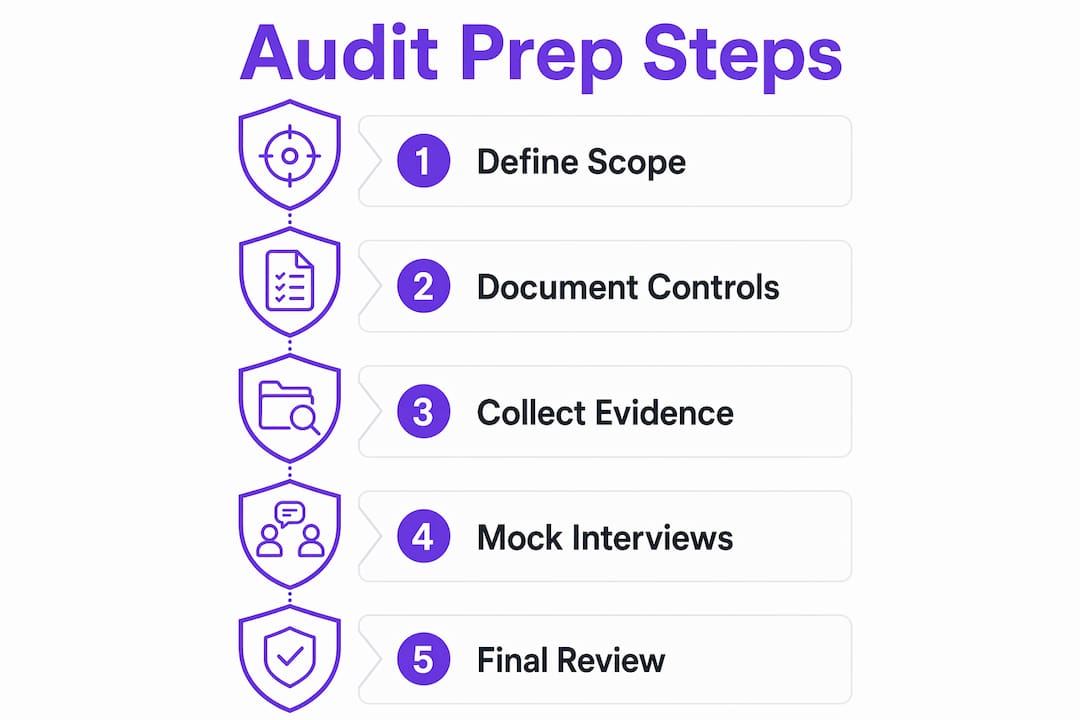
The 4 to 8 week gap between Stage 1 and Stage 2 exists precisely to let organizations demonstrate that management reviews, internal audits, awareness training, and controls have been operating over a meaningful period. Do not waste that window.
Build your evidence pack in this sequence:
- Risk register updates showing periodic reviews with dated entries and treatment decision changes
- Internal audit records covering at least one full cycle with findings, corrective actions, and closure evidence
- Management review minutes with attendance, agenda items covering ISMS performance, and documented decisions
- Training records showing all in-scope staff completed security awareness training with dates and completion rates
- Incident logs including near-misses, response actions taken, and lessons learned
- Supplier security assessments for all material third parties, including review dates and risk ratings
- Backup and recovery test results with dates, scope, and outcomes
- Corrective action register linking nonconformities to root cause analysis and verified closure
Audit-ready evidence packs that map each risk and control to underlying operational proof reduce last-minute scrambling and facilitate auditor walkthroughs. Cross-link from your risk register entry to the specific control, then to the evidence artifact. Auditors trace processes end-to-end, so a broken link in that chain becomes a finding.
The most common pitfall in finance audits is controls that appear to have been activated the week before the audit. Backup logs starting two weeks before Stage 2, or a training completion record dated the day after Stage 1, signal to auditors that the ISMS is performative rather than operational.
Pro Tip: Label every evidence artifact with the control number it supports, the date range it covers, and the name of the person responsible. A folder called “A.8.15 Logging Evidence” containing three months of log review records is far more useful to an auditor than a folder called “Security Stuff.”
Which teams and roles need to be prepared for auditor interviews?
Personnel preparation includes briefing staff on ISMS basics, their roles, policies, and expected audit behavior. Auditors interview ISMS managers, control owners, and in-scope staff from departments including finance operations, IT, HR, and procurement. Mock interviews improve confidence and reduce surprises on audit day.
The key groups to prepare are:
- ISMS manager or information security officer: Must articulate the scope, risk methodology, and how the ISMS links to business objectives. Expect detailed questions on risk treatment decisions and internal audit findings.
- Control owners: Each person responsible for a specific Annex A control must explain what the control does, how it is implemented, and where the evidence lives. A control owner who cannot describe their own control is a major red flag for auditors.
- IT operations staff: Expect questions on access management, patch management, backup procedures, and incident response. Auditors may ask for a live demonstration of access provisioning or log review processes.
- HR and procurement staff: HR will be asked about onboarding and offboarding security procedures. Procurement staff face questions on supplier due diligence and contract security clauses.
- General staff: Any employee in scope may be asked basic questions: “What do you do if you receive a suspicious email?” or “Where do you find the information security policy?” Inconsistent answers across staff indicate training gaps.
Schedule mock interviews at least two weeks before Stage 2. Keep briefings focused: staff do not need to memorize the entire ISMS, but they must know their own responsibilities and where to direct auditors for evidence. Logistics matter too. Book quiet rooms, confirm availability of key personnel for the full audit window, and designate one person to accompany the auditor at all times.
What risk assessment and third-party risk strategies support ISO 27001 audits in finance?
Finance organizations need a documented risk assessment methodology using likelihood and impact scoring, a risk register with treatment decisions traceable to controls, and a Statement of Applicability reviewed periodically. This is the backbone of audit defensibility in the banking and financial services sector.
The risk register must go beyond a spreadsheet of threats. Each entry needs an identified asset, a named threat, a vulnerability that enables the threat, a likelihood score, an impact score, a risk rating, a treatment decision (accept, treat, transfer, or avoid), the specific control applied, and the control owner. Auditors verify that asset inventories are accurate, ownership is assigned to named individuals, and assets map consistently to the risk assessment.
Third-party risk is where many finance companies have the most exposure. The table below shows how common finance sector outsourcing scenarios map to ISO 27001 control requirements:
| Third-party scenario | ISO 27001 control area | Evidence auditors expect |
|---|---|---|
| Cloud infrastructure provider (AWS, Azure) | A.5.19 to A.5.22 Supplier relationships | Signed security addendum, annual review record, incident notification clause |
| Payment processor outsourcing | A.5.19, A.8.30 Outsourced processing | Risk assessment, contract security clauses, audit rights clause |
| Core banking software vendor | A.5.20 Supplier agreements | Penetration test results, patch management SLA, data processing agreement |
| Regulatory reporting service | A.5.19, A.5.22 | Supplier register entry, concentration risk assessment, exit plan |
Concentration risk is a finance-specific consideration that generic ISO 27001 guidance often misses. If three critical processes all depend on a single cloud provider, your risk register must reflect that dependency and your treatment plan must address it. Auditors familiar with financial regulation will look for this explicitly.
How does ISO 27001 compare to SOC 2 for finance audit preparation?
ISO 27001 is generally favored by regulators in financial services for its structured approach to risk management and information security governance. SOC 2 satisfies many US-based client requirements but does not carry the same regulatory weight with bodies like the FCA, FINMA, or the European Banking Authority.
The practical differences for finance compliance officers are:
- Scope: ISO 27001 certifies your entire ISMS against a defined scope. SOC 2 reports on specific trust service criteria over a defined period, typically six or twelve months.
- Evidence requirements: ISO 27001 requires a continuous, documented ISMS with risk treatment traceability. SOC 2 Type II requires evidence of control operation over the report period but does not mandate the same risk management framework depth.
- Regulatory recognition: ISO 27001 certification satisfies many regulatory information security requirements in the EU and UK financial sector. SOC 2 reports are primarily a client assurance tool, not a regulatory compliance instrument.
- Complementarity: Many finance companies pursue both. ISO 27001 builds the underlying ISMS and risk framework; SOC 2 Type II provides the client-facing assurance report. The evidence base overlaps significantly, so running both in parallel is more efficient than treating them as separate programs.
For finance companies choosing where to invest first, ISO 27001 delivers broader regulatory coverage and a more defensible audit trail. SOC 2 adds value when US institutional clients or fintech partners require it as a procurement condition.
Key takeaways
Effective ISO 27001 audit prep for finance companies requires current documentation, continuous operational evidence, prepared staff, and traceable third-party risk records before Stage 1 begins.
| Point | Details |
|---|---|
| Documentation must be current | Version-controlled policies, a complete SoA, and a traceable risk register are Stage 1 prerequisites. |
| Operational evidence wins Stage 2 | Risk register updates, internal audit records, and training logs must cover a meaningful operating period. |
| Staff preparation reduces findings | Control owners and general staff need mock interviews and clear briefings on their specific responsibilities. |
| Third-party risk needs finance-specific depth | Supplier registers must include audit rights, concentration risk, and named ownership for each vendor. |
| ISO 27001 outranks SOC 2 for regulators | In EU and UK financial services, ISO 27001 certification carries stronger regulatory recognition than SOC 2 reports. |
What I’ve learned from finance ISO 27001 audits that no checklist tells you
Most finance teams approach ISO 27001 audit prep as a documentation exercise. They build policies, fill in the SoA, and consider themselves ready. The auditors I have seen cause the most trouble are not looking for missing documents. They are looking for controls that exist on paper but have never been tested in practice.
The internal audit program is the single most underinvested element in finance ISMS programs. A planned, risk-prioritized internal audit program synchronized with management reviews and corrective action tracking demonstrates continuous improvement to auditors and reduces the risk of major nonconformities. One-off audits conducted the month before certification are transparent to any experienced auditor.
My strongest recommendation is to choose a certification body with auditors who have direct experience in financial services regulation. An auditor who understands the FCA’s operational resilience requirements or FINMA’s outsourcing rules will not penalize you for finance-specific controls that look unusual against a generic ISO 27001 template. Auditors familiar with FINMA or FCA understand sector-specific risks and reduce findings caused by regulatory overlay misunderstandings.
Finally, the organizations that pass first time are not the ones with the most polished documentation. They are the ones where security is a practiced behavior, not a compliance artifact. Your staff should be able to explain what they do to protect information without consulting a policy document. That kind of culture takes months to build and cannot be faked in an auditor interview.
— Martin
How Ismscalculator helps finance teams prepare for ISO 27001 audits
Finance compliance officers and IT managers need more than a checklist to get audit-ready. Ismscalculator provides a real-time ISO 27001 readiness assessment built specifically for organizations that need to validate their preparation against model reference comparisons before the auditor arrives.
The platform covers maturity assessments across all four ISO/IEC 27001:2022 control themes, maps your current controls to gaps, and generates a prioritized action plan with effort estimates. For finance teams managing tight timelines between Stage 1 and Stage 2, Ismscalculator’s Gantt chart output translates gap findings into a workable schedule. Start with the free 2-minute readiness check to identify your highest-risk preparation gaps before committing to a full assessment.
FAQ
What documents are required for an ISO 27001 Stage 1 audit?
The Stage 1 audit requires your ISMS scope statement, information security policy, risk assessment methodology, risk register, Statement of Applicability, risk treatment plan, and asset inventory. All documents must be version-controlled and current at the time of review.
How long does ISO 27001 audit preparation take for a finance company?
Most mid-sized finance organizations complete Stage 1 and Stage 2 within six to eight weeks of engaging a certification body, but the underlying ISMS must have been operating for several months before that to generate sufficient operational evidence.
What is the difference between ISO 27001 and SOC 2 for financial services?
ISO 27001 certifies your entire ISMS against a defined scope and carries stronger regulatory recognition with bodies like the FCA and EBA. SOC 2 reports on specific trust service criteria and is primarily a client assurance instrument rather than a regulatory compliance tool.
How should finance companies handle third-party risk for ISO 27001 audits?
Finance companies need a supplier register with named ownership, risk ratings, audit rights clauses, and evidence of periodic reviews. Concentration risk, where multiple critical processes depend on a single vendor, must be explicitly assessed and treated in the risk register.
What causes most ISO 27001 Stage 2 audit failures?
Stage 2 failures most commonly result from insufficient operational evidence, not missing documentation. Auditors look for proof that controls have been running over a meaningful period, including internal audit records, training logs, incident logs, and management review minutes.