
Three factors decide most of what ISO 27001 costs you: how big your scope is, how many people and sites fall inside that scope, and whether you implement it yourself, hire a consultant, or use a compliance platform. Most small and mid-sized organizations land somewhere between $6,000 and $54,000 in year one, depending on those three levers. Budget for a three-year cycle, not a single certification event, since surveillance audits and recertification keep the meter running.
TL;DR:
- The total first-year cost for ISO 27001 ranges from $6,000 to $54,000 depending on scope, headcount, and implementation approach, with expenses spread across preparation, implementation, certification, and maintenance.
- Most of the initial spend is concentrated in the first year due to one-time costs such as policy development and audit fees, while subsequent years mainly involve surveillance and tooling renewals.
- Tightening scope, leveraging existing certifications, and choosing a cost-effective implementation route can significantly reduce expenses without compromising compliance.
- Certification fees depend on audit scope, auditor days, travel, and accreditation, with accredited bodies providing more globally recognized certificates at typically higher costs.
- Planning budget with detailed line items, a readiness check, and scenario testing helps prevent cost overruns and ensures a realistic estimate across the full three-year certification cycle.
Table of Contents
- Cost Overview: The Four Budget Buckets
- What Are the Primary Cost Factors for ISO 27001?
- How Does Implementation Approach Change the Bill?
- What Do Certification Body and Audit Fees Actually Cover?
- What Are the Typical Line-Item Costs?
- How Much Do Surveillance and Recertification Cost Over Three Years?
- How Can You Reduce ISO 27001 Cost Without Cutting Corners?
- How Do You Build an Accurate ISO 27001 Budget?
- Budget With Evidence, Not Paperwork
- Get a Tailored ISO 27001 Budget in Under Two Minutes
- Sources
- FAQ
Cost Overview: The Four Budget Buckets
ISO 27001 spending breaks into four buckets, and most first-time budget owners underestimate at least one of them. Get familiar with all four before you commit to a number your board will hold you to.
- Preparation: gap analysis, scoping decisions, policy drafting, and risk assessment work
- Implementation: control deployment, technical remediation, staff training, and internal audits
- Certification audit: Stage 1 and Stage 2 fees paid to your certification body
- Maintenance: annual surveillance audits, tooling renewals, and continuous evidence collection
A small company with under 50 employees and a tightly scoped ISMS might spend $8,000 to $15,000 in year one and $3,000 to $6,000 annually afterward. A mid-sized company with 200 to 500 employees, multiple product lines, and a broader Annex A control set often sees $30,000 to $54,000 in year one, with surveillance years running $8,000 to $15,000. Over a full three-year cycle, that mid-sized organization can expect total spend in the $55,000 to $85,000 range once recertification and tooling renewals are included.
Year one is almost always the heaviest spend because it absorbs one-time costs that never repeat: writing your first set of policies, buying your first round of tooling, and paying for the Stage 1 and Stage 2 audits together. Every subsequent year only carries surveillance and maintenance costs, which is why annualizing your budget matters more than fixating on the initial certification invoice. Framing this as a three-year program rather than a one-time expense also makes the number easier to defend to a board that expects steady, predictable security spending.
What Are the Primary Cost Factors for ISO 27001?
Five mechanical factors move your final invoice more than anything else, and each one works through a specific, traceable path rather than a vague “bigger company, bigger cost” logic.
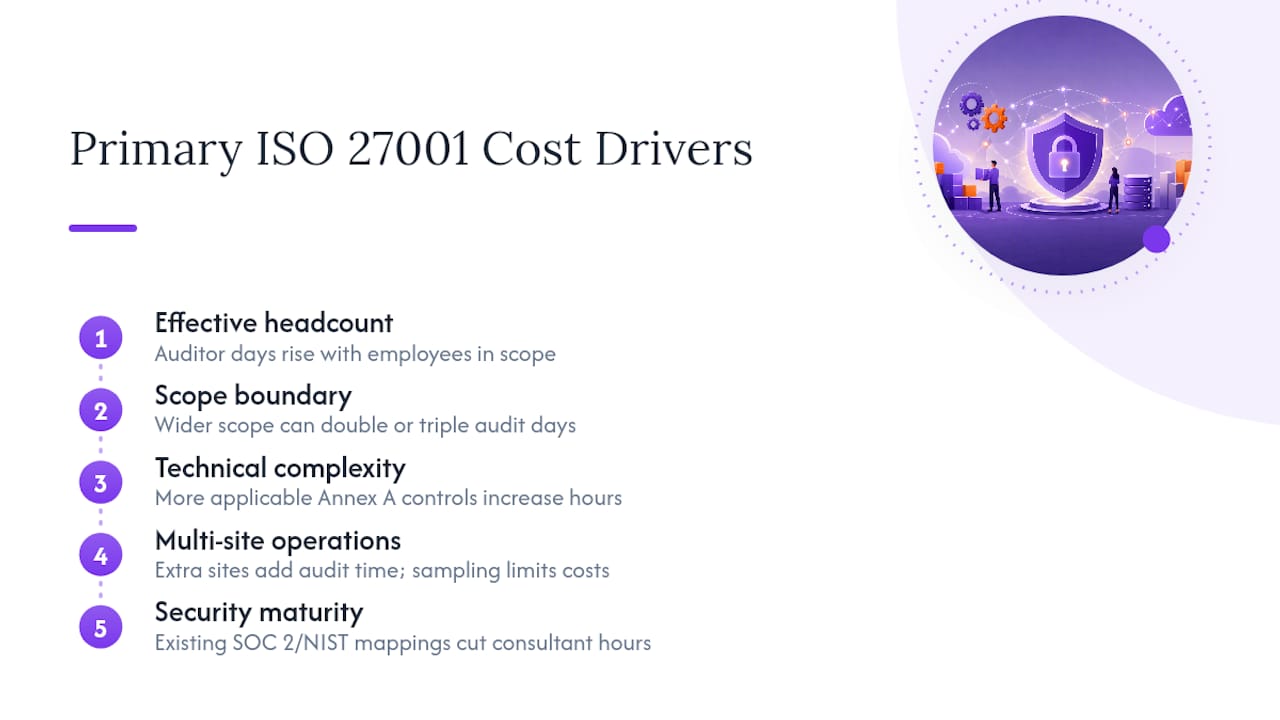
Headcount and effective headcount. Certification bodies calculate auditor mandays based largely on the number of employees inside your ISMS scope, following guidance rooted in ISO/IEC 27006. A 30-person scope typically needs a few audit days for Stage 2; a 300-person scope can require several more days. Auditor day rates commonly fall within a moderate range depending on the certification body and region, so each additional day noticeably increases cost.
Scope boundary decisions. This is the single biggest lever most planners overlook. Certifying “the whole company” instead of “the SaaS platform and its supporting infrastructure” can double or triple your audit days, your control count, and your internal labor hours. Tight scope decisions are consistently the most reliable way to control total cost.
Technical complexity and control count. Annex A gives you a menu of controls, and how many genuinely apply to your environment drives implementation hours. A company running a handful of cloud services faces a lighter lift than one managing on-premises data centers, multiple business units, and legacy systems that all need documented controls.
Multi-site operations. Every additional physical location theoretically adds audit time and travel expense. Fortunately, certification bodies follow sampling principles that let auditors visit a representative subset of sites rather than every location, often following a square-root-based sampling approach that keeps multi-site costs from scaling linearly.
Security maturity and framework overlap. An organization that already holds SOC 2 or has mapped controls to the NIST Cybersecurity Framework walks in with a head start. Reusing existing evidence and control mappings can cut gap-analysis time and consultant hours significantly, since much of the documentation work has already been done.
Pro Tip: Before you request quotes, tally your effective headcount inside scope, not your total company headcount. Certification bodies price against the smaller number if your scope documentation makes the boundary clear.
How Does Implementation Approach Change the Bill?
The path you choose to get compliant, not just your company size, decides a large share of your total spend. Three routes dominate the market, and each carries a different cost profile.
- Internal effort. A typical SMB assigns a project lead and a handful of contributors somewhere between 400 and 800 hours across six to nine months. Model this as payroll-equivalent cost, not a vague “internal effort” line; at a blended $60 to $90 hourly cost, that is $24,000 to $72,000 in labor your finance team needs to see, even though no invoice arrives for it.
- Consultants. Fixed-fee consulting engagements for SMBs commonly run $10,000 to $30,000, typically covering gap analysis, policy templates, and implementation guidance. Confirm what is excluded: many packages stop short of technical remediation, penetration testing, and ongoing evidence collection.
- Compliance platforms. Subscription-based platforms automate evidence collection and control monitoring, often compressing project timelines significantly. Subscription platforms can cost varying amounts depending on headcount and integrations, potentially offsetting some consultant fees and internal labor.
Choosing between these comes down to three questions: how fast you need to certify, how much internal bandwidth your security and IT teams actually have, and how mature your current controls already are. A company with strong existing documentation and a technical team that already understands its environment often does fine with a platform and light consulting support. A company starting from zero, with no dedicated security staff, usually needs a consultant to avoid costly missteps in scoping and control design.
What Do Certification Body and Audit Fees Actually Cover?
Certification body invoices break into a predictable structure, and understanding that structure lets you interrogate a quote instead of accepting it at face value.
- Stage 1 audit: a documentation review checking whether your ISMS, policies, and Statement of Applicability are ready for a full audit; typically 0.5 to 1.5 days
- Stage 2 audit: the substantive audit testing whether controls actually operate as documented; typically 1.5 to 6 days depending on headcount and scope
- Auditor day rates: commonly $1,500 to $3,000 per day, set by the certification body and influenced by market and auditor seniority
- Travel and expenses: billed separately for on-site visits; always request this as a line item, since it can add several thousand dollars for multi-site or international audits
- Accreditation: certification is performed by accredited third-party bodies, not by ISO itself, and accreditation status shapes both recognition and price
Accreditation deserves particular attention because it directly affects what your certificate is worth. A certification body accredited by a recognized national accreditation body carrying IAF membership, such as ANAB in the United States or UKSAS in the United Kingdom, gives your certificate international recognition that customers and auditors trust. An unaccredited or locally recognized body might quote a lower price, but the certificate carries less weight in procurement reviews and vendor risk assessments, which can cost you more in lost deals than you saved on audit fees.
When comparing quotes, always ask for the manday calculation behind the number, not just the total fee. A quote that bundles Stage 1 and Stage 2 into a flat number without breaking out days makes it impossible to compare against a competing certification body’s pricing.
What Are the Typical Line-Item Costs?
Beyond audit fees, a handful of recurring line items make up the bulk of preparation and implementation spend. Budgeting each one separately, rather than lumping them into a single “consulting” number, gives finance a much clearer picture of where money actually goes.
A gap analysis or readiness assessment typically costs $3,000 to $8,000 and should be one of your first purchases, since it clarifies scope before you commit to a bigger engagement. Penetration testing and vulnerability management usually run $5,000 to $20,000 annually depending on environment size and testing frequency. Tooling, covering endpoint detection, mobile device management, vulnerability scanners, and security awareness training platforms, tends to land between $3,000 and $15,000 per year once you account for licensing across your headcount. Internal audits or “dress rehearsal” pre-audits, whether run by staff or a contracted auditor, generally cost $2,000 to $6,000.
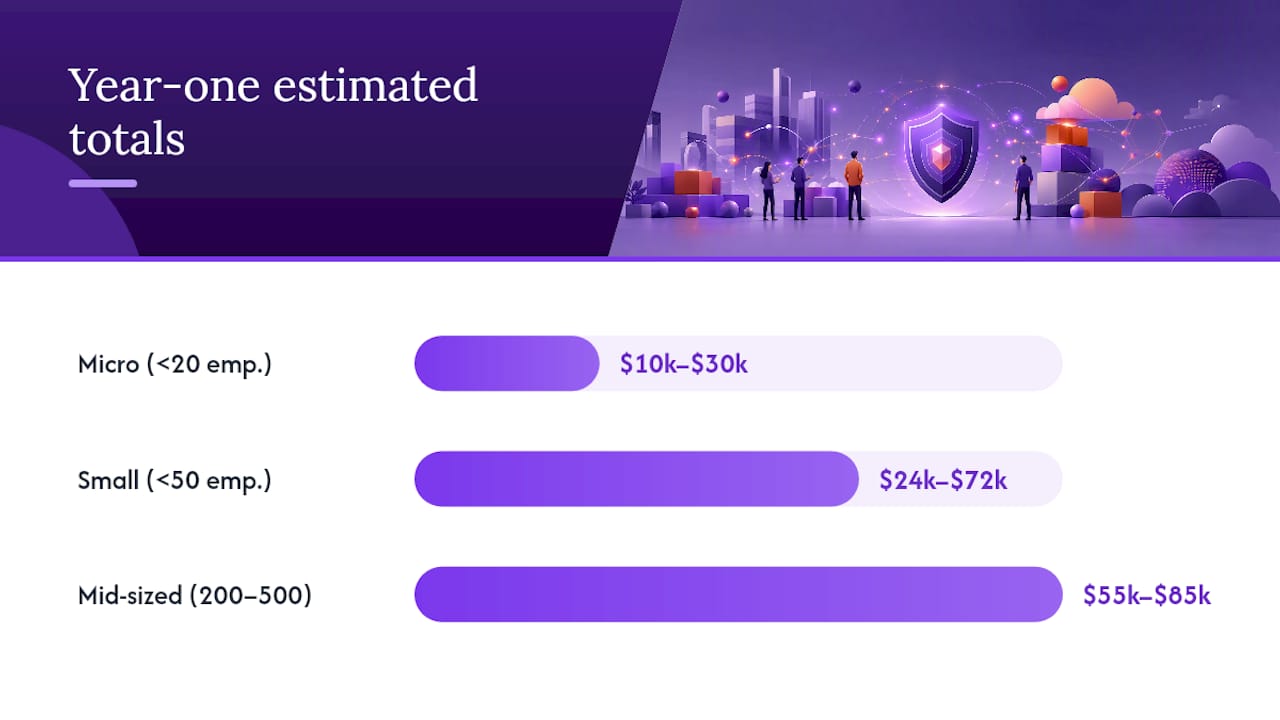
| Company size | Gap analysis | Implementation labor/consulting | Tooling (annual) | Certification audit | Estimated year-one total |
|---|---|---|---|---|---|
| Micro (under 20 employees) | $3,000–$5,000 | $3,000 to $15,000 | $2,000 to $6,000 | $3,000–$6,000 | $10,000 to $30,000 |
| Small (under 50 employees) | $3,000 to $6,000 | $10,000 to $30,000 | $3,000–$6,000 | $5,000–$10,000 | $24,000 to $72,000 |
| Mid-sized (200–500 employees) | $5,000–$8,000 | $30,000 to $54,000 | $3,000 to $15,000 | $8,000 to $15,000 | $55,000 to $85,000 |
These ranges echo the broader $6,000 to $54,000 first-year market range reported across smaller and mid-sized organizations, with variance driven almost entirely by scope, headcount, and implementation approach.
How Much Do Surveillance and Recertification Cost Over Three Years?
Certification does not end when you pass Stage 2. ISO 27001 runs on a three-year cycle, and skipping the ongoing costs is the most common budgeting mistake finance teams make.
- Surveillance audits happen annually in years one and two after certification, typically costing 30% to 50% of your original certification audit fee
- Recertification happens in year three and closely resembles the original Stage 2 audit, since the certification body re-verifies your entire ISMS rather than sampling a subset
- Tooling and platform subscriptions renew every year regardless of audit cycle, and should be modeled as a fixed annual line rather than folded into “one-time implementation” costs
- Internal FTE allocation for maintaining evidence, updating risk assessments, and running internal audits typically requires 0.1 to 0.3 of a full-time security or compliance role annually
A mid-sized company that spent tens of thousands in year one might spend several thousands in each surveillance year and a higher amount in the recertification year, bringing the full three-year total to a substantial six-figure range. Model this out before you sign your first certification body contract, not after your first surveillance invoice arrives.
How Can You Reduce ISO 27001 Cost Without Cutting Corners?
Cutting cost and cutting compliance value are not the same thing. These four levers reduce spend while keeping your certificate meaningful to customers and auditors.
- Tighten your scope to what customers actually require. Certifying one product line and its supporting infrastructure instead of the entire company is the fastest way to cut audit days, control count, and consultant hours simultaneously.
- Leverage cloud shared-responsibility models. If your infrastructure runs on a certified cloud provider, you inherit evidence for physical security and infrastructure controls, shrinking what your own team needs to document.
- Reuse SOC 2 or NIST artifacts. Map existing compliance evidence to ISO 27001 controls instead of rebuilding documentation from scratch; this alone can cut gap-analysis and policy-writing time substantially.
- Negotiate multi-year commitments with your certification body. Some bodies offer reduced day rates or bundled surveillance pricing when you commit to the full three-year cycle upfront instead of negotiating each audit separately.
Pro Tip: Ask your certification body directly whether they offer an integrated audit combining ISO 27001 with a standard you already hold, like ISO 9001. Integrated audits often share Stage 2 days across standards, cutting total audit time.
How Do You Build an Accurate ISO 27001 Budget?
Follow this sequence before you finalize a number for your board or finance team.
- Run a gap analysis or readiness check first. This tells you your real starting maturity before you commit to a consultant contract or platform subscription sized for the wrong problem.
- Define your scope and Statement of Applicability clearly. Do this before requesting quotes, since certification bodies price against your stated scope, not your actual company size.
- Request manday calculations and travel assumptions from every certification body you compare. A flat fee with no breakdown makes real comparison impossible.
- Model internal hours as payroll-equivalent cost. Add tooling renewals into a three-year forecast rather than treating year one as the whole story.
- Build in a remediation contingency, plus a surveillance and recertification line. Gap analyses routinely surface unplanned technical fixes, and skipping this step is how budgets blow past their original estimate.
Budget With Evidence, Not Paperwork
The temptation in ISO 27001 budgeting is to chase the cheapest path to a certificate: buy a template pack, skip the technical remediation, and hope the auditor does not look too closely. That approach tends to backfire during Stage 2, when auditors increasingly expect live, automated evidence rather than static screenshots pulled together the week before the audit.
Spend where it compounds: ongoing monitoring tooling and a properly resourced internal maintenance function pay off every year of your three-year cycle. A one-time paperwork exercise pays off exactly once, and often not even then.
— Martin
Get a Tailored ISO 27001 Budget in Under Two Minutes
Every range in this article is a market average. Your actual number depends on your scope, your headcount, your industry, and how mature your controls already are, and averaging those variables away is exactly how budgets go wrong. The ISO 27001 Cost Calculator from Ismscalculator generates a tailored cost and effort estimate in real time, benchmarked against organizations of similar size and industry, with a full maturity assessment across all four ISO/IEC 27001:2022 control themes and a Gantt-style implementation timeline you can export directly into your planning documents.
Every assumption behind your estimate stays editable, so you can test what happens to your budget if you tighten scope, add a site, or swap a consultant for a platform subscription. Save multiple scenarios and compare them side by side before you present a number to finance. Start with the free 2-minute readiness check to see where your organization stands, or head straight to the ISO 27001 Readiness Assessment if you want a deeper maturity read before committing to a full implementation budget.
Sources
- How Much Does ISO 27001 Certification Cost in 2026? | Factorial
- ISO 27001 Certification Cost in 2026: Full Breakdown
- Certification — International Organization for Standardization (ISO)
FAQ
How Much Does ISO 27001 Cost?
Most small and mid-sized organizations spend $6,000 to $54,000 in the first year, depending on scope, headcount, and implementation approach. Surveillance audits in years two and three typically cost 30% to 50% of that initial figure annually. Run the ISO 27001 Cost Calculator for a number based on your specific scope and industry.
Is ISO 27001 Hard to Get?
It is achievable for most organizations but demands real technical and documentation work, not just paperwork. The difficulty depends heavily on your starting security maturity and how tightly you scope the certification.
How Much Do ISO Certifications Cost in General?
Costs vary widely by standard, but most follow a similar structure: preparation, implementation, a certification body audit fee, and recurring surveillance costs. ISO 27001 tends to run higher than simpler standards because of its broad control set and headcount-driven auditor mandays.
What Is the Average Salary for an ISO 27001 Lead Auditor?
Lead auditor compensation varies significantly by region, employer, and experience level, and no single reliable figure applies across markets. What matters more for budgeting purposes is the auditor day rate your certification body charges, typically $1,500 to $3,000 per day, since that is the figure that actually appears on your invoice.