
ISO 27001 model reference comparisons come in three kinds: certificate counts (how many organizations are certified, and where), cost and timeline ranges (what certification takes), and maturity scores (how ready a sector is). Only the first kind comes from a neutral body. The other two come mostly from vendors and consultancies, so use them to sanity-check your own estimate, not to replace it. This guide shows which figures are solid, which are soft, and how to turn a model reference value into a budget you can defend to your CFO or auditor.
TL;DR
- Certificate counts come from the ISO Survey. They show where certification is common, not what it costs you.
- Cost and timeline benchmarks vary widely by company size, scope and starting maturity, so a single “average” is rarely your number.
- Financial services, SaaS and healthcare-adjacent firms tend to face the most customer and regulator pressure, which shapes scope and cost.
- Treat a benchmark as a range to test your plan against. Then adjust for headcount, sites, existing controls and how much evidence you collect by hand.
- A 2-minute readiness check and a calculator with editable assumptions get you from model reference value to your own figure quickly.
Table of Contents
- What ISO 27001 benchmarks actually measure
- Which U.S. industries pursue ISO 27001
- Cost and timeline benchmarks: how to read the ranges
- Industry-specific planning
- How to turn a benchmark into your estimate
- Promo: get your own number in minutes
- Perspective
- Common mistakes when using benchmarks
- FAQ
- Sources
What ISO 27001 benchmarks actually measure
When someone says “the benchmark” for ISO 27001, they usually mean one of three things. Mixing them up is the most common reason budgets miss.
| Benchmark type | What it tells you | Typical source | How much to trust it |
|---|---|---|---|
| Certificate counts | How many valid certificates exist, by country and sector | The ISO Survey | High for direction, low for demand or cost |
| Cost and effort ranges | Spend, staff time and elapsed months | Consultancies, vendors, your own scoping | Medium, depends on method and sample |
| Maturity scores | How far along a sector is on controls | Vendor surveys | Low to medium, self-reported |
The ISO Survey and its limits
The ISO Survey reports valid certificates, sectors and sites. It is the nearest thing to an official dataset. It also has known gaps: some certification bodies do not take part, some data is protected as a trade secret, and sites are reported inconsistently. A development economist who studied the survey pointed to non-participation and shifting participation rates as reasons year-to-year comparisons are shaky.
The practical lesson: a jump in certificates may reflect better reporting or wider coverage, not a sudden wave of new certifications. Read the counts as a rough picture of where certification is established.

Where the U.S. sits
According to an ISO publication on digital trade, the United States reached 1,563 valid ISO 27001 certificates in 2023. That puts it among the top countries worldwide, though well behind the leading Asian markets. For context, a 2016 press release citing the survey put U.S. certifications at 814 in 2014 and 1,445 in 2015. Given the reporting caveats above, treat the long-run direction as the finding, not any single year.

What this means for you: ISO 27001 is a minority choice in the U.S. compared with SOC 2, which is why it tends to be driven by specific customers, international contracts or procurement questionnaires rather than by default.
Which U.S. industries pursue ISO 27001
There is no reliable public U.S.-only breakdown of certificates by industry. What we can say is directional, and we would rather tell you that than invent a league table.
- Information technology and SaaS. IT is the largest sector globally in the ISO Survey data. Cloud and software firms often certify because enterprise buyers and non-U.S. customers ask for it.
- Financial services. Banks, payment firms, fintechs and asset managers face heavy third-party risk reviews, so an independent certificate shortens due diligence.
- Professional services. An RSM survey of U.S. law firms found ISO 27001/27002 was the most-used security framework, chosen by 29% of respondents. Nearly 80% of those mapping to ISO had more than 1,000 employees, which points to large firms with international ties.
- Healthcare-adjacent and data processors. Vendors handling sensitive data for others often add ISO 27001 on top of U.S. regulatory obligations.
The RSM finding is useful beyond law. It shows a pattern you will see in most sectors: ISO 27001 adoption follows international exposure and customer demand, not industry label alone.
Cost and timeline benchmarks: how to read the ranges
Published cost ranges for ISO 27001 are wide because the cost drivers are wide. Third-party posts report everything from a few tens of thousands of dollars in year one for a small startup to several hundred thousand for a large enterprise. That spread is real, not sloppy: a 20-person SaaS company with one cloud environment and a 600-person financial group with several sites are different projects.
The drivers that move your number most:
- Headcount. Certification body audit effort scales with employees in scope.
- Scope. Which products, sites, teams and cloud environments the ISMS covers.
- Starting maturity. Existing policies, risk process and controls from SOC 2, PCI DSS or similar frameworks cut the work.
- Consultant use. External guidance is often the largest variable line, and you can scale it up or down.
- Evidence collection. Manual screenshots and spreadsheets cost staff time that tooling can reduce.
- Internal labor. Often left out of quotes, yet usually substantial.
Benchmarks from our own guides
We publish ranges for the segments we model. Our guide to ISO 27001 cost drivers for SMBs frames a $6,000–$54,000 budget range and explains what pushes a company toward either end. For the years after certification, our maintenance cost analysis shows a three-year total cost view with an annual range of $8,000–$50,000. If you want the full picture in one place, start with how much ISO 27001 certification costs.
Notice that these are ranges tied to stated assumptions. That is the standard to hold any benchmark to. If a figure does not tell you the company size, scope and starting point behind it, it is not comparable to your situation.
Timelines
Elapsed time depends mostly on how much you already have in place and how much effort you can dedicate. A company with an existing security program will move faster than one writing its first policy. Automating evidence gathering also shortens the run compared with doing it by hand; this SaaS security compliance checklist gives a useful frame for what to have ready before you start.
For a realistic plan, read our certification timeline guide and the implementation timeline breakdown. Both split the work into phases so you can see where your own schedule would run long or short.
Staffing
The other half of effort is people. Audit days are tied to headcount in scope, and the standard that governs certification body audit duration treats contractors in a specific way. Our staffing benchmarks guide explains how to count contractors per ISO/IEC 27006, which affects both scope and audit fees.
Industry-specific planning
SaaS and tech
Cloud-native companies benefit from the cloud and secure development controls in the 2022 edition of the standard, and they usually have a lot of automation to build on. The main risk is scope creep: certifying every environment on day one when a single product line would satisfy your biggest customer. See our ISO 27001 guide for SaaS and tech companies and the piece on cloud security in a startup ISMS.
Financial firms
Financial services generally sit at the expensive end of published benchmarks. The reasons are structural: more sites, more third parties, stricter evidence requirements, and often overlapping obligations from regulators and partners. If you work in finance, expect scope definition, supplier management and risk assessment depth to drive your estimate more than the headline audit fee.
Startups with little security history
A first-time team should benchmark against companies of similar size, not against the model reference value. Averages are pulled up by large organizations. Start with the smallest scope your key customer will accept, and expand later at surveillance audits.
How to turn a benchmark into your estimate
Here is a method that works whether you use a spreadsheet or a tool.
- Pick the closest comparison. Match by headcount band and delivery model, not by industry name alone.
- Define scope in one sentence. Products, locations, teams and environments in, everything else out.
- Score your starting point. Rate your current controls across the 14 ISO 27001 Annex A domains in the 2013 grouping we use for planning, or by the 2022 themes. Be honest: overrated maturity is the top reason estimates fall short.
- Separate one-time from recurring cost. Implementation, certification audit, then annual surveillance and maintenance.
- Price internal time. Multiply hours by a loaded rate. This is the line most budgets miss.
- Add a contingency. Findings from the Stage 1 audit can add remediation work.
- Compare against the benchmark range. If you are far outside it, find out why before you present the number.
If you want to go deeper on the task list, our 80-step certification checklist covers the full path.
Promo: get your own number in minutes
Benchmarks tell you what is typical. You need what is likely for your organization. Our ISO 27001 cost calculator produces a real-time estimate from your company size, industry and security maturity, with model reference comparisons alongside so you can see where you sit against the range. The initial calculation needs no signup, and the assumptions are editable, so you can challenge any figure. You can also save several scenarios and compare them, export a PDF, and share a link with your finance team.
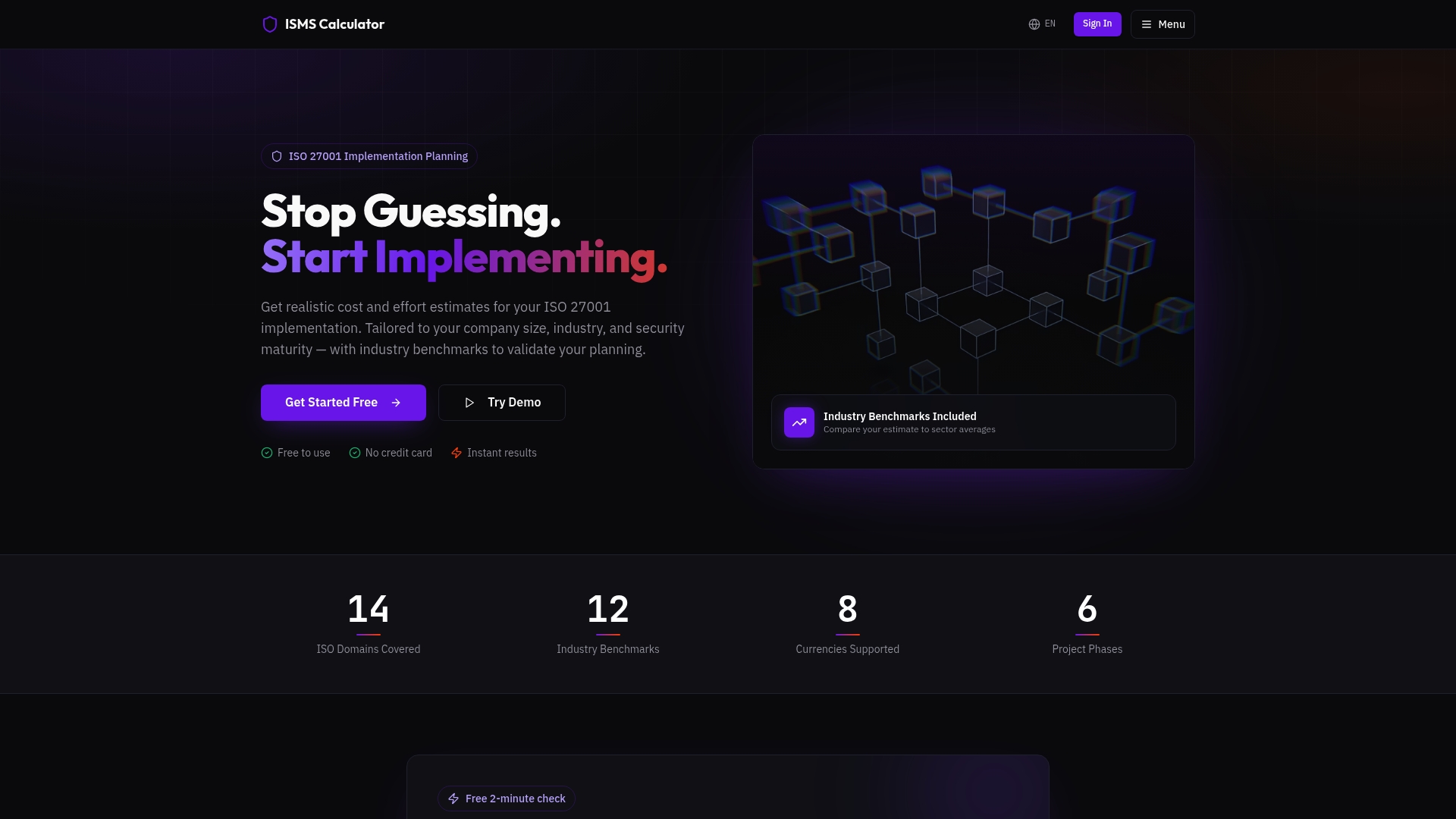
Not sure where you stand? Take the free 2-minute check for a quick readiness read, or run the full readiness assessment across the four Annex A control themes. You can see how we build the figures on the methodology page.
Perspective
Most people ask for a benchmark because they want permission: permission to ask for a budget, or to promise a date. A model reference value cannot give them that, because averages hide the one thing an auditor and a CFO both care about, which is your scope and your starting point.
We built the calculator around that idea. Benchmarks are the guardrails, and your own inputs are the estimate. When every assumption is visible and editable, you can defend the number line by line, and when the scope changes you can change the number in seconds rather than rebuilding a spreadsheet.
Our advice: run two or three scenarios before you take anything to leadership. A narrow scope, a broader scope, and one with more outside help. The gap between them is usually the most useful finding in the whole exercise.
Martin
Common mistakes when using benchmarks
- Using a global average for a U.S. budget. Labor rates, consultant fees and audit pricing differ by region.
- Treating certificate counts as demand. As the survey caveats show, counts move with reporting as much as with adoption.
- Forgetting year two. Surveillance audits and upkeep recur, so plan a three-year view, not just the first invoice.
- Ignoring the cost of staff time. It rarely shows up in a vendor quote.
- Copying a competitor’s scope. What a rival certified tells you nothing about what your buyers will accept.
FAQ
Are there official ISO 27001 benchmarks by industry?
The closest official source is the ISO Survey, which counts valid certificates and groups them by sector and country. It does not publish what certification costs, and participation gaps limit how far you can compare years. Use it for direction, and use your own scope for budgeting.
What is a typical ISO 27001 timeline?
It depends on your starting point and the effort you can commit. Teams with an existing security program and strong automation move faster than those starting from nothing. Our certification timeline guide walks through the phases so you can place your own project.
Should a startup use the model reference value as its budget?
No. Averages are pulled up by large organizations. A startup should compare itself with companies of similar headcount, limit scope to what its key customer requires, and plan for annual upkeep after the first year.
How accurate is a free online estimate?
It is as accurate as the inputs and the visible assumptions. Choose a tool that lets you edit those assumptions and shows its method, then confirm the result with quotes from certification bodies and, if you use one, an independent consultant.
Sources
- ISO: The impact of ISO/IEC 27001 certification on digital trade
- MesoPartner: QI Data, The ISO Survey of Management System Standard Certifications
- RSM: Security Framework for Law Firms
- EIN Presswire: US-based organizations experience a 78% increase in ISO 27001 certifications