
The role of the IT team in ISO 27001 is to implement and manage the technological controls that form the backbone of any Information Security Management System (ISMS). ISO 27001, the international standard for information security, organizes its controls into four categories. IT teams own the 34 technological controls in Annex A, covering everything from access control and cryptography to network security and configuration management. That scope represents roughly 40% of all Annex A controls. No other department carries that level of technical accountability in a compliant ISMS.
What is the IT team’s role in ISO 27001?
IT teams are the primary owners of technological compliance in ISO 27001. The 2022 revision of Annex A consolidated controls into four groups: Organizational (37), People (8), Physical (14), and Technological (34). The technological category belongs almost entirely to IT. That means your team is responsible for implementing, documenting, and maintaining the controls that auditors scrutinize most closely.
The scope is wider than most IT professionals expect when they first encounter the standard. Access control, cryptography, network security, secure configuration, change management, capacity management, and logging all fall under IT’s operational scope. Tools like Jira, SharePoint, and Confluence are not just project management platforms in this context. They become the backbone of your compliance documentation and audit trail.
Understanding this scope early prevents the most common mistake: treating ISO 27001 as a documentation exercise rather than an operational discipline. The standard requires IT to build security into daily workflows, not bolt it on at audit time.
Which technological controls does IT own under annex a?
The 34 technological controls in Annex A 2022 define the full technical surface IT must cover. The table below maps the major control categories to their practical implementations.
| Control Category | Annex A Reference | Typical IT Implementation |
|---|---|---|
| Access Control | 8.2–8.5 | Identity and access management (IAM), role-based access, MFA |
| Cryptography | 8.24 | TLS/SSL, disk encryption, key management policies |
| Network Security | 8.20–8.22 | Firewalls, network segmentation, web filtering |
| Configuration Management | 8.9 | Hardened baselines, CIS Benchmarks, configuration audits |
| Change Management | 8.32 | Jira workflows, change advisory board (CAB) approvals |
| Logging and Monitoring | 8.15–8.16 | SIEM platforms like Splunk or Microsoft Sentinel, log retention |
| Backup and Recovery | 8.13 | Offline ransomware-resistant backups, recovery testing |
| Data Loss Prevention | 8.12 | DLP tools, endpoint controls, email filtering |
Security teams must implement access management automation, identity management, web filtering, and data loss prevention to satisfy the 2022 Annex A technological requirements. These controls address the majority of what auditors test during certification assessments.
- Access control: Implement least-privilege principles across all systems. Every user account should have only the permissions required for their specific role.
- Cryptography: Encrypt data at rest and in transit. Document your key management process, including rotation schedules and custodian responsibilities.
- Logging and monitoring: The role of logging and monitoring in ISO 27001 is to detect anomalies and provide forensic evidence. A SIEM platform centralizes this function and satisfies Annex A 8.15 and 8.16.
- Backups: The role of backups in ISO 27001 goes beyond data recovery. Offline, ransomware-resistant storage is a specific requirement, not a general best practice.
Pro Tip: Review the ISMS maturity assessment framework to benchmark your current control coverage across all four ISO/IEC 27001:2022 control themes before you start gap analysis.
How does IT handle change management and incident response?
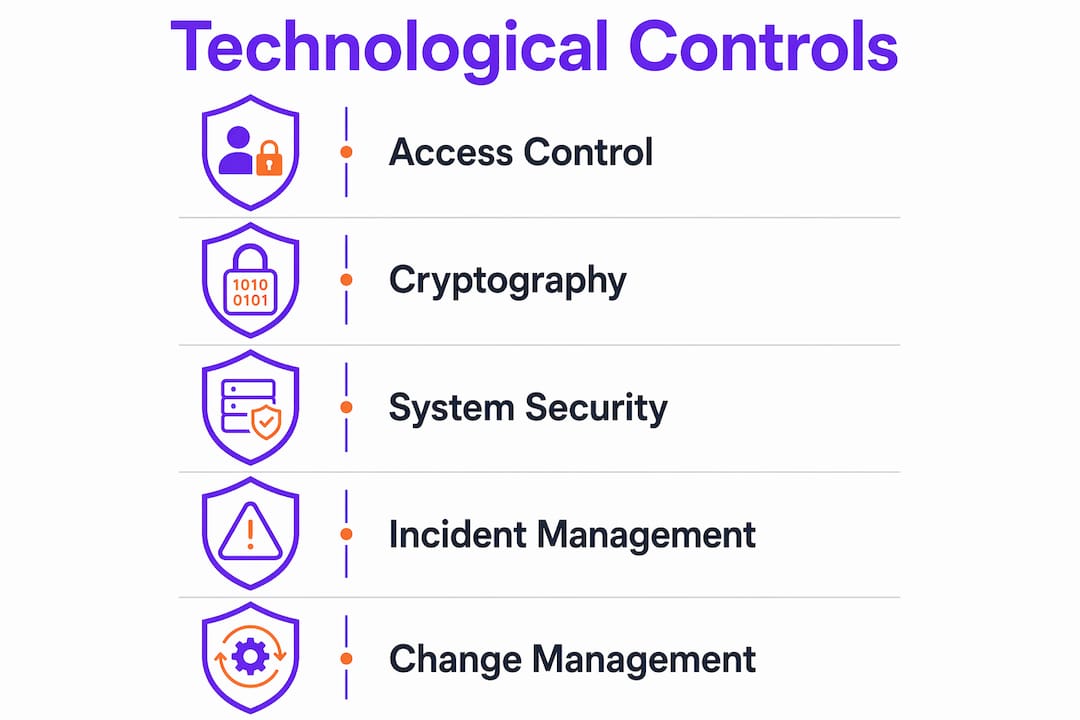
Change management and incident response are two areas where IT teams either build credibility with auditors or lose it fast. Both require documented, repeatable processes, not ad hoc responses.

Change management under clause 6.3 and annex a 8.32
ISO 27001 Clause 6.3 and Annex A 8.32 mandate that every system modification undergoes risk evaluation, approval, and recording with a full audit trail. The standard does not prescribe a specific tool, but the process must be consistent and verifiable. Here is a practical workflow IT teams can follow:
- Submit the change request. Log the proposed change in Jira or your existing IT service management (ITSM) platform. Include the system affected, the reason for the change, and the risk assessment.
- Review and approve. Route the request through a change advisory board or designated approver. Document the decision and the rationale.
- Implement and test. Execute the change in a controlled environment first where possible. Record the outcome.
- Close and archive. Link the completed ticket to the relevant risk assessment and any meeting minutes. This creates the audit trail auditors require.
Effective change management is both a compliance necessity and a business enabler. It gives leadership visibility into what is changing, who approved it, and who is accountable.
Incident management process under ISO 27001
The incident management process in ISO 27001 follows a structured lifecycle defined in Annex A controls 5.24 through 5.28. IT’s role covers detection, containment, eradication, recovery, and post-incident review. Compliance evidence must be maintained for every security incident, with forensic-capable log retention periods required by Annex A 8.16.
Pro Tip: Assign a dedicated incident log owner on your IT team. A single person responsible for maintaining the incident register prevents gaps in evidence that auditors flag during certification reviews.
How can IT teams integrate ISO 27001 without disrupting operations?
The most common failure mode in ISO 27001 implementation is not a technical gap. It is a usability problem. IT teams that create controls so restrictive that employees work around them actually undermine compliance. A locked-down system that drives shadow IT is worse than a moderately open one with documented compensating controls.
The solution is to integrate security into the tools your team already uses, not create parallel compliance systems.
- Use Jira for change and incident tracking. Your team already lives in Jira. Adding ISO 27001 workflows to existing projects costs less time than building a separate compliance platform.
- Use SharePoint or Confluence for policy documentation. Store information security policies, risk assessments, and meeting minutes where people already look for documents.
- Embed risk assessments into project templates. Add a mandatory risk field to your change request template. This makes risk evaluation automatic rather than an afterthought.
- Automate where the standard allows it. Use your SIEM for log aggregation and alerting. Automate access reviews with your IAM platform. Reserve human effort for decisions that require judgment.
Integrating documentation into existing tools like Jira and SharePoint transforms compliance from a separate burden into a natural part of IT operations. That shift matters because ISO 27001 is not a one-time project. It is a continuous management system that requires ongoing evidence.
For IT teams working in cloud environments, cloud security best practices align closely with ISO 27001 technological controls and can reduce duplication of effort across compliance frameworks.
How do IT teams build audit trails that actually satisfy auditors?
Audit trail quality separates organizations that pass certification on the first attempt from those that face nonconformities. The standard requires evidence that controls are operating, not just that they exist on paper.
Auditors require manual, human-verifiable audit trails such as Jira ticket histories linked to risk assessments and SharePoint meeting minutes. Automated dashboards alone are not sufficient evidence. This distinction catches many IT teams off guard.
The table below contrasts what auditors accept versus what they discount.
| Evidence Type | Auditor Verdict | Why It Matters |
|---|---|---|
| Jira ticket with linked risk assessment and approval | Accepted | Shows assessed, approved, and implemented change |
| Automated SIEM dashboard screenshot | Insufficient alone | No proof of human review or decision-making |
| SharePoint meeting minutes with attendees | Accepted | Demonstrates management oversight and governance |
| Email chain approving a change | Accepted with caveats | Acceptable if archived and traceable to the change |
| Verbal confirmation from IT manager | Rejected | No verifiable record exists |
The audit trail purpose in ISO 27001 is to demonstrate that governance is real, not theoretical. Every change, incident, and risk decision needs a paper trail that a third-party auditor can follow without your team explaining it.
Pro Tip: Run a mock audit internally every six months. Have someone outside your immediate team try to trace a change from request to implementation using only the documentation. If they cannot do it without help, your audit trail has gaps.
Deep knowledge from ISO 27001 audit preparation confirms that auditors specifically discount data shown only on automated dashboards. They insist on manual proof of risk assessments, approvals, and meeting minutes to demonstrate governance. Build your documentation habits around that expectation from day one.
Key takeaways
The IT team’s success in ISO 27001 depends on owning the 34 technological controls, integrating compliance into daily workflows, and producing human-verifiable audit evidence that satisfies third-party auditors.
| Point | Details |
|---|---|
| IT owns 34 technological controls | Annex A 2022 assigns access control, cryptography, logging, backups, and change management to IT. |
| Change management requires full audit trails | Every system change needs a risk assessment, approval record, and implementation log in tools like Jira. |
| Incident response demands documented evidence | Annex A 5.24–5.28 requires IT to maintain forensic-capable logs and a complete incident lifecycle record. |
| Automated dashboards are not enough | Auditors require human-verifiable records such as Jira histories and SharePoint minutes, not just system reports. |
| Integration beats isolation | Embedding ISO 27001 workflows into existing IT tools prevents compliance from becoming a separate, unsustainable burden. |
Where IT teams actually struggle: a perspective from the field
The technical controls are rarely where ISO 27001 implementations break down. Most IT teams can configure a firewall, set up MFA, and deploy a SIEM. What trips them up is the governance layer: proving that humans reviewed, approved, and acted on the information those systems generate.
I have seen teams with genuinely strong security postures fail certification audits because their change management process lived entirely in someone’s head. The changes were good. The approvals happened. Nobody wrote any of it down in a way a third-party auditor could verify. That is a fixable problem, but it requires a mindset shift. Documentation is not bureaucracy. It is the evidence that your security controls are real.
The other pattern I see consistently is IT teams working in isolation from leadership. Management must demonstrate commitment to information security alongside IT teams for ISO 27001 to work. When IT treats the ISMS as a technical project rather than an organizational program, the controls become orphaned. Policies lack authority. Risk decisions lack sign-off. Auditors notice immediately.
The teams that succeed treat ISO 27001 as a collaboration between IT and leadership, with IT providing the technical execution and leadership providing the governance mandate. Early adoption of that mindset pays dividends at every subsequent audit cycle.
— Martin
Start your ISO 27001 compliance assessment today
Knowing your responsibilities is the first step. Knowing where your organization currently stands is what makes implementation realistic.
Ismscalculator provides a free 2-minute readiness check that benchmarks your current ISO 27001 posture across the key control domains IT teams own. For a deeper analysis, the full ISO 27001 readiness assessment maps your gaps against Annex A controls, generates tailored effort estimates, and gives you the data you need to build a credible implementation plan. If your team needs expert support, Ismscalculator also connects you with independent ISO 27001 consultants who specialize in technical implementation and audit preparation.
FAQ
What controls does the IT team own in ISO 27001?
The IT team owns the 34 technological controls in Annex A of ISO 27001, covering access control, cryptography, network security, logging, backups, and change management. These controls represent roughly 40% of all Annex A requirements.
What is the role of change management in ISO 27001?
ISO 27001 Clause 6.3 and Annex A 8.32 require IT teams to document every system change with a risk evaluation, approval record, and audit trail. Tools like Jira satisfy this requirement when configured with proper change request workflows.
How does the incident management process work under ISO 27001?
The incident management process in ISO 27001 follows Annex A controls 5.24–5.28 and requires IT to document containment, eradication, recovery, and post-incident review. Forensic-capable log retention is mandatory to support evidence requirements.
What is the role of SIEM in ISO 27001 compliance?
A SIEM platform like Splunk or Microsoft Sentinel satisfies Annex A 8.15 and 8.16 by centralizing log collection and anomaly detection. SIEM output must be reviewed by humans and linked to documented decisions to count as valid audit evidence.
Are automated dashboards enough for ISO 27001 audits?
Automated dashboards alone are not sufficient for ISO 27001 audits. Auditors require human-verifiable records such as Jira ticket histories, risk assessments, and meeting minutes that demonstrate active governance and decision-making.