
The single biggest lever on where you fall in that range isn’t company size. It’s how narrow you draw the certification scope and how mature your existing controls already are. If you want a number tied to your actual environment rather than a rule of thumb, run it through a readiness check before you present anything to finance.
TL;DR:
- Organizational maturity and certification scope are the most significant factors influencing certification costs, more than company size alone.
- Typical first-year costs range from $8,000 to $80,000 depending on size and control maturity, with larger scope and lower maturity increasing expenses.
- Budget estimates should focus on labor hours, audit fees, tooling, remediation, and contingency, with internal hours often underestimated.
- Spreading costs over a three-year cycle, including surveillance audits, ensures accurate planning and prevents budget overruns.
- Using a tailored cost calculator based on company specifics yields a more reliable and defensible budget than generic thumb rules.
Table of Contents
- How Much of Your Budget Should Go to Security Certification?
- How Do You Calculate Your ISO 27001 Budget Percentage?
- What Cost Line Items Belong in Your Percentage?
- What Does Your Budget Buy Over Three Years?
- Why Traceable Estimates Beat Thumb Rules
- Get a Tailored Percentage Instead of Guessing
- Sources
- FAQ
How Much of Your Budget Should Go to Security Certification?
The security budget percentage for an ISO 27001 project isn’t one number. It’s a band that moves based on three things: how many people you employ, how mature your current controls are, and how tightly you scope the certification. Most guidance conflates “security spending” with “certification project cost,” but for budgeting purposes you need the latter, isolated from your ongoing security operations budget.
Here’s how the ranges break down by organization size:
- Micro organizations (1 to 10 employees): First-year certification costs often run $8,000 to $20,000, which for a small consultancy or SaaS startup can represent 1.5% to 3% of a modest annual budget. Scope tends to be small here, which helps.
- Small organizations (10 to 50 employees): Expect a first-year range closer to $15,000 to $40,000. Factorial’s cost breakdown puts many small and mid-sized companies between roughly $8,000 and $54,000, with maturity swinging you significantly within that band.
- Mid-sized organizations (50 to 250 employees): Budgets commonly land between $30,000 and $60,000 for the first certification cycle, according to figures reported by Safeguard’s cost analysis, which places most first-time certifications in a $20,000 to $80,000 corridor overall.
- Larger organizations (250+ employees): Costs can exceed $80,000 once you factor in multiple business units, larger audit scopes, and more internal stakeholders pulled into evidence collection.
The maturity modifier matters more than the size bucket. An organization with documented policies, an existing risk register, and basic access controls in place can sit at the low end of its bucket. One starting from zero, with no formal risk assessment process and no security training program, should budget toward the high end, sometimes past it.
How Do You Calculate Your ISO 27001 Budget Percentage?
You don’t need a finance degree to build a defensible number. You need five steps and a willingness to write down your assumptions so someone else can check them.
- Pick your budget base. Decide whether you’re calculating the percentage against total annual revenue, your IT budget, or a standalone project envelope. Most finance teams prefer a standalone project number for the first cycle, then fold ongoing costs into the annual security line later.
- Estimate internal labor hours. This is where almost everyone undercounts. Map hours by role, not by department: your CISO or security lead, an IT engineer handling technical controls, HR for onboarding and training policy, and whoever owns document management. Apply a blended loaded hourly rate across those roles rather than guessing a flat number.
- Price external consulting and audit fees. Certification-body fees for Stage 1 and Stage 2 audits form a predictable line item, and Blueprint’s cost data shows these commonly range from mid four-figure to mid five-figure amounts for SMEs. Consulting support on top of that varies with how much of the implementation you’re outsourcing.
- Add tooling, remediation, and training, then build in contingency. Compliance platform subscriptions, penetration testing, technical remediation, and staff awareness training all belong in the total. Add 10% to 15% contingency for scope creep, because it happens on nearly every first cycle.
- Convert to a percentage and stress-test it. Divide your total by your chosen base, then rerun the math at plus and minus 25% scope to show finance a range instead of a single fragile number.
Pro Tip: Run a paid gap analysis before you lock in your percentage. It typically costs a fraction of the full project and converts a rough band into a line-item number finance can actually approve, a step Blueprint highlights as common practice among first-time applicants.
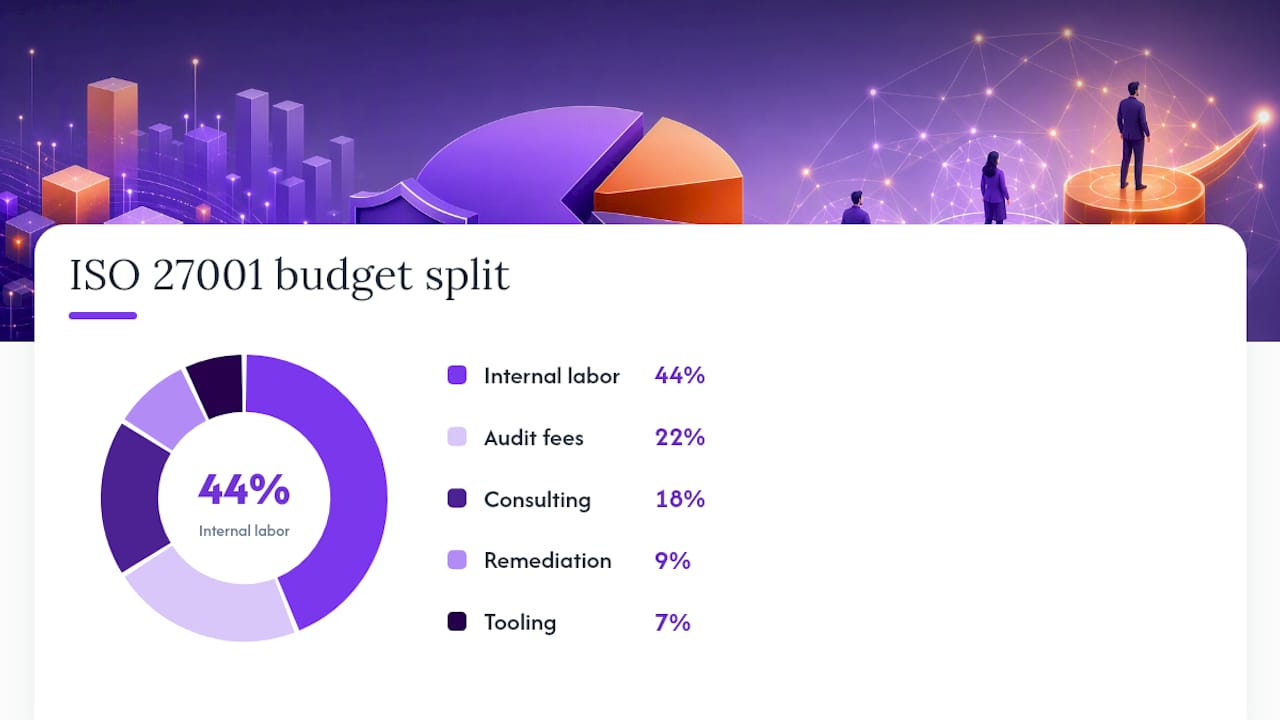
A worked example: a 60-person software company with moderate maturity estimates 400 internal hours at a $60 blended rate ($24,000), $12,000 in Stage 1 and Stage 2 audit fees, $10,000 in consulting support, $4,000 in tooling, and $5,000 in remediation and training.
What Cost Line Items Belong in Your Percentage?
A security budget percentage that skips line items isn’t a budget. It’s a guess that will blow past its own ceiling by month six. Before you present a number to your CFO, check it against this list.
- Certification audit fees. Stage 1 and Stage 2 audits, plus surveillance audits in years two and three, which Blueprint reports typically run 30% to 40% of the initial combined fee.
- External consultancy and gap analysis. Covers scoping, policy drafting support, and project management if you’re not running implementation entirely in house.
- Internal staff time and opportunity cost. The category most teams underestimate, because the hours don’t show up on an invoice, they show up as delayed product work and missed deadlines elsewhere.
- Tooling and GRC subscriptions. Compliance automation platforms cut manual evidence collection but add a recurring annual line, shifting cost from labor hours to software fees, per Safeguard’s analysis.
- Remediation and penetration testing. One-off technical fixes uncovered during the gap analysis, plus any required penetration test for higher-risk scopes.
- Training, exercises, and contingency. Staff awareness training is a separate line from consultancy, not a footnote inside it, and every budget needs slack for scope creep.
Scope reduction is the lever most teams ignore. Certifying only the product or service your customers actually care about, instead of your entire company, cuts audit days and consulting hours in a way that materially lowers the recommended percentage.
What Does Your Budget Buy Over Three Years?
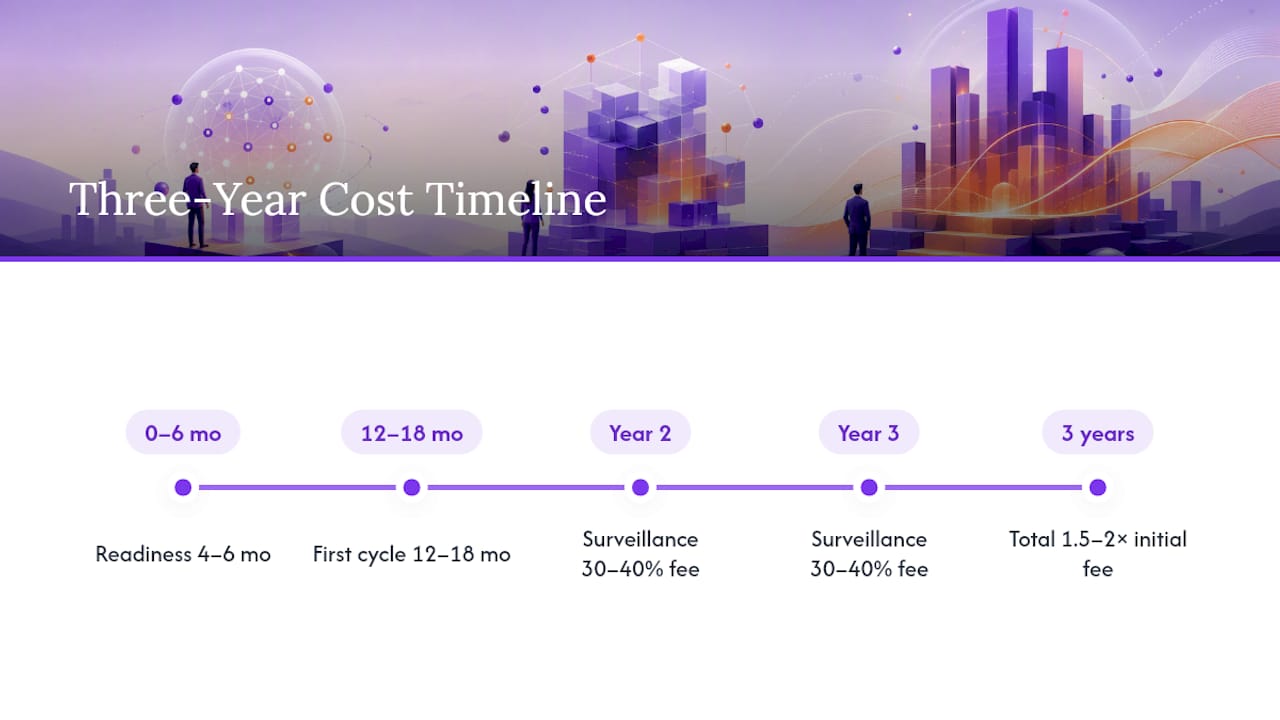
A typical readiness window runs four to six months before you’re prepared for Stage 1, with the full first cycle, from kickoff to Stage 2 certification, taking 12 to 18 months for most mid-sized organizations. That timeline is where your percentage gets spent: heaviest in months one through six on policy work and gap remediation, then tapering into audit prep.
Surveillance audits in years two and three cost roughly 30% to 40% of your initial certification fee each, and AuditFront’s breakdown suggests ongoing annual costs across the cycle commonly run 25% to 40% of the initial total. Over a full three-year cycle, that stacks up to roughly 1.5 to 2 times your initial audit fee. Smooth this by spreading surveillance costs across fiscal years in your annual budget rather than treating certification as a one-time expense that disappears after year one.
Why Traceable Estimates Beat Thumb Rules
Internal labor is the cost every team underestimates, and it’s not close. People assume a percentage of revenue and stop thinking, when the real driver is hours: hours spent writing policies, hours spent chasing evidence, hours spent in meetings nobody budgeted for. A blended percentage hides all of that.
What actually prevents budget disputes isn’t a better guess. It’s writing down your assumptions, per role, per phase, so finance can see exactly where the number came from and challenge a specific line instead of the whole figure. That’s the difference between a budget that survives a board meeting and one that gets rewritten in front of you. If you haven’t mapped your own maturity gaps yet, a quick readiness check will tell you which assumptions are shakiest before you put them in writing.
— Martin
Get a Tailored Percentage Instead of Guessing
Every range in this article is a starting point, not your number. Your actual security budget percentage depends on your headcount, your scope, and how mature your controls already are, and the fastest way to find it is to run those inputs through something built for exactly that.
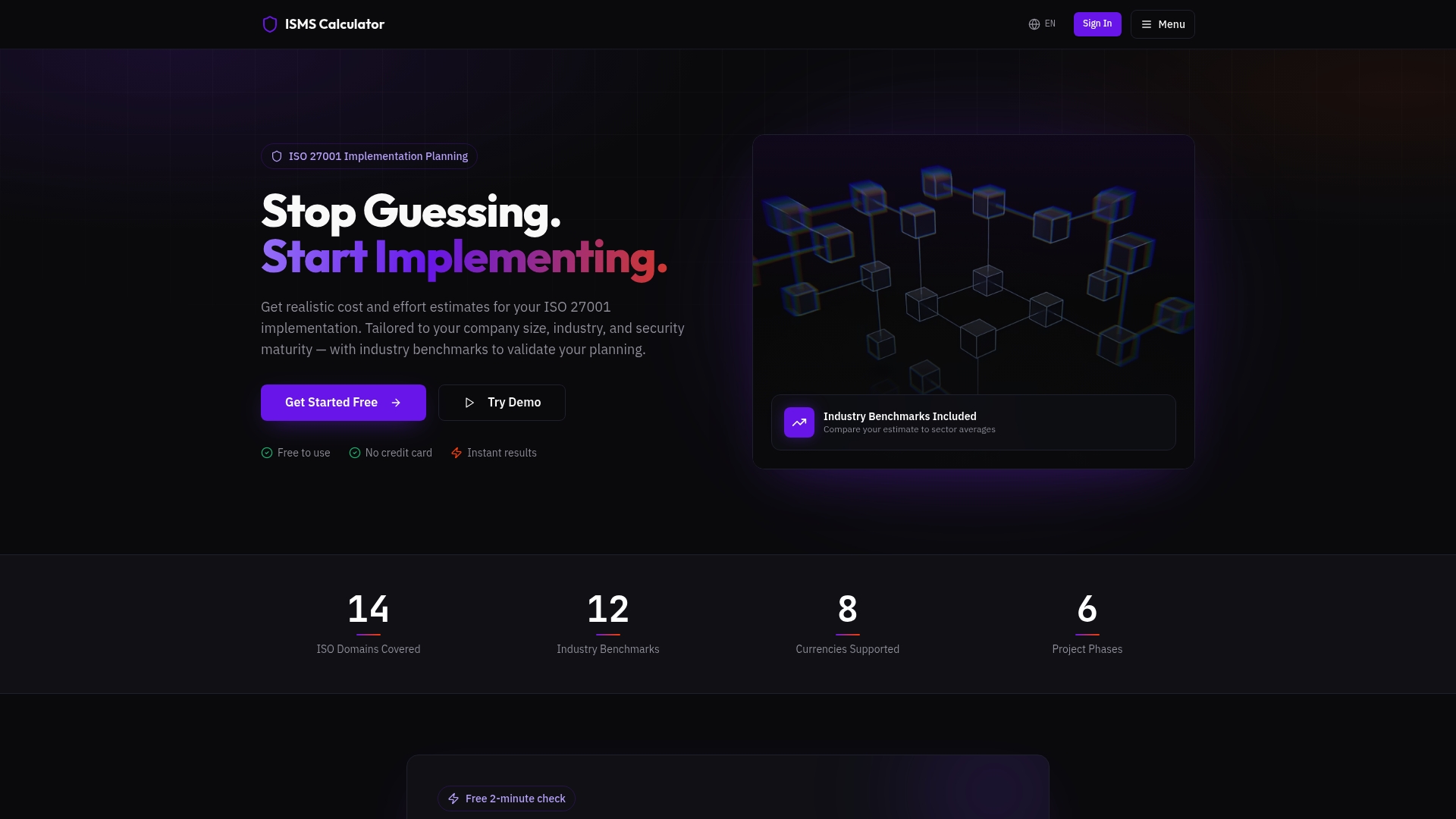
The ISO 27001 Cost Calculator turns company size, industry, and maturity into a real-time, editable estimate, backed by model reference comparisons so you can see how your number stacks up against the model reference. It includes a 14-domain maturity assessment, customizable Gantt charts for phasing the work, and the ability to save and compare multiple scenarios side by side, so you can show finance a range instead of a single fragile figure. Every assumption behind the estimate is documented on the cost model methodology page, so nothing in the number is a black box. Start with the free 2-minute readiness check to see where your organization stands before building the full estimate.
Sources
The percentage bands and line items in this article draw on cost breakdowns from Blueprint covering UK and Netherlands audit fee data, Safeguard’s certification cost analysis, Factorial’s size-based cost ranges, and AuditFront’s realistic cost breakdown. For automation’s effect on security tooling budgets more broadly, see this enterprise AI security guide.
- ISO 27001 cost: real numbers for UK + Netherlands (2026) | Blueprint
- ISO 27001 Certification Cost Breakdown (2026)
- How Much Does ISO 27001 Certification Cost in 2026? | Factorial
- ISO 27001 Certification Cost in 2026: A Realistic Breakdown - AuditFront Blog
FAQ
What Percentage of Revenue Should ISO 27001 Take?
Larger organizations with narrower certification scopes often land at the lower end of that range.
How Much Does ISO 27001 Certification Typically Cost?
First-year certification costs commonly range from $20,000 to $80,000, according to Safeguard’s cost breakdown, with smaller companies sometimes certifying for as little as $8,000 per Factorial’s data. Your actual figure depends heavily on headcount, scope, and how mature your existing controls are.
What Is the Biggest Hidden Cost in ISO 27001 Budgets?
Internal staff time is the cost most organizations underestimate, since it rarely shows up as an invoice but consumes real hours across security, IT, and HR roles. Mapping hours by role against a blended loaded rate is the most reliable way to surface this cost before it derails your budget.
How Much Do Surveillance Audits Cost After Certification?
Surveillance audits in years two and three typically run 30% to 40% of your initial combined Stage 1 and Stage 2 audit fee, based on figures from Blueprint. Across a full three-year cycle, ongoing costs often total 1.5 to 2 times the initial certification fee.
Does the ISMS Calculator Cost Anything to Use?
The ISO 27001 Cost Calculator and the free 2-minute readiness check are both available to try without commitment. Current pricing details for any deeper assessment tiers are listed directly on the site.