
Audit-ready ISMS documentation is the complete, controlled set of policies, procedures, records, and evidence that proves your information security management system operates as designed. ISO 27001 certification depends on it. A well-structured document set covers roughly 20–25 mandatory documents at minimum, with mature organizations maintaining 30–40 for a mid-sized company. This audit-ready ISMS documentation guide walks compliance professionals and IT managers through exactly what to prepare, how audit stages shape your evidence requirements, and how to avoid the documentation mistakes that derail certifications.
What documents does an audit-ready ISMS actually require?
ISO 27001:2022 defines a mandatory baseline of approximately 20–25 documents, and organizations with around 100 employees typically maintain 30–40 documents to satisfy auditors fully. That range is not arbitrary. Each document serves a specific control or clause requirement, and auditors check for both existence and quality.
The centerpiece of any ISMS documentation checklist is the Statement of Applicability (SoA). The SoA links organizational risks to Annex A controls, documenting which controls apply, which are excluded, and why. Auditors scrutinize it more than any other single document because it reveals whether your risk treatment decisions are coherent and defensible.

Beyond the SoA, the mandatory document set includes:
| Document Category | Examples |
|---|---|
| Scope and context | ISMS scope statement, context of the organization |
| Risk management | Risk assessment report, risk treatment plan |
| Policy framework | Information security policy, acceptable use policy, access control policy |
| Operational procedures | Incident response procedure, backup procedure, supplier management procedure |
| Performance evaluation | Internal audit program, management review minutes |
| Continual improvement | Corrective action records, nonconformity logs |
Records differ from documents in one critical way. Documents describe what you intend to do. Records prove you did it. Both categories are required, and auditors treat a missing record as evidence of a missing control.
Pro Tip: Avoid the temptation to create a document for every conceivable scenario. Over-documentation creates administrative burden without improving audit maturity. Thirty focused, current documents outperform sixty outdated ones every time.
How do ISO 27001 audit stages shape your preparation?
The ISO 27001 certification audit runs in two distinct stages, and each one demands a different type of preparation. Understanding the difference prevents you from showing up to Stage 2 with only paperwork and no proof.
Stage 1 lasts 1–2 days and focuses entirely on documentation review. The auditor checks whether your ISMS document set is complete, coherent, and covers the declared scope. They are not yet verifying that your controls work. They are confirming that the framework exists on paper before investing time in a full audit.
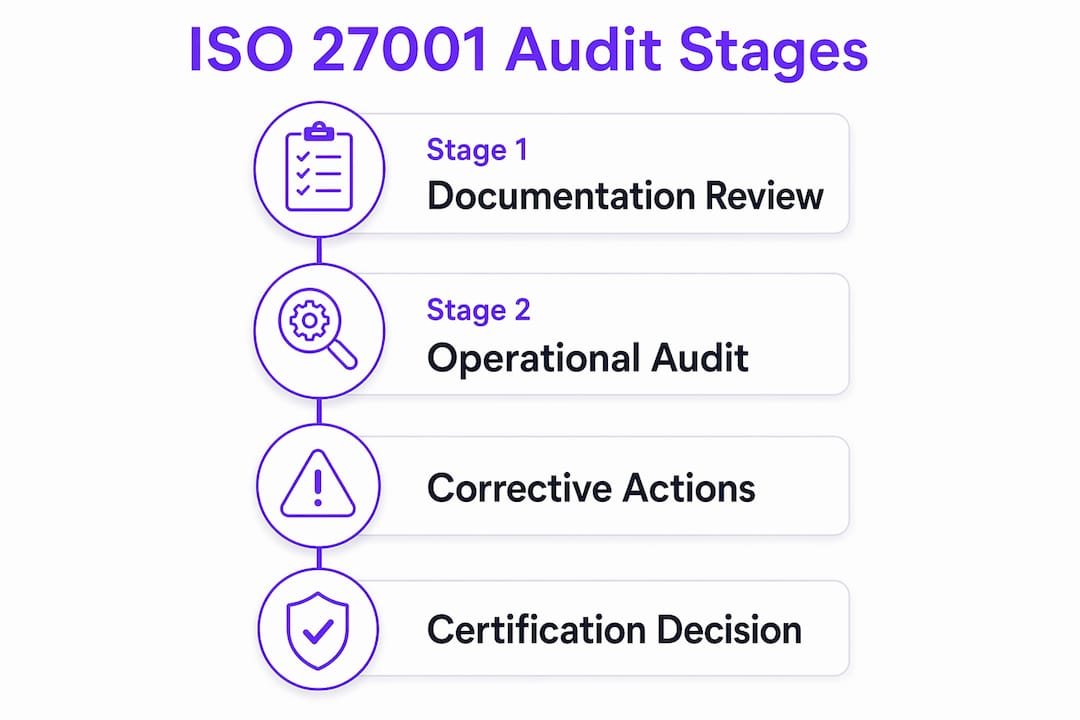
Stage 2 is the certification audit and runs 3–8 days depending on your organization’s size. Here, auditors verify implementation through interviews, system walkthroughs, and evidence review. A policy that exists in a document but is unknown to the staff responsible for it will generate a nonconformity finding.
For Stage 2, prepare evidence packs organized by control domain. The evidence auditors require includes:
- Access control logs and user provisioning records
- Security awareness training completion records
- Incident reports and post-incident review notes
- Supplier risk assessments and contract registers
- Vulnerability scan results and patch management logs
- Management review meeting minutes from the past 12 months
- Internal audit reports with corrective action closure evidence
Pro Tip: Organize your evidence packs by ISO 27001 clause number before Stage 2. Auditors work through clauses sequentially. Pre-mapped evidence packs cut retrieval time and signal that your ISMS is genuinely operational, not assembled the week before the audit.
The most common Stage 2 failure is a mismatch between documented policies and operational reality. Auditors conduct staff interviews specifically to test whether employees understand and follow the procedures your documents describe. If your incident response procedure says all incidents are logged within four hours but your team has never heard that requirement, you have a finding.
What are the best practices and pitfalls in ISMS documentation?
Effective ISMS documentation is a discipline, not a one-time project. The organizations that pass their audits cleanly treat their document control system as infrastructure, not paperwork.
The following practices define audit documentation best practices that experienced compliance teams rely on:
- Establish a document control register. Every document needs a unique identifier, version number, owner, approval date, and next review date. Without this register, version conflicts and outdated policies are inevitable.
- Set review triggers beyond the calendar. Annual reviews are the minimum. Scope changes, significant incidents, and new supplier relationships should all trigger immediate document reviews. Automated reminders tied to events keep your document control system current without relying on memory.
- Validate documentation against actual workflows. Walk through each procedure with the team that executes it. If the written steps do not match what people actually do, update the document or update the practice. Auditors will find the gap.
- Conduct mock audits before the real one. A successful ISMS audit requires that documented procedures reflect actual workflows. Mock audits that test staff knowledge reveal gaps you can fix before the certification auditor arrives.
- Time your internal audit correctly. Plan internal audits at least 8 weeks before Stage 2 to allow time for corrective actions to be implemented and evidenced. An internal audit completed the week before certification leaves no remediation window.
“Auditors assess an ongoing risk mitigation and policy adherence system, not just static documents. Demonstrating continual improvement is what distinguishes organizations that pass from those that struggle.”
The most common pitfall is treating documentation as a compliance checkbox rather than a management tool. Organizations that write policies to satisfy a clause, then file them away, consistently fail Stage 2 because their staff cannot demonstrate familiarity with those policies.
How to build and maintain audit-ready ISMS documentation step by step
A practical workflow for preparing ISMS policies and procedures removes ambiguity and keeps your documentation current through the full certification cycle. Follow this sequence to move from gap assessment to audit-ready status.
Step 1: Define scope and assign document ownership. Every document needs a named owner who is accountable for its accuracy and review. Scope definition determines which Annex A controls apply and directly shapes your SoA. Use your ISMS maturity assessment results to identify which domains have documentation gaps.
Step 2: Use templates to build your baseline document set. Templates from recognized sources accelerate the drafting process and reduce the risk of missing required elements. Customize each template to reflect your actual environment. A generic access control policy that references systems you do not use will confuse auditors and your own staff.
Step 3: Map each document to its ISO 27001 clause or Annex A control. This mapping becomes your ISMS documentation checklist and proves to auditors that your document set is complete. It also makes gap identification straightforward during internal audits.
Step 4: Establish your evidence collection process before Stage 2. Identify which systems generate the logs, reports, and records that prove control effectiveness. Assign responsibility for collecting and storing that evidence in a centralized location auditors can access.
Step 5: Integrate internal audit findings into documentation updates. Internal audit reports are not just compliance artifacts. They are the primary mechanism for keeping your documentation aligned with operational reality. Each finding should trigger a documented corrective action with a closure date and evidence of resolution.
Organizations using managed service platforms typically achieve certification in 4–5 months, while self-managed programs take 9–12 months. The difference comes from structured workflows, pre-built templates, and systematic evidence management rather than raw effort. For finance sector teams, the ISO 27001 audit prep considerations add regulatory overlay requirements that make structured documentation even more critical.
Pro Tip: Build your audit pack as a living folder, not a last-minute assembly. Maintain a shared drive or GRC platform with folders labeled by ISO 27001 clause. Drop evidence into the relevant folder as it is generated. By audit time, your pack is already 80% complete.
Key takeaways
Audit-ready ISMS documentation requires a controlled, evidence-backed document set that reflects actual operations, maintained through structured ownership, regular review cycles, and internal audits timed to allow remediation.
| Point | Details |
|---|---|
| Mandatory document baseline | ISO 27001 requires 20–25 mandatory documents; mature ISMS typically holds 30–40 for mid-sized organizations. |
| SoA is the audit centerpiece | The Statement of Applicability ties risk decisions to Annex A controls and receives the most auditor scrutiny. |
| Stage 1 vs. Stage 2 preparation | Stage 1 checks document existence; Stage 2 verifies operational reality through interviews and evidence packs. |
| Internal audit timing | Schedule internal audits at least 8 weeks before Stage 2 to allow corrective actions to be completed and evidenced. |
| Documentation quality over quantity | Focused, current documents outperform excessive paperwork; auditors value consistency and accuracy above volume. |
What years of ISMS audit prep taught me about documentation
The biggest misconception I see compliance teams carry into their first ISO 27001 audit is that documentation volume signals maturity. It does not. I have reviewed ISMS document sets with 80 documents that failed Stage 1 and sets with 32 documents that sailed through Stage 2 without a single major nonconformity. The difference was always the same: the passing organizations had documentation that matched what their people actually did.
The most uncomfortable truth about preparing for ISMS audits is that your documentation will expose gaps in your actual security practices, not just your paperwork. That is the point. When a mock audit reveals that your incident response team cannot locate the escalation procedure, the problem is not the document. The problem is that the procedure was written by a compliance officer and never operationalized. Fix the practice, then update the document.
Technology has genuinely changed what is possible here. GRC platforms with automated review reminders, pre-mapped control frameworks, and centralized evidence repositories have compressed what used to take 12 months into 4 or 5. But the tool does not replace the judgment call of deciding which controls are genuinely applicable to your environment. That is where the SoA earns its reputation as the most scrutinized document in the audit. A weak SoA with vague exclusion justifications signals to an auditor that your risk assessment was superficial.
My advice to any compliance professional starting this process: run your internal audit early, treat every finding as a gift, and build your evidence collection habits before you need the evidence. The organizations that find independent ISO 27001 consultants early in the process consistently avoid the last-minute scrambles that generate nonconformities.
— Martin
Benchmark your ISMS documentation readiness with Ismscalculator
Knowing where your documentation stands before an auditor arrives is the single most valuable step you can take right now.
Ismscalculator provides a free 2-minute readiness check that benchmarks your current ISMS documentation status against ISO 27001 requirements across the four Annex A control themes. For teams that need deeper analysis, the full ISO 27001 readiness assessment delivers tailored gap reports with model reference comparisons, so you know exactly which documents and evidence packs need attention before Stage 1. Ismscalculator also connects you with independent implementers and lead auditors who specialize in getting organizations to certification efficiently. Start with the readiness check and know where you stand today.
FAQ
What is the minimum number of documents required for ISO 27001?
ISO 27001:2022 requires a baseline of approximately 20–25 mandatory documents. Organizations with around 100 employees typically maintain 30–40 documents to fully satisfy auditor expectations.
What is the statement of applicability and why does it matter?
The Statement of Applicability (SoA) maps your organization’s risks to specific Annex A controls and documents all exclusion decisions. It is the most scrutinized document in a Stage 1 audit because it reveals whether your risk treatment logic is sound.
How long before my certification audit should i run an internal audit?
Schedule your internal audit at least 8 weeks before Stage 2. That window gives your team time to implement corrective actions and generate the closure evidence auditors will expect to see.
What is the difference between stage 1 and stage 2 in an ISO 27001 audit?
Stage 1 is a 1–2 day documentation review confirming your ISMS framework exists on paper. Stage 2 is a 3–8 day operational audit that verifies your controls are implemented and your staff can demonstrate them.
How can i speed up ISO 27001 certification?
Managed service platforms reduce certification timelines to 4–5 months compared to 9–12 months for self-managed programs. Structured templates, automated evidence collection, and early gap assessments drive the difference.