
The most damaging ISO 27001 budgeting mistakes share one root cause: treating certification as a one-time project with a fixed price tag. The reality is a three-year audit cycle with recurring costs that catch most organizations off guard. Here are the top mistakes and their one-line fixes:
- Treating it as a one-time project. Budget a 3-year TCO from day one, including surveillance and recertification reserves. (NQA and Reepa Solutions call this the “18-month cliff.”)
- Ignoring internal staff hours. Add a dedicated internal-labor line item; senior time can represent a substantial opportunity cost potentially exceeding typical audit fees.
- Skipping security awareness training. Training is a required Annex A control — budget $1,000–$10,000 per year.
- Budgeting only for the audit fee. Audit fees are a small fraction; implementation, remediation, and tooling are the major cost drivers.
- Underfunding remediation debt. Reserve a separate line for technical controls (MFA, logging, backups) surfaced in the gap analysis.
- No contingency reserve. Allocate 15–30% of total budget depending on maturity.
- Underestimating scope creep. Define ISMS scope in writing before any cost estimate.
- Skipping a professional gap analysis. A $5,000–$8,000 consultant gap analysis prevents over-engineering and late surprises.
- Forgetting surveillance and recertification spikes. Surveillance audits run 30–50% of Stage 2 cost annually; recertification can hit 80–100%.
- No benchmark validation. Use Ismscalculator to sanity-check estimates against model reference comparisons before presenting to stakeholders.
Table of Contents
- Why ISO 27001 budgets are structurally different from normal IT projects
- The most common ISO 27001 budgeting mistakes, examined in detail
- How to build a realistic ISO 27001 budget
- How to validate your estimates with benchmarks and tools
- Sample budgets by organization size
- Key Takeaways
- The real cost of the wrong mindset
- Validate your ISO 27001 budget before you commit to it
- Sources and further reading
Why ISO 27001 budgets are structurally different from normal IT projects
Standard IT project budgets have a clear end date. ISO 27001 does not. The certification body returns every year, and the cost structure reflects that ongoing rhythm in ways most project budgets are not designed to capture.
Four drivers make ISO 27001 budgeting unique. First, the audit cadence: initial certification (Stage 1 + Stage 2), annual surveillance audits in years two and three, and a full recertification in year three. Second, internal labor as opportunity cost: your CISO, IT leads, and HR all contribute hours that never appear on an invoice but represent real spend. Third, remediation vs. ISMS work: gap analyses almost always surface foundational security gaps — MFA, centralized logging, backup controls — that sit outside the ISMS design budget but are mandatory for audit readiness. Fourth, tooling and automation: SIEM, IAM, vulnerability scanning, and MDM licenses are recurring costs, not one-time purchases.
The “18-month cliff” is what happens when organizations treat certification as a project. Documentation goes stale, evidence collection stops, and the surveillance audit arrives to find a program that has effectively been abandoned. Rushed fixes and surprise consulting fees follow.
Timeline reality: Small organizations (10–50 people) typically certify in 6–9 months. Mid-market (50–250) runs 9–14 months. Enterprise (250+) often takes 14–18 months or longer. Every additional month adds internal labor cost.
A 3-year certification cycle with surveillance audits plus maintenance typically adds 25–40% of the initial certification cost annually. Budget for that from the start, or plan to explain the spike later.
The most common ISO 27001 budgeting mistakes, examined in detail
1. Treating ISO 27001 as a one-time project
The mindset is understandable: get certified, move on. The consequence is the 18-month cliff. Documentation becomes outdated, internal audit evidence dries up, and the surveillance auditor finds a program that exists on paper only. The fix is structural: build a recurring OPEX model, not a capital project budget.
2. Ignoring internal staff time
This is the single largest hidden cost in most implementations. Senior staff across IT, legal, HR, and operations contribute 200–500 hours collectively. At a blended rate of $75–$150 per hour, that is $15,000–$75,000 in opportunity cost that never appears on a vendor invoice. Budget it explicitly using role-level hourly rates.

Pro Tip: Multiply each role’s hours by 1.3x to account for meeting overhead, rework, and context-switching. A project manager at $90/hour contributing 80 hours costs closer to $9,400 fully loaded, not $7,200.
3. Budgeting only for the audit fee
Budgeting only for the certification audit routinely underestimates total cost by a factor of three to five. Audit fees are $5,000–$20,000+ depending on scope, but implementation, remediation, and consulting are the real cost drivers. The audit is the finish line, not the race.
4. Underfunding remediation debt
Gap analyses surface foundational gaps that must be closed before Stage 2. MFA rollouts, centralized logging, and backup validation are not optional enhancements — they are pre-audit requirements. Treat remediation as mandatory spend and reserve a separate line item for it, distinct from ISMS design work.
5. Skipping or under-scoping the gap analysis
A professional gap analysis costs $5,000–$8,000 and prevents over-engineering. A DIY gap analysis pushes 40+ hours of senior staff time into the project and often misses control gaps that surface at Stage 2. The consultant fee is cheap insurance.
6. Underestimating the DIY tradeoff
DIY implementation can cut upfront spend by 30%–50% but often doubles or triples timelines and creates hidden costs from lost internal productivity. If your team lacks ISO 27001 experience, the time cost of learning while doing typically exceeds what a hybrid consultant engagement would have cost.
7. Forgetting training as a required line item
Security awareness training is not optional — it is mandated by Annex A controls. Underfunding it leads to audit findings and corrective spending that costs more than the training would have. Budget an appropriate amount for awareness programs and $500–$3,000 per person for lead auditor or lead implementer training.
8. No surveillance or recertification reserve
Surveillance audits cost a significant fraction of the Stage 2 audit effort annually; recertification in year three can cause a notable cost increase compared to the initial Stage 2 cost. Organizations that budget only for year one face a genuine cash-flow problem in year two. Build a surveillance reserve into the initial budget approval.
9. Scope creep without a budget adjustment process
Scope creep is the silent budget killer. Adding a new office, a cloud environment, or a third-party integration mid-implementation adds audit days and consultant hours. U.S. auditor day rates run $1,400–$2,500 per day; each additional site or system in scope adds days directly. Lock scope in writing and establish a formal change-control process for any additions.
10. No contingency allocation
A 15% contingency is the floor for organizations with strong existing controls. For organizations starting from scratch, 25–30% is more realistic. Failed Stage 2 audits require remediation and a re-assessment that typically costs 60% of the original audit fee, plus external consultant time at $100–$300 per hour.
How to build a realistic ISO 27001 budget
A complete budget equals: gap analysis + remediation + tooling/licenses + consulting + audit fees + training + internal labor + contingency + 3-year maintenance reserve.
| Line Item | What It Covers | U.S. Benchmark Range |
|---|---|---|
| Gap analysis | Baseline assessment of current controls vs. ISO 27001 | $5,000–$25,000 |
| Remediation | MFA, logging, backups, policy gaps surfaced in gap analysis | $5,000–$8,000 |
| Consulting | Implementation support, policy development, audit prep | $15,000–$75,000 |
| Tooling/licenses | SIEM, IAM, vulnerability scanning, MDM, GRC platform | $7,000–$40,000/year |
| Security awareness training | Annual program for all staff (Annex A required) | $1,000–$10,000/year |
| Lead auditor/implementer training | Core team certification | $500–$3,000/person |
| Internal labor (opportunity cost) | 200–500 senior hours across IT, legal, HR, ops | $15,000–$75,000 |
| Certification audit (Stage 1 + Stage 2) | External certification body fees | $5,000–$20,000+ |
| Surveillance audits (years 2–3) | Annual audit to maintain certification | $3,000–$15,000/year |
| Recertification (year 3) | Full re-audit at three-year cycle | $5,000–$20,000+ |
| Contingency | Buffer for scope changes, failed audits, rework | 15–30% of total |
For phasing, a typical implementation timeline runs: gap analysis (weeks 1–4), policy and control development (weeks 5–16), internal audit (weeks 17–20), Stage 1 audit (week 22), Stage 2 audit (week 26). Each phase has distinct cost peaks — consulting is heaviest in weeks 5–16; internal labor peaks around the internal audit and Stage 1 prep.
To cost internal hours, multiply each role’s estimated hours by their fully loaded hourly rate. A CISO at $175/hour contributing 60 hours is $10,500. An IT engineer at $90/hour contributing 120 hours is $10,800. These numbers belong in the budget, not in a footnote.
How to validate your estimates with benchmarks and tools
The most reliable inputs for any ISO 27001 cost estimator are: ISMS scope (headcount, number of locations, cloud dependencies), existing control maturity, implementation approach (DIY, hybrid, or consultant-led), and industry sector.
Key benchmarks to validate against:
- Auditor day rates (U.S.): $1,400–$2,500 per auditor-day; audit days scale with effective headcount and site count.
- Consultant day rates: $800–$2,000/day depending on specialization and firm size.
- Gap analysis: $5,000–$8,000 (small org, consultant-led); up to $25,000 for complex environments.
- Security awareness training: $1,000–$10,000/year for a full program.
- GRC/compliance platform: $7,000–$40,000/year depending on features and org size.
Run a sensitivity check at ±25% on your total estimate. If the low end is still fundable and the high end is still approvable, your budget is defensible. If the high end breaks the business case, revisit scope before presenting to leadership.
Pro Tip: Structure your estimate in two tiers: a “base” tier covering mandatory ISMS work (policies, risk assessment, internal audit, certification fees) and a “remediation” tier covering technical control gaps. Stakeholders can then see what is non-negotiable vs. what depends on current maturity — and the conversation shifts from “why does this cost so much” to “how mature are we today.”
When procuring consulting or tooling through a formal process, RFP Forge AI can help generate procurement documents that capture the right scope and evaluation criteria, reducing the risk of comparing mismatched proposals.
Ismscalculator’s real-time estimator lets you toggle scope, headcount, industry, and maturity level to see how each variable moves the total. The ISO 27001 cost breakdown on their blog provides additional benchmark context for each line item.
Sample budgets by organization size
| Size | First-Year Estimate | Biggest Cost Driver | Common Pitfall |
|---|---|---|---|
| Small (10–50 staff) | — | Internal labor + gap analysis | Scope too broad for team capacity |
| Mid-market (50–250 staff) | — | Consulting + remediation | No dedicated ISMS owner; scope creep |
| Enterprise (250+ staff) | — | Audit days + tooling + multi-site costs | Late remediation discoveries; under-sampling |
Small organizations (10–50): The highest-impact single adjustment is scope narrowing. Limiting the ISMS to one product line or one office cuts audit days and consultant hours significantly. The small business guide on Ismscalculator walks through scope decisions specific to this size.
Mid-market (50–250): The most common miss is failing to assign a dedicated ISMS manager. Without one, implementation stalls, internal audit evidence is incomplete, and Stage 2 prep becomes a crisis. Budget 0.5–1.0 FTE for this role across the first year.
Enterprise (250+): Multi-site scope is the primary cost amplifier. Each additional physical location adds auditor travel and audit days. Use sampling strategies where the certification body allows, and negotiate the audit plan before Stage 1.
Key Takeaways
The single most expensive ISO 27001 budgeting mistake is treating certification as a one-time project rather than a three-year recurring program with predictable, plannable cost cycles.
| Point | Details |
|---|---|
| Budget for three years, not one | Include surveillance audits (30–50% of Stage 2 annually) and a recertification reserve from the start. |
| Internal labor is the largest hidden cost | Model 200–500 senior hours at role-specific rates; this line item often exceeds $30,000. |
| Remediation is mandatory, not optional | Reserve a separate budget line for technical control gaps surfaced in the gap analysis. |
| Contingency is non-negotiable | Allocate 15–30% depending on maturity; failed audits cost 60% of the original audit fee plus remediation. |
| Ismscalculator validates your estimates | Use the free 2-minute readiness check to benchmark your numbers against industry ranges before finalizing the budget. |
The real cost of the wrong mindset
The most persistent problem in ISO 27001 budget planning is not a missing line item — it is a framing error. Organizations that treat this as a project to complete, rather than a program to run, make every other mistake downstream almost inevitable.
When the framing is “get certified,” the budget reflects only the path to the certificate. Surveillance costs, training renewals, and internal audit cycles get deferred to “next year’s budget” — which means they arrive as surprises. The organizations that handle this well are the ones that present ISO 27001 to their finance teams as a recurring operational cost from the first conversation, not a capital project with a defined end date. That framing change alone tends to produce more honest budgets, better stakeholder alignment, and far fewer emergency funding requests at the 18-month mark.
Validate your ISO 27001 budget before you commit to it
Ismscalculator gives you a real-time cost and effort estimate tailored to your company size, industry, and current security maturity — without a sales call. The platform covers every major line item: gap analysis, consulting, tooling, internal labor, audit fees, and the 3-year TCO model most organizations skip.
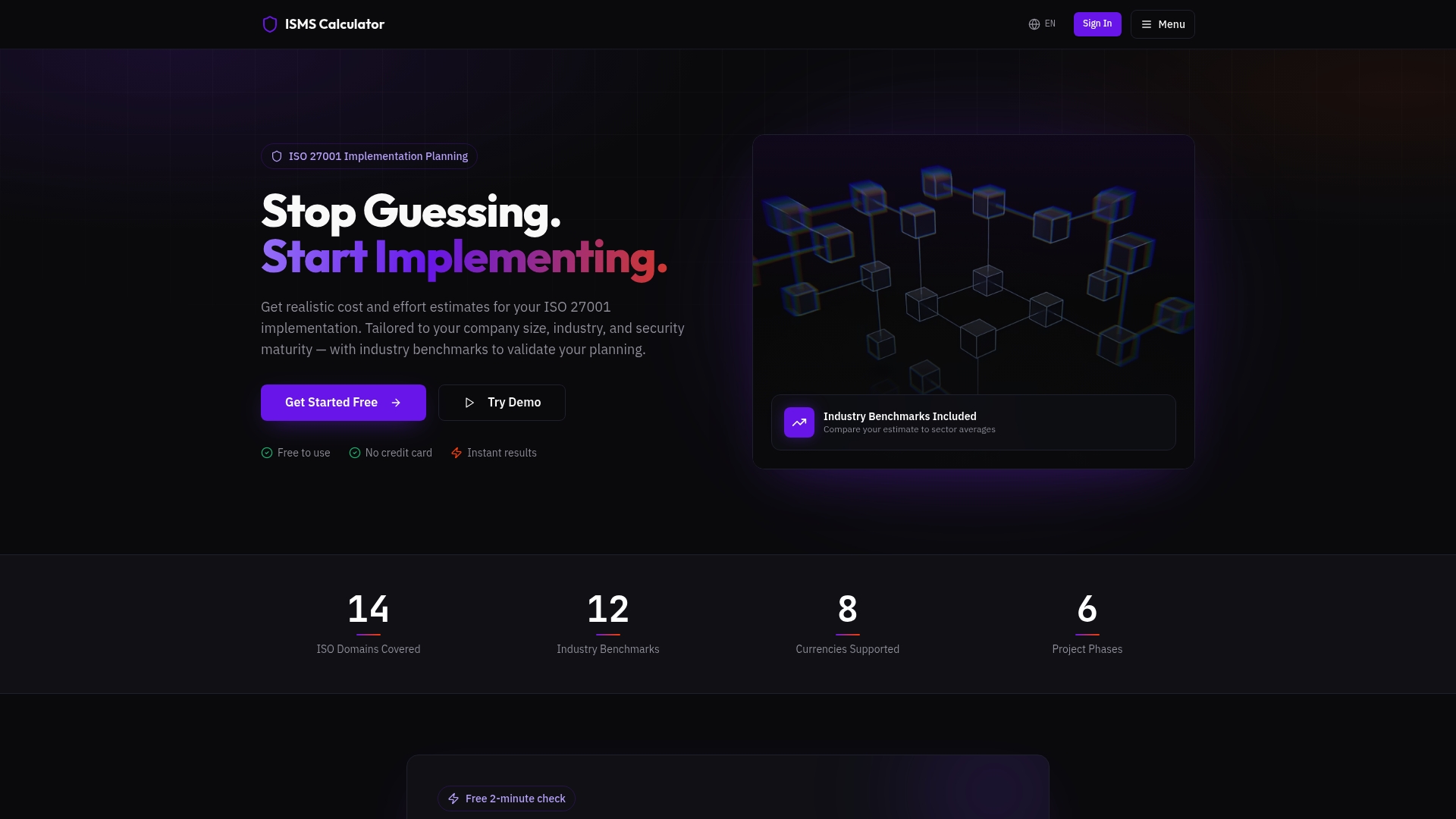
Key capabilities relevant to budget validation: a free 2-minute readiness check for a fast sanity check, maturity assessments across all four ISO/IEC 27001:2022 control themes, benchmarked cost ranges by sector and org size, save-and-compare functionality for scenario modeling, and a independent consultant directory for organizations that decide to bring in external help. Run the full readiness assessment to get a detailed model you can take directly into your budget approval process.
Sources and further reading
- NQA Blog — Common ISO 27001 Mistakes: Expert observations on the one-time-project mindset and training gaps; primary source for the 18-month cliff concept.
- SecureSlate — ISO 27001 Cost Breakdown: Detailed line-item analysis including internal hours, gap analysis costs, and surveillance ratios.
- iso27001cost.com — $10K Floor, $138K Ceiling: U.S.-market cost ranges, auditor day rates, DIY tradeoff figures, and remediation debt framing.
- Reepa Solutions — Mid-Market Cost Guide: 3-year TCO modeling, approach-based cost variance, and surveillance reserve guidance.
- Ecofico — ISO 27001 Certification Costs: Broad cost layer breakdown and hidden cost categories including tooling and legal alignment.
- Ismscalculator Blog: Practical knowledge base covering IT team roles and internal hours, finance implementation mistakes, and the 80-step certification checklist.
This article is general information for planning purposes, not legal or financial advice. Confirm current certification body fees, audit day requirements, and regulatory obligations with a qualified ISO 27001 consultant or your certification body for your specific situation.