
Cryptography control in an ISMS is the structured set of policies and procedures that govern how cryptographic techniques protect information assets for confidentiality, integrity, and authenticity. Under ISO 27001 Annex A Control 8.24, organizations must establish formal governance frameworks rather than rely on ad hoc encryption decisions. The standard does not mandate specific algorithms but requires risk-based policies that document when and how cryptography is used, which algorithms are approved, and how keys are managed across their full lifecycle. For compliance officers and security professionals, understanding what cryptography control in ISMS actually requires is the difference between passing an audit and failing one.
What is cryptography control in an ISMS?
Cryptography control in an ISMS is defined as the formal framework of policies, procedures, and technical measures that determine how an organization applies cryptographic methods to protect its information assets. The industry term for this control is ISO 27001 Annex A Control 8.24, titled “Use of Cryptography.” It covers every decision point from algorithm selection to key destruction.
The scope of this control is broader than most professionals initially expect. It applies to data at rest on servers and endpoints, data in transit across networks, and data in use within applications. Encryption across all data states requires different technical approaches. Disk encryption handles data at rest, TLS handles data in transit, and application-level controls handle data in use.

Governance is the core of this control. An encryption policy acts as a rulebook that prevents inconsistent and insecure implementation across the organization. Without it, individual teams make independent encryption decisions that create gaps auditors will find. ISO 27001 emphasizes risk-based governance over mandatory encryption standards, which means strong algorithms alone do not guarantee compliance.
What are the core components of cryptography controls in an ISMS?
Effective cryptography controls rest on four interconnected components: policy, algorithm governance, key management, and monitoring. Each one must be documented and consistently applied.
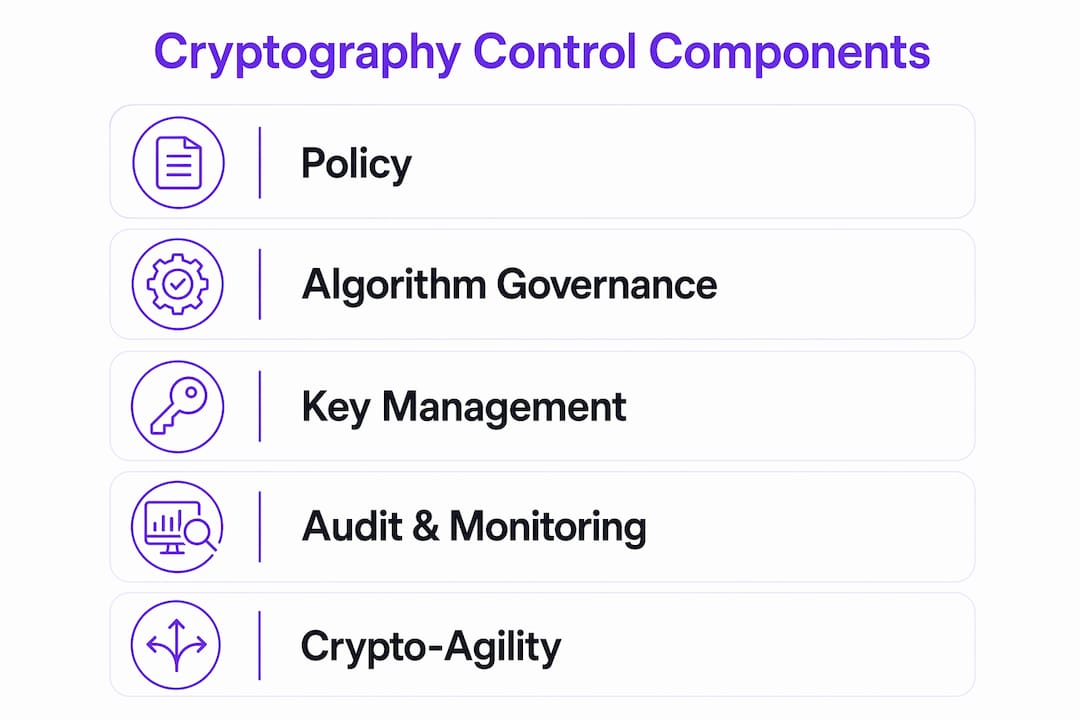
Policy development is the foundation. Your policy must specify when cryptography is required, which data classifications trigger encryption, who approves algorithm choices, and how exceptions are handled. A policy that says “encrypt sensitive data” without defining sensitive data or approved methods fails this requirement.
Algorithm and key length governance ties directly to risk assessment. The policy must list approved algorithms per data sensitivity level. For example, AES-256 for data at rest and TLS 1.2 or higher for data in transit are widely accepted baselines. The 10 distinct obligations identified in compliance frameworks include cryptographic agility and state-of-the-art compliance reviews, meaning your approved algorithm list must be reviewed and updated regularly.
Key management lifecycle is where most organizations underinvest. The lifecycle covers:
- Generation: Keys must be created using approved, cryptographically secure methods.
- Distribution: Keys must be transmitted securely, never in plaintext.
- Storage: Keys must be stored separately from the data they protect, never in source code or configuration files.
- Rotation: Keys must be replaced on a defined schedule or after a security event.
- Backup: Key backups must be protected with the same rigor as the keys themselves.
- Revocation: Compromised keys must be revoked and replaced immediately with documented response procedures.
- Destruction: Expired keys must be destroyed in a way that prevents recovery.
Audit and monitoring closes the loop. Cryptographic controls require evidence of consistent application, not just written policies. Log key management events, track algorithm usage, and review compliance against your policy on a defined schedule.
Pro Tip: Design your systems for crypto-agility from the start. Crypto-agility means your architecture can swap out a cryptographic algorithm without rebuilding the entire system. When a vulnerability is discovered in a widely used algorithm, organizations with crypto-agile systems respond in days. Others take months.
How does cryptography control contribute to ISO 27001 compliance and audit readiness?
Auditors evaluating cryptography controls in 2026 focus on governance evidence, not technical sophistication. Audit failures most often result from missing formal governance and undocumented policies rather than from choosing the wrong encryption algorithm. That finding should reframe how your team prepares.
The four criteria auditors consistently check are:
- Policy existence. A written, approved, and current cryptography policy that covers algorithm selection, key management, and data state requirements. A policy last reviewed three years ago will raise questions.
- Algorithm appropriateness. Evidence that approved algorithms match the sensitivity of the data they protect. Auditors look for a documented rationale, not just a list of algorithms.
- Key management evidence. Records showing that key lifecycle stages are followed. This includes generation logs, rotation schedules, and documented revocation events. Checking for common ISO 27001 audit failures before your assessment reveals gaps in this area quickly.
- Consistent application. Proof that encryption is applied uniformly across all data states, not just in the systems that received the most attention during implementation.
The most common audit failure pattern is an organization that encrypts data in transit but leaves databases unencrypted or stores encryption keys in application configuration files. Auditors check actual implementation against written policy. Gaps between the two are findings. Reviewing your ISO 27001 audit readiness posture before a formal assessment gives your team time to close those gaps.
What are the best practices and common pitfalls when implementing cryptographic controls?
The most critical pitfall in cryptographic control implementation is separating encryption from key management in your thinking but not in your architecture. Encryption is only as strong as key management. Many breaches occur because keys are stored in application source code or configuration files rather than a dedicated Key Management System (KMS). A KMS automates lifecycle management, enforces separation of duties, and provides the audit trail auditors require.
The second most common pitfall is inconsistent application across data states. Organizations often encrypt data in transit because TLS is easy to configure, then neglect database encryption or endpoint disk encryption. Documenting data state distinctions in your policy forces your team to address all three states explicitly.
Best practices that consistently improve both security and audit outcomes include:
- Use a dedicated KMS. Tools like AWS KMS, Azure Key Vault, or HashiCorp Vault enforce lifecycle controls and generate the audit logs you need.
- Align with legal requirements. GDPR treats encryption as a primary safeguard. Legal frameworks have elevated encryption to a compliance requirement, and lacking controls creates direct liability in breach scenarios.
- Build in crypto-agility. Abstract your cryptographic implementations so algorithm changes do not require application rewrites.
- Conduct regular policy reviews. Approved algorithm lists become outdated. Schedule annual reviews at minimum, and trigger an out-of-cycle review whenever a significant vulnerability is published.
- Train your teams. Developers who understand why keys cannot live in config files make better decisions without needing a policy check every time.
Pro Tip: Integrate your KMS with your secrets management pipeline. When developers can retrieve encryption keys programmatically through a secure API rather than copying them into config files, the insecure storage problem largely disappears without requiring behavior change.
How is cryptography control evolving with legal and technological trends?
Cryptography control requirements are expanding across multiple regulatory frameworks simultaneously. GDPR established encryption as a primary safeguard for personal data, and regulators treat its absence as an aggravating factor in breach investigations. Regulators treat encryption as a primary measure with direct implications for breach accountability, not just a technical best practice.
The NIS2 Directive adds another layer of obligation for organizations operating in the European Union. NIS2 requires cryptography policies that document algorithms, key lifecycle management, and usage protocols across 10 grouped obligations. The Directive is technology-neutral and algorithm-agnostic, which mirrors ISO 27001’s approach. Organizations already compliant with ISO 27001 Annex A Control 8.24 have a strong foundation for NIS2 alignment.
The table below maps the key regulatory and technological drivers shaping cryptography controls in 2026:
| Driver | Requirement | Impact on ISMS |
|---|---|---|
| GDPR | Encryption as primary personal data safeguard | Mandatory controls for personal data processing |
| NIS2 Directive | 10 documented cryptography obligations | Policy must cover algorithm selection and key lifecycle |
| ISO 27001:2022 | Risk-based governance under Annex A Control 8.24 | Formal policy and consistent application required |
| Post-quantum cryptography | Algorithm transition readiness | Crypto-agility becomes a design requirement, not optional |
Post-quantum cryptography is the most significant emerging technical challenge. Current asymmetric encryption algorithms, including RSA and elliptic curve cryptography, are vulnerable to quantum computing attacks. The U.S. National Institute of Standards and Technology (NIST) finalized its first post-quantum cryptographic standards in 2024. Organizations with crypto-agile architectures can adopt these standards without rebuilding systems. Those without that flexibility face significant remediation costs.
Key Takeaways
Cryptography control in an ISMS requires documented governance policies, consistent application across all data states, and a managed key lifecycle. Governance gaps cause more audit failures than algorithm choices.
| Point | Details |
|---|---|
| Governance over algorithms | ISO 27001 requires formal policies and risk-based decisions, not specific encryption standards. |
| Key management is the weak link | Keys stored in source code or config files undermine even strong encryption. Use a dedicated KMS. |
| Cover all data states | Policies must address encryption for data at rest, in transit, and in use without exception. |
| Audit failures are governance failures | Auditors look for documented policies and consistent application, not technical sophistication. |
| Crypto-agility future-proofs compliance | Systems that can swap algorithms without rebuilds are ready for post-quantum and emerging threats. |
Why governance is the real work in cryptography control
The organizations I see struggle most with cryptography controls are not the ones using outdated algorithms. They are the ones that treat encryption as a technical checkbox rather than a governance discipline. A developer enables TLS on a web server, a DBA encrypts a database, and the security team writes a policy that nobody reads. Three separate decisions, zero coordination, and a compliance gap that shows up the moment an auditor asks for evidence of consistent application.
The uncomfortable truth is that most cryptography control failures are organizational, not technical. The technology to encrypt everything correctly has existed for decades. What fails is the governance layer: the policy that defines what gets encrypted, the process that ensures keys are managed properly, and the training that makes developers understand why it matters. I have seen organizations with sophisticated encryption architectures fail audits because they could not produce a key rotation log. The encryption was working. The governance was not.
The shift toward post-quantum cryptography makes crypto-agility more urgent than most teams realize. Organizations that built their encryption into application logic rather than abstracting it through a service layer are going to face expensive rewrites when NIST’s post-quantum standards become the baseline expectation. The teams that built for agility will update a configuration. The others will run a multi-year remediation project. That gap is entirely a governance and architecture decision made years earlier.
My advice: treat your cryptography policy as a living document with a named owner, a review schedule, and a direct line to your risk register. Connect it to your ISMS maturity assessment process so it gets reviewed alongside your other controls. Cryptography control done well is invisible. Done poorly, it is the finding that defines your audit.
— Martin
Assess your cryptography control readiness with Ismscalculator
Knowing the requirements is one thing. Knowing where your organization stands against them is another.
Ismscalculator provides a structured ISO 27001 readiness assessment that maps your current controls against all four ISO/IEC 27001:2022 control themes, including Annex A Control 8.24 on cryptography. The platform benchmarks your posture against organizations of similar size and industry, so you can see exactly where your cryptography policies, key management practices, and audit evidence fall short. If you want a faster starting point, the 2-minute readiness check identifies your highest-priority gaps without requiring a full assessment session. Both tools give you a clear picture of what needs to change before your next audit.
FAQ
What is cryptography control in an ISMS?
Cryptography control in an ISMS is the formal set of policies and procedures governing how cryptographic techniques are used to protect information assets. Under ISO 27001 Annex A Control 8.24, it covers algorithm selection, key management lifecycle, and consistent application across all data states.
Does ISO 27001 require specific encryption algorithms?
ISO 27001 does not mandate specific encryption algorithms. It requires risk-based policies that document approved algorithms per data sensitivity level and a managed key lifecycle.
What causes most cryptography control audit failures?
Audit failures most often result from missing formal governance and undocumented policies, not from choosing the wrong algorithm. Auditors expect consistent application across data at rest, in transit, and in use, backed by written policies and evidence.
What is crypto-agility and why does it matter?
Crypto-agility is the ability to replace or upgrade cryptographic algorithms without rebuilding the systems that use them. It matters because newly discovered vulnerabilities and post-quantum computing threats require organizations to update algorithms quickly.
How does GDPR affect cryptography control requirements?
GDPR treats encryption as a primary safeguard for personal data. Regulators view the absence of encryption as an aggravating factor in breach investigations, making documented cryptographic controls a direct compliance and legal liability issue.