
Most organizations pay between $8,000 and $50,000 a year to keep ISO 27001 certification active, with internal staff time and surveillance audits driving the bulk of that spend. As a rule of thumb, annual maintenance runs roughly 25% to 40% of the initial certification total spread across three fixed points on a recurring three-year cycle: two surveillance audits and one recertification audit.
TL;DR:
- Audit fees vary depending on location, scope, and whether audits are remote or onsite, with remote audits offering potential savings of 15% to 25%.
- Internal staff time remains the largest hidden cost, often comprising hours from multiple departments for audit preparation and ongoing compliance activities.
- Tooling and platform subscriptions generally cost between $3,000 and $15,000 annually, with automation reducing the number of consultant days needed.
- The three-year total cost for surveillance and recertification audits for a $10,000 initial certification typically ranges from $17,000 to $22,000, influenced by physical sites and audit complexity.
- Budgeting should include full three-year TCO, written certification body quotes, and documented assumptions to avoid surprises and ensure compliance costs are accurately forecasted.
Table of Contents
- What Drives ISO 27001 Maintenance Cost Each Year?
- Surveillance Vs. Recertification: What Changes Each Year?
- How Much Does ISO 27001 Maintenance Cost by Company Size?
- How Do You Build an ISO 27001 Maintenance Budget?
- How Do Certification Bodies Set Audit Fees?
- Turning These Ranges Into Your Own Number
- What Compliance Officers Get Wrong About Maintenance Budgets
- Get a Maintenance Budget Built Around Your Organization
- Sources
- FAQ
What Drives ISO 27001 Maintenance Cost Each Year?
Five line items make up nearly every maintenance budget, and they behave differently enough that lumping them together is how finance teams get blindsided.
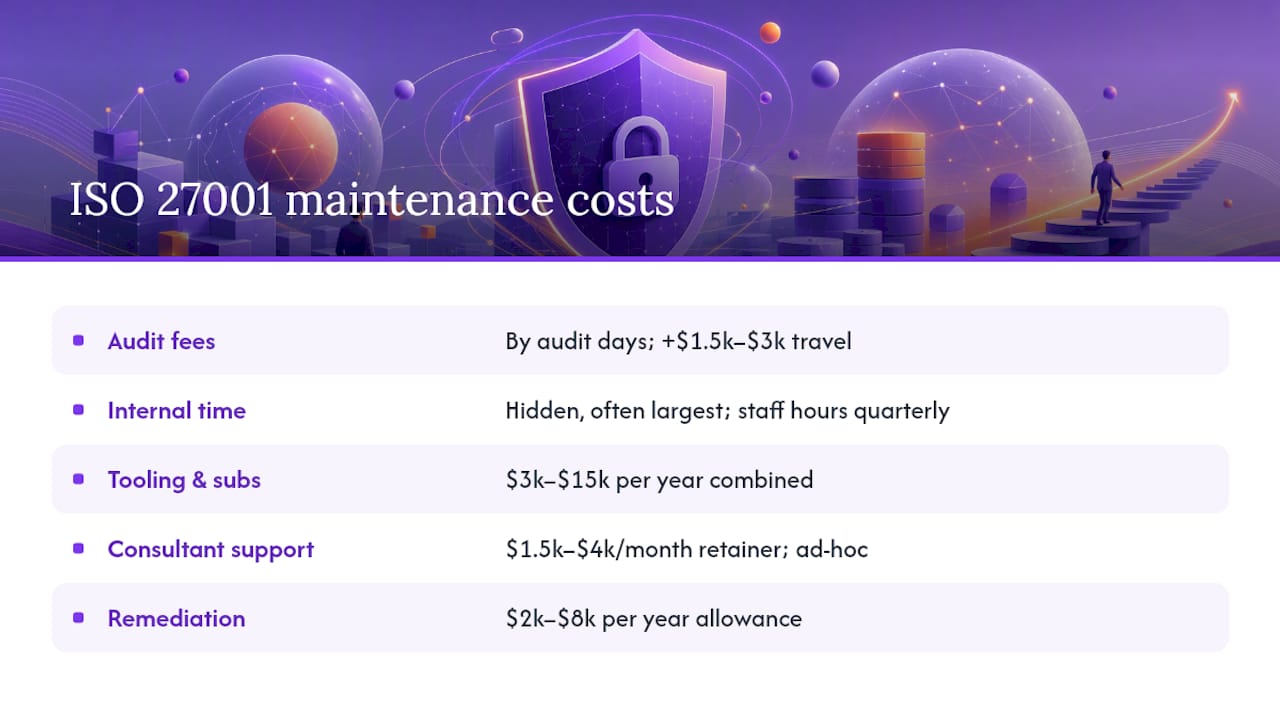
Audit fees are the most predictable cost because certification bodies price them using audit days, a fixed unit of auditor time set under ISO/IEC 27006. The formula is audit days multiplied by a day rate, plus travel and expenses if the auditor comes onsite. A remote surveillance audit for a 40-person software company might run two days. The same audit with an onsite visit, hotel, and flights can add $1,500 to $3,000 in incidental costs alone. Ask your certification body to split the quote into base audit fee versus travel so you can compare bids apples to apples.
Internal staff time is the cost nobody puts a number on until it’s too late. Internal time is consistently the largest hidden line item in ISO 27001 maintenance, because someone has to run internal audits, update risk registers, chase corrective actions, and prep evidence before every external visit. That role typically pulls in help from IT, HR, and legal for a few hours each per quarter, and those borrowed hours belong in the budget too, even if no invoice ever shows up for them.
Tooling and platform subscriptions add a steady annual line. GRC platforms, vulnerability scanners, security awareness training licenses, and log management tools commonly run $3,000 to $15,000 a year combined, depending on headcount and how much you automate versus track in spreadsheets. Automation here has a real payoff: GRC tooling can cut the number of consultant days needed for audit prep, though the software itself still needs its own line in the budget.
Consultant support splits into two models. A retainer arrangement, often $1,500 to $4,000 a month, makes sense for organizations without a mature internal compliance function. Ad-hoc support, billed hourly or per engagement, fits organizations that only need a specialist for tricky risk assessments or before recertification. Most mid-market companies land somewhere in between: light retainer coverage plus a burst of consultant hours before each surveillance audit.
Remediation and technical refresh costs cover patching gaps the audit turns up, renewing expiring certificates or licenses, and updating controls as infrastructure changes. Budget a modest annual allowance, often $2,000 to $8,000, for the fixes that inevitably surface.
A quick way to size the tooling and remediation piece: weigh it against what a breach would cost you. Breach costs vary sharply by region and sector, and that gap is exactly why boards approve ongoing security spend instead of treating certification as a one-time expense.
Pro Tip: *Track internal ISMS hours in a shared spreadsheet for one full quarter before you build next year’s budget.
Surveillance Vs. Recertification: What Changes Each Year?
Initial certification runs through two stages: Stage 1 reviews your documentation, and Stage 2 tests whether your controls actually work in practice. Once you pass Stage 2 and get certified, the clock starts on a three-year cycle with a different audit rhythm each year.
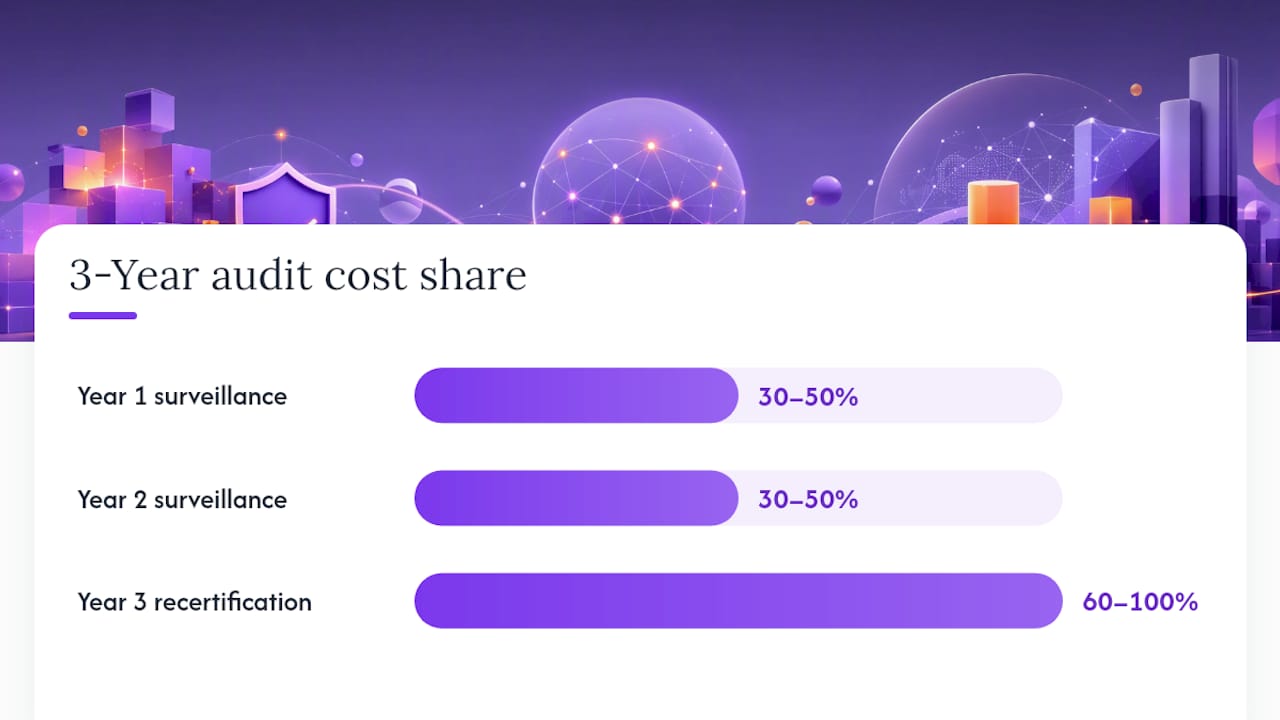
- Year 1 surveillance audit. This is a narrower check, typically covering a sample of controls rather than the full ISMS. It usually runs 30% to 50% of the auditor-days used in your Stage 2 audit, and costs commonly fall between $5,000 and $12,000 depending on organization size and audit location.
- Year 2 surveillance audit. Similar scope and similar cost to year one, though auditors often dig into whichever controls showed weaknesses previously. Expect the same $5,000 to $12,000 range unless your scope has grown.
- Year 3 recertification audit. This is a full re-examination of the ISMS, closer in depth to the original Stage 2 audit. Cost typically runs 60% to 100% of your initial Stage 2 fee, since the auditor is verifying the entire system again rather than sampling it.
Add all three years together and the audit-fee total for the cycle often lands at 1.7 to 2.2 times your original Stage 2 cost. An organization that paid $10,000 for Stage 2 might reasonably expect $17,000 to $22,000 in combined surveillance and recertification fees over the following three years, before tooling or internal time enter the picture.
Location and audit format shift these numbers meaningfully. A company that qualifies for fully remote audits, common for cloud-only SaaS businesses with no physical office to inspect, can shave 15% to 25% off audit costs by cutting travel days entirely. A manufacturer with three physical sites will sit at the high end of every range, since auditors bill for time at each location.
Pro Tip: When you get your Stage 2 quote, ask the certification body to also quote years 1 through 3 in writing. A low first-year number that hides an expensive recertification is one of the most common ways companies get surprised by their real three-year cost.
How Much Does ISO 27001 Maintenance Cost by Company Size?
Budget guidance splits cleanly into three bands, and each one includes different assumptions about scope and staffing.
- Small organizations (10 to 50 employees): annual maintenance typically runs $8,000 to $18,000, covering one part-time compliance owner, a lean GRC tool or spreadsheet-based tracking, and remote-first surveillance audits.
- Mid-market organizations (50 to 250 employees): annual maintenance typically runs $18,000 to $40,000, reflecting a near full-time compliance role, a paid GRC platform, occasional consultant hours, and audits that mix remote and onsite work.
- Larger organizations (250+ employees): annual maintenance often exceeds $40,000, sometimes reaching $80,000 or more, driven by multi-site audits, dedicated compliance staff, layered security tooling, and broader scope across business units.
Four variables push a given organization toward the top or bottom of its band. Scope breadth matters most: certifying one product line costs far less to maintain than certifying an entire company across every department. Multiple physical sites multiply audit days directly, since ISO/IEC 27006 requires sampling across locations. A large cloud footprint with dozens of SaaS integrations adds vendor risk assessments and access reviews that a simpler, single-platform environment doesn’t need. Regulatory overlays, like combining ISO 27001 with SOC 2 or HIPAA, add audit preparation time even when the underlying controls overlap.
A mid-market company sitting in the middle of its band might see a three-year total that looks like this in narrative terms: $28,000 in year one (surveillance audit, tooling renewal, and roughly 0.15 FTE of internal time), $27,000 in year two (similar structure, minor tooling price increases), and $38,000 in year three (recertification audit plus the same internal time and tooling baseline). That’s a three-year total near $93,000, or an annualized figure close to $31,000, a number that fits comfortably inside published mid-market benchmarks and gives finance a defensible line to plan against.
How Do You Build an ISO 27001 Maintenance Budget?
The math is simpler than most compliance teams expect once you separate hard costs from labor.
- Add up your three-year total cost of ownership. Sum audit fees across all three years, tooling subscriptions across all three years, consultant spend, and remediation allowances. Divide by three to get your annualized maintenance figure, the number that actually belongs in a yearly operating budget.
- Convert internal hours into dollars. Take your compliance owner’s blended salary (base pay plus benefits, divided by annual working hours), multiply by the percent-FTE estimate for your organization size, and add contributions from IT, legal, and HR staff who pitch in during audit prep.
- Demand transparent quotes from certification bodies. Ask for the exact audit-day count, not just a lump-sum fee, along with the stage split, whether the audit is remote or onsite, and a written estimate covering all three years, not just year one.
- Cut costs without cutting corners. Keep your certification scope tight rather than certifying departments that don’t need it, push for remote audits where your certification body allows them, stagger remediation work instead of fixing everything at once, and train internal staff to handle routine evidence-gathering so you’re not paying a consultant for tasks your own team can learn.
Pro Tip: Build your budget request around the three-year total, not the year-one number. Finance teams approve multi-year commitments more easily when they see the full cycle cost upfront instead of getting hit with a recertification surprise in year three.
How Do Certification Bodies Set Audit Fees?
Audit days are the unit everything else gets built from, and they’re driven by three factors: the number of people whose work falls inside your ISMS scope, the number of physical sites you operate, and how complex your environment is (multiple business units, extensive third-party integrations, regulated data types).
When you’re comparing quotes, ask each certification body the same set of questions:
- How many audit days are you allocating to Stage 1, Stage 2, and each surveillance year?
- Is the audit remote, onsite, or a mix, and how does that affect the day count?
- What are the estimated travel and expense costs, itemized separately from the audit fee?
- Can you provide a written accreditation statement confirming you’re accredited for ISO 27001 in our sector?
- Can you quote the full three-year cycle, not just the initial certification?
Watch for a few red flags. A quote that only covers Stage 1 and Stage 2 without mentioning surveillance pricing is incomplete by design. A day rate that’s dramatically lower than competitors often means fewer audit days than your scope actually needs, which risks a weak audit that a later recertification catches the hard way. And a certification body that won’t put its audit-day count in writing is one you should be cautious about hiring.
ISO/IEC 27006 exists precisely so audit-day counts aren’t arbitrary. Certification bodies that resist sharing their day calculation usually aren’t following it closely, and that’s leverage you can use to push for a clearer quote or walk toward a competitor that will provide one.
Turning These Ranges Into Your Own Number
Benchmark ranges are a starting point, not your actual budget. The gap between a 30-person startup and a 200-person company with three offices is too wide for one number to serve both. Running your specifics through the ISO 27001 Cost Calculator turns the ranges above into a figure tied to your organization.
The inputs that matter most are headcount, certification scope, current security maturity, whether your infrastructure is cloud-based or on-premises, and how many physical sites fall inside the audit boundary. Feed those in and the output breaks into a three-year TCO, an annualized maintenance line you can hand straight to finance, and a per-category split across audit fees, tooling, and internal staff time.
Every assumption behind the estimate is documented and exportable, so you can attach a PDF to a procurement request or board presentation without reconstructing the math yourself. If you’re not ready for a full estimate, the free 2-minute check gives a quick directional number before you invest time in a detailed model.
What Compliance Officers Get Wrong About Maintenance Budgets
The most common mistake is treating certification as a one-time project instead of a recurring operating cost. Teams budget carefully for the initial audit, then get blindsided when internal FTE time and tooling renewals show up in year two with no line item waiting for them.
A board-ready budget needs four things: a three-year TCO figure, not just next year’s number; a lean-scope and full-scope scenario side by side; written confirmation from your certification body on audit days for every year of the cycle; and documented assumptions behind every estimate, so finance can question them instead of taking them on faith. Retain a consultant on an ongoing basis only if your internal team lacks bandwidth for routine audit prep; for most mature ISMS programs, ad-hoc support before recertification is enough.
— Martin
Get a Maintenance Budget Built Around Your Organization
Generic benchmark ranges tell you what similar companies pay. They don’t tell you what you’ll pay, and that gap is exactly where budget requests get rejected by finance. Ismscalculator closes it with a calculator that takes your actual headcount, scope, and maturity level and turns them into a specific three-year maintenance estimate instead of a range you have to defend by hand.
Start with the free 2-minute check if you want a fast directional number, or go straight to the full calculator for a detailed breakdown across audit fees, tooling, and internal staff time. Every assumption behind the output can be documented and exported as a PDF, so the number you bring to procurement or the board is backed by a methodology that can be checked, not a guess dressed up as a figure. If you want to see exactly how the model works before you rely on it, the methodology page walks through every input and calculation. Run your numbers, then compare the output against any quote a certification body sends you.
Sources
- Certification — International Organization for Standardization (ISO)
- Iso27001cost
- ISO 27001 Certification Cost 2026 — What Do Mid-Market Companies Really Pay? | Reepa Solutions
- How Much Does ISO 27001 Cost in 2026? Full Breakdown | SecureSlate
FAQ
How Much Does ISO 27001 Cost?
Initial certification for a small to mid-sized organization typically runs $10,000 to $50,000 or more, depending on scope, headcount, and current security maturity.
Is ISO 27001 Hard to Get?
Certification is achievable for most organizations, but it demands sustained internal effort across risk assessment, documentation, and control implementation rather than a quick checklist. The harder part for many compliance officers isn’t passing the audit itself, it’s maintaining the internal discipline (regular internal audits, updated risk registers, staff training) that keeps the ISMS audit-ready year after year.
How Much Does the ISO 27001 Exam Cost?
There’s no single “exam” fee for ISO 27001 certification itself. The cost structure is built around certification body audit fees, calculated as audit days multiplied by a day rate, covering Stage 1, Stage 2, and the ongoing surveillance and recertification audits across the three-year cycle.
How Much Does ISO 22000 Cost?
ISO 22000 is a separate food safety management standard with its own certification process, and its costs aren’t covered by the ISO 27001 pricing data in this guide. Organizations pursuing food safety certification should request audit-day based quotes from certification bodies accredited for that specific standard.