
ISO 27001 certification is an accredited third-party confirmation that your organization’s Information Security Management System (ISMS) conforms to ISO/IEC 27001:2022, the current authoritative standard for information security management. If customers, contracts, or insurers are asking for proof of security, the path starts with scoping your ISMS and running a readiness check to set a realistic budget and timeline before you commit resources.
Here is what that means in practice:
- Certification ≠ self-declaration. An accredited certification body audits your ISMS and issues the certificate. ISO publishes the standard; ISO does not issue certificates.
- Three-year cycle. Initial certification is followed by annual surveillance audits in Years 1 and 2, then full recertification in Year 3.
- Commercial trigger. Most U.S. organizations pursue certification because a customer, insurer, or contract requires it, not because a law mandates it.
- First step. Define your ISMS scope and run a gap analysis or readiness assessment before engaging a certification body.
Table of Contents
- What ISO/IEC 27001 certification actually means
- Why organizations pursue ISO 27001 certification
- Is ISO 27001 certification mandatory in the United States?
- What the standard actually requires: clauses, Annex A, and the SoA
- How the certification process works, step by step
- What certification costs and how long it takes
- How to choose an accredited certification body
- Common pitfalls that delay certification
- A compact pre-audit checklist for Stage 1 and Stage 2
- Key Takeaways
What ISO/IEC 27001 certification actually means
ISO/IEC 27001:2022 is the standard. Certification is what happens when an independent, accredited body audits your ISMS against that standard and finds it conformant. The distinction matters because many organizations say they are “ISO 27001 compliant” when they mean they follow the standard internally. Compliance and certification are not the same thing to an enterprise procurement team.
The standard itself is published by the International Organization for Standardization (ISO) and the International Electrotechnical Commission (IEC). It defines what an ISMS must include, from risk assessment through management review, but it does not tell you which certification body to use or how long the process takes. That is governed by a separate framework: ISO/IEC 17021 and ISO/IEC 27006, which set the rules certification bodies must follow, including mandatory audit day formulas based on employee count.
One point that trips up U.S. teams: ISO 27001 and SOC 2 are not interchangeable. ISO 27001 certifies a management system; SOC 2 attests to operating effectiveness over a defined period. Many organizations selling to multiple buyer types end up pursuing both, often in a phased approach. A maturity assessment helps you decide whether to run them simultaneously or sequence them.
Why organizations pursue ISO 27001 certification
The business case for certification is almost always procurement-driven. Enterprise buyers, particularly in finance, healthcare, and government contracting, increasingly treat ISO 27001 certification as a baseline vendor requirement rather than a differentiator.
- SaaS companies selling to enterprise. Fortune 500 procurement teams routinely require ISO 27001 as a condition of vendor onboarding. Without it, deals stall in security review.
- Managed service providers (MSPs). You hold administrative access to client environments. Certification signals that your own security posture has been independently verified.
- Fintech and healthtech vendors. These sectors often use ISO 27001 as a baseline before layering on SOC 2 or HIPAA-specific controls. Regulators and insurers notice.
- Government contractors. Federal and state procurement programs increasingly reference ISO 27001 in vendor risk frameworks, even when it is not formally mandated.
Beyond procurement, the operational benefits are real. A properly implemented ISMS forces structured risk assessment, defined incident response procedures, and documented supplier oversight. Teams that go through certification typically find that their internal audit function, which is mandatory under Clause 9.2, surfaces control gaps they did not know existed. That is the point. The audit is not the goal; the operating ISMS is.
Is ISO 27001 certification mandatory in the United States?
No U.S. federal law mandates ISO 27001 certification. The standard is voluntary under U.S. law. That said, “voluntary” does not mean optional in practice.
The commercial reality is that customers, insurers, and contracts create de facto requirements. A SaaS company that loses a $2M enterprise deal because it cannot produce an ISO 27001 certificate has experienced a mandatory requirement, even if no statute required it. Common scenarios where certification becomes effectively required include:
- Enterprise procurement questionnaires that list ISO 27001 as a pass/fail criterion
- Cyber insurance underwriting, where carriers offer lower premiums or require certification for higher coverage limits
- Regulated-sector vendor risk programs in banking, healthcare, and critical infrastructure
- Government and defense supply chains, where security frameworks increasingly reference ISO 27001
Before budgeting for certification, review your actual contract language and any vendor risk questionnaires from your top five customers. That review will tell you whether certification is a near-term commercial requirement or a medium-term strategic investment.
What the standard actually requires: clauses, Annex A, and the SoA
ISO/IEC 27001:2022 is structured around ten clauses (Clauses 4–10 are the mandatory requirements) and Annex A, which lists 93 controls organized into four themes: Organizational (37), People (8), Physical (14), and Technological (34). The 2022 revision consolidated the previous 114 controls from 14 domains into this cleaner structure.

The Statement of Applicability (SoA) is the document auditors treat as central. It declares which of the 93 controls apply to your organization, which are excluded, and the justification for each decision. An incomplete or internally inconsistent SoA is one of the fastest ways to fail a Stage 1 review.
The mandatory documentation set includes:
- ISMS scope statement
- Information security policy
- Risk assessment methodology and results
- Risk treatment plan
- Statement of Applicability
- Internal audit reports (Clause 9.2)
- Management review minutes (Clause 9.3)
- Documented roles and responsibilities
Annex A controls do not all need to be implemented. You implement the ones your risk assessment identifies as applicable and document exclusions in the SoA. For a typical SaaS company, that means roughly 80–90% of the 93 controls will apply. Physical controls for unmanned data centers you do not operate are a common legitimate exclusion.
Pro Tip: Assign a named owner and a target date to every risk treatment action in your plan. Auditors will ask who is responsible for each control. “The security team” is not an acceptable answer.
How the certification process works, step by step
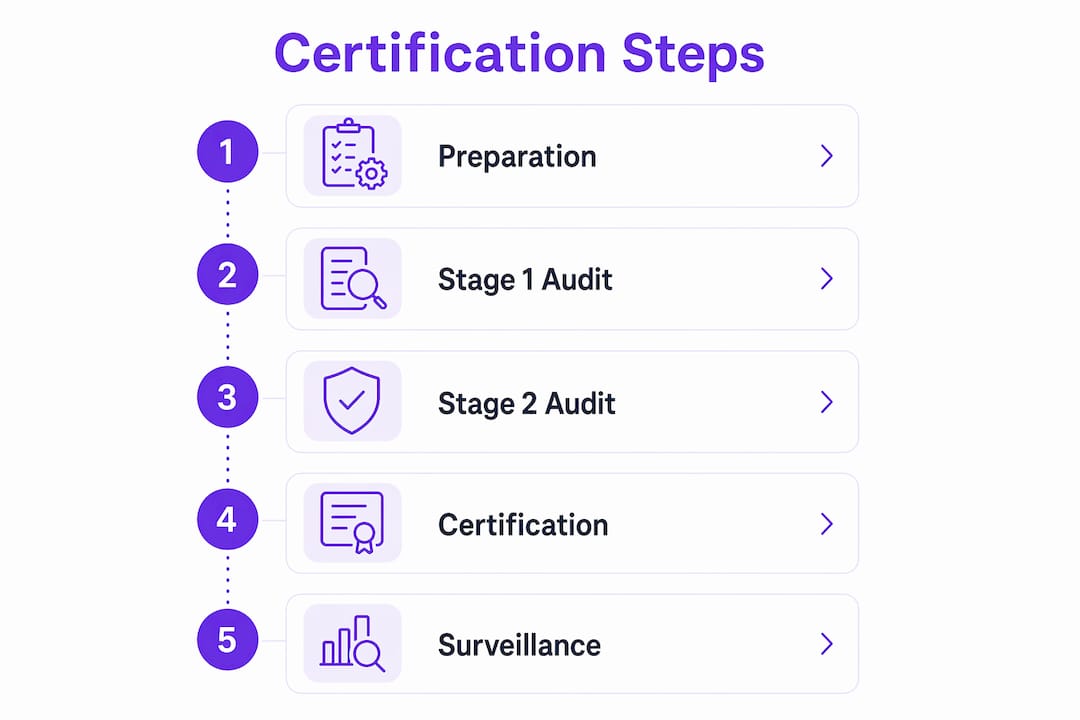
The path from decision to certificate follows a defined sequence. Skipping steps does not save time; it creates nonconformities that cost more time to fix than the step would have taken.
- Define ISMS scope. Decide which parts of the organization, which systems, and which locations fall inside the ISMS boundary. Scope creep is the most common cause of budget overruns. Tight, defensible scope beats ambitious scope every time.
- Appoint an ISMS lead. Someone needs to own the project. This person coordinates risk assessment, documentation, and internal audit. For smaller organizations, this is often the IT manager or CISO; for larger ones, a dedicated compliance role.
- Run a gap analysis or readiness assessment. Map your current controls against ISO/IEC 27001:2022 requirements. This tells you what you have, what you are missing, and how much work lies ahead.
- Implement controls and build documentation. Complete the risk assessment, write the SoA, develop policies and procedures, and collect evidence that controls are operating. This phase takes the longest.
- Conduct an internal audit (Clause 9.2). Mandatory before Stage 1. The internal audit must be structured, documented, and linked to corrective actions. Auditors will specifically review internal audit reports during Stage 1; missing or substandard records commonly block progression to Stage 2.
- Hold a management review (Clause 9.3). Senior leadership must formally review ISMS performance, audit findings, and risk treatment status. Minutes must be documented.
- Stage 1 audit (documentation review). The certification body reviews your ISMS documentation. Stage 1 typically runs 1–2 days, often remotely. The auditor checks whether your design is sound: Is the scope defined? Does the SoA exist and make sense? Are mandatory documents present?
- Remediate Stage 1 findings. Fix any nonconformities before Stage 2. A major nonconformity at Stage 1 means Stage 2 cannot proceed until it is resolved.
- Stage 2 audit (implementation and effectiveness). The auditor verifies that controls are actually operating as documented. This is longer than Stage 1 and typically conducted on-site or via remote session with screen sharing and live evidence review. A single major nonconformity blocks certification until resolved.
- Certification decision. The certification body’s review panel issues the certificate if no unresolved major nonconformities remain. Minor nonconformities require a corrective action plan but do not block issuance.
- Annual surveillance audits (Years 1 and 2). Smaller audits that verify the ISMS continues to operate. Surveillance audits cover a subset of controls and check that corrective actions from the initial audit have been closed.
- Recertification (Year 3). A full audit cycle repeats. Certificates follow a three-year cycle: initial certification, two surveillance audits, then recertification.
What certification costs and how long it takes
Cost and timeline vary significantly by organization size, ISMS maturity, and scope breadth. The figures below are ballpark ranges; your actual numbers depend on employee count, number of sites, and whether you use external consultants.
| Cost or Timeline Item | Typical Range | Key Variables |
|---|---|---|
| Initial certification audits typically range from $8,000 to $30,000+; surveillance audits commonly fall in the $6,000–$8,000 range. | Employee count, sites, scope | |
| External consultant (optional) | Varies widely | Engagement model, duration |
| Internal resource time | Significant | Team size, maturity baseline |
| Implementation to certificate duration varies significantly based on maturity at start and scope size | Maturity at start, scope size | |
| Stage 1 audit duration usually lasts one to two days, often conducted remotely | Often remote | |
| Stage 2 audit duration | Scales with headcount | Per ISO/IEC 17021 formulas |
Audit duration is not negotiable. Certification bodies follow ISO/IEC 17021-derived formulas that mandate audit durations based on employee count and risk. Example guidance from audit time tables: organizations with 1–25 employees typically require 5–7 audit days; 26–45 employees, 8–9 days; 126–175 employees, 12–13 days. Failing to account for mandatory audit days produces unrealistic timelines and scheduling conflicts with your chosen certification body.
Budget for the full three-year cycle from day one. Surveillance audits are not optional, and organizations that treat certification as a one-time project often get surprised by Year 2 costs. Common ISO 27001 budgeting mistakes include underestimating internal staff time and ignoring the cost of corrective actions triggered by Stage 1 findings.
How to choose an accredited certification body
Accreditation is what separates a certificate that enterprise procurement teams accept from one they reject. An accredited certification body has been independently assessed against ISO/IEC 17021 and ISO/IEC 27006 by a national accreditation body. In the United States, that body is ANAB (ANSI National Accreditation Board). As of January 2026, the International Accreditation Forum (IAF) merged into Global ACI, which now maintains the accreditation and certificate database. When verifying a certification body’s accreditation, check the Global ACI database or ANAB’s directory directly.

Well-known certification bodies operating in the U.S. market include BSI (British Standards Institution), DNV, and A-LIGN, among others. Each has different strengths in terms of sector experience, audit team depth, and remote audit capability. None of them is automatically the right choice for your organization.
Questions to ask any prospective certification body before signing:
- Is your ISO/IEC 27001 accreditation current, and can you provide the accreditation certificate number?
- How do you calculate audit days, and what is the estimate for our employee count and scope?
- What is your policy on remote versus on-site audits for Stage 2?
- What is your lead auditor’s experience in our sector?
- How do you handle conflicts of interest if you have previously provided consulting to us?
- What is your typical turnaround from Stage 2 completion to certificate issuance?
Pro Tip: Request a sample audit report from the certification body before you sign. The quality of their findings documentation tells you a great deal about how useful the audit will be as an improvement tool, not just a compliance exercise.
Common pitfalls that delay certification
Most certification delays are predictable. The same mistakes appear repeatedly across organizations of every size.
- Under-scoping and then expanding. Defining scope too narrowly to save time, then discovering mid-implementation that key systems or teams must be included. Scope changes after implementation begins are expensive.
- Incomplete or inconsistent SoA. Controls listed as applicable in the SoA with no corresponding evidence, or controls excluded without documented justification. Auditors flag this immediately.
- Weak internal audit records. The internal audit must be structured and documented, with findings tracked through to corrective action closure. A one-page “we checked everything and it’s fine” document will not pass Stage 1.
- Treating management review as a formality. Management review minutes must show that leadership actually reviewed ISMS performance data, risk treatment status, and audit findings. Generic minutes copied from a template are a red flag.
- Poor evidence sampling. Knowing a control exists is not enough. Auditors sample evidence that the control operates consistently. Access control logs, training completion records, and supplier review documentation need to be retrievable on demand.
- Unrealistic timelines. Organizations that compress implementation to six weeks typically arrive at Stage 1 with documentation gaps and no internal audit. The audit body then cannot proceed to Stage 2.
Pro Tip: Run a formal mock Stage 1 review four to six weeks before your scheduled audit date. Have someone unfamiliar with your ISMS try to find the mandatory documents using only your document management system. If they cannot find the SoA in under two minutes, your auditor will have the same problem.
A compact pre-audit checklist for Stage 1 and Stage 2
Use this checklist in the final weeks before your external audit. It is not exhaustive; treat it as a minimum bar, not a ceiling. A full ISO 27001 certification checklist covers the complete 80-step implementation sequence.
Stage 1 essentials (documentation review):
- ISMS scope statement, signed and version-controlled
- Information security policy, approved by senior management
- Statement of Applicability, with all 93 controls addressed and exclusions justified
- Risk assessment results, documented with methodology explained
- Risk treatment plan, with named owners and target dates
- Internal audit report (Clause 9.2), with findings and corrective action status
- Management review minutes (Clause 9.3), showing leadership engagement
Stage 2 evidence examples (implementation verification):
- Access control logs showing least-privilege enforcement
- Incident records (even if no incidents occurred, document the process and any near-misses)
- Training completion records for all in-scope staff
- Supplier security review documentation (annual reviews of key vendors)
- Vulnerability scan or penetration test results with remediation tracking
- Change management records for in-scope systems
- Evidence mapped to SoA control references, organized so the auditor can follow the thread
Present evidence in a shared folder or document management system organized by Annex A theme. Auditors working remotely will request specific evidence during the session; if you are hunting through email threads to find a supplier review record, you are losing time and credibility simultaneously.
Internal audit records are the single most common Stage 1 failure point. Auditors will specifically review internal audit reports and management review evidence; missing or substandard records block progression to Stage 2 more often than any other gap.
How Ismscalculator helps you plan budget and timeline
Before you engage a certification body or hire a consultant, you need a realistic picture of what certification will cost and how long it will take for your specific organization. That is what Ismscalculator is built to answer.
The platform generates real-time cost and effort estimates tailored to your company size, industry, and current security maturity. It covers the full implementation picture: audit fees, internal resource time, consultant costs, and the ongoing surveillance cycle. A maturity assessment across all four ISO/IEC 27001:2022 control themes shows you where your ISMS is strong and where it needs work before you spend money on controls you may not need.
The toolkit includes customizable Gantt timelines for implementation phases, model reference comparisons to validate your estimates against that reference, and the ability to save and compare multiple scenarios, such as in-house implementation versus consultant-assisted. The free 2-minute readiness check gives you an immediate baseline before you commit to anything.
Key Takeaways
ISO 27001 certification requires documented, operating evidence of a conformant ISMS, a three-year audit cycle, and an accredited certification body, not just a policy document.
| Point | Details |
|---|---|
| Certification vs. compliance | ISO issues the standard; accredited third-party bodies issue certificates after Stage 1 and Stage 2 audits. |
| Three-year cycle | Budget for initial certification, two annual surveillance audits, and full recertification in Year 3. |
| SoA and internal audit | The Statement of Applicability and internal audit records are the two documents auditors scrutinize most at Stage 1. |
| Cost range | Initial certification audits typically range from $8,000 to $30,000+; surveillance audits commonly fall in the $6,000–$8,000 range. |
| Ismscalculator | Run the free 2-minute readiness check to get a tailored cost and effort estimate before engaging a certification body. |
The part most guides skip
Most ISO 27001 guides spend their energy on the standard’s structure and not enough on the decision that actually determines whether certification succeeds: scope. Organizations that scope too broadly burn through budget implementing controls for systems that add no certification value. Organizations that scope too narrowly get a certificate that enterprise buyers immediately question because it excludes the systems that actually handle customer data.
The right scope is the one that covers what your customers care about, not the one that is easiest to certify. That sounds obvious, but the pressure to get a certificate quickly pushes teams toward the path of least resistance. A SaaS company that certifies only its development environment while excluding its production infrastructure has a certificate that will not survive a serious vendor questionnaire.
The second thing guides understate is the internal audit function. Most organizations treat Clause 9.2 as a paperwork requirement. The organizations that get the most value from certification treat internal audit as a genuine control-testing exercise, one that runs quarterly rather than once before Stage 1. By the time the external auditor arrives, they have a year of internal audit history showing that the ISMS actually operates. That evidence base is what separates a confident Stage 2 from a stressful one.
For U.S. organizations specifically: confirm ANAB accreditation for any certification body you shortlist. A certificate from an unaccredited body will not satisfy most enterprise procurement requirements, and you will not know that until a deal is already in jeopardy.
Ismscalculator gives you a clear budget before you commit
Certification costs catch organizations off guard because most guides give ranges without context. Ismscalculator closes that gap. Enter your company size, industry, and current maturity level, and the platform produces a tailored estimate covering audit fees, internal effort, consultant costs, and the full three-year surveillance cycle, with model reference comparisons so you can see how your numbers compare to similar organizations.
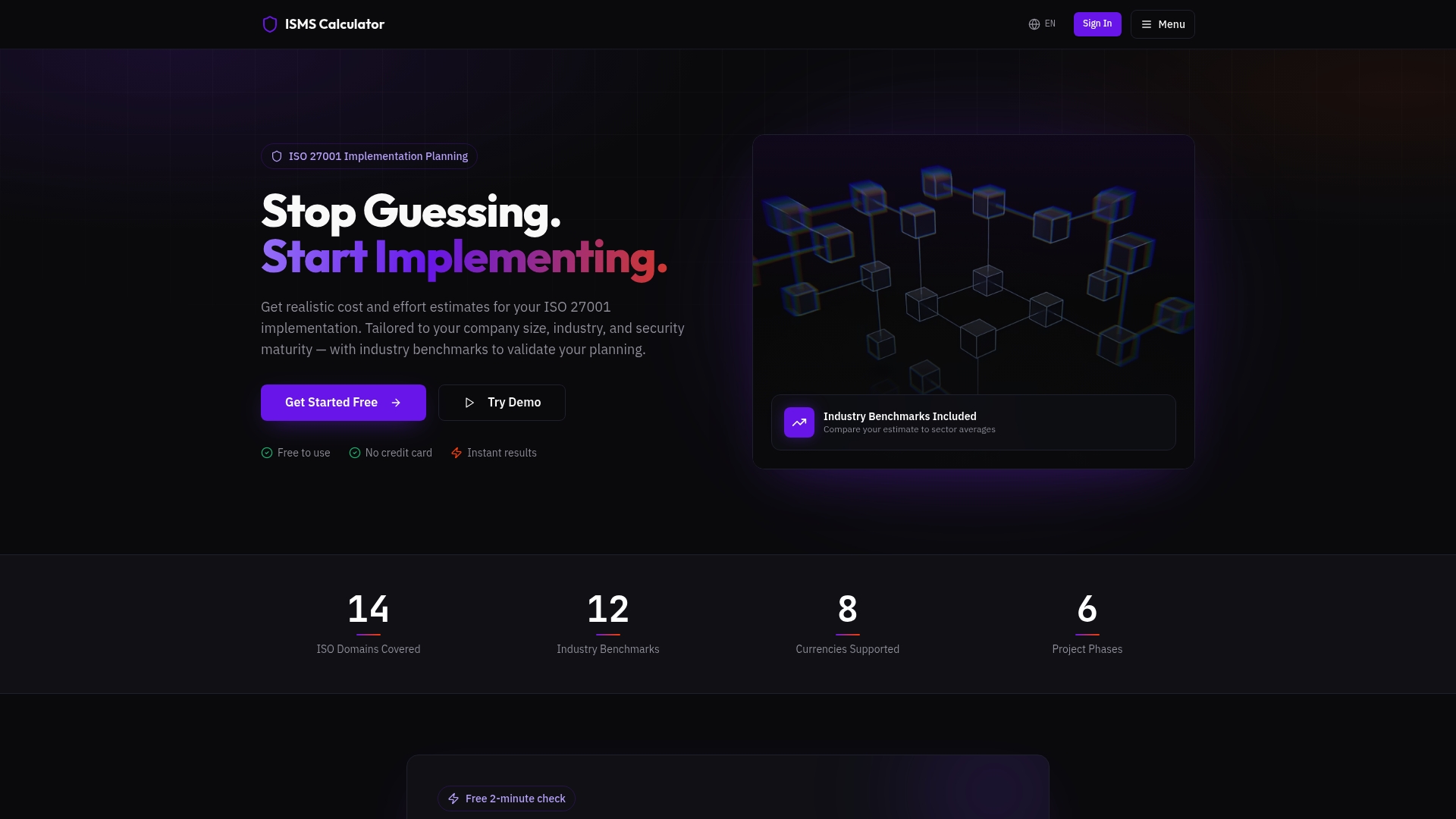
For teams in the early planning stage, the free 2-minute readiness check gives you an immediate baseline: where your ISMS stands today, what gaps need closing before Stage 1, and a rough cost and timeline estimate you can take to leadership. For teams further along, the full readiness assessment produces a detailed, domain-by-domain maturity profile with a prioritized action plan. Both are faster than a consultant call and give you numbers you can actually defend in a budget conversation.
Authoritative sources and references
The claims in this article draw from primary and high-authority sources. Here is where to go for verification and deeper reading.
- ISO/IEC 27001:2022 — The authoritative standard document. U.S. organizations should reference this page when confirming the current version of the standard (2022 replaced the 2013 edition) and when communicating certification scope to customers.
- ANAB (ANSI National Accreditation Board) — The primary U.S. accreditation body for ISO 27001 certification bodies. Use ANAB’s directory to verify that a certification body’s accreditation is current before signing an audit contract.
- Global ACI — As of January 2026, the database of accredited certification bodies and issued certificates is maintained by Global ACI (formerly IAF/ILAC). Search here to confirm a certificate’s validity.
- ISO/IEC 17021 and ISO/IEC 27006 — The standards that govern how certification bodies must conduct audits, including mandatory audit day formulas. Relevant when evaluating a certification body’s audit day estimate for your organization.
For ISO 27001 audit prep specific to finance companies, regulated-sector teams will find sector-specific evidence requirements and control mapping guidance worth reviewing before Stage 1.