
Data security controls for finance firms are the technical, procedural, and governance measures that protect sensitive financial information from unauthorized access, disclosure, and loss. Finance firms operate under some of the strictest regulatory requirements of any industry, including the Gramm-Leach-Bliley Act (GLBA), PCI DSS, and MiFID. Non-compliance carries real consequences: fines, criminal charges, and loss of payment processing rights. Effective financial data protection requires more than deploying encryption. It demands a layered approach that connects technical controls to governance, monitoring, and documented evidence of compliance.
What regulatory frameworks guide data security controls for finance firms?
Three frameworks set the baseline for financial institution security practices in the United States and the United Kingdom. Understanding each one tells you exactly what controls you must implement and document.
GLBA Safeguards Rule requires firms to designate a Qualified Individual to oversee the information security program, conduct written risk assessments, implement encryption and multi-factor authentication (MFA), and apply critical patches within 30 days. The updated rule also requires annual penetration testing for firms holding more than 5,000 customer records, plus biannual vulnerability assessments. That threshold catches most mid-sized financial firms, not just large banks.
PCI DSS governs the security of payment card data. Non-compliance can trigger monthly penalties from $5,000 to $100,000 and suspension of payment processing. That last consequence is existential for any firm that processes card transactions.
MiFID Org Reg applies to UK-regulated firms and requires five-year minimum record retention for business and internal organization records submitted to the PRA. This is a governance control, not just a technical one.
Beyond these three, NIST SP 800-53 Rev 5 provides 192 controls across 22 domains that map directly to GLBA, PCI DSS, and other financial regulations simultaneously. Using NIST SP 800-53 as a master control catalog lets your team satisfy multiple regulators with a single documented program rather than maintaining separate compliance tracks.
The GUARD Financial Data Act, currently moving through Congress, proposes data minimization and consumer rights including access and deletion requests. Finance firms that build data mapping and retention controls now will absorb this requirement with far less disruption than those who wait.
| Regulation | Core Requirement | Key Penalty |
|---|---|---|
| GLBA Safeguards Rule | Encryption, MFA, annual pen testing, Qualified Individual | Up to $100,000 per violation |
| PCI DSS | Card data security, access controls, logging | $5,000–$100,000 per month |
| MiFID Org Reg | 5-year record retention, governance documentation | Regulatory sanction |
| NIST SP 800-53 Rev 5 | 192 controls across 22 domains | Framework, not a law |
Which technical controls are essential to protect financial data?
Technical controls form the core of any financial data protection program. The following controls appear in every major regulatory framework and every serious audit checklist.
-
Encryption in transit and at rest. All customer data must be encrypted using current standards. Customer-managed encryption, where your firm controls the decryption keys, means vendors cannot access sensitive data even under a government disclosure order. This reduces fiduciary risk under overlapping privacy laws.
-
Multi-factor authentication and least privilege access. Every user account accessing systems with customer data must use MFA. Access rights must follow the least privilege principle: users get only the permissions their role requires, nothing more. Privileged accounts must be segregated from standard user accounts.
-
Unique user credentials. Each employee must have a unique login. Shared credentials are one of the most common audit failures flagged by regulators. They make it impossible to trace who accessed what data and when.
-
Audit logging with active review. Capture all security-relevant events and retain logs for at least two years. Collecting logs without reviewing them is not compliance. Regulators expect evidence that your team actively monitors logs for anomalies.
-
Vulnerability scanning and patch management. Run biannual vulnerability assessments and apply critical patches within 30 days. The 30-day patching window is a hard requirement under the updated GLBA Safeguards Rule, not a guideline.
-
Annual penetration testing. For firms above the 5,000-record threshold, annual pen tests are mandatory. Document the results, remediate findings, and retain the reports as compliance evidence.
-
Network segmentation and endpoint protection. Isolate systems that process customer data from general corporate networks. Endpoint protection must cover all devices that touch financial data, including remote and mobile devices.
Pro Tip: Before your next audit, search your systems for any shared service accounts used to access customer data. Replacing them with individual credentials is the single fastest way to close a common audit gap.
How to implement organizational processes that sustain compliance
Technical controls fail without governance behind them. The following organizational practices keep your security program functional between audits.
- Written Information Security Program (WISP). Document your entire security program in writing. The WISP must cover risk assessment methodology, control objectives, and roles. Regulators treat an undocumented program as a non-existent one.
- Designate a Qualified Individual. The GLBA Safeguards Rule requires a named person responsible for the information security program. This person must report to the board at least annually. Lack of a documented designation equals non-compliance.
- Security awareness training. Train every employee with access to customer data at least annually. Training records must be dated and retained. Regulators check training logs during examinations.
- Incident response planning. Write and test an incident response plan. The plan must define breach notification timelines, which vary by state law and federal regulation. Testing the plan annually through tabletop exercises is the standard expectation.
- Vendor and service provider oversight. Require security safeguards from every service provider by contract. Periodic monitoring of vendor compliance is a regulatory requirement, not optional due diligence. The convergence of GDPR, DORA, and banking secrecy laws makes vendor security a primary liability area for fintechs.
- Board reporting. Present the security program status to your board or senior leadership at least once per year. Document the meeting and retain the minutes.
Compliance fatigue is real. Finance teams managing GLBA, PCI DSS, and state privacy laws simultaneously face overlapping documentation demands. The solution is control mapping: align your controls to NIST SP 800-53 Rev 5 once, then demonstrate how each control satisfies multiple regulators. This cuts audit preparation time significantly.
Pro Tip: Create a compliance evidence calendar. Assign a due date to every required artifact: pen test reports, training logs, vendor review records, and board meeting minutes. Missing a date is the most common reason firms fail audits they were otherwise prepared for.
What tools and frameworks support data security control management?
Finance firms need technology that matches the scale and complexity of their compliance obligations. The right tools reduce manual effort and produce the documented evidence regulators require.
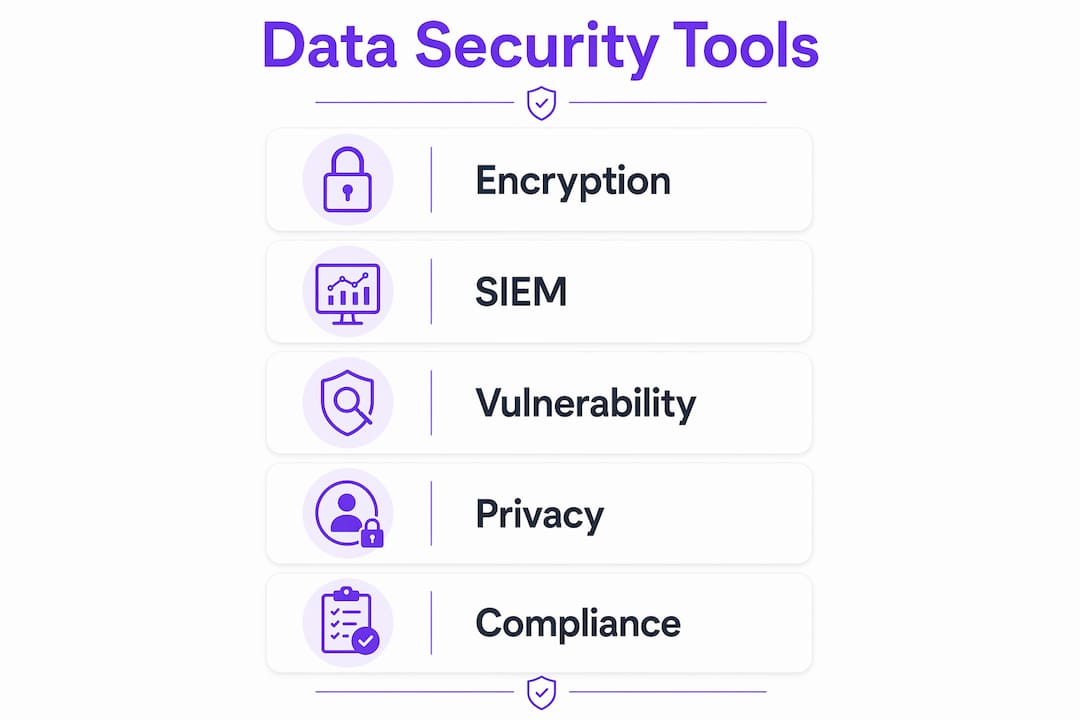
Security Information and Event Management (SIEM) platforms aggregate log data from across your environment and generate alerts when anomalies appear. A SIEM turns passive log collection into active monitoring, which is what regulators actually require. Without one, log review at scale becomes impractical.
ISO 27001 aligned frameworks provide a structured control set that maps well to GLBA, PCI DSS, and NIST SP 800-53. Firms that align ISO 27001 with NIST can satisfy multiple regulatory frameworks through a single documented program. ISO 27001 also provides a certification pathway that demonstrates security maturity to clients and regulators.

Automated vulnerability management tools schedule scans, track remediation, and produce reports that serve as compliance evidence. Manual tracking in spreadsheets fails at scale and creates documentation gaps that surface during audits.
Privacy infrastructure tools support data mapping, retention scheduling, and consumer rights workflows. The GUARD Financial Data Act’s proposed requirements make automated data mapping a near-term necessity rather than a future consideration.
The table below summarizes the main control categories, their purpose, and the type of tool that supports each one.
| Control Category | Purpose | Typical Tool Type |
|---|---|---|
| Encryption | Protect data in transit and at rest | Key management platforms |
| Access management | Enforce MFA and least privilege | Identity and access management (IAM) |
| Log monitoring | Detect anomalies and support audits | SIEM platforms |
| Vulnerability management | Identify and remediate weaknesses | Automated scanning tools |
| Privacy infrastructure | Data mapping, retention, consumer rights | Data governance platforms |
| Incident response | Coordinate breach response | Ticketing and workflow tools |
Ismscalculator supports finance firms navigating ISO 27001 adoption with maturity assessments across the four Annex A control themes, customizable Gantt charts for implementation phases, and real-time cost estimates based on company size and security maturity.
What are common mistakes in enforcing financial data security controls?
Most audit failures trace back to a short list of recurring mistakes. Knowing them in advance lets you fix them before a regulator finds them.
- Ignoring service provider compliance. Firms sign contracts with vendors and then never verify that those vendors maintain the required security controls. Regulators expect documented evidence of periodic vendor reviews, not just a signed contract.
- Skipping or undocumenting penetration tests. Some firms conduct pen tests but fail to retain the reports or document remediation. Dated, signed documentation for every control is what transforms a completed activity into compliance evidence.
- Treating log collection as log review. Collecting logs satisfies the letter of a requirement. Actively reviewing them for anomalies satisfies the intent. Regulators distinguish between the two during examinations.
- Accepting weak MFA implementations. SMS-based MFA is better than nothing, but regulators increasingly expect phishing-resistant MFA methods such as hardware tokens or passkeys for systems holding customer data.
- Undocumented incident response plans. A plan that exists only in someone’s head is not a plan. The plan must be written, tested, and updated after every significant incident or organizational change.
Pro Tip: Build continuous evidence collection into your daily operations. Every time you complete a required activity, log it with a date and the name of the responsible person. Audit readiness is not a sprint before an examination. It is a daily habit.
Overlapping regulatory demands create a temptation to treat each regulation as a separate project. Control mapping eliminates that problem. Map your existing controls to NIST SP 800-53 Rev 5 first, then identify which GLBA, PCI DSS, and state law requirements each control satisfies. You will find that most requirements overlap significantly, and a single well-documented control satisfies three or four regulatory obligations at once.
Key Takeaways
Finance firms that align technical controls with documented governance and active monitoring satisfy multiple regulatory frameworks simultaneously and reduce audit risk.
| Point | Details |
|---|---|
| Regulatory alignment | GLBA, PCI DSS, and MiFID each require specific controls; map all three to NIST SP 800-53 Rev 5 to reduce duplication. |
| Technical control essentials | Encryption, MFA, unique credentials, active log review, and 30-day patching are non-negotiable baseline requirements. |
| Documentation is compliance | Undated or unsigned records equal non-compliance; every control activity needs a dated, named evidence trail. |
| Vendor oversight matters | Contractual safeguards alone are insufficient; periodic monitoring of service provider security is a regulatory requirement. |
| Control mapping cuts fatigue | Mapping one framework to multiple regulations reduces audit burden and prevents duplicate compliance work. |
Why compliance culture beats compliance checklists
After working with finance firms across multiple regulatory cycles, the pattern is clear: firms that treat data security as a culture rather than a project sustain compliance far better than those that treat it as an annual audit exercise.
The technical controls are not the hard part. Encryption, MFA, and patching are well-understood. The hard part is maintaining the evidence trail, keeping vendor oversight current, and ensuring that log review actually happens every week rather than the week before an examination. I have seen firms with excellent technical infrastructure fail audits because a Qualified Individual was never formally designated in writing, or because pen test reports were completed but never filed.
The shift toward operational privacy infrastructure, driven by proposals like the GUARD Financial Data Act, makes this even more pressing. Data mapping and consumer rights workflows are not one-time projects. They require ongoing maintenance as your data flows change. Firms that build these processes into their operations now will absorb new regulatory requirements without crisis.
Customer-managed encryption is one control I think finance firms consistently undervalue. Controlling your own decryption keys removes a significant liability: your technology vendors cannot respond to government data disclosure orders on your behalf. That is a legal and operational advantage that goes well beyond basic compliance.
The firms that handle compliance best treat their ISO 27001 implementation as a living program, not a one-time deployment. They review controls quarterly, update documentation after every change, and train staff continuously. That approach costs less in the long run than emergency remediation before an audit.
— Martin
Assess your financial data security posture with Ismscalculator
Finance firms that want a clear picture of where their security program stands before an audit or regulatory examination need a structured starting point.
Ismscalculator provides an ISO 27001 readiness assessment built for organizations that need to map their current controls against a recognized framework and identify gaps before regulators do. The platform delivers tailored estimates based on your firm’s size, industry, and current security maturity, with benchmarks drawn from model reference values so you can see exactly where you stand. For firms that want immediate insight, the 2-minute readiness check provides a fast baseline. For those ready for deeper implementation support, Ismscalculator connects you with independent ISO 27001 consultants who specialize in financial sector compliance.
FAQ
What are the core data security controls required for finance firms?
Finance firms must implement encryption in transit and at rest, MFA, unique user credentials, active audit log review, vulnerability scanning, and annual penetration testing. These controls satisfy the baseline requirements of GLBA, PCI DSS, and most state-level financial privacy laws.
What penalties apply for non-compliance with GLBA or PCI DSS?
GLBA violations can result in fines up to $100,000 per violation and $10,000 per officer, plus criminal charges. PCI DSS non-compliance carries monthly penalties from $5,000 to $100,000 and can result in suspension of payment card processing rights.
How does NIST SP 800-53 Rev 5 help finance firms manage multiple regulations?
NIST SP 800-53 Rev 5 provides 192 controls across 22 domains that map to GLBA, PCI DSS, and other financial regulations simultaneously. Using it as a master control catalog lets firms satisfy multiple regulators through a single documented program.
What is a Qualified Individual under the GLBA Safeguards Rule?
A Qualified Individual is the named person responsible for overseeing a firm’s written information security program. The GLBA Safeguards Rule requires this designation to be documented and the individual to report to the board at least annually.
How should finance firms handle vendor security oversight?
Firms must require security safeguards from service providers by contract and conduct periodic monitoring to verify compliance. A signed contract alone does not satisfy the regulatory requirement for ongoing vendor oversight.