
Comment se comparent les principales normes américaines de sécurité des données financières
Les professionnels de la finance ont rarement affaire à une seule réglementation. La plupart des entreprises font face à un enchevêtrement de lois obligatoires, de référentiels volontaires et d'obligations imposées au niveau des États, qui se recoupent dans certains domaines et s'opposent dans d'autres. Le tableau ci-dessous simplifie cette complexité en mettant côte à côte les huit normes américaines de sécurité des données financières les plus déterminantes.
| Norme | Obligatoire ou volontaire | Autorité réglementaire | Périmètre | Sanctions | Risque tiers | Certification / Reporting |
|---|---|---|---|---|---|---|
| GLBA / FTC Safeguards Rule | Obligatoire | FTC, agences fédérales bancaires | Établissements financiers traitant des NPI consommateurs | Jusqu'à 100 000 $ par violation, poursuites pénales | Exigé par voie contractuelle | Rapport annuel au conseil d'administration |
| PCI DSS | Obligatoire (contractuel) | PCI Security Standards Council | Toute entité traitant des données de porteurs de cartes | Amendes, pénalités des réseaux de cartes, perte des droits de traitement | Conformité des prestataires exigée | Évaluation annuelle par un QSA ou SAQ |
| NIST Cybersecurity Framework | Volontaire | NIST (sans pouvoir de sanction) | Tous secteurs ; largement adopté dans la finance | Aucune directement | Pris en compte dans les niveaux du référentiel | Pas de certification formelle |
| SOX | Obligatoire | SEC, PCAOB | Sociétés cotées en bourse | Sanctions civiles et pénales | Indirect (indépendance des auditeurs) | Attestation annuelle sur le contrôle interne |
| ISO 27001 | Volontaire | Organismes de certification accrédités | Toute organisation dans le monde | Aucune réglementaire ; conséquences commerciales | Les contrôles de l'Annex A couvrent les prestataires | Audit de certification par un tiers |
| 23 NYCRR 500 | Obligatoire | NY Department of Financial Services | Entreprises financières agréées par l'État de New York | Sanctions pécuniaires civiles | Politique tiers explicite requise | Certification annuelle par un dirigeant senior |
| CSBS Nonbank Model Law | Volontaire (loi modèle) | Législatures des États (variable) | Prestataires de services financiers non bancaires | Variable selon l'État adoptant | Pris en compte dans les dispositions modèles | Variable selon l'adoption par l'État |
| SOC 2 | Volontaire | AICPA | Organisations de services | Aucune réglementaire ; pas d'amendes contrairement à la GLBA | Couvert dans les critères de services de confiance | Attestation par un auditeur tiers |
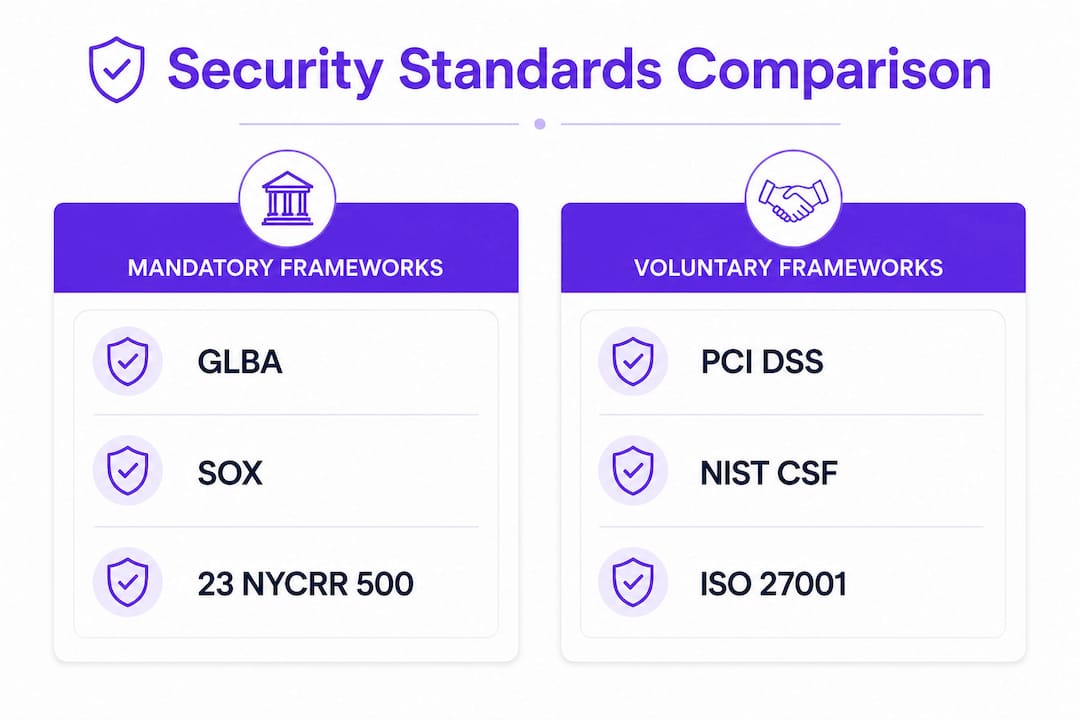
Quelques tendances se dégagent immédiatement. La GLBA et la 23 NYCRR 500 disposent des mécanismes de sanction les plus contraignants pour les entreprises financières. Le NIST et ISO 27001 offrent la guidance technique la plus approfondie, mais s'appuient sur la pression du marché plutôt que sur les régulateurs. PCI DSS occupe une position intermédiaire : techniquement contractuel, mais le pouvoir d'application des réseaux de cartes le rend effectivement obligatoire pour toute entreprise qui traite des paiements.
Caractéristiques clés en un coup d'œil :
- GLBA : Couvre les informations personnelles non publiques (NPI) ; exige un programme de sécurité de l'information écrit, des avis de confidentialité et la désignation d'un Qualified Individual rendant compte à la direction générale.
- PCI DSS : Douze exigences organisées autour de la protection des environnements de données de porteurs de cartes ; validation annuelle par un Qualified Security Assessor ou un questionnaire d'auto-évaluation.
- NIST CSF : Cinq fonctions (Identifier, Protéger, Détecter, Répondre, Récupérer) fournissant une structure fondée sur les risques ; largement utilisé comme référentiel de base pour le rapprochement avec d'autres réglementations.
- SOX : Axé sur l'intégrité du reporting financier et le contrôle interne ; la Section 404 exige une attestation de la direction et des auditeurs sur l'efficacité des contrôles.
- ISO 27001 : Norme de Système de Management de la Sécurité de l'Information (SMSI) ; exige une évaluation des risques, des plans de traitement et une amélioration continue sur la base de 93 contrôles de l'Annex A.
- 23 NYCRR 500 : Réglementation prescriptive de New York en matière de cybersécurité ; impose le chiffrement, l'authentification multifacteur (MFA), les tests de pénétration et le rapport annuel du RSSI.
- CSBS Nonbank Model Law : Loi modèle à l'intention des États ciblant les sociétés financières non bancaires ; reprend de nombreuses exigences de la GLBA Safeguards Rule avec une spécificité supplémentaire au niveau des États.
- SOC 2 : Référentiel d'attestation de l'AICPA couvrant cinq critères de services de confiance ; renforce la confiance sur le marché mais ne donne lieu à aucune amende réglementaire.
1. La GLBA et la FTC Safeguards Rule
Le Gramm-Leach-Bliley Act, promulgué en 1999, oblige les établissements financiers à expliquer leurs pratiques de partage d'informations et à protéger les données sensibles de leurs clients. Ses deux principales composantes opérationnelles sont la Privacy Rule et la Safeguards Rule. La Privacy Rule régit la divulgation des informations personnelles non publiques à des tiers et exige des avis de désinscription. La Safeguards Rule va plus loin en imposant un programme de sécurité de l'information écrit comprenant des contrôles administratifs, techniques et physiques.
La révision de la Safeguards Rule par la FTC, entrée pleinement en vigueur en 2023, a apporté une précision que l'original n'avait pas. Les entreprises concernées doivent désormais désigner un Qualified Individual disposant d'une autorité directe de reporting auprès du conseil d'administration ou des dirigeants seniors, réaliser des évaluations des risques annuelles, mettre en œuvre la MFA, chiffrer les données clients en transit et au repos, et élaborer un plan de réponse aux incidents écrit. L'exigence relative au Qualified Individual pose problème à de nombreuses entreprises. Attribuer un titre ne suffit pas ; le rôle exige une autorité démontrée et une ligne de reporting claire vers la direction.
La gestion du risque tiers est au cœur de la conformité à la GLBA. Les Interagency Guidelines exigent que les établissements financiers obligent contractuellement leurs prestataires à mettre en œuvre des mesures de sécurité appropriées. Les entreprises ne peuvent pas externaliser leur responsabilité en se contentant de faire appel à un prestataire ; elles doivent surveiller et faire respecter ces exigences contractuelles.
2. PCI DSS
Le Payment Card Industry Data Security Standard s'applique à toute organisation qui stocke, traite ou transmet des données de porteurs de cartes, quelle que soit sa taille. Le PCI Security Standards Council publie la norme, et les réseaux de cartes comme Visa et Mastercard l'appliquent via leurs accords commerçants. La version 4.0, publiée en 2022 et pleinement en vigueur depuis mars 2025, a introduit des options de mise en œuvre personnalisées permettant aux organisations de satisfaire à l'intention d'une exigence par des contrôles alternatifs, à condition d'en documenter le raisonnement.

PCI DSS organise ses exigences en douze catégories principales : sécurité réseau, protection des données de porteurs de cartes, gestion des vulnérabilités, contrôle d'accès, surveillance et politique de sécurité de l'information, entre autres. La réduction du périmètre est l'outil de conformité le plus puissant disponible dans le cadre de PCI DSS. En isolant les environnements de données de porteurs de cartes du reste du réseau par tokenisation ou chiffrement point à point, les entreprises peuvent réduire considérablement le nombre de systèmes soumis à évaluation.
La gestion des prestataires dans le cadre de PCI DSS est explicite. L'exigence 12.8 impose aux organisations de tenir à jour une liste de tous les prestataires tiers ayant accès aux données de porteurs de cartes, de confirmer annuellement leur statut de conformité PCI DSS et d'attribuer la responsabilité du suivi de ces relations. Une violation attribuable à un prestataire ne réduit pas la responsabilité de l'organisation principale.
3. Le NIST Cybersecurity Framework
Le NIST Cybersecurity Framework (CSF), initialement publié en 2014 et mis à jour en version 2.0 en 2024, est ce qui se rapproche le plus d'un langage universel de la cybersécurité aux États-Unis. Il est volontaire, mais les agences fédérales sont tenues de s'y conformer, et les régulateurs financiers y font régulièrement référence comme référence. Les cinq fonctions principales du référentiel — Identifier, Protéger, Détecter, Répondre, Récupérer — fournissent une structure qui s'articule clairement avec la plupart des exigences réglementaires.

Le NIST SP 800-53, le catalogue de contrôles associé, est un ensemble de contrôles de sécurité et de confidentialité axé sur les risques et orienté résultats, couvrant la confidentialité, l'intégrité et la disponibilité. Les entreprises financières qui fondent leur bibliothèque de contrôles sur le NIST 800-53 constatent généralement que satisfaire aux exigences de la GLBA, de la 23 NYCRR 500 et de la SOX devient une question de rapprochement plutôt que de reconstruction. C'est l'efficacité qui explique principalement que les équipes conformité privilégient le NIST comme référentiel de base.
L'absence de pouvoir de sanction est à la fois une force et une limite. Le NIST donne aux organisations la flexibilité d'adapter les contrôles à leur profil de risque réel plutôt que de simplement cocher des cases. L'inconvénient est que sans pression externe, les équipes sous-dotées en ressources peuvent négliger la profondeur de mise en œuvre.
4. La SOX (Sarbanes-Oxley Act)
La SOX a été adoptée en 2002 à la suite des scandales comptables d'Enron et de WorldCom. Son objectif principal est l'intégrité du reporting financier, et non la cybersécurité en tant que telle, mais la Section 404 a des implications significatives en matière de sécurité informatique. La direction doit évaluer et attester de l'efficacité des contrôles internes sur le reporting financier (ICFR), et l'auditeur externe doit évaluer indépendamment cette évaluation. Tout système informatique alimentant les données financières des rapports publics entre dans le périmètre.
Pour les équipes informatiques et de sécurité, la SOX se traduit par des contrôles sur la gestion des accès, la gestion des changements et la journalisation des audits pour les systèmes financiers. La séparation des tâches est un point d'audit récurrent : la personne qui initie une transaction ne doit pas être celle qui l'approuve ou qui rapproche les comptes. Les contrôles automatisés dans les systèmes ERP tels que SAP ou Oracle Financials sont fréquemment testés lors des audits SOX.
La SEC et le Public Company Accounting Oversight Board (PCAOB) supervisent la conformité à la SOX. Les sanctions pour inexactitudes significatives ou violations intentionnelles comprennent des amendes civiles et des poursuites pénales à l'encontre des dirigeants. La SOX ne réglemente pas directement les programmes de cybersécurité, mais une violation qui altère les données financières ou perturbe les systèmes de reporting peut donner lieu à des constats liés à la SOX.
5. ISO 27001
ISO 27001 est la norme internationale relative aux systèmes de management de la sécurité de l'information. Contrairement à la GLBA ou à la SOX, elle est entièrement volontaire aux États-Unis, mais la certification a un réel poids sur le marché, notamment pour les entreprises de technologie financière, les fournisseurs de services cloud et les organisations qui servent des clients réglementés. La révision de 2022 a restructuré les contrôles de l'Annex A, passant de 114 à 93, organisés en quatre thèmes : organisationnel, humain, physique et technologique.
La norme exige que les organisations définissent le périmètre de leur SMSI, réalisent une évaluation formelle des risques, sélectionnent et mettent en œuvre des contrôles proportionnés aux risques identifiés, et se soumettent à un audit de certification par un tiers. La certification n'est pas permanente ; des audits de surveillance ont lieu chaque année et un audit complet de recertification intervient tous les trois ans. Ce cycle continu impose un niveau d'amélioration continue que les évaluations ponctuelles n'offrent pas.
La FTC Safeguards Rule et ISO 27001 présentent des écarts significatifs lorsqu'elles sont rapprochées l'une de l'autre. La certification ISO 27001 ne satisfait pas automatiquement aux exigences spécifiques de la GLBA en matière d'avis de confidentialité, de notification des violations ou du rôle de Qualified Individual. Les entreprises qui poursuivent les deux ont besoin d'une analyse des écarts délibérée plutôt que de supposer que l'une couvre l'autre. Pour les entreprises fintech qui naviguent dans ce chevauchement, la feuille de route de conformité ISO 27001 pour les fintech d'Ismscalculator détaille précisément où ces écarts apparaissent et comment les combler.
6. La 23 NYCRR 500
Le Department of Financial Services (DFS) de New York a émis la 23 NYCRR 500 en 2017, ce qui en fait l'une des premières réglementations étatiques en matière de cybersécurité dotée d'un véritable pouvoir contraignant. Le deuxième amendement, finalisé en novembre 2023, a considérablement élargi ses exigences. Toute entreprise agréée par le NY DFS — banques, compagnies d'assurance, gestionnaires de prêts hypothécaires, transmetteurs de fonds — doit s'y conformer.
La réglementation exige un programme de cybersécurité écrit fondé sur une évaluation périodique des risques, révisée et mise à jour au moins annuellement. Les entreprises de classe A (celles dont le chiffre d'affaires annuel brut dépasse 20 millions de dollars et qui comptent plus de 2 000 clients, ou dont les actifs dépassent 1 milliard de dollars) font face à des exigences supplémentaires, notamment des audits de cybersécurité indépendants. Toutes les entités couvertes doivent mettre en œuvre le chiffrement des informations non publiques, tant en transit qu'au repos, avec des contrôles compensatoires autorisés uniquement lorsque le chiffrement est réellement infaisable et approuvé par le RSSI.
La responsabilisation de la direction générale est une caractéristique déterminante de la 23 NYCRR 500. Un dirigeant senior ou l'organe de gouvernance doit approuver les politiques de cybersécurité au moins annuellement, et le RSSI doit rendre compte au conseil d'administration de l'état du programme de cybersécurité. La certification annuelle de conformité déposée auprès du DFS crée une responsabilité personnelle directe pour les dirigeants d'une manière que la plupart des référentiels fédéraux ne prévoient pas.
7. La CSBS Nonbank Model Data Security Law
La Conference of State Bank Supervisors (CSBS) a élaboré sa Nonbank Model Data Security Law pour donner aux États un modèle permettant de réglementer les sociétés financières non bancaires — sociétés de prêts hypothécaires, prestataires de services monétaires et prêteurs à la consommation — qui échappent à la supervision bancaire fédérale. La loi modèle s'inspire en grande partie de la GLBA Safeguards Rule, mais est conçue pour être adoptée et appliquée au niveau des États.
Les États qui adoptent la loi modèle exigent des entreprises non bancaires concernées qu'elles mettent en œuvre des programmes de sécurité de l'information écrits, réalisent des évaluations des risques, supervisent leurs prestataires tiers et élaborent des plans de réponse aux incidents. Les exigences variant selon les États, une entreprise non bancaire multi-états peut se trouver face à des versions différentes de ces obligations selon les États où elle opère. La loi modèle de la CSBS représente le plancher réglementaire ; les États individuels peuvent et font le choix d'y ajouter des exigences supplémentaires.
L'importance de la loi modèle tient moins à sa portée actuelle qu'à la direction qu'elle indique. À mesure que davantage d'États l'adoptent ou l'adaptent, les sociétés financières non bancaires feront face à une mosaïque d'obligations étatiques qui ressemblent de plus en plus aux exigences prescriptives déjà en vigueur pour les entités réglementées par les banques dans le cadre de la 23 NYCRR 500.
8. SOC 2
SOC 2 est un référentiel d'attestation développé par l'American Institute of Certified Public Accountants (AICPA). Il s'applique aux organisations de services qui stockent, traitent ou transmettent des données clients, et évalue les contrôles au regard de cinq critères de services de confiance : sécurité, disponibilité, intégrité du traitement, confidentialité et vie privée. Un rapport de type I évalue la conception des contrôles à un moment donné ; un rapport de type II couvre l'efficacité opérationnelle sur une période donnée, généralement de six à douze mois.
SOC 2 ne donne lieu à aucune amende réglementaire. Son pouvoir est entièrement d'ordre commercial : les clients entreprises et les établissements financiers exigent de plus en plus des rapports SOC 2 de type II de leurs prestataires avant de signer des contrats. Pour un fournisseur cloud ou une plateforme fintech au service d'entreprises financières réglementées, la certification SOC 2 est souvent un prérequis pour remporter des marchés. La comparaison ISO 27001 vs SOC 2 d'Ismscalculator mérite d'être consultée si votre organisation doit décider quel référentiel adopter en premier, car les deux se recoupent considérablement mais s'adressent à des publics différents.
Ce qui rend la conformité véritablement difficile à travers ces normes
La difficulté principale n'est pas de comprendre une norme en particulier. C'est de gérer simultanément les chevauchements, les lacunes et les incohérences entre toutes. Une entreprise financière soumise à la GLBA, à la 23 NYCRR 500, à PCI DSS et à la SOX fait face à quatre cycles d'évaluation des risques différents, quatre ensembles d'exigences documentaires et quatre populations d'audit potentielles, chacun avec sa propre terminologie et sa propre approche des contrôles.
Les amendes GLBA peuvent atteindre 100 000 $ par violation, et des poursuites pénales sont possibles en cas de violations intentionnelles. Le NY DFS a démontré sa volonté d'infliger des sanctions pécuniaires civiles aux entreprises qui déposent des certifications inexactes ou qui ne mettent pas en œuvre les contrôles requis. Ce ne sont pas des risques théoriques.
Les points de défaillance courants en matière de conformité sont notamment :
- Lacunes relatives au Qualified Individual : Attribuer le titre sans conférer de réelle autorité ni établir une ligne de reporting directe vers le conseil d'administration, ce qu'exige explicitement la guidance GLBA de la FTC.
- Supervision insuffisante des tiers : Signer des contrats avec les prestataires sans surveiller la conformité continue, une lacune que les experts en gestion du risque tiers identifient systématiquement comme l'une des principales sources d'exposition aux violations.
- Évaluations des risques obsolètes : Réaliser une évaluation des risques une seule fois et la considérer comme permanente, plutôt que de la réviser annuellement ou après des changements significatifs.
- Lacunes en matière de chiffrement : Ne pas couvrir les données au repos, mais uniquement les données en transit, alors que la GLBA et la 23 NYCRR 500 l'exigent explicitement.
- Plans de réponse aux incidents existant uniquement sur le papier : Des plans qui n'ont jamais été testés lors d'exercices de simulation ou de simulations sur table.
- Fatigue de rapprochement : Traiter chaque réglementation comme un projet de conformité distinct plutôt que de construire un ensemble de contrôles unifié.
Conseil d'expert : Lors de la préparation d'un examen par le DFS ou d'une enquête de la FTC, documentez non seulement les contrôles en place, mais aussi les raisons pour lesquelles vous avez pris des décisions spécifiques fondées sur les risques. Les régulateurs évaluent de plus en plus la qualité de votre raisonnement en matière de risques, et pas seulement la présence de contrôles.
Meilleures pratiques pour gérer la conformité à plusieurs normes simultanément
Les programmes de conformité les plus efficaces commencent par une approche centrée sur les risques plutôt que sur des listes de contrôle. Identifier le paysage de menaces réel de votre entreprise — les données détenues, les systèmes qui les traitent, les prestataires qui y ont accès — donne à chaque décision de contrôle ultérieure une justification défendable.
Les étapes pratiques qui réduisent systématiquement la charge de conformité :
- Délimitez précisément votre périmètre. Sachez exactement quels systèmes, flux de données et collaborateurs relèvent de chaque réglementation avant de mettre en place des contrôles. L'extension non maîtrisée du périmètre est le moyen le plus rapide de faire exploser les coûts d'audit.
- Construisez votre bibliothèque de contrôles autour du NIST 800-53 ou d'ISO 27001. L'un ou l'autre référentiel est suffisamment large pour satisfaire la plupart des exigences réglementaires par rapprochement plutôt que par duplication. Les experts recommandent une approche fondée sur les risques qui renforce la cyber-résilience au-delà des minimums réglementaires.
- Formalisez le rôle de Qualified Individual. Documentez la nomination, la ligne de reporting et l'autorité accordée. Conservez les procès-verbaux des réunions du conseil d'administration qui font état des briefings sur la cybersécurité.
- Mettez en œuvre le chiffrement de manière universelle. Chiffrez les informations non publiques en transit et au repos comme standard de base, et non en réponse à une réglementation spécifique. Cela satisfait simultanément la GLBA, la 23 NYCRR 500 et PCI DSS.
- Réalisez des évaluations des risques annuelles selon un calendrier fixe. Alignez le cycle de révision sur votre exercice fiscal pour en faire un événement opérationnel prévisible plutôt qu'une réaction précipitée.
- Étendez les exigences de conformité aux prestataires par voie contractuelle. Exigez des prestataires qu'ils maintiennent des normes de sécurité spécifiques, fournissent des preuves de conformité et vous notifient des incidents dans des délais définis. La gestion du risque prestataire n'est pas optionnelle dans le cadre de l'un ou l'autre des principaux référentiels de sécurité des données financières.
- Testez votre plan de réponse aux incidents. Des exercices de simulation sur table au moins une fois par an ; des tests de pénétration selon le calendrier que dicte votre évaluation des risques.
- Documentez le rapprochement des contrôles. Tenez à jour un document vivant montrant quels contrôles satisfont à quelles exigences réglementaires. C'est la base d'une approche « se conformer une fois, satisfaire plusieurs ».
Conseil d'expert : Utilisez un référentiel de base unifié comme le NIST CSF ou ISO 27001 comme architecture de contrôles, puis rapprochez les exigences spécifiques de chaque réglementation à cette base. Vous constaterez que 70 à 80 % des exigences de la GLBA, de la 23 NYCRR 500 et de PCI DSS sont déjà couvertes par un ensemble de contrôles NIST ou ISO bien mis en œuvre, ne laissant que les lacunes propres à chaque réglementation à traiter séparément.
Pour une ventilation détaillée des contrôles spécifiques que les entreprises financières doivent mettre en œuvre, le guide des contrôles de sécurité des données d'Ismscalculator couvre en profondeur les exigences de la GLBA, de la FTC Safeguards Rule et de la 23 NYCRR 500.
Réglementations émergentes au niveau des États et direction du paysage réglementaire
La trajectoire réglementaire aux États-Unis s'oriente vers une plus grande prescriptivité, une responsabilisation accrue de la direction générale et des exigences explicites en matière de risque tiers. Le deuxième amendement de la 23 NYCRR 500 de New York a établi le modèle. D'autres États observent attentivement, et plusieurs ont introduit ou envisagent des mandats similaires en matière de cybersécurité pour les entreprises financières opérant sur leur territoire.
Tendances clés qui façonnent la prochaine vague de conformité en matière de sécurité des données financières :
- Les certifications annuelles deviennent la norme. Le modèle de la 23 NYCRR 500, qui exige qu'un dirigeant senior certifie personnellement la conformité, se répand. Cela transfère la responsabilité de l'équipe conformité vers la direction générale d'une manière qui concentre le risque réglementaire au sommet.
- Le risque tiers comme exigence formelle de programme. Les régulateurs vont au-delà de l'exigence de contrats prestataires pour imposer des programmes documentés d'évaluation du risque prestataire, une surveillance continue et des preuves de remédiation lorsque les prestataires n'atteignent pas les objectifs fixés.
- Le chiffrement comme standard de base, non comme option. L'exigence de la 23 NYCRR 500 pour des politiques de chiffrement écrites couvrant les données en transit et au repos devient le standard attendu dans les référentiels étatiques et fédéraux.
- La résilience opérationnelle numérique comme concept. Le règlement européen DORA (Digital Operational Resilience Act) traite la sécurité des TIC comme essentielle à la stabilité des marchés financiers, et non seulement comme une préoccupation au niveau de l'entreprise. Les régulateurs américains intègrent cette approche, et elle influence la manière dont les agences fédérales envisagent le risque systémique lié aux défaillances de cybersécurité.
- Délais de réponse aux incidents et de notification de plus en plus courts. La Regulation S-P amendée de la SEC exige désormais que les courtiers et les conseillers en investissement notifient rapidement les personnes concernées après des incidents impliquant des informations sensibles sur les clients, s'alignant sur la direction prise par les règles de notification des violations de la GLBA.
- Adoption accélérée de la loi modèle CSBS. À mesure que davantage d'États adoptent des versions de la CSBS Nonbank Model Data Security Law, les sociétés financières non bancaires multi-États feront face à une mosaïque plus complexe d'obligations étatiques qui nécessite une gestion centralisée du programme de conformité.
Les entreprises qui gèrent le mieux cet environnement sont celles qui traitent la conformité comme un programme continu plutôt que comme un projet périodique. Les mises à jour réglementaires arrivent plus vite que la plupart des cycles de conformité annuels ne peuvent les absorber, ce qui signifie que l'écart entre la date d'entrée en vigueur d'une réglementation et la mise en œuvre effective par une entreprise constitue une fenêtre de risque réelle.
L'évolution historique de ces normes
La réglementation américaine en matière de sécurité des données financières n'est pas apparue pleinement formée. Elle s'est développée en réponse à des défaillances spécifiques, à des évolutions technologiques et à des moments politiques particuliers. Comprendre cette histoire explique pourquoi le cadre actuel se présente comme il le fait.
La GLBA a été adoptée en 1999 principalement pour moderniser les lois bancaires datant de la Grande Dépression et permettre aux banques commerciales, aux banques d'investissement et aux assureurs de fusionner. La protection des données était une préoccupation secondaire, traitée dans le Titre V. La Safeguards Rule mettant en œuvre les exigences de sécurité de la GLBA n'a été finalisée qu'en 2002, et la révision majeure de la FTC n'est entrée en vigueur qu'en 2023, plus de deux décennies après la loi originale.
La SOX a suivi l'effondrement d'Enron en 2001 et la fraude de WorldCom en 2002. Le Congrès l'a adoptée en 2002 avec une rapidité inhabituelle. Ses implications en matière de sécurité informatique n'étaient pas l'intention législative principale, mais l'exigence d'un reporting financier fiable a inévitablement intégré les contrôles informatiques dans le périmètre.
PCI DSS est apparu d'une direction entièrement différente. Après une série de violations importantes de données de cartes de paiement au début des années 2000, les principaux réseaux de cartes ont développé leurs propres normes de sécurité indépendamment avant de les consolider dans PCI DSS version 1.0 en 2004. La norme a connu quatre révisions majeures depuis lors, la version 4.0 représentant la restructuration la plus significative.
Le NIST Cybersecurity Framework a été créé par décret présidentiel en 2013 à la suite de préoccupations concernant les vulnérabilités des infrastructures critiques. ISO 27001 trouve ses racines dans la norme britannique BS 7799, publiée pour la première fois en 1995, et a subi plusieurs révisions, la version 2022 étant la norme actuelle.
La 23 NYCRR 500 en 2017 a marqué un tournant : un régulateur étatique agissant en avance des agences fédérales pour imposer des exigences spécifiques et prescriptives en matière de cybersécurité aux entreprises financières. Ce modèle a influencé la réflexion réglementaire à l'échelle nationale.
Les contrôles techniques spécifiés par chaque norme
Les exigences techniques dans ces référentiels se recoupent considérablement, mais diffèrent en termes de précision. Voici où se situe chaque norme sur les principales catégories de contrôles :
Contrôle d'accès et authentification : L'exigence 8 de PCI DSS impose la MFA pour tous les accès administratifs non consolés et pour les accès à distance à l'environnement de données de porteurs de cartes. La 23 NYCRR 500 exige la MFA pour les accès à distance, les comptes privilégiés et l'accès aux systèmes d'informations non publiques. La Safeguards Rule de la GLBA exige la MFA comme contrôle spécifiquement nommé. ISO 27001 traite le contrôle d'accès dans les contrôles de l'Annex A A.5.15 à A.5.18, mais laisse les modalités de mise en œuvre à l'évaluation des risques de l'organisation.
Chiffrement : La GLBA et la 23 NYCRR 500 exigent toutes deux le chiffrement des informations non publiques en transit et au repos, avec des contrôles compensatoires autorisés uniquement lorsque le chiffrement est réellement infaisable. PCI DSS exige une cryptographie robuste pour la transmission des données de porteurs de cartes sur des réseaux ouverts et pour les données stockées. Le NIST 800-53 fournit des spécifications détaillées de contrôles de chiffrement dans sa famille de contrôles SC (System and Communications Protection). ISO 27001 traite la cryptographie dans le contrôle A.8.24 de l'Annex A.
Gestion des vulnérabilités : PCI DSS exige des analyses de vulnérabilités internes et externes trimestrielles ainsi que des tests de pénétration annuels. La 23 NYCRR 500 exige des tests de pénétration et des évaluations des vulnérabilités périodiques basés sur l'évaluation des risques de l'organisation. Le NIST 800-53 traite la gestion des vulnérabilités dans les familles de contrôles RA (Risk Assessment) et SI (System and Information Integrity). La Safeguards Rule de la GLBA exige des tests réguliers des contrôles clés, mais ne précise pas la fréquence des tests de pénétration.
Journalisation des audits et surveillance : La SOX exige des pistes d'audit pour les accès aux systèmes financiers et les modifications. L'exigence 10 de PCI DSS impose la journalisation de tous les accès aux composants système et aux données de porteurs de cartes, avec une révision quotidienne des journaux pour les systèmes critiques. La 23 NYCRR 500 exige des pistes d'audit conçues pour détecter et répondre aux cyberévénements. La famille de contrôles AU (Audit and Accountability) du NIST 800-53 fournit les spécifications de journalisation les plus détaillées de tous les référentiels.
Réponse aux incidents : Chaque référentiel majeur exige un plan de réponse aux incidents écrit. Les modalités diffèrent. La 23 NYCRR 500 exige la notification au DFS dans les 72 heures suivant un cyberévénement répondant à certains critères. Les exigences de notification des violations de la GLBA s'appliquent lorsqu'une violation affecte 500 clients ou plus. La Regulation S-P amendée de la SEC exige la notification des personnes concernées sans délai injustifié.
Comment le périmètre et le secteur ciblé diffèrent selon les référentiels
La question la plus importante lors de la comparaison de ces référentiels n'est pas de savoir lequel est le plus rigoureux. C'est de déterminer lesquels s'appliquent réellement à votre organisation et ce qu'ils exigent spécifiquement de vous.
La GLBA s'applique aux établissements financiers tels que définis par la FTC, une catégorie suffisamment large pour inclure les concessionnaires automobiles proposant des financements, les préparateurs fiscaux et les courtiers en prêts hypothécaires aux côtés des banques et des coopératives de crédit. PCI DSS s'applique à toute entité qui manipule des données de cartes de paiement, quel que soit son secteur. La SOX ne s'applique qu'aux sociétés cotées en bourse et à leurs filiales. La 23 NYCRR 500 ne s'applique qu'aux entités agréées par le NY DFS. ISO 27001 et le NIST CSF s'appliquent à quiconque choisit de les adopter.
Le ciblage sectoriel varie également. La GLBA se concentre sur la confidentialité financière des consommateurs et la protection des informations personnelles non publiques. PCI DSS se focalise étroitement sur les données de cartes de paiement. La SOX concerne l'intégrité du reporting financier. ISO 27001 couvre la sécurité de l'information dans son ensemble, sans exclusions sectorielles spécifiques. Le NIST CSF a été conçu pour les infrastructures critiques, mais a été adopté dans les services financiers, la santé et l'administration.
Pour une entreprise qui traite des paiements, détient des données financières sur les consommateurs et est cotée en bourse, les quatre référentiels obligatoires s'appliquent simultanément. La charge de conformité n'est pas additive au sens simple du terme ; de nombreux contrôles satisfont à plusieurs exigences. Mais la charge d'audit, les exigences documentaires et les relations avec les régulateurs sont véritablement multiplicatives.
Comment les exigences de conformité remodèlent l'infrastructure informatique et les opérations
Satisfaire à ces normes n'est pas purement un exercice de politique. Chaque référentiel entraîne des décisions technologiques spécifiques qui affectent l'architecture informatique, la sélection des prestataires et les processus opérationnels.
Les exigences de chiffrement poussent les entreprises vers des modules matériels de sécurité (HSM) pour la gestion des clés et vers des fournisseurs cloud disposant de capacités de chiffrement certifiées. Les exigences MFA entraînent des investissements dans des plateformes de gestion des identités et des accès (IAM). Les exigences de journalisation et de surveillance créent une demande pour des systèmes de gestion des informations et des événements de sécurité (SIEM) capables d'ingérer, de corréler et de conserver des données de journaux à grande échelle.
L'impact organisationnel est tout aussi significatif. Les programmes de conformité nécessitent du personnel dédié : un Qualified Individual dans le cadre de la GLBA, un RSSI dans le cadre de la 23 NYCRR 500, des fonctions d'audit interne pour la SOX. Ce ne sont pas des rôles qui peuvent être attribués à titre secondaire à quelqu'un dans une entreprise financière réglementée d'une taille significative. L'attente des régulateurs est que ces personnes disposent d'une réelle autorité et de ressources suffisantes.
Les programmes de gestion du risque tiers nécessitent leur propre infrastructure : systèmes d'inventaire des prestataires, plateformes de gestion des contrats et processus de surveillance continue. Les menaces sur la sécurité des données financières qui se matérialisent par le biais des relations avec les prestataires sont parmi les plus difficiles à détecter et à contenir, raison pour laquelle les régulateurs ont fait de la supervision des prestataires une exigence explicite plutôt qu'une bonne pratique.
Les implications budgétaires sont réelles. La conformité à plusieurs référentiels qui se recoupent nécessite un investissement en technologie, en personnel et en évaluations externes. Les entreprises qui traitent la conformité comme un centre de coûts à minimiser ont tendance à constater que le coût de la non-conformité, en amendes, en remédiation et en dommages réputationnels, dépasse substantiellement ce qu'un investissement proactif aurait coûté.
Comment intégrer des normes qui se recoupent sans dupliquer les efforts
L'approche « se conformer une fois, satisfaire plusieurs » est la réponse la plus pratique pour gérer simultanément plusieurs référentiels. L'idée centrale est de construire son architecture de contrôles autour d'un seul référentiel de base, puis de rapprocher les exigences spécifiques de chaque réglementation à cette fondation.
Le NIST 800-53 et ISO 27001 sont les deux référentiels de base les plus couramment utilisés dans cette approche. Le NIST 800-53 est plus granulaire et se rapproche bien des exigences réglementaires américaines. ISO 27001 fournit une structure de système de management qui soutient la certification et la gouvernance continue. De nombreuses entreprises financières utilisent le NIST 800-53 comme bibliothèque de contrôles techniques et ISO 27001 comme référentiel de management, les traitant comme complémentaires plutôt que concurrents.
Le processus d'intégration pratique fonctionne comme suit. Commencez par mettre en œuvre des contrôles qui satisfont à votre réglementation applicable la plus exigeante. Pour la plupart des entreprises financières, il s'agit soit de la 23 NYCRR 500, soit de PCI DSS, selon leur modèle d'affaires. Rapprochez ensuite ces contrôles aux exigences de chaque référentiel supplémentaire. Des écarts existeront, mais ils sont généralement moins importants que de repartir de zéro pour chaque réglementation.
La documentation est le tissu conjonctif. Une matrice de contrôles qui rapproche chaque contrôle mis en œuvre aux exigences réglementaires qu'il satisfait vous donne une source unique de vérité pour les auditeurs de plusieurs référentiels. Lorsqu'une nouvelle réglementation arrive ou qu'une réglementation existante est mise à jour, vous mettez à jour la matrice plutôt que de reconstruire votre programme de conformité.
De nombreuses organisations confondent conformité réglementaire et sécurité réelle. La conformité à la GLBA ne garantit pas un niveau de défense solide. L'alignement sur le NIST 800-53 fournit une base de sécurité plus robuste précisément parce qu'il est conçu autour des résultats en matière de risques plutôt qu'autour des minimums réglementaires. Les entreprises qui intègrent efficacement les référentiels finissent généralement par être plus sécurisées, et pas seulement plus conformes.
Succès et échecs en matière de conformité : ce que le bilan révèle
Le bilan de la conformité dans les services financiers révèle des schémas qui se répètent dans les entreprises de différentes tailles et différents modèles d'affaires.
Là où les entreprises réussissent : Les organisations qui traitent leur première grande initiative de conformité — qu'il s'agisse de la certification PCI DSS ou d'ISO 27001 — comme une opportunité de construire une véritable infrastructure de contrôles ont tendance à trouver plus facile d'absorber les exigences réglementaires ultérieures. Les habitudes de documentation, les processus d'évaluation des risques et les programmes de gestion des prestataires construits pour un référentiel se transfèrent directement au suivant. Les entreprises financières qui ont investi dans des plateformes SIEM et des programmes formels de réponse aux incidents avant l'entrée en vigueur du deuxième amendement de la 23 NYCRR 500 ont constaté que les nouvelles exigences étaient en grande partie couvertes par les capacités existantes.
Là où les entreprises échouent : Le schéma d'échec le plus courant est de traiter la conformité comme un exercice documentaire plutôt que comme une réalité opérationnelle. Les entreprises qui produisent des politiques, des procédures et des rapports d'évaluation des risques sans réellement mettre en œuvre les contrôles sous-jacents échouent systématiquement aux audits et examens. Le NY DFS a pris des mesures coercitives contre des entreprises qui avaient déposé des certifications annuelles attestant de la conformité à des exigences qu'elles n'avaient en réalité pas mises en œuvre. Les actions coercitives de la FTC au titre de la GLBA ont également ciblé des entreprises dotées de programmes de sécurité écrits qui n'avaient que peu de rapport avec leurs pratiques réelles.
Un second schéma d'échec concerne le risque tiers. Les entreprises qui signent des contrats prestataires avec un langage de sécurité approprié, mais qui ne vérifient jamais la conformité des prestataires ni ne surveillent les changements dans leur posture de sécurité, se sont retrouvées exposées lorsque des prestataires ont subi des violations. Le langage contractuel satisfait à l'exigence documentaire ; l'absence de surveillance continue crée le risque réel.
La leçon des deux schémas est la même. Les régulateurs font preuve d'une sophistication croissante pour distinguer la conformité sur le papier de la conformité opérationnelle. Les équipes d'examen demandent des preuves du fonctionnement des contrôles, et pas seulement des preuves de l'existence de politiques. Mettre en place des contrôles qui fonctionnent réellement est à la fois l'approche éthique et stratégiquement judicieuse.
La place d'Ismscalculator dans votre planification de la conformité
Si ISO 27001 fait partie de votre stratégie de conformité — que ce soit comme objectif de certification ou comme référentiel de base pour une approche « se conformer une fois, satisfaire plusieurs » — Ismscalculator vous offre un point de départ concret. L'évaluation de maturité ISO 27001 de la plateforme prend environ deux minutes et produit une estimation personnalisée du coût et de l'effort que votre organisation spécifique devra consentir, en fonction de la taille de l'entreprise, du secteur et du niveau de maturité actuel en matière de sécurité.
Pour les entreprises financières naviguant dans plusieurs référentiels qui se recoupent, connaître le périmètre réaliste d'une mise en œuvre ISO 27001 avant d'engager des ressources est la discipline de planification qui distingue les entreprises qui exécutent efficacement de celles qui s'enlisent en cours de projet.
Points clés à retenir
Aucun référentiel unique ne couvre l'ensemble des obligations d'une entreprise financière américaine en matière de sécurité des données financières ; une conformité efficace exige de rapprocher plusieurs normes obligatoires et volontaires à une architecture de contrôles unifiée.
| Point | Détails |
|---|---|
| La GLBA prévoit les sanctions les plus sévères | Les amendes peuvent atteindre 100 000 $ par violation, et des poursuites pénales sont possibles en cas de non-conformité intentionnelle. |
| Le NIST et ISO 27001 fonctionnent mieux comme référentiels de base | Construire les contrôles autour de l'un ou l'autre standard permet aux entreprises de rapprocher la plupart des exigences réglementaires sans dupliquer les efforts. |
| La gestion du risque tiers est explicitement requise | La GLBA, la 23 NYCRR 500 et PCI DSS imposent toutes des programmes formels de supervision des prestataires, et pas seulement un langage contractuel. |
| La 23 NYCRR 500 fixe le référentiel au niveau des États | Sa certification annuelle par un dirigeant senior et ses obligations de chiffrement influencent la réflexion réglementaire à l'échelle nationale. |
| Conformité ne signifie pas sécurité | Les minimums réglementaires de la GLBA ne produisent pas la profondeur de défense qu'une mise en œuvre complète du NIST 800-53 ou d'ISO 27001 procure. |
Recommandé
- Contrôles de sécurité des données pour les entreprises financières : Guide 2026 | ISMS Calculator
- Construire un SMSI pour la protection des données financières : Guide 2026 | ISMS Calculator
- Plan de mise en œuvre d'un SMSI pour le secteur financier : Guide 2026 | ISMS Calculator
- Classification des données dans un SMSI : Guide 2026 | ISMS Calculator