
A financial sector ISMS implementation plan is a structured roadmap that aligns ISO 27001’s Information Security Management System requirements with the specific regulatory obligations financial institutions face, including DORA, FINMA, MaRisk, and GDPR. Since january 2025, DORA compliance is mandatory, and ISO 27001 provides the auditable foundation supervisors expect. This guide walks compliance officers and security managers through every phase of the process, from initial scoping to post-certification maintenance, with practical steps grounded in real financial sector requirements.
What are the essential prerequisites for a financial ISMS implementation plan?
Before writing a single policy, financial institutions must map their existing compliance obligations. Most banks and fintechs already operate under frameworks like MaRisk, SOC 2, or PSD2. Identifying where those frameworks overlap with ISO 27001 Annex A controls prevents duplicate documentation and wasted effort later.
Regulatory overlay mapping is the first concrete deliverable. Create a spreadsheet that lists each applicable regulation across columns: DORA, FINMA, GDPR, and ISO 27001. Then map each control requirement to a row. This single document becomes the backbone of your multi-framework control library, ensuring one control set evidences multiple audits simultaneously.

Leadership commitment is not optional. Embedding ISMS into leadership priorities is the most effective way to sustain information security in finance firms. Without a sponsor at the board or C-suite level, ISMS projects stall at the policy approval stage.
Key prerequisites before kickoff:
- Define the ISMS scope. Specify which business units, systems, and data types fall inside the boundary. A scope that is too broad creates unmanageable audit surface; too narrow leaves critical assets unprotected.
- Appoint a CISO or equivalent. CISO central coordination with clear accountability across IT, HR, and Compliance prevents security gaps at handoff points between departments.
- Conduct a gap assessment. Compare your current controls against ISO 27001 Annex A and your regulatory overlay to identify what is missing.
- Allocate budget and staff. Assign dedicated hours for the project team, not just nominal responsibilities added to existing roles.
- Document the Statement of Applicability (SoA). This formal record lists which Annex A controls apply, which are excluded, and why.
Pro Tip: Run your ISO 27001 readiness check before committing to a timeline. Ismscalculator’s free readiness assessment benchmarks your current maturity across all four ISO/IEC 27001:2022 control themes and flags the highest-priority gaps in minutes.
How to execute the phased ISMS implementation lifecycle in finance
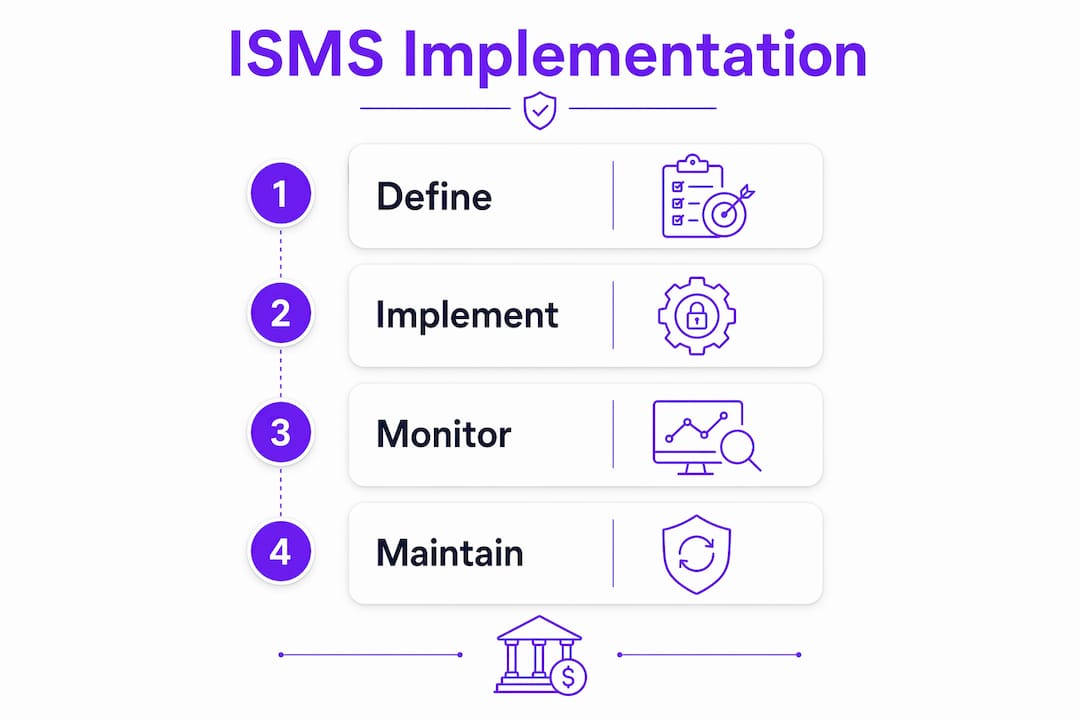
High-maturity financial ISMS implementations follow four defined phases. Mapping Annex A controls to regulations from the start prevents redundant documentation and keeps the project on schedule.
Phase 1: Define and establish (months 1–3)
Set the ISMS scope, write the information security policy, and establish governance structures. Assign roles, define risk assessment methodology, and complete the regulatory overlay map. Deliverables include the SoA, risk register, and an approved policy set.
Phase 2: Implement and operate (months 3–8)
Deploy controls aligned with ISO Annex A and your regulatory overlays. This phase covers access management, encryption standards, supplier contracts, business continuity procedures, and incident response playbooks. Incident response deserves special attention: each playbook must produce three outputs simultaneously, an ISO incident record, a regulator notification, and an operational report. This triple-stack design is a top audit failure point in Swiss fintech and financial services.
Phase 3: Monitor and review (months 8–11)
Activate KPI dashboards, conduct internal audits, and run tabletop exercises. Third-party oversight becomes critical here. DORA’s ICT third-party requirements mean your supplier register must be current and your vendor risk assessments documented. The ISMS framework serves dual roles as both an internal management system and an external regulatory communication instrument.
Phase 4: Maintain and improve (months 11–14+)
Address nonconformities from internal audits, update the risk register, and prepare for the certification audit. Continuous improvement is not a phase you complete. It is the operating mode your ISMS runs in permanently.
| Phase | Key deliverables | Typical duration |
|---|---|---|
| Define and establish | Scope, SoA, risk register, policies | Months 1–3 |
| Implement and operate | Controls deployed, playbooks active | Months 3–8 |
| Monitor and review | Internal audits, KPIs, vendor reviews | Months 8–11 |
| Maintain and improve | Corrective actions, certification prep | Months 11–14+ |
Mid-sized financial firms complete ISO 27001 implementation in 9–14 months. Firms with existing frameworks like SOC 2 or MaRisk land closer to 9–12 months. Organizations starting from scratch typically need 12–14 months.
Pro Tip: Build your Gantt chart before Phase 1 ends. Ismscalculator generates customizable implementation timelines based on your firm’s size, industry, and current maturity level, so you start with a realistic schedule rather than a generic template.
What are the common mistakes in financial ISMS implementation?
The most damaging mistake is treating ISMS as a one-time project rather than an integrated regulatory workflow. Teams that complete certification and then shift focus elsewhere find their controls drift out of alignment within months. Supervisory readiness requires continuous operation, not periodic bursts of activity.
Experts caution against out-of-the-box Annex A adoption. Applying all 93 controls without tailoring them to your actual risk profile wastes resources and creates documentation that auditors immediately recognize as generic. Prioritize the controls that address your highest-risk scenarios first, then build outward.
Common pitfalls and how to avoid them:
- Fragmented incident response. Teams that handle ISO incident records, regulator notifications, and operational reports as three separate processes miss deadlines and create inconsistent audit trails. Design one playbook that triggers all three outputs automatically.
- Weak role accountability. Assigning ISMS responsibilities to people who already carry full workloads produces nominal compliance, not real security. The CISO must own the program with explicit interface responsibilities defined for IT, HR, Legal, and Compliance.
- Annual-only audit mindset. Waiting for the annual surveillance audit to check compliance creates surprises. Continuous supervisory dialogue reduces audit risk and keeps your ISMS aligned with evolving mandates.
- Ignoring third-party risk. DORA specifically targets ICT third-party oversight. A supplier register that is not refreshed quarterly will fail a DORA-aligned audit.
“The organizations that struggle most with financial ISMS audits are those that built their program around documentation rather than operations. Auditors test whether controls actually work, not whether they are written down.” — Compliance advisory insight from Abilene Academy
How do you prepare for ISO 27001 certification in financial services?
The certification audit consists of two stages: a documentation review and an onsite assessment of control effectiveness. Internal audits and readiness reviews conducted before the certification audit surface nonconformities while you can still correct them. Treat your internal audit as a dress rehearsal, not a formality.
Selecting an accredited certification body matters. Choose a body accredited by a recognized national accreditation authority, such as UKAS in the UK or DAkkS in Germany. For financial institutions operating under FINMA supervision, confirm the body has experience with Swiss financial regulatory requirements.
| Activity | Frequency | Purpose |
|---|---|---|
| Internal audit | Annual minimum | Identify nonconformities before external review |
| Supplier register refresh | Quarterly | Maintain DORA-aligned third-party oversight |
| Regulatory overlay review | Quarterly | Catch new mandates before they create gaps |
| Management review | Annual | Confirm leadership alignment and resource allocation |
| Surveillance audit | Annual post-certification | Maintain ISO 27001 certification status |
Post-certification, the work does not stop. Quarterly reviews of supplier registers and regulatory overlays keep your ISMS aligned with evolving mandates and reduce the risk of audit findings. Build these reviews into your compliance calendar as fixed events, not optional check-ins.
Pro Tip: Before selecting a certification body, use Ismscalculator’s ISMS maturity assessment to benchmark your readiness across all four ISO/IEC 27001:2022 control themes. Knowing your maturity score helps you negotiate a realistic audit scope and timeline with the certification body.
For detailed audit preparation steps specific to financial organizations, the ISO 27001 audit prep guide from Ismscalculator covers documentation checklists, common auditor questions, and control evidence requirements.
Key Takeaways
A successful financial sector ISMS implementation plan requires regulatory overlay mapping, phased execution across 9–14 months, and continuous operation well beyond initial certification.
| Point | Details |
|---|---|
| Start with regulatory mapping | Build a multi-framework control library linking ISO Annex A to DORA, FINMA, and GDPR before writing policies. |
| Follow the four-phase lifecycle | Define, implement, monitor, and maintain. Each phase has distinct deliverables and realistic timelines. |
| Design triple-stack incident response | Every playbook must trigger an ISO record, regulator notification, and operational report simultaneously. |
| Assign CISO accountability clearly | Central coordination with defined interfaces across IT, HR, and Compliance prevents gaps at handoff points. |
| Review quarterly, not annually | Supplier registers and regulatory overlays need quarterly refreshes to stay audit-ready under DORA. |
What I have learned from financial ISMS implementations
After working through multiple ISMS programs in financial services, the pattern that separates successful implementations from stalled ones is always the same: leadership either owns the program or they do not. When a CISO has board-level backing, controls get resourced, exceptions get escalated, and the program survives staff turnover. When ISMS is treated as a compliance team side project, it produces documentation that looks good until the first real audit.
The regulatory overlay approach changed how I think about implementation efficiency. Before multi-framework control libraries became standard practice, teams would build separate evidence sets for ISO 27001, DORA, and FINMA audits. That tripled the documentation burden and created inconsistencies that auditors noticed immediately. A single control mapped to three frameworks is not just more efficient. It is more credible.
The triple-stack incident response requirement is the detail most teams get wrong on the first pass. They build a great ISO incident record process and forget that DORA requires a separate regulator notification with its own timeline and format. Designing both outputs from one trigger event is not complicated, but it requires deliberate architecture before an incident happens, not during one.
My honest recommendation: do not wait until you are 80% through implementation to start thinking about certification. The firms that pass on the first attempt start their internal audit program in Phase 2, not Phase 4. That cadence catches control gaps while there is still time to fix them without delaying the certification timeline.
— Martin
How Ismscalculator supports your financial ISMS implementation
Financial institutions face a specific challenge when planning an ISMS program: estimating the real cost and effort before committing resources. Generic project templates do not account for your firm’s size, existing frameworks, or regulatory obligations.
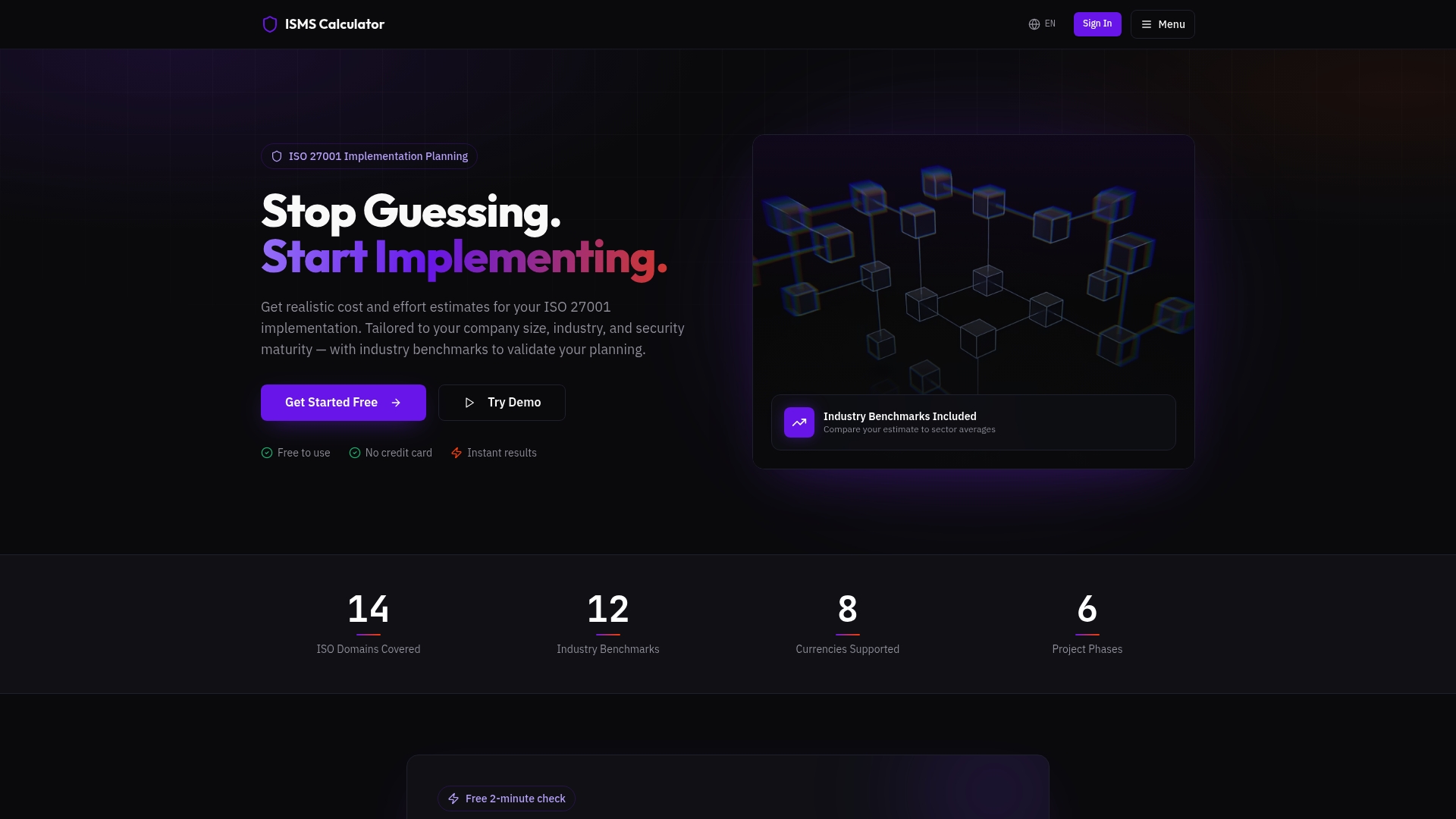
Ismscalculator addresses this directly. The platform’s real-time cost estimator delivers tailored estimates based on company size, industry, and security maturity. The toolkit covers maturity assessments across all four ISO/IEC 27001:2022 control themes, customizable Gantt charts for each implementation phase, and a consultant directory of independent ISO 27001 implementers and lead auditors. Start with the free 2-minute readiness check to get an immediate picture of where your program stands. For a full gap analysis, the ISO 27001 readiness assessment delivers the benchmarks you need to build a credible implementation plan. If you need hands-on support, find an independent consultant with direct financial sector experience.
FAQ
What is an ISMS implementation plan in the financial sector?
An ISMS implementation plan in the financial sector is a structured program that deploys ISO 27001 controls while integrating financial regulations like DORA, FINMA, and MaRisk. It covers scope definition, risk assessment, control deployment, and ongoing compliance maintenance.
How long does financial sector ISMS implementation take?
Mid-sized financial firms typically complete ISO 27001 implementation in 9–14 months. Firms with existing compliance frameworks like SOC 2 or MaRisk complete the process in 9–12 months, while organizations starting from scratch need 12–14 months.
What is the triple-stack incident response requirement?
The triple-stack requirement means every incident response playbook must simultaneously produce an ISO incident record, a regulator notification, and an operational report. Failing to design this from the start is a top audit failure point in financial services.
Does ISO 27001 satisfy DORA requirements?
ISO 27001 provides the structured, auditable foundation that DORA supervisors look for, including scope documentation, a risk register, third-party oversight records, and incident logs. It does not replace DORA compliance but significantly reduces the gap.
How often should a financial institution review its ISMS?
Supplier registers and regulatory overlays require quarterly reviews to stay aligned with evolving mandates. The formal management review and internal audit occur at least annually, with annual surveillance audits required to maintain ISO 27001 certification.