
An ISMS maturity assessment is a structured self-evaluation that measures how effectively your Information Security Management System is implemented and operating, benchmarked against ISO/IEC 27001 requirements. It is the diagnostic tool compliance professionals and IT managers use to identify control gaps, validate risk treatment methods, and establish a credible baseline before engaging a certification body. Unlike a gap analysis, which flags missing elements, a maturity assessment scores the depth of implementation across every major clause and control domain. Tools like the ISO 27001 self-assessment from Cognicert and readiness checklists from providers like Privalex give practitioners structured formats to conduct these evaluations systematically.
What is an ISMS maturity model and how does it measure progression?
An ISMS maturity model is a scoring framework that maps your current security practices to defined levels of implementation quality, from nothing in place to continuously optimized. The most widely used scale runs from 0 to 5, and each level represents a qualitatively different state of control effectiveness, not just documentation completeness.
The 0 to 5 maturity scale works as follows: Level 0 means a control is not implemented at all. Level 1 is ad hoc, meaning activity happens but without structure or repeatability. Level 2 is partially implemented, where some elements exist but coverage is inconsistent. Level 3 is defined and documented, meaning policies and procedures are formally written. Level 4 is implemented and monitored, where controls operate consistently and evidence of performance exists. Level 5 is optimized, meaning the organization continually improves based on measurement data. The gap between Level 3 and Level 4 is where most certification failures originate. A policy that exists on paper scores a 3, but a policy that is actively enforced, logged, and reviewed scores a 4.

This distinction matters because assessments distinguish between documented and operationalized controls. Auditors from certification bodies like BSI, Bureau Veritas, or DNV do not accept documentation alone as evidence of conformity. They look for records, logs, and review outputs that prove a control is running.
| Maturity level | Label | What it means in practice |
|---|---|---|
| 0 | Not implemented | No activity, no documentation, no awareness |
| 1 | Ad hoc | Reactive actions taken, no repeatable process |
| 2 | Partially implemented | Some controls exist, inconsistent coverage |
| 3 | Defined and documented | Formal policies written and approved |
| 4 | Implemented and monitored | Controls active, evidence collected, reviewed |
| 5 | Optimized | Continuous improvement cycle in operation |
Pro Tip: Score each ISO/IEC 27001 clause and Annex A control domain separately. Averaging scores across the entire ISMS hides critical weak spots, particularly in high-risk domains like access control or incident management.
How is the ISMS maturity assessment process conducted?
The assessment process follows the structure of ISO/IEC 27001 itself. Coverage aligns to clauses 4 through 10, spanning organizational context, leadership commitment, risk assessment, objectives, competence, operational controls, performance monitoring, internal audit, management review, and continual improvement. Annex A controls are evaluated separately across all 93 control categories in the 2022 version of the standard.
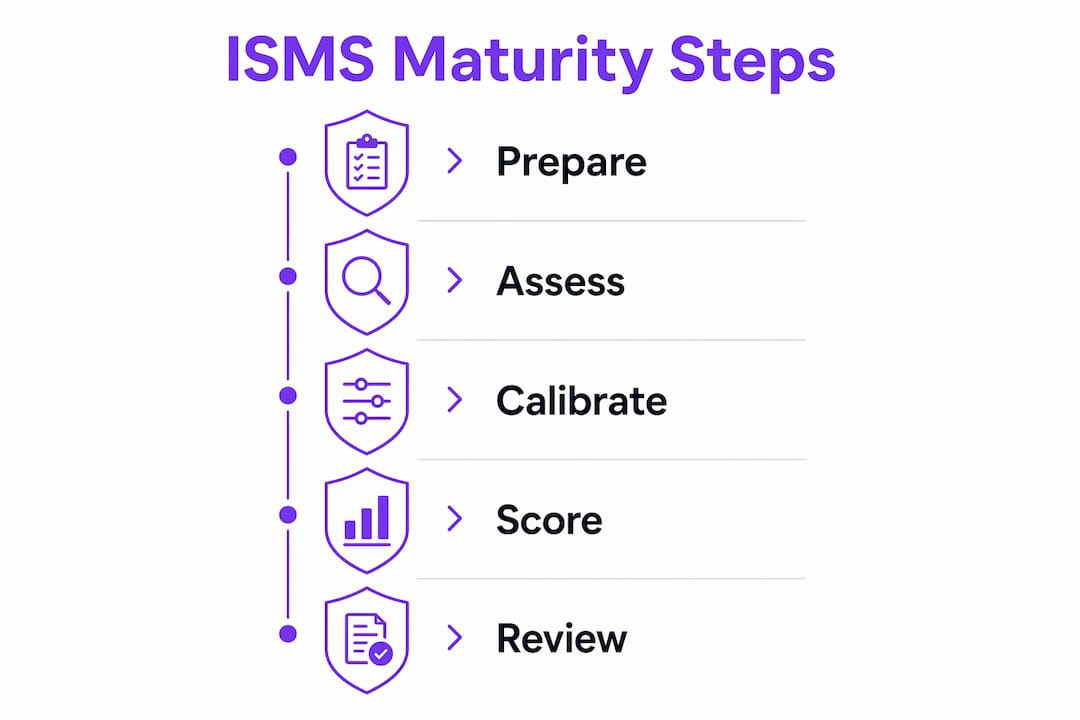
A typical assessment runs through these steps:
- Define scope and assessment criteria. Agree on which clauses, controls, and business units fall within scope. Document any exclusions with explicit justification before scoring begins.
- Assemble the assessment team. Security managers, internal auditors, and compliance leads each bring different perspectives. Involving all three reduces blind spots and scoring bias.
- Collect evidence artifacts. For each clause and control, gather the documentation, logs, meeting minutes, and review records that support a maturity claim. Common artifacts include risk registers, Statement of Applicability, training completion records, audit reports, and incident logs.
- Score each domain against the maturity scale. Apply the 0 to 5 scale consistently. Where evidence is ambiguous, default to the lower score and document the reasoning.
- Identify gaps and prioritize remediation. Map low-scoring domains to their risk exposure. Controls in high-risk areas with a score of 2 or below require immediate attention before any certification timeline is set.
- Produce a structured output report. Assessment outputs translate naturally into evidence trails for audits and management reviews, making the report a living document rather than a one-time snapshot.
The actors involved matter as much as the process itself. Self-assessments conducted solely by the team responsible for implementing controls carry an inherent conflict of interest. Bringing in an internal auditor or a cross-functional reviewer adds objectivity and strengthens the credibility of the output.
Pro Tip: Before scoring begins, hold a calibration session where the team agrees on what constitutes acceptable evidence for each maturity level. Without this step, two assessors will score the same control differently, and your results will be inconsistent across domains.
Why perform an ISMS maturity assessment before ISO 27001 certification?
Maturity assessments identify documentation gaps and control weaknesses early enough to fix them before a certification audit, which is the primary reason compliance teams conduct them. Discovering a Level 1 risk assessment process two weeks before your Stage 2 audit is a costly problem. Discovering it six months earlier is a planning input.
ISO 27001 certification timelines typically run 3 to 12 months depending on organizational size, scope, and existing control maturity. That range exists precisely because organizations that start with a maturity assessment compress the timeline by knowing exactly where to invest effort. Organizations that skip this step often discover scope creep and paper-only controls mid-implementation, which pushes timelines out and increases cost.
The certification readiness benefits of a maturity assessment include:
- Gap identification before Stage 1 audit. Certification bodies conduct a document review at Stage 1. A maturity assessment surfaces missing or incomplete documentation before that review occurs.
- Risk methodology validation. Assessments confirm whether your risk assessment and treatment process meets ISO/IEC 27001 clause 6 requirements, not just whether a risk register exists.
- Management review evidence. Assessment results support management review by providing structured data on ISMS performance, which is a direct input required by clause 9.3.
- Leadership alignment. Maturity scores give executives a concrete picture of where the organization stands, making it easier to secure budget and resource commitments for remediation.
- Avoiding paper-only controls. Many certification delays result from controls that exist only in documentation. A maturity assessment forces the distinction between defined and implemented states.
Critical nuances and challenges in ISMS maturity assessments
The most difficult part of any information security maturity assessment is not the scoring itself. It is agreeing on what counts as evidence. The hardest challenge in ISMS maturity assessment is defining what documentation, logs, or review records constitute acceptable proof for each level, particularly when differentiating between partially and fully monitored controls. A team that skips this calibration step produces scores that look precise but carry no real meaning.
A second common pitfall involves control exclusions. Marking controls as not applicable without defensible justification is a frequent error that weakens audit narratives. Every exclusion must be documented with a clear rationale tied to the organization’s scope and risk context. Auditors from certification bodies will challenge exclusions that appear convenient rather than justified.
The regulatory dimension of maturity assessments is also growing. BSI RUN criteria applied after April 1, 2025 now require evidence-based maturity level assessments in KRITIS audits for critical infrastructure operators in Germany. This means standardized and traceable maturity scoring is no longer just a best practice in regulated sectors. It is a compliance requirement. Other regulatory frameworks are moving in the same direction.
“Practitioners who embed ISMS maturity assessments within Plan-Do-Check-Act cycles avoid the most common failure mode: scoring well on paperwork but failing operational effectiveness during audits.”
Maintaining alignment with the PDCA cycle is the structural answer to this problem. Assessments conducted once and filed away produce a snapshot. Assessments conducted quarterly or at each management review cycle produce a trend line, and trend lines are what auditors and regulators find most credible.
How to apply maturity assessment results for continual improvement
Assessment results are only useful if they drive decisions. The output of a maturity assessment should feed directly into your remediation roadmap, budget planning, and audit cycle. Here is how to translate scores into action:
- Prioritize by risk exposure, not just score. A control scoring Level 1 in a low-risk domain is less urgent than a control scoring Level 2 in a domain covering customer data or critical infrastructure. Cross-reference maturity gaps with your risk register before setting priorities.
- Link remediation to governance cycles. Present maturity results at the next management review meeting. Clause 9.3 requires management to review ISMS performance, and maturity scores are the most concrete data you can bring to that conversation.
- Use scores to justify resource requests. A maturity gap in access control or supplier security is a quantified risk, not an abstract concern. Framing budget requests around specific maturity deficits makes the business case concrete and auditable.
- Integrate results into training programs. Domains scoring at Level 1 or 2 often reflect awareness gaps as much as process gaps. Use low-scoring areas to target security awareness training for the teams responsible for those controls.
Pro Tip: Track maturity scores over time in a simple spreadsheet or GRC tool. A score moving from 2 to 4 across two assessment cycles is evidence of continual improvement, which is exactly what clause 10.2 of ISO/IEC 27001 requires you to demonstrate.
Key takeaways
An ISMS maturity assessment is the most direct method for measuring whether your security controls are genuinely operational, not just documented, and it is the foundation of any credible ISO 27001 certification program.
| Point | Details |
|---|---|
| Definition and purpose | An ISMS maturity assessment scores control implementation depth against ISO/IEC 27001 clauses and Annex A domains. |
| Maturity scale | The 0 to 5 scale distinguishes documented controls from implemented, monitored, and optimized ones. |
| Evidence calibration | Teams must agree on acceptable proof artifacts before scoring to produce consistent, defensible results. |
| Certification readiness | Assessments surface gaps early, validate risk methodology, and provide management review evidence before Stage 1 audits. |
| Regulatory direction | BSI RUN criteria and similar frameworks now require standardized, traceable maturity scoring in regulated sector audits. |
Why most teams get maturity assessments wrong
I have reviewed dozens of ISMS maturity assessments across financial services, healthcare, and technology companies, and the pattern is consistent. Teams score their documentation and call it done. A policy exists, so they mark Level 3 or even Level 4, and move on. The problem surfaces six months later when an auditor asks for evidence that the policy is actually followed, and the team cannot produce it.
The most common misunderstanding is treating maturity as a measure of intent rather than operational reality. A Level 4 score means you have logs, review records, and monitoring outputs proving the control runs. It does not mean you plan to have them. This distinction sounds obvious in writing, but under the time pressure of a certification project, teams consistently conflate the two.
Collaborative calibration is the fix I recommend most often. Before any scoring begins, gather your security team, internal auditor, and at least one business unit representative. Walk through three or four sample controls and agree on what evidence each maturity level requires. That 90-minute session will save you weeks of rework and prevent the most damaging audit findings.
Frequent, iterative assessments also change the culture around ISMS management. When teams know they will be assessed again in 90 days, they stop treating the ISMS as a certification project and start treating it as an operational discipline. That shift is worth more than any single high score on a one-time assessment.
— Martin
How Ismscalculator can accelerate your maturity assessment
Ismscalculator provides a structured ISO 27001 readiness assessment that covers all four ISO/IEC 27001:2022 control themes, scoring your current maturity state and identifying the specific gaps that need remediation before certification. The platform aligns directly to ISO/IEC 27001:2022 and produces outputs you can use immediately in management reviews and audit preparation.
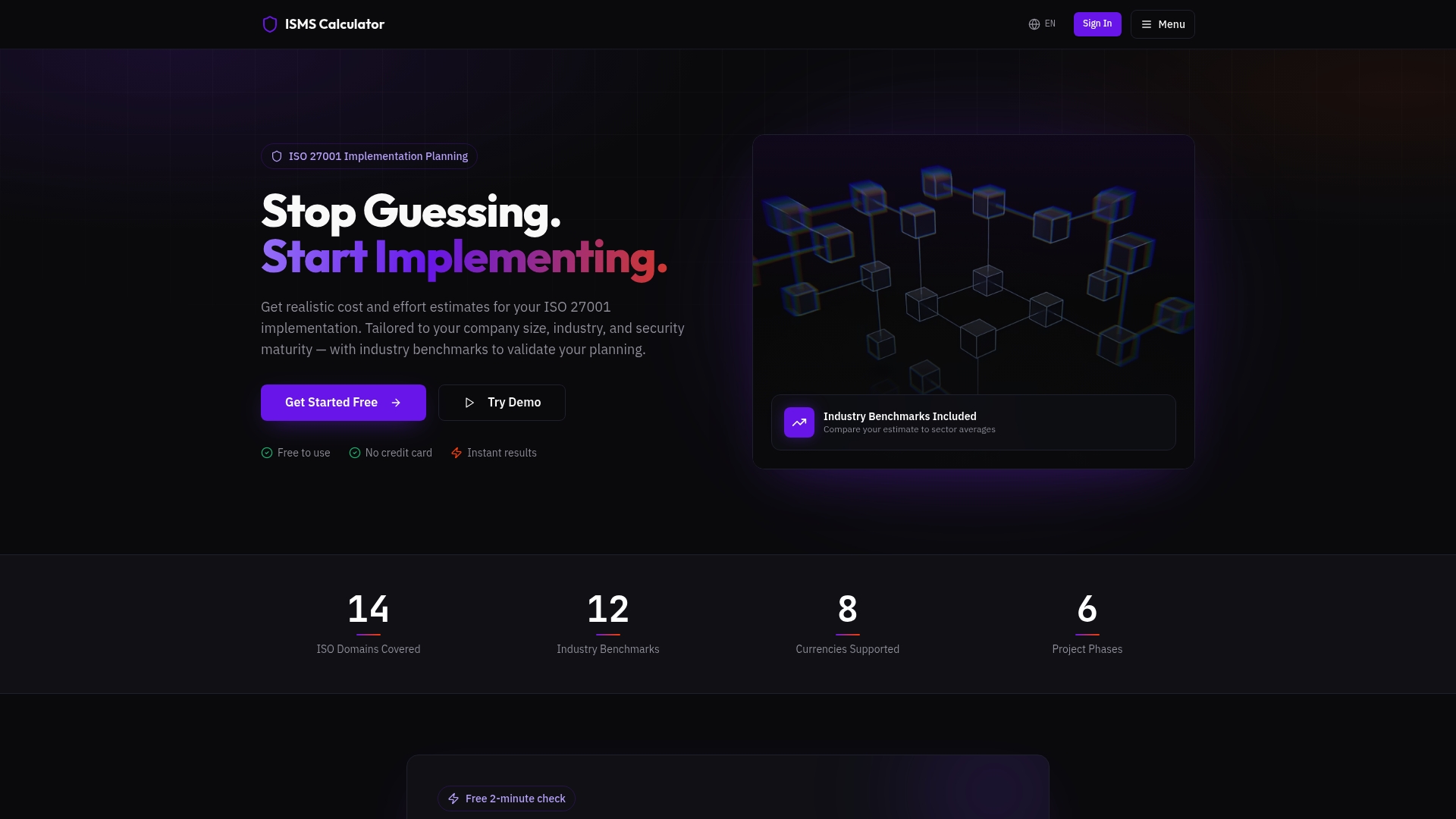
If you want a fast starting point, the free 2-minute readiness check gives you an initial maturity snapshot without any setup. For teams planning a full implementation, Ismscalculator combines maturity evaluation with cost estimation, Gantt chart planning, and model reference comparisons so you can build a realistic program from day one. Start your assessment at Ismscalculator and know exactly where you stand before your certification body does.
FAQ
What is an ISMS maturity assessment?
An ISMS maturity assessment is a structured self-evaluation that scores how well your Information Security Management System is implemented and operating across ISO/IEC 27001 clauses and Annex A controls. It identifies gaps between documented policies and operationalized security practices before a formal certification audit.
What maturity levels are used in an ISMS maturity model?
The standard 0 to 5 scale runs from Not Implemented (0) through Ad Hoc (1), Partially Implemented (2), Defined and Documented (3), Implemented and Monitored (4), and Optimized (5). Most certification bodies expect controls to reach at least Level 4 before a Stage 2 audit.
How often should you conduct an ISMS maturity assessment?
Conduct a full maturity assessment at least annually, aligned to your management review cycle under ISO/IEC 27001 clause 9.3. Organizations preparing for initial certification or operating in regulated sectors should assess quarterly to track improvement trends.
What is the difference between an ISMS gap analysis and a maturity assessment?
A gap analysis identifies whether a required element is present or absent. A maturity assessment goes further by scoring the depth and operational effectiveness of each control, distinguishing between a policy that exists and one that is actively enforced and monitored.
Are ISMS maturity assessments required by regulators?
In some sectors, yes. BSI RUN criteria applied from April 2025 require standardized, evidence-based maturity level assessments for KRITIS operators in Germany. Other regulatory frameworks are adopting similar requirements for critical infrastructure and financial services organizations.