
An ISO 27001 audit is measured in two ways, and budgets go wrong when they get mixed up. Audit days are the days an auditor spends assessing you. For a company of about 100 people, an accredited certification body quotes 8 to 12 days for the initial audit (Stage 1 plus Stage 2), then 3 to 4 days a year for surveillance and 6 to 8 days for renewal. Calendar time is how long the whole project runs, and it is usually set by your preparation, not by the audit. If you want your own audit-day and effort estimate before you ask certification bodies for quotes, our ISO 27001 cost calculator builds it from your size, industry and security maturity.
TL;DR
- Initial certification (Stage 1 plus Stage 2) takes roughly 8 to 12 audit days for a 100-person company, depending on sector and complexity. Very small teams need far fewer.
- Surveillance audits run about 3 to 4 days a year and recertification about 6 to 8 days, at that same company size.
- A focused single-site scope can be certified in about six to ten weeks end to end. Multi-site or heavily outsourced scopes take longer.
- Headcount, sites, scope complexity and your audit readiness move the number of audit days. Your certification body fixes the final figure in its quote.
- The internal audit and a management review must happen before Stage 2, and that sequencing usually sets your earliest date.
Table of Contents
- What the audit consists of
- How the number of audit days is calculated
- What pushes audit days up or down
- Calendar time: why the audit is rarely the bottleneck
- Remote versus on-site audits
- What changed in the U.S. in recent years
- How to make the audit efficient without cutting scope
- Estimate your own audit effort
- Our perspective
- FAQ
- Sources
What the audit consists of
ISO 27001 certification is a cycle, not a single event. Each part has its own length.
| Audit | When | What it checks | Typical length (100 FTE example) |
|---|---|---|---|
| Stage 1 | Start of certification | Documentation and readiness | Part of the 8 to 12 day initial total |
| Stage 2 | After Stage 1 | Whether the ISMS is implemented and working | Part of the 8 to 12 day initial total |
| Surveillance | Annually in years two and three | Sample of the ISMS, continued conformity | 3 to 4 days per year |
| Recertification | End of the three-year cycle | Full review of the ISMS | 6 to 8 days |
The LRQA figures above are for an organization of 100 full-time equivalents. The same page says the range depends on the sector, the complexity of the working environment, whether you develop software and whether you must build security into a product. Treat these as a reference point, not a quote.
The certificate is valid for three years. Surveillance audits keep it alive in between, and the recertification audit renews it. Our guide to what auditors look for in a surveillance audit covers the records to have ready for those yearly visits.
How the number of audit days is calculated
Certification bodies do not pick audit days by feel. The standard that governs them, ISO/IEC 27006-1:2024, bases the calculation on the number of people in the scope, adjusted for risk, and looks the result up in a table. According to a summary of that standard, an organization with 1 to 10 personnel needs 5 days for initial ISMS certification. The same summary says adjustment factors can raise or lower the figure by up to 30%, and that on-site time must not fall below 70% of the calculated value.
That last point matters when someone promises a shortcut. The days are a floor tied to your size and risk, not a number that negotiation or good paperwork can shrink indefinitely.
For the older, general method used across management-system standards, the International Accreditation Forum notes that a surveillance audit is unlikely to run under one audit day. ISMS audits follow the ISO 27006 tables, so use the IAF document as context and your certification body’s quote as the answer.

Who counts as “personnel”
The headcount in the formula is not just employees on payroll. Contractors, part-timers and outsourced staff who work inside the scope can count. If you are unsure how your mix of staff translates, our piece on ISO 27001 staffing benchmarks and counting contractors walks through it.
What pushes audit days up or down
Five factors do most of the work.
- Headcount in scope. This is the starting point of the table lookup.
- Number of sites. Each location in scope adds sampling and travel, whether physical or remote.
- Scope complexity. Software development, products with security built in, and many outsourced services all push the number up.
- ISMS complexity and risk. Higher-risk activities and more complex information flows raise the starting figure.
- Audit readiness. A mature, well-evidenced ISMS can earn adjustments toward the lower side of the allowed range, within the limits above.
You can reduce audit days legitimately in one way: narrow the scope to what you truly need certified, such as one product line or one site, and document the boundary clearly. Do not shrink scope only to cut days if customers expect the whole business to be covered. A certificate that does not cover what your buyers care about will not close deals.
A worked example
Take a 100-person SaaS company with one office and two cloud environments. Using the LRQA reference range, you would plan for about 8 to 12 audit days across Stage 1 and Stage 2. Because it develops software, it should expect the upper half of that range. Then add the cycle: about 3 to 4 days each in years two and three for surveillance, and 6 to 8 days in year three for recertification. Over three years that is roughly 20 to 28 audit days. Multiply by your certification body’s day rate to see the audit fees. Our guide on how much ISO 27001 certification costs shows what else belongs in the budget.

Calendar time: why the audit is rarely the bottleneck
Audit days are the smaller part of the schedule. A published U.S. certification guide says a focused single-site scope is commonly certified in six to ten weeks, provided reasonable IT hygiene is already in place. Multi-site or heavily outsourced scopes take longer. The same source stresses that the internal audit and one management review must be done before Stage 2, and that this sequencing, not the audit, usually sets the earliest date.
A typical sequence looks like this:
- Scoping and planning. Define what is in scope and who owns it.
- Gap assessment. Compare current controls with the standard.
- Implementation. Write policies, run risk assessment, collect evidence.
- Internal audit and management review. Both must be complete before Stage 2.
- Stage 1. The auditor reviews documentation and readiness.
- Stage 2. The auditor verifies that the ISMS works in practice.
- Certification decision. The certification body reviews the audit file and decides.
Starting from nothing, plan for months rather than weeks. Our ISO 27001 implementation timeline and certification timeline explain the ranges by company size, and the project milestones guide explains why booking Stage 2 first keeps the schedule honest.
Book the auditor early
Certification bodies schedule auditors weeks or months ahead. If you wait until your ISMS is finished to request dates, you add idle time to the project. Request quotes and a provisional Stage 2 window early, then work backward so the internal audit and management review land in time.
Remote versus on-site audits
Many audits can be done remotely, and the summary of ISO/IEC 27006-1:2024 notes that the standard sets out risk analysis, planning and reporting requirements for remote auditing. It also says remote methods cannot be used where the risk is judged unacceptable. Your certification body decides whether remote fits your scope, and remote audits still need evidence tracked as rigorously as any test audit in software. Our guide to the ISO 27001 remote audit lists what to prepare: screen-sharing sessions, access to evidence repositories and a quiet interview setting.
What changed in the U.S. in recent years
If you read older articles, check one rule. The U.S. accreditation body ANAB set October 31, 2025 as the transition deadline for certificates issued against ISO/IEC 27001:2013, and its rule required initial and recertification audits to use ISO/IEC 27001:2022 from April 30, 2024. Any audit you schedule today is against the 2022 edition, so ignore guidance about a transition window.
The same rule says ANAB assesses accredited certification bodies every year and witnesses them conducting an ISMS audit. That is why an accredited body’s quote and audit-day logic are consistent with the standard, and why you should choose one accredited for ISO 27001 in the first place.
How to make the audit efficient without cutting scope
The aim is fewer surprises, not fewer controls. These steps shorten calendar time and limit rework without touching required scope.
- Settle the scope statement first. Auditors spend time on every boundary question you have not answered.
- Assign an owner to every control. Interviews go faster when the right person answers.
- Keep evidence in one place. Samples, logs, review minutes and training records should be retrievable in minutes. Our audit stages guide lists the sample records teams are asked for.
- Run the internal audit properly. It is both a requirement and the best rehearsal. Fix the findings before Stage 1.
- Hold the management review on schedule. It is a Stage 2 prerequisite and an easy item to miss.
- Use a checklist. Our certification checklist breaks the work into 80 steps.
Estimate your own audit effort
Our free 2-minute check gives you an instant readiness picture with no signup. For a fuller view, the ISO 27001 readiness assessment covers maturity across the four Annex A control themes, and the calculator turns your company size, industry and security maturity into a real-time estimate of cost and effort. You can edit the assumptions, compare scenarios side by side, save several estimates, export a PDF report and share a link with your finance lead or your certification body. The calculation method is documented and versioned, so you can defend each figure to whoever approves the budget.
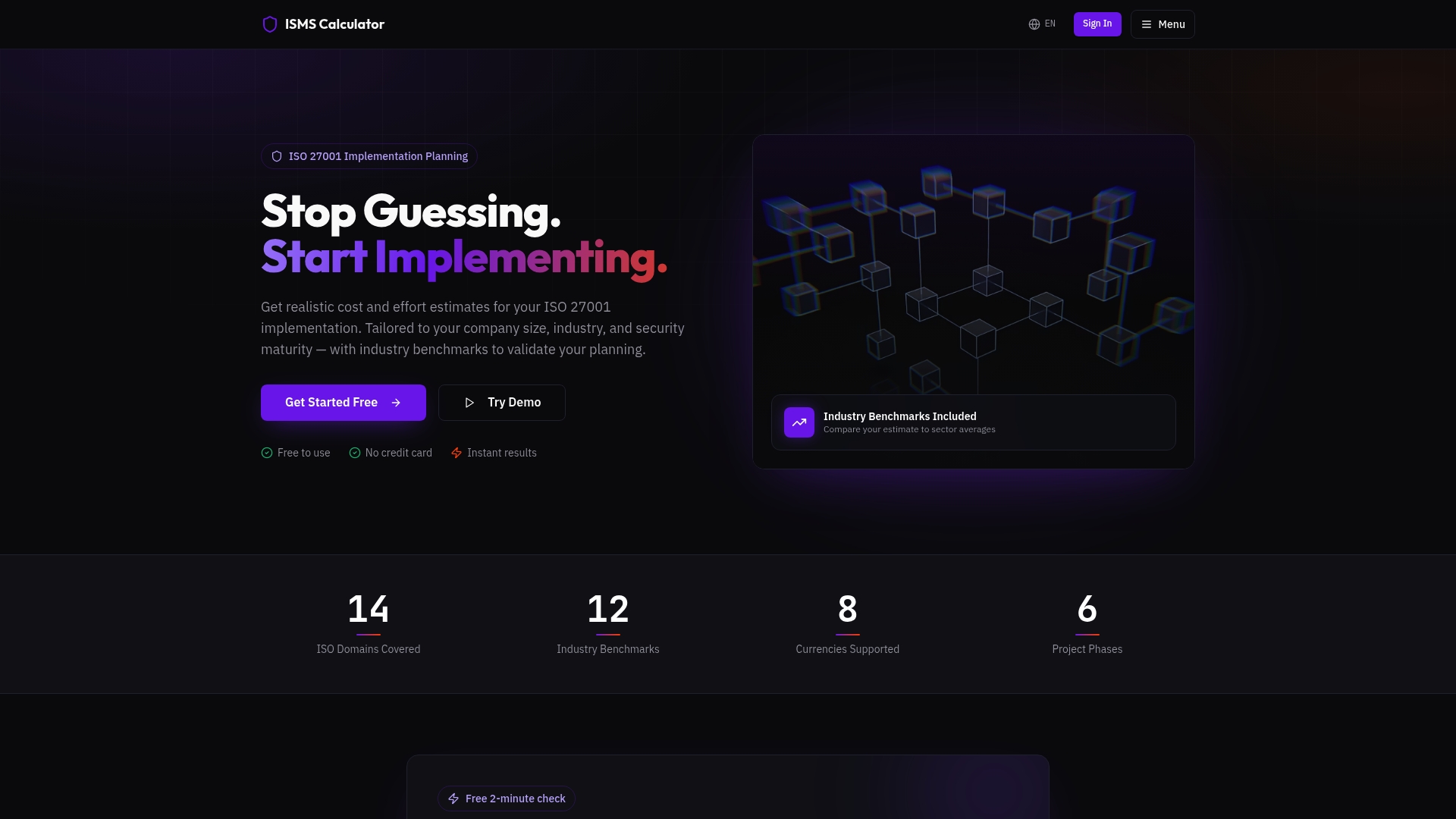
If you want help beyond the numbers, you can also request an introduction to an independent ISO 27001 consultant from the platform.
Our perspective
Most teams we talk to about audit duration are really asking a budgeting question: how many days will I pay for, and how many weeks will my people be pulled away from their jobs? Those are two different numbers, and the second is almost always bigger.
The audit days follow a published logic: headcount, risk, sites and complexity. You cannot argue them away, but you can understand them before the quote arrives. The weeks around the audit are where a plan either holds or slips, because the internal audit and management review have to exist before Stage 2.
That is why we built a calculator that shows its assumptions and lets you change them. When a compliance officer can see how company size, industry and maturity shape the estimate, and compare two scenarios, the conversation with finance and with the certification body gets shorter. A figure you can trace is a figure you can defend.
Our advice: estimate first, book the auditor early, and treat the audit as the last step of a project that was already finished.
Martin
FAQ
How long does an ISO 27001 audit take?
For an organization of 100 full-time equivalents, the initial Stage 1 plus Stage 2 audit typically takes 8 to 12 days, depending on sector and complexity. Smaller organizations need fewer days and larger ones more. Your certification body confirms the figure in its quote.
How long do surveillance and recertification audits take?
Using the same 100-person example, surveillance audits run about 3 to 4 days per year and recertification about 6 to 8 days. Surveillance happens in the years between certification and renewal. Recertification closes the three-year cycle.
How long does it take to get certified overall?
A focused single-site scope with sound IT hygiene can be certified in six to ten weeks. Multi-site or heavily outsourced scopes take longer, and starting from scratch takes months. The internal audit and management review before Stage 2 usually set the earliest date.
Can remote auditing shorten the audit?
Remote auditing can change how an audit is delivered, but it does not remove the calculated audit time. The ISO/IEC 27006-1:2024 on-site time floor of 70% applies as the standard describes, and your certification body decides whether remote methods fit your scope.
Sources
- ISO 27001 Certification Services FAQ, LRQA US
- ISO 27001 Certification Cost, Process and Timeline, SIS
- ANAB Accreditation Rule 28
- ISO/IEC 27006-1:2024 summary, KPT-BJ
- IAF MD 5:2019