
Most enterprises should plan for a first-year ISO 27001 budget that varies widely, influenced primarily by how tightly you scope the certification and how many internal hours you invest in evidence collection. Budget for a three-year commitment, as surveillance audits and recertification occur on a recurring cycle.
TL;DR:
- Narrowing your scope to a single business unit or product line can significantly reduce your certification costs, often by nearly half.
- Organizational and site complexity, especially involving third-party contractors and multiple locations, substantially increase internal staff and audit hours.
- Building contingency into your budget for audit findings, especially nonconformities, prevents delays and hidden expenses during certification.
- Integrating existing frameworks like SOC 2 or NIST can lower costs through control overlap, but poorly managed segmentation may lead to duplication and extra effort.
Table of Contents
- Executive Summary: What to Approve This Quarter
- How Does the ISO 27001 Audit Lifecycle Affect Cost?
- What Are the Line-Item Costs of ISO 27001 Certification?
- How Do Scope and Headcount Change ISO 27001 Costs?
- What Does a Three-Year ISO 27001 Budget Look Like?
- How Can You Reduce ISO 27001 Costs Without Cutting Corners?
- How ISMS Calculator Turns These Ranges Into Your Number
- Budgeting for Security Awareness and Culture Change
- Why You Need Contingency Budgeting for Audit Findings
- Integration Costs With Existing IT and Security Frameworks
- How Employee Turnover Affects Certification Costs
- What Finance Leaders Consistently Underestimate
- Get a Tailored Estimate Before You Present to Finance
- Sources
- FAQ
Executive Summary: What to Approve This Quarter
Split your ISO 27001 budget into two buckets before you present anything to finance. One-time implementation costs (gap analysis, consulting, initial certification audit) hit hardest in year one. Recurring costs (annual surveillance audits, GRC tooling licenses, refresher training) continue every year after that, and they don’t shrink much just because you’ve been certified for a while.
Before you ask for a number, get these three things done:
- Narrow the scope. Decide whether you’re certifying one business unit, one product line, or the whole enterprise. Scope changes everything downstream.
- Run a gap analysis. You cannot budget consulting or internal hours accurately until you know how far your current controls sit from the ISO 27001 requirements.
- Collect 2 to 3 quotes. Ask both certification bodies and implementation consultants to quote against your defined scope, not a generic package.
Audit findings, scope creep, and delayed evidence collection are the norm, not the exception, and a board that sees breach-cost benchmarks from sources like Statista’s regional data breach cost analysis will understand why that cushion matters.
How Does the ISO 27001 Audit Lifecycle Affect Cost?
Your certification runs on a fixed three-year clock, and each stage costs differently. Stage 1 is a documentation and readiness review: the auditor checks whether your Information Security Management System (ISMS) exists on paper and whether you’re actually ready for the deeper look. Stage 2 is where the real cost sits. It’s a full evidence review with on-site or remote sampling of controls in action, and it typically runs more audit days than Stage 1.
After certification, you enter a recurring three-year cycle: annual surveillance audits in years one and two, followed by a full recertification audit in year three that resembles Stage 2 in depth. Surveillance audits are shorter and cheaper individually, but they never stop. Recertification costs more than a single surveillance audit because the certification body has to re-verify the whole system, not just sample changes.
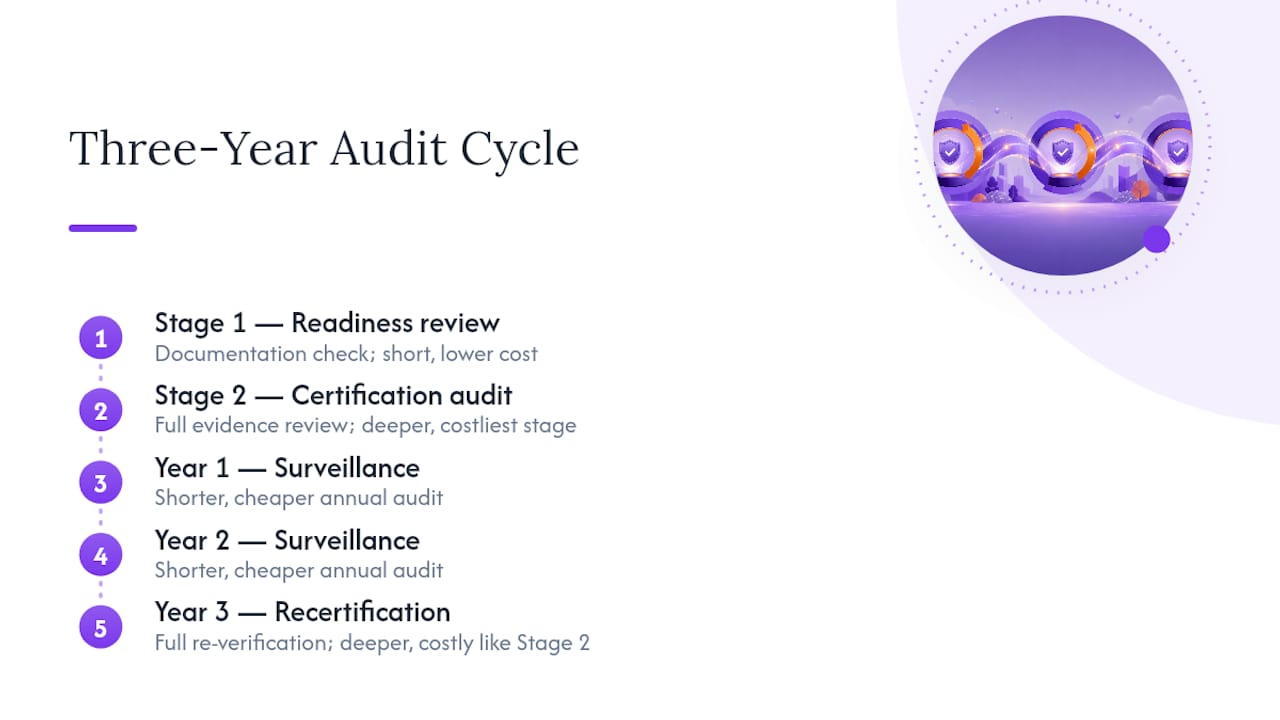
Here’s the detail most budget guides skip: ISO/IEC 27006 governs how certification bodies calculate audit days, but the actual day tables sit behind ISO’s paywall. That means no certification body publishes a public rate card. Every quote is negotiated per engagement, based on your headcount, sites, and scope. Treat any flat number you see online as a starting reference point, not a quote.
What Are the Line-Item Costs of ISO 27001 Certification?
An enterprise budget breaks into six line items, and each one behaves differently depending on your organization’s maturity.
- Gap analysis: $5,000 to $20,000, usually a fixed-fee consulting engagement lasting two to four weeks.
- Consulting and implementation support: $20,000 to $80,000, scaling with how many of the four Annex A control themes need work from scratch.
- Internal staff time: often the largest line item once you convert hours to dollars. A security lead spending 10 hours a week for six months at a $75 blended hourly rate adds up to roughly $19,500, and that’s before counting IT, HR, and department heads pulled in for evidence gathering.
- Certification audit fees: Stage 1 and Stage 2 combined commonly run $15,000 to $40,000 for a mid-size enterprise scope, quoted per engagement since no certification body publishes a public rate card.
- Penetration testing: $8,000 to $25,000 annually, depending on how many systems sit inside scope.
- Training: $3,000 to $15,000 for initial security awareness rollout across the organization.
Two example budgets illustrate how these add up. A 200-employee SaaS company certifying a single core product line might land near $95,000 in year one: $10,000 gap analysis, $45,000 consulting, $22,000 internal staff time, $18,000 Stage 1 and Stage 2 audit fees, no penetration testing (bundled into consulting), and $5,000 training and travel. A 1,200-employee enterprise certifying multiple business units across three sites might land closer to $210,000, with consulting alone reaching $70,000 and internal staff time climbing past $50,000 because more departments touch the scope.
One more thing worth flagging for procurement: GRC platform subscriptions listed on marketplaces like AWS are separate published figures. They cover software licensing, not audit fees, and they show up as an annual line item regardless of where you are in the audit cycle. Ismscalculator’s ISO 27001 project budget breakdown walks through a comparable range if you want to sanity-check your own numbers against a documented example.
How Do Scope and Headcount Change ISO 27001 Costs?
Scope is the single biggest lever you control. Certifying one core service instead of the entire enterprise can cut audit time and cost nearly in half, because fewer people, systems, and sites fall inside the audit boundary.
Headcount counting has a wrinkle that trips up a lot of finance teams: ISO/IEC 27006 counts everyone doing work within the ISMS scope, including contractors and third-party staff, not just full-time employees. If your outsourced help desk touches in-scope systems, they count toward audit days even though they’re not on your payroll.
Three practical scoping moves keep costs contained. First, define a service-only boundary rather than certifying the whole company on day one. Second, consider phased certification, where you certify a core product now and expand scope in year two or three. Third, use site sampling rules to avoid auditing every location in full when you have multiple offices with similar controls.
The most common pitfall is scope creep during implementation, where “let’s just include this other system too” quietly doubles your audit days. Lock scope before you request quotes, and Ismscalculator’s guide for SaaS and tech companies breaks down how employee count and system boundaries interact in more technical detail.
What Does a Three-Year ISO 27001 Budget Look Like?
Certification is a three-year financial commitment, not a single project expense. Here’s how the cashflow typically lands:
- Year 1: Full implementation cost plus the initial Stage 1 and Stage 2 audit. This is where 100% of your gap analysis, consulting, and initial audit fees hit the budget.
- Year 2: A surveillance audit, commonly priced well below the initial certification cost, plus continued tooling subscriptions and refresher training.
- Year 3: A recertification audit that resembles the depth of Stage 2, priced higher than a surveillance audit but still typically below year-one total spend, since your ISMS is now mature and evidence collection is faster.
Aggregated across all three years, surveillance and recertification audits often account for 60% to 70% of your initial certification cost when totaled together. Build a contingency reserve into every year, not just year one, and keep an internal staffing buffer for whoever owns evidence collection, since turnover in that role creates real schedule risk.
On timing: booking your certification body by month six of your project timeline reduces schedule risk significantly. Auditor availability is often the tightest constraint in the whole process, and a late booking can push your certification date by months, which extends the period you’re paying consultants without a certificate to show for it.
How Can You Reduce ISO 27001 Costs Without Cutting Corners?
Cost containment works best when you separate short-run, medium-run, and long-run tactics instead of trying to cut everywhere at once.
In the short run, narrow your initial scope and plan phased expansion rather than certifying everything simultaneously. In the medium run, adopt GRC automation to cut evidence-collection hours, since manual screenshot gathering is one of the biggest hidden time sinks in any implementation. In the long run, institutionalize controls so surveillance audits require smaller samples and less internal prep time each year, because auditors sample less when your evidence trail is consistently organized.
- Negotiate fixed-fee consulting engagements instead of hourly billing where possible.
- Reuse existing IT policies and procedures rather than writing new ones from scratch.
- Request itemized quotes from at least two certification bodies before committing.
Pro Tip: Ask your consultant which controls you already satisfy through existing frameworks like SOC 2 or NIST before paying for redundant work. Overlap between frameworks is common, and most consultants won’t flag it unless you ask directly.
How ISMS Calculator Turns These Ranges Into Your Number
Generic ranges only get you so far in a board presentation. Ismscalculator’s ISO 27001 Cost Calculator takes your actual headcount, systems in scope, current security maturity, number of sites, and target timeline, then returns a line-item breakdown instead of a guess.
You get a Gantt-style implementation timeline, a PDF export for procurement, and a benchmark comparison against model reference values. Save two or three scenarios side by side, the best case, expected case, contingency case, so finance can see exactly which assumptions move the number before anyone signs a contract.
Budgeting for Security Awareness and Culture Change
Technical controls satisfy the auditor. Culture change is what keeps those controls working after certification day. Most enterprises underbudget this line because it doesn’t show up as a single invoice, it shows up as recurring hours across the whole organization.
Plan for $3,000 to $15,000 in initial training rollout, covering security awareness sessions, phishing simulation tools, and role-specific training for staff handling sensitive data. That’s the visible cost. The invisible cost is the time every employee spends sitting through training, filling out acknowledgment forms, and adjusting daily habits like password practices or data handling procedures.
For a 500-person organization, even 30 minutes of mandatory training per employee represents 250 hours of aggregate time. At a blended rate across roles, that’s a real dollar figure finance teams often miss when they only look at the training vendor invoice.
Budget for refreshers annually, not just once at launch. ISO 27001 auditors expect to see evidence of ongoing awareness activity, not a one-time kickoff event, and surveillance audits will ask for it. Building a lightweight quarterly touchpoint, a short email campaign, a phishing test, a five-minute refresher video, costs far less than a full annual re-training push and keeps the evidence trail auditors want to see.
Treat this as a permanent operating cost of your ISMS, not a project expense that ends when the certificate arrives. Organizations that underbudget culture change often find their surveillance audits take longer because employees can’t demonstrate awareness under questioning, which adds audit days and cost right when you thought the hard part was over.
Why You Need Contingency Budgeting for Audit Findings
Audit findings are not a sign of failure. They’re close to a certainty on any first-time certification, and your budget needs to reflect that reality instead of assuming a clean pass.
Minor nonconformities are the most common outcome of Stage 2 audits. They require a corrective action plan, evidence of remediation, and sometimes a follow-up review before the certificate issues. Each of those steps costs time, and time converts to dollars whether it’s internal staff hours or additional consulting support to close the gap fast.
Major nonconformities are rarer but far more expensive. They can delay certification entirely, requiring a full re-audit of the affected control area before the certification body will issue anything. If that happens close to a contract deadline where a customer is waiting on your ISO 27001 certificate, the cost isn’t just the re-audit fee, it’s the business risk of a delayed sale.
The gap analysis phase should give you an early read on how many findings to expect, so treat a rushed or skipped gap analysis as a direct driver of contingency risk later.
Build the reserve into your capex or opex approval package explicitly, labeled as contingency rather than folded into consulting. Boards approve contingency lines more easily when they’re named and justified than when they’re buried inside a bigger number that looks padded.
Integration Costs With Existing IT and Security Frameworks
Few enterprises implement ISO 27001 as their first framework. Most already run SOC 2, NIST CSF, HIPAA, or a homegrown security program, and the integration question is whether that existing work reduces your ISO 27001 budget or adds to it.
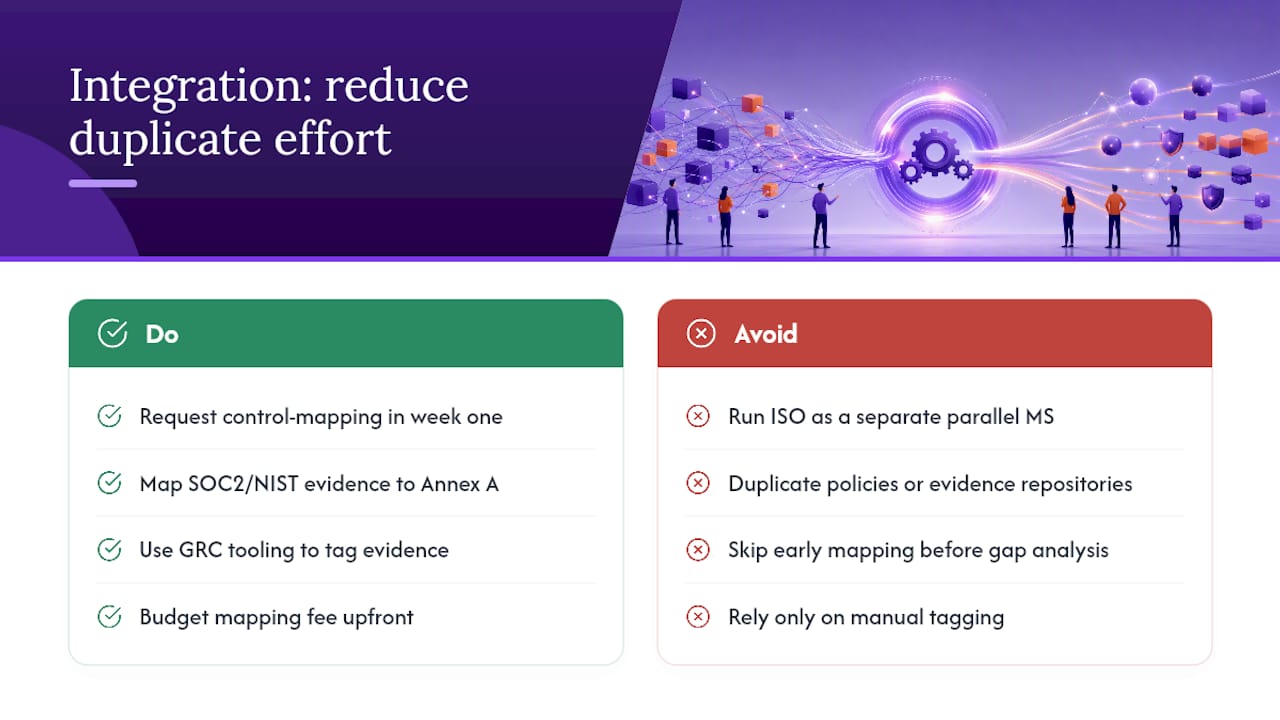
Done well, integration lowers cost. Control overlap between ISO 27001 and SOC 2 Type II is substantial, particularly around access control, change management, and incident response. If your consultant maps existing SOC 2 evidence against ISO 27001’s Annex A controls before starting from scratch, you avoid paying twice for the same documentation and evidence-gathering work.
Done poorly, integration adds cost. Running ISO 27001 as a fully separate management system, with its own policy set, its own evidence repository, and its own review cadence, duplicates effort your team is already doing for other frameworks. That duplication shows up as extra internal staff hours and extra consulting hours to maintain two parallel systems that largely cover the same ground.
The practical move is asking your consultant for a control-mapping exercise in week one, before the gap analysis even starts. It typically adds a modest fee to the front end of the project, but it often saves multiples of that cost by identifying which policies, risk assessments, and audit evidence can be reused rather than rebuilt. This is also where GRC tooling earns its subscription cost: platforms built for multi-framework compliance let you tag one piece of evidence against several frameworks at once, cutting the duplicate-effort problem structurally rather than manually. Ismscalculator’s common budgeting mistakes guide covers this integration blind spot in more depth, since it’s one of the most frequent sources of underestimated year-one cost. For SaaS teams standing up new compliance tooling quickly, a partner resource on deploying SaaS platforms without a lengthy IT rollout offers a useful parallel framework for thinking about deployment speed.
How Employee Turnover Affects Certification Costs
Turnover during a certification project is one of the least discussed budget risks, and it hits harder than most finance leaders expect. ISO 27001 implementation depends heavily on a small number of people, often a security lead, a compliance manager, or an IT director, who carry institutional knowledge about the project’s status. When that person leaves mid-implementation, the replacement doesn’t just need onboarding. They need to relearn the entire scope, control mapping, and evidence status from scratch, often without complete documentation of where things stood.
The direct cost is re-training and knowledge transfer, which can add weeks to the timeline and thousands of dollars in consulting hours to get a new lead back up to speed. The indirect cost is schedule slippage. If your certification body booking was set assuming a certain readiness date and turnover pushes that date back, you either eat a rescheduling fee or lose your slot entirely and wait for the next available audit window.
Post-certification turnover carries a different but related cost: training refreshers. Every new employee who joins after certification needs security awareness training before they touch in-scope systems, and every departure means updated access reviews and offboarding evidence that auditors will check during the next surveillance audit. High-turnover industries, retail, hospitality, call centers, should budget training refreshers as a recurring quarterly cost rather than an annual one, since the gap between new-hire onboarding and next year’s scheduled training creates a real compliance exposure window.
Build a documentation habit early: keep implementation status, control ownership, and evidence locations in a shared system that survives a departure, not just in one person’s head. It costs almost nothing to maintain and it’s the cheapest insurance against the most expensive kind of delay.
What Finance Leaders Consistently Underestimate
Internal staff time is the cost line every enterprise budget gets wrong, usually by counting only the security team’s hours and ignoring the dozens of smaller contributions from IT, HR, and department heads pulled into evidence gathering. That hidden opportunity cost often rivals or exceeds consulting fees once you add it up honestly.
When you present this budget to the board, tie it directly to revenue risk. Frame ISO 27001 as the thing that unblocks enterprise contracts requiring certification, not as a pure compliance expense, and the approval conversation gets a lot shorter.
— Martin
Get a Tailored Estimate Before You Present to Finance
Every range in this article is a starting point, not your actual number. Your real budget depends on your headcount, your scope, and your current maturity level, and guessing at those inputs is how year-one estimates end up 40% off by month six.
Ismscalculator’s free 2-minute readiness check gives you a baseline estimate without requiring a signup, built on transparent, editable assumptions you can challenge line by line rather than a black-box number. From there, the full ISO 27001 Cost Calculator lets you build out a complete scenario, headcount, sites, maturity level, timeline, and export it as a PDF to hand directly to procurement or your CISO. Save two scenarios side by side for comparison, so the board sees the range instead of a single number that looks like a guess. The full methodology behind every estimate is published and versioned, so you can trace exactly how each figure was calculated before you defend it in a budget meeting.
Sources
Verify the standard itself at ISO’s official ISO/IEC 27001 page, cross-check cost ranges against the Factorial certification cost breakdown, and review the methodology behind Ismscalculator’s estimates directly on its methodology page.
- How Much Does ISO 27001 Certification Cost? | Factorial
- ISO 27001 2022 Certification Cost: 12-Month Roadmap | Ciphers Security
- ISO 27001 Implementation Cost Guide: Enterprise Certification Budget Planning & Cost-Saving Strategies | CloudInsight
FAQ
How Much Does ISO 27001 Certification Cost?
There’s no flat rate. Small-to-mid projects commonly range from $6,000 to $55,000 in year one, while enterprise-scale projects typically land between $80,000 and $250,000 depending on scope, headcount, and maturity. Ismscalculator’s free 2-minute check generates a tailored baseline in under two minutes.
How Much Do ISO 27001 Auditors Get Paid?
Certification bodies don’t publish a public rate card. Auditors quote fees per engagement based on ISO/IEC 27006 rules, which calculate audit days from your headcount, sites, and scope rather than a fixed hourly rate.
Is the ISO 27001 Exam Difficult?
The ISO/IEC 27006 rules governing audit days are technical, but there’s no single “exam” for ISO 27001 certification itself. Organizations undergo a Stage 1 documentation review followed by a Stage 2 evidence audit, and difficulty depends more on how prepared your ISMS is than on any test format.
Can You Explain ISO 27001 in a Simple Way?
ISO 27001 is an international standard for building a management system that protects company information through defined policies, risk assessments, and controls across the four Annex A control themes. Certification proves to customers and regulators that your security practices meet that standard, verified through an independent audit.
Does GRC Tooling Actually Reduce ISO 27001 Costs?
Automation and GRC platforms cut the hours spent on manual evidence collection, which lowers internal staff time and can shorten consulting engagements. Platform subscription costs are a separate line item from audit fees, so tooling reduces labor cost without replacing the certification body’s quote.