
Count every person doing work under your organization’s control within the ISMS scope, including employees, contractors, and relevant part-time staff. Certification bodies convert that number into auditor days using ISO/IEC 27006-1 charts, and they allow documented reductions for groups doing identical work under the square-root rule. Confirm your certifier’s counting rules before you request a quote, since payroll headcount alone rarely matches what shows up on the invoice.
TL;DR:
- Accurate in-scope headcount includes full-time, part-time, contractors, and freelancers working on systems, data, or processes within the ISMS boundary, with part-timers counted as fractions.
- Certification bodies use industry-standard audit-time charts tied to headcount bands, where crossing certain thresholds can significantly increase the required auditor days and costs.
- Building a defensible headcount involves defining scope boundaries first, mapping roles to processes, and documenting assumptions and groupings with supporting evidence before requesting a quote.
- Grouping reductions are possible through the square-root rule for identical activities, but require justified sampling and cannot be applied when roles involve varied tasks or elevated risks.
- Properly estimating headcount and scope from the start reduces project timelines, internal disruptions, and the risk of scope surprises during the audit.
Table of Contents
- What Does “In-Scope Headcount” Actually Mean?
- How Certification Bodies Turn Headcount Into Auditor Days
- How to Build a Defensible In-Scope Headcount
- The Square-Root Rule for Grouping Reductions
- Common Headcount Mistakes and What to Ask Your Certifier
- Why Getting Headcount Right Protects Your Timeline
- Turn Your Role List Into a Real Budget Number
- Sources
- FAQ
What Does “In-Scope Headcount” Actually Mean?
Auditors don’t care about your org chart. They care about “persons doing work under the organization’s control within the ISMS scope,” a phrase pulled straight from certification body methodology and one worth memorizing before your first quote request.
That definition pulls in more people than most compliance officers expect. Full-time staff count, obviously. Part-time employees count too, typically calculated pro rata against a full-time equivalent. Contractors, freelancers, and temporary staff count if their work touches systems, data, or processes inside your ISMS boundary, even when they’re on a vendor’s payroll rather than yours.
Here’s how to sort roles quickly:
- Include: developers touching in-scope code, IT operations staff, security analysts, outsourced monitoring or help desk teams, HR staff who manage access to in-scope systems.
- Exclude: sales, marketing, or facilities staff who never touch in-scope systems or customer data covered by the ISMS.
- Gray zone: part-time or shared-service employees who spend a fraction of their time on in-scope work. Count them by the fraction, not by headcount.
Get this wrong in either direction, and your quote either lowballs the real audit effort or inflates it with irrelevant departments.
How Certification Bodies Turn Headcount Into Auditor Days
Certification bodies don’t negotiate auditor days from scratch. They start from a published audit-time chart tied to headcount, then adjust for scope complexity, number of sites, and the criticality of what you’re protecting.
The total quote is Stage 1 plus Stage 2 audit time, calculated against an eight-hour audit day. The headcount band you fall into sets the baseline before any adjustments get layered on.
Auditor-Day Bands by Headcount
These bands come from practical audit-time charts used across the industry, and they matter for budgeting because the jump between bands isn’t gradual. Cross from 44 to 47 employees and you can land in a materially higher day count, which means a higher invoice, before anyone has even discussed complexity adjustments. That’s why nailing the count before you request quotes saves real money.
How to Build a Defensible In-Scope Headcount
A headcount number that survives a certification body’s scrutiny doesn’t happen by guessing. Follow this sequence before you ask anyone for a quote.
- Lock your ISMS scope boundaries first. Define the systems, services, locations, and business units the certification will actually cover. Headcount only makes sense once scope is fixed.
- Map processes to roles. List every process inside that boundary, then identify which roles perform work on it. This catches indirect contributors, like a shared IT help desk, that a simple org-chart review misses.
- Count people doing work under your control. Convert part-time staff to FTE fractions, add contractors and freelancers doing in-scope work, and keep a running list rather than a single summary number.
- Identify groups doing identical activities. If you have multiple people performing the same in-scope task under the same conditions, flag them as a potential grouping candidate and start collecting job descriptions and activity logs as evidence.
- Write a headcount statement. Document your assumptions, your scope boundary, and your grouping rationale in one page, then hand it to the certifier alongside your quote request.
Pro Tip: Keep your headcount statement as a living document. Certification bodies expect it to be updated at each surveillance audit, and starting from a clear baseline saves hours when headcount shifts between audits.
A tool like the ISO 27001 cost calculator can help turn that role list into a working estimate once you’ve done the counting.
The Square-Root Rule for Grouping Reductions
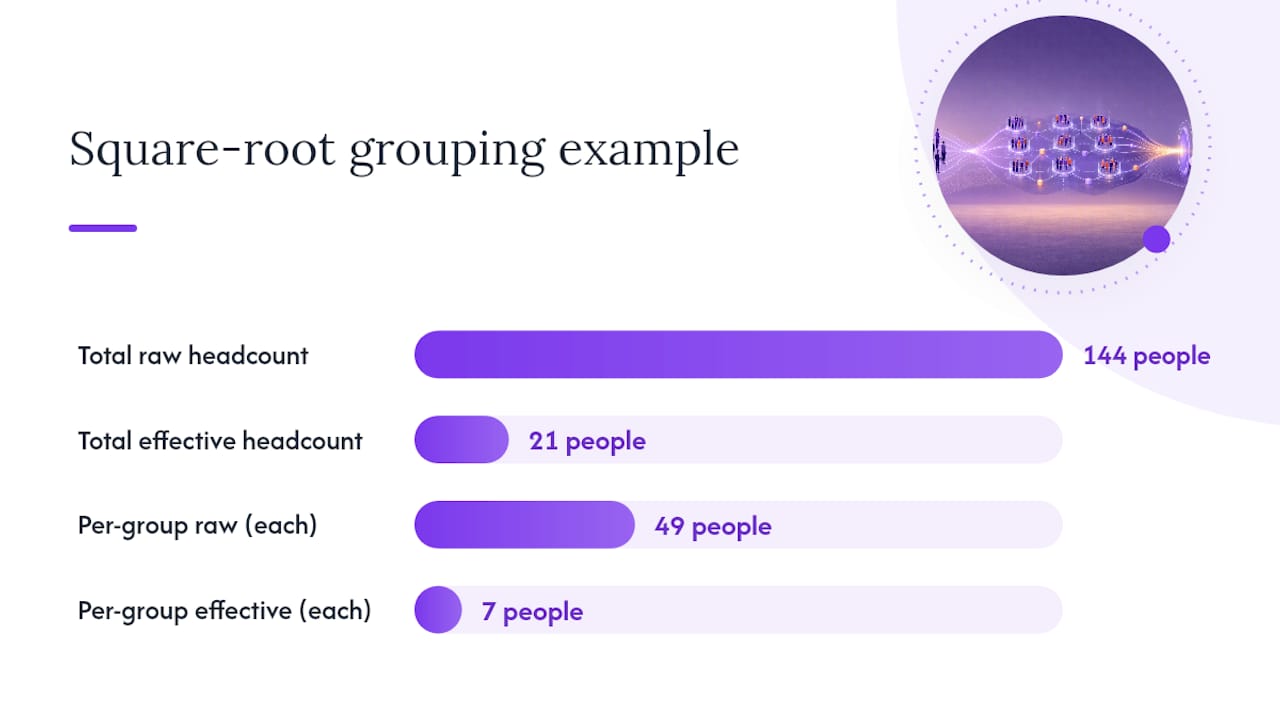
ISO/IEC 27006-1 allows a reduction in audit-time headcount for groups of people who perform identical activities, but the reduction has to be earned, not assumed. The rule takes the square root of the headcount within each identical-activity group, rounded up, and that becomes the effective count for audit-time purposes instead of the raw number.
Here’s the worked example from European Accreditation’s guidance: a 144-person organization splits into three groups of 49 people, each doing genuinely identical work.
| Group | Raw headcount | Square root (rounded up) |
|---|---|---|
| Group 1 | 49 | 7 |
| Group 2 | 49 | 7 |
| Group 3 | 49 | 7 |
| Total effective headcount | 144 | 21 |
That’s a drop from 144 to 21 for audit-time purposes, a difference large enough to move an organization down several auditor-day bands. But this reduction is a ceiling, not an entitlement. Certification bodies will demand risk-based justification and sampling evidence showing the groups genuinely perform identical work, not just similar job titles. Grouping falls apart fast when roles involve varied tasks, different systems access, or elevated risk, like admins with privileged credentials. Those people usually get counted individually regardless of how many teammates share their title.
Common Headcount Mistakes and What to Ask Your Certifier
Most quote surprises trace back to the same handful of counting errors, and they’re avoidable with a short conversation before you sign anything.
- Excluding contractors or outsourced monitoring staff because they’re not on payroll, when their work is squarely in scope.
- Miscounting part-time employees as full headcount instead of FTE fractions.
- Including departments that never touch in-scope systems, which inflates your number and your quote.
- Claiming a grouping reduction without documented job descriptions or activity logs to back it up.
Before you request a quote, ask your certifier directly: How do you count part-time and contract staff? Do you accept grouping reductions, and what evidence do you require? Will you sample across sites or roles during the audit?
Bring a scope statement, a role list with FTE fractions noted, any grouping justification with supporting job descriptions, and a system inventory. A certification checklist covering these deliverables ahead of time keeps the quote conversation short and the eventual audit free of scope surprises.
Why Getting Headcount Right Protects Your Timeline
Bad headcount numbers don’t just distort your quote. They distort your entire project timeline. An inflated count pulls your audit into a higher day band, which means more internal staff pulled into evidence collection, more scheduling friction, and a longer path to a certificate you may not have needed to stretch out.
The organizations that certify fastest usually keep their scope tight and their headcount statement airtight from day one. Many ISMS tasks, like policy documentation, don’t scale with headcount, but auditor days do, so a lean, well-documented scope is one of the few levers that reliably shortens both the audit and the internal disruption around it. Getting the count right the first time also means fewer awkward corrections mid-audit, which auditors notice and certification bodies do not appreciate.
— Martin
Turn Your Role List Into a Real Budget Number
A dedicated ISO 27001 planning tool can provide a faster path from a documented headcount to an audit-day and cost estimate than working through a certifier’s quote process cold. Once you’ve mapped your in-scope roles using the steps above, you can plug them straight into a calculator built specifically for ISO 27001 planning instead of reverse-engineering a generic quote.
Start with the free ISO 27001 readiness assessment, a two-minute check that flags where your scope and headcount assumptions need tightening before you talk to a certifier. From there, the ISMS Calculator lets you enter your scope, list your roles and contractors, adjust for any grouping assumptions, and pull model reference comparisons to sanity-check your numbers against the model reference. You can save multiple scenarios, compare them side by side, and export a PDF report to hand directly to certification bodies when you request quotes. If your organization also tracks broader data security controls, resources like Tax Form Hero’s guide to data security are worth a look alongside your ISO 27001 planning. Run your numbers before your next quote call.
Sources
Share European Accreditation’s Q&A on ISO/IEC 27006-1 when discussing grouping reductions, and reference practical auditor-day charts or certification cost guides to sanity-check any quote against industry norms before you sign.
- Question 48.6 Audit time determination to ISO/IEC 27006-1:2024, determination of initial number of persons (C.3.4) - European Accreditation
- How many auditor days an ISO 27001 certification takes, by headcount | StandardOS
FAQ
What Does ISO 27001 Stand For?
ISO/IEC 27001 is the international standard for information security management systems, published jointly by the International Organization for Standardization and the International Electrotechnical Commission.
Is ISO 27001 Certification Hard to Get?
Certification is achievable for organizations of any size, but the effort scales with scope and headcount complexity rather than difficulty of the standard itself. A tight, well-documented scope with an accurate in-scope headcount is the single biggest factor in a smooth certification process.
How Much Does an ISO 27001 Auditor Typically Cost?
Auditor cost is calculated as auditor days multiplied by a day rate, and the day count comes from headcount-based charts rather than a flat fee. Running your role list through a tool like the ISO 27001 cost calculator gives you a realistic starting estimate before you contact certification bodies.
How Many Security Controls Are in ISO 27001?
Annex A contains 93 controls organized into four themes: organizational, people, physical, and technological.
Do Part-Time Employees Count Toward ISO 27001 Headcount?
Yes, part-time employees count toward in-scope headcount, typically calculated as a fraction of a full-time equivalent based on their actual hours worked on in-scope activities.