
La certification ISO 27001 multi-sites délivre un certificat chapeau couvrant un siège central ainsi qu'un nombre quelconque de sites secondaires ou satellites, chacun recevant un sous-certificat dépendant. C'est le bon choix lorsque votre organisation exploite un SMSI gouverné de manière centralisée, lorsque les sites exercent des activités sensiblement similaires et lorsque vous anticipez une stabilité durable de la propriété sur l'ensemble de ces sites. Si l'une de ces trois conditions n'est pas remplie, les gains d'efficacité s'évaporent et des certificats de site distincts vous serviront généralement mieux.
Trois tests rapides pour évaluer l'adéquation :
- Contrôle centralisé. Une seule équipe est-elle responsable des politiques du SMSI, de la méthodologie d'appréciation des risques et de la Déclaration d'Applicabilité (DdA) pour tous les sites ? Si la gouvernance est fragmentée, la certification multi-sites crée une exposition aux audits plutôt qu'elle ne la réduit.
- Activités similaires entre les sites. Les sites traitent-ils des processus, des types de données et des environnements informatiques comparables ? Une divergence opérationnelle significative contraint les auditeurs à traiter chaque site comme unique, annulant la logique d'échantillonnage qui rend la démarche multi-sites économiquement pertinente.
- Stabilité de la propriété. Êtes-vous certain qu'aucun site ne sera cédé à court terme ? Un sous-certificat devient invalide dès qu'un site quitte le groupe, obligeant à une re-certification indépendante depuis le début.
Le compromis immédiat est simple : vous bénéficiez d'une charge administrative réduite et d'une diminution des dépenses d'audit grâce à l'échantillonnage, mais vous acceptez qu'une non-conformité majeure sur un seul site puisse suspendre l'ensemble du certificat chapeau, et vous perdez en flexibilité lorsque la structure organisationnelle évolue.
Points clés
La certification ISO 27001 multi-sites génère de réelles économies de coûts et d'audit, mais uniquement lorsque la gouvernance centralisée, l'uniformité opérationnelle et la stabilité de la propriété sont toutes en place avant de s'engager.
| Point | Détails |
|---|---|
| Trois tests d'adéquation | La gouvernance centralisée, la similarité des activités entre sites et la stabilité de la propriété doivent être toutes présentes pour que la certification multi-sites procure ses avantages économiques. |
| L'échantillonnage par racine carrée réduit les jours d'audit | Une organisation disposant de 25 sites audite généralement environ 5 sites échantillonnés par cycle, réduisant substantiellement les visites sur site par rapport à une certification de site indépendante. |
| Risque de transférabilité des sous-certificats | Un site cédé perd immédiatement son sous-certificat ; planifiez la stabilité de la propriété sur l'ensemble du cycle de certification de 3 ans avant de vous engager dans le modèle chapeau. |
| Commencer par un site pilote | Faire passer un site par une certification complète avant d'étendre le programme chapeau révèle les lacunes de gouvernance et la préparation des coordinateurs à faible coût. |
| Ismscalculator pour la budgétisation | Les fonctionnalités multi-sites de la plateforme, l'évaluation de maturité et le plan de projet Gantt donnent aux responsables sécurité une estimation structurée à présenter lors des discussions budgétaires avant de solliciter un organisme de certification. |
Sommaire
- Que couvre réellement la certification ISO 27001 multi-sites ?
- SMSI chapeau unique ou certificats de site distincts : quelle structure convient à votre organisation ?
- Comment fonctionne concrètement le processus d'audit multi-sites ?
- Pourquoi les organisations choisissent la certification multi-sites et ce qu'elle leur coûte
- Quels facteurs déterminent le coût de la certification multi-sites ?
- Liste de contrôle et calendrier de mise en œuvre d'un SMSI multi-sites
- Huit questions pour décider si la certification multi-sites vous convient
- Pièges courants et signaux d'alerte à éviter lors des audits
- Comment estimer l'effort et le coût à l'aide de références et d'un calculateur
- La première action qui compte vraiment
- Planifiez votre SMSI multi-sites avec des chiffres réels, pas des suppositions
- Sources
Que couvre réellement la certification ISO 27001 multi-sites ?
La certification multi-sites, formellement régie par l'IAF MD 1, est une certification ISO 27001 unique couvrant un ensemble défini de sites opérant sous un seul système de management. Le siège central détient le certificat chapeau ; chaque site inclus reçoit un sous-certificat légalement valide uniquement tant que le certificat chapeau reste actif. Retirez un site du périmètre ou laissez le certificat chapeau expirer, et tous les sous-certificats tombent avec lui.
La norme trace une ligne claire entre ce qui doit être centralisé et ce qui peut rester local. Les éléments centralisés sont non négociables : structure de gouvernance du SMSI, méthodologie d'appréciation des risques, DdA, politiques de sécurité de haut niveau et programme d'audit interne. Les éléments locaux, en revanche, peuvent refléter les conditions propres au site, notamment les contrôles d'accès physiques, les contacts locaux pour la réponse aux incidents et les traitements des risques spécifiques au site, à condition qu'ils s'inscrivent dans le cadre défini centralement.
Les limites du périmètre importent plus que la plupart des organisations ne le pensent. La définition du périmètre sur plusieurs entités exige une cartographie précise des entités juridiques, des flux d'information et de l'infrastructure partagée. Un périmètre mal défini est l'une des causes les plus fréquentes de retards d'audit et de désalignements dans la mise en œuvre, selon les recommandations de définition du périmètre multi-entités.
Trois scénarios illustrent les cas où la certification multi-sites s'applique naturellement :
Réseaux de succursales de commerce de détail. Un détaillant disposant de 40 magasins exploitant des systèmes de point de vente identiques, les mêmes procédures de traitement des paiements et une infrastructure informatique gérée centralement est un candidat idéal. L'équipe centrale IT et conformité est propriétaire du SMSI ; les magasins l'exécutent.
Bureaux régionaux d'un cabinet de services professionnels. Des bureaux dans différentes villes traitant les mêmes types de données clients sous une politique de classification des données unifiée et une infrastructure cloud partagée peuvent opérer sous un seul SMSI avec des coordinateurs locaux gérant les contrôles physiques et RH.
Centres de données répliqués. Deux ou trois centres de données exécutant des environnements en miroir pour une seule organisation, tous gérés par une seule équipe opérationnelle, s'inscrivent naturellement dans un périmètre unique, car le parc technique est effectivement identique.
Les programmes transfrontaliers ajoutent un niveau de complexité. Les organismes d'accréditation de différentes juridictions peuvent appliquer l'IAF MD 1 légèrement différemment, et certains organismes de certification limitent le nombre de sites pouvant figurer sous un même certificat. Confirmez ces deux limites auprès de votre organisme de certification avant de finaliser le périmètre.
SMSI chapeau unique ou certificats de site distincts : quelle structure convient à votre organisation ?
Le choix entre un SMSI chapeau unique et des certificats de site distincts est avant tout une question de gouvernance et d'organisation, non une question technique. Le tableau ci-dessous présente les dimensions qui importent le plus aux auditeurs et aux équipes achats.
| Dimension | SMSI chapeau multi-sites | Certificats de site distincts |
|---|---|---|
| Jours d'audit et déplacements | Moins de jours d'audit au total grâce à l'échantillonnage ; siège central audité à chaque cycle | Chaque site est audité indépendamment ; les jours d'audit se multiplient avec le nombre de sites |
| Uniformité opérationnelle requise | Élevée : les sites doivent exercer des activités similaires dans un cadre commun | Faible : chaque site peut disposer d'un SMSI sur mesure |
| Complexité de mise en œuvre | Élevée en amont : gouvernance centralisée, déploiements en vagues, réseau de coordinateurs | Modérée par site ; la complexité évolue de façon linéaire |
| Flexibilité (ajout/retrait de sites) | L'ajout de sites est simple ; le retrait d'un site invalide son sous-certificat | Flexibilité totale ; les sites se certifient et se décertifient indépendamment |
| Logistique d'audit | L'échantillonnage réduit les jours sur site ; les entretiens à distance sont de plus en plus acceptés | Audit complet sur chaque site ; aucun bénéfice d'échantillonnage |
| Signal pour les achats | Un seul certificat couvre tous les sites ; utile pour les appels d'offres grands comptes | Chaque site produit son propre certificat ; plus lisible pour les contrats spécifiques à un site |
| Risque de point de défaillance unique | Une non-conformité majeure sur un site peut suspendre tous les sous-certificats | Une non-conformité sur un site n'affecte que ce site |
Quand l'approche chapeau l'emporte : Les organisations disposant de 5 sites ou plus exerçant des activités similaires, d'une fonction IT centrale mature et d'une propriété stable en bénéficient le plus. Un prestataire de services managés exploitant 12 bureaux de support régionaux sous un seul NOC est un candidat de choix. Il en va de même pour un groupe de services financiers dont les agences utilisent toutes la même plateforme bancaire de base.
Quand des certificats distincts l'emportent : Les organisations dont les sites présentent des profils de risque véritablement différents, des bases clients différentes ou des obligations réglementaires différentes sont mieux servies par des certifications indépendantes. Une holding dont les filiales opèrent dans des secteurs sans rapport ne devrait pas les forcer sous un seul SMSI. De même, si un site est susceptible d'être vendu ou scindé dans le cycle de certification, un certificat distinct protège la continuité de ce site.
La recommandation la plus claire : si vous pouvez répondre oui à la gouvernance centralisée, aux activités similaires et à la stabilité de la propriété, commencez par l'approche chapeau. Si l'une de ces trois conditions est incertaine, conduisez d'abord un site pilote jusqu'à la certification et réévaluez le modèle chapeau une fois les fondations de gouvernance consolidées.
Comment fonctionne concrètement le processus d'audit multi-sites ?
Le cycle d'audit d'un programme multi-sites suit la même structure en Phase 1 / Phase 2 qu'une certification sur site unique, avec un ajout critique : le siège central est traité comme un audit de site complet et obligatoire à chaque cycle, et non comme un site échantillonné. Il s'agit d'une exigence impérative au titre de l'IAF MD 1.
Phase 1 (revue documentaire) : L'organisme de certification examine la documentation centrale du SMSI, notamment la déclaration de périmètre, la méthodologie d'appréciation des risques, la DdA et les politiques de haut niveau. Les lacunes identifiées ici doivent être résolues avant le début de la Phase 2. Pour les programmes multi-sites, les auditeurs vérifient également que la structure de gouvernance centrale contrôle réellement tous les sites dans le périmètre.
Phase 2 (audit de certification initiale) : Le siège central fait l'objet d'un audit complet. Un échantillon de sites secondaires est ensuite sélectionné pour des visites sur site. La sélection des sites n'est pas aléatoire au sens arbitraire du terme ; les auditeurs appliquent généralement une approche fondée sur les risques, en priorisant les sites les plus complexes, ceux ayant le plus grand nombre de collaborateurs ou ceux présentant une sensibilité des données plus élevée.
L'échantillonnage par racine carrée est la formule la plus couramment citée dans les guides pratiques : le nombre de sites à auditer est égal à la racine carrée du nombre total de sites. Une organisation disposant de plusieurs sites peut s'attendre à ce que le nombre de sites échantillonnés par cycle d'audit soit approximativement égal à la racine carrée du nombre total de sites, selon les recommandations d'échantillonnage multi-sites. Confirmez la formule exacte auprès de votre organisme de certification, certains appliquant des ajustements en fonction du risque ou de la complexité du site.
Audits de surveillance (années 1 et 2 du cycle de 3 ans) : Le siège central est audité à chaque visite de surveillance. Un nouvel échantillon de sites secondaires est tiré à chaque fois, ce qui signifie que les sites non visités en année 1 peuvent être sélectionnés en année 2. Cette rotation est intentionnelle : elle empêche les organisations de ne préparer que les sites qu'elles s'attendent à voir audités.
Renouvellement de certification (année 3) : Un audit de renouvellement complet couvre le siège central ainsi qu'un nouvel échantillon de sites. L'organisme de certification peut également revisiter les sites qui avaient des actions correctives ouvertes lors des cycles précédents.
Au siège central, les auditeurs vérifient les enregistrements de gouvernance du SMSI, les comptes rendus de revue de direction, les rapports d'audit interne couvrant tous les sites, les mises à jour du registre des risques et le suivi des actions correctives. Sur les sites secondaires échantillonnés, ils vérifient la mise en œuvre locale des contrôles définis centralement, la sécurité physique, les journaux de gestion des accès, les enregistrements d'incidents locaux et les preuves de sensibilisation du personnel.
Pourquoi les organisations choisissent la certification multi-sites et ce qu'elle leur coûte
Les principaux avantages sont réels et mesurables. L'échantillonnage seul réduit substantiellement le nombre de jours d'audit sur site par rapport à l'audit de chaque site indépendamment. Une organisation auditant un échantillon de sites au lieu de la totalité supprime de nombreuses visites par cycle d'audit. Ajoutez à cela le recours aux entretiens à distance pour les contrôles non physiques, désormais plus largement accepté suite aux mises à jour des pratiques d'audit en 2024, et la réduction du budget déplacements est significative. Centraliser les contrôles, recourir à l'échantillonnage et basculer les entretiens en ligne sont des tactiques éprouvées pour réduire sensiblement le temps d'audit et les frais de déplacement.
Des contrôles cohérents entre les sites comportent également un avantage lors des achats. Un seul certificat chapeau couvrant tous les sites est un signal plus clair pour les grands clients et les équipes d'achats publics qu'une mosaïque de certificats de site individuels à différents stades du cycle de certification.
Les inconvénients sont tout aussi concrets. La dynamique de point de défaillance unique est celle qui surprend le plus souvent les organisations. Une non-conformité majeure sur un site secondaire échantillonné — par exemple, un manquement à l'implémentation cohérente des contrôles d'accès — peut déclencher la suspension de l'ensemble du certificat chapeau. Tous les sites perdent simultanément leur sous-certificat. C'est un profil de risque fondamentalement différent des certificats de site distincts, où un problème sur un site reste cantonné à ce site.
La transférabilité des sous-certificats constitue l'autre contrainte structurelle. Lorsqu'un site est cédé, son sous-certificat ne l'accompagne pas. L'entité acquéreuse doit entamer une certification indépendante depuis le début. Cela revêt une importance considérable dans les secteurs à forte activité de fusions-acquisitions.
Conseil pratique : Définissez le périmètre du programme multi-sites de façon conservatrice dans un premier temps. N'inclure que les sites aux opérations les plus homogènes et aux coordinateurs locaux les plus solides limite votre exposition aux audits durant le cycle de certification initiale. Vous pourrez ajouter des sites lors des cycles suivants, une fois le modèle de gouvernance centrale éprouvé.
La charge de surveillance est également réelle. Exploiter un SMSI multi-sites implique de maintenir des preuves de l'efficacité des contrôles sur tous les sites, pas seulement sur ceux audités lors d'un cycle donné. Les programmes d'audit interne doivent couvrir chaque site selon une rotation définie, et les actions correctives doivent être suivies centralement. Les organisations qui sous-estiment cet effort continu constatent souvent que les économies réalisées grâce à l'échantillonnage sont partiellement compensées par la charge en ressources internes.

Quels facteurs déterminent le coût de la certification multi-sites ?
Le coût se décompose en cinq composantes : jours d'audit de l'organisme de certification, déplacements et logistique, heures de projet internes, honoraires de conseil externe et outillage plus remédiation. Les deux premiers sont les plus visibles ; les trois derniers sont souvent sous-estimés.
Les jours d'audit sont le levier principal. Les organismes de certification facturent les audits à la journée, et le nombre de jours dépend de l'effectif total sur l'ensemble des sites, du nombre de sites échantillonnés et de la complexité du parc informatique. Un programme plus vaste et plus complexe implique davantage de jours d'audit au siège central et des visites de site plus longues.
Les déplacements et la logistique évoluent directement avec l'étendue géographique. Une organisation disposant de sites dans trois pays fait face à des frais de déplacement sensiblement plus élevés que celle dont les sites se trouvent dans une même agglomération. Les entretiens à distance, désormais plus largement acceptés, peuvent réduire les déplacements sans les éliminer pour les sites nécessitant une inspection physique.
Les heures de projet internes constituent fréquemment le poste de coût le plus important que les organisations ne budgétisent pas correctement. Coordonner la collecte de preuves sur 10 ou 20 sites, conduire les audits internes, former les coordinateurs locaux et gérer les actions correctives nécessite des ressources dédiées. Les praticiens rapportent systématiquement que la mise en œuvre multi-sites est un problème d'une complexité sans commune mesure avec la certification sur site unique, et le volume d'heures internes le reflète.
Les coûts de conseil externe varient selon le modèle de mission. Un consultant sollicité uniquement pour l'analyse d'écarts et la préparation à l'audit coûte moins qu'un consultant intégré tout au long de la mise en œuvre. Pour les organisations nouvelles à ISO 27001, un accompagnement externe pour la phase de conception du SMSI central vaut généralement l'investissement.
Tactiques de réduction des coûts qui fonctionnent : Centraliser la collecte de preuves dans un référentiel partagé, planifier à l'avance les entretiens à distance pour les contrôles non physiques, et organiser l'échantillonnage des sites de façon stratégique (regrouper les sites géographiquement proches dans la même fenêtre d'audit) comptent parmi les moyens les plus efficaces de réduire les dépenses d'audit. Les déploiements par phases, commençant par un site pilote avant d'étendre à l'ensemble des sites, réduisent également les coûts de remédiation en détectant les défauts de conception tôt.
À titre de référence approximative : les coûts de certification ISO 27001 varient considérablement selon la taille de l'organisation, le secteur et le niveau de maturité. Les programmes multi-sites ajoutent un multiplicateur au coût de base qui dépend principalement du nombre de sites et de leur diversité. Un programme à 5 sites avec des opérations uniformes et une fonction IT centrale mature coûte substantiellement moins qu'un programme à 20 sites avec des environnements hétérogènes.
Liste de contrôle et calendrier de mise en œuvre d'un SMSI multi-sites
Les mises en œuvre multi-sites réussies suivent une structure par phases. Le tableau ci-dessous associe les livrables à un calendrier réaliste pour une organisation partant d'un niveau de maturité sécurité faible à modéré.
| Phase | Mois | Livrables clés | Responsable |
|---|---|---|---|
| Fondation | 1–3 | Définition du périmètre, cartographie de l'infrastructure, cartographie des entités juridiques, responsable SMSI central nommé | Équipe SMSI centrale |
| Politique et cadre | 2 | Politiques de haut niveau, méthodologie de gestion des risques, projet de DdA, objectifs de contrôle définis | Équipe SMSI centrale + juridique |
| Site pilote | 3–6 | Un site met en œuvre les contrôles, audit interne conduit, actions correctives résolues | Équipe centrale + coordinateur de site |
| Déploiement en vagues | 5–10 | Les sites restants se déploient en vagues de 3 à 5 ; coordinateurs de site formés et responsabilisés | Coordinateurs de site + équipe centrale |
| Programme d'audit interne | 8–11 | Tous les sites couverts par la rotation d'audit interne ; référentiel de preuves central renseigné | Responsable audit interne |
| Préparation à la certification | 10–12 | Analyse d'écarts, audit blanc, clôture des actions correctives | Équipe SMSI centrale + consultant |
| Audit Phase 1 | Mois 12 | Revue documentaire avec l'organisme de certification | Organisme de certification |
| Audit Phase 2 | Mois 14 | Siège central + sites échantillonnés audités | Organisme de certification |
Quelques points structurels que les praticiens identifient systématiquement comme critiques :
Définir des objectifs de contrôle, pas des technologies. Spécifier qu'un site doit atteindre un résultat défini en matière de contrôle d'accès, plutôt que de prescrire un outil spécifique, donne aux coordinateurs de site la flexibilité nécessaire pour mettre en œuvre des contrôles adaptés à leur environnement local tout en restant auditables par rapport à un standard cohérent.
Responsabiliser les coordinateurs de site. L'équipe centrale ne peut pas gérer la collecte quotidienne de preuves sur 15 sites. Des coordinateurs de site disposant d'une autorité claire, de responsabilités définies et d'un accès direct à l'équipe SMSI centrale constituent l'épine dorsale opérationnelle de tout programme multi-sites réussi.

Mettre en œuvre un programme d'audit interne unifié. Les audits internes doivent couvrir tous les sites selon une rotation garantissant que chaque site est audité au moins une fois par cycle de certification. La liste de contrôle de certification ISO 27001 d'Ismscalculator couvre les 80 étapes de mise en œuvre en détail, y compris la planification de l'audit interne, et constitue une référence utile pour construire le planning d'audit.
L'intégration avec d'autres systèmes de management (ISO 9001 pour la qualité, ISO 22301 pour la continuité d'activité) vaut la peine d'être planifiée dès le départ. De nombreuses organisations exploitant des programmes multi-sites détiennent déjà une certification ISO 9001. Aligner les cycles d'audit, utiliser des preuves partagées là où les contrôles se recoupent et conduire des audits intégrés réduit la charge totale d'audit pour l'ensemble des normes.
Huit questions pour décider si la certification multi-sites vous convient
Passez ces questions en revue avant de vous engager dans l'une ou l'autre approche. Une majorité de réponses « oui » oriente vers le modèle chapeau ; une majorité de réponses « non » oriente vers des certificats distincts ou une approche par phases.
- Votre SMSI est-il gouverné centralement ? Oui : une seule équipe est propriétaire des politiques, de la méthodologie de gestion des risques et de la DdA pour tous les sites. Non : la gouvernance est distribuée ou incohérente entre les sites.
- Les sites exercent-ils des activités similaires ? Oui : processus comparables, mêmes types de données et environnements informatiques. Non : les sites opèrent dans des contextes métier sensiblement différents.
- Votre parc informatique est-il raisonnablement uniforme ? Oui : plateformes partagées, postes de travail gérés centralement, services cloud communs. Non : chaque site exploite sa propre infrastructure informatique indépendante.
- Les profils de risque sont-ils alignés entre les sites ? Oui : paysages de menaces similaires et niveaux de sensibilité des données comparables. Non : un site traite des données hautement sensibles tandis que d'autres ne le font pas.
- La rotation des sites est-elle faible ? Oui : aucune cession ou acquisition planifiée dans les 3 prochaines années. Non : pipeline de fusions-acquisitions actif ou restructuration planifiée.
- Avez-vous besoin d'une reconnaissance internationale de l'accréditation ? Oui : des clients ou des régulateurs dans plusieurs pays exigent des preuves de conformité ISO 27001. Non : la certification est principalement destinée à un seul marché.
- Les appels d'offres exigent-ils des certificats par site ? Oui : les clients précisent que chaque lieu de livraison doit détenir son propre certificat. Non : un certificat chapeau couvrant tous les sites est acceptable.
- Avez-vous les capacités internes pour gérer un programme multi-sites ? Oui : une équipe SMSI dédiée ainsi que des coordinateurs de site capables d'assurer la collecte continue de preuves. Non : une petite équipe sécurité aux ressources limitées.
Interprétation du schéma de réponses : Cinq réponses « oui » ou plus aux cinq premières questions constituent un signal fort en faveur de l'approche chapeau. Si les questions 6 ou 7 donnent une réponse « non », confirmez auprès de votre organisme de certification et de vos clients clés avant de poursuivre. Si la capacité interne (question 8) est le facteur limitant, un déploiement par phases commençant par un site pilote laisse le temps de constituer le réseau de coordinateurs avant de s'engager dans le programme complet.
Pièges courants et signaux d'alerte à éviter lors des audits
La plupart des échecs d'audit multi-sites sont imputables à un petit nombre d'erreurs récurrentes. Les connaître à l'avance est la forme de gestion des risques la moins coûteuse.
Décisions de DdA incohérentes entre les sites. La DdA doit s'appliquer de façon uniforme. Si un site exclut un contrôle qu'un autre site inclut sans justification documentée, les auditeurs le signaleront comme un défaut de gouvernance, et non comme un problème propre au site.
Preuves centrales insuffisantes. L'audit du siège central est un audit complet, et non une revue allégée. Les organisations qui traitent le siège central comme un simple hub administratif plutôt que comme une entité SMSI auditable échouent systématiquement lors de la Phase 2. Les comptes rendus de revue de direction, les mises à jour du registre des risques et les rapports d'audit interne couvrant tous les sites doivent être à jour et complets.
Autonomie au niveau des sites qui annule l'échantillonnage. Si les sites échantillonnés mettent en œuvre les contrôles différemment du cadre central parce que les responsables locaux ont modifié les politiques sans autorisation, l'auditeur ne peut pas vérifier une efficacité opérationnelle cohérente. C'est la cause la plus fréquente de non-conformités majeures dans les programmes multi-sites.
Couverture insuffisante de l'audit interne. Un programme d'audit interne ne couvrant que les sites susceptibles d'être échantillonnés par l'organisme de certification est un signal d'alerte. Les auditeurs examinent les enregistrements d'audit interne et repèreront les lacunes. Chaque site doit être couvert selon une rotation documentée.
Actions correctives non résolues des cycles précédents. Des actions correctives ouvertes reportées d'un précédent audit de surveillance signalent à l'organisme de certification que le processus de revue de direction du SMSI ne fonctionne pas. Clôturez les actions correctives avant la prochaine fenêtre d'audit, pas pendant.
Actions d'atténuation à mettre en œuvre avant votre audit de certification :
- Conduire un audit interne complet du siège central au moins 8 semaines avant la Phase 2, avec les actions correctives clôturées avant la date d'audit.
- Réaliser un audit blanc sur un ou deux sites secondaires représentatifs pour tester la préparation des preuves.
- Vérifier que tous les coordinateurs de site peuvent produire des preuves de mise en œuvre des contrôles sans assistance de l'équipe centrale.
- S'assurer que la DdA est cohérente sur tous les sites et que toute exclusion spécifique à un site est formellement documentée et justifiée.
- Contrôler que le registre des actions correctives est à jour et qu'aucune action n'est en retard.
Comment estimer l'effort et le coût à l'aide de références et d'un calculateur
Traduire les décisions structurelles ci-dessus en budget nécessite des données concrètes. Les variables qui ont le plus d'impact sont : le nombre de sites, l'effectif moyen par site, la complexité du parc informatique (nombre de systèmes, cloud vs. sur site, dépendances vis-à-vis de tiers) et le niveau de maturité sécurité actuel pour les quatre thèmes de contrôle de l'Annex A.
Le niveau de maturité est la donnée que la plupart des organisations sous-estiment. Un site au niveau de maturité 1 (contrôles ad hoc, non documentés) nécessite substantiellement plus d'effort de remédiation qu'un site au niveau 3 (défini et documenté). Lorsque les sites présentent des maturités différentes, ce sont les sites à la maturité la plus faible qui dictent le calendrier de mise en œuvre, et non la moyenne.
Comment utiliser Ismscalculator pour la planification multi-sites : La plateforme accepte le nombre de sites, l'effectif, le secteur d'activité et le niveau de maturité comme données d'entrée, et produit des estimations d'heures d'effort, des plages de jours d'audit, des fourchettes de coûts et un calendrier de mise en œuvre de type Gantt. Pour les programmes multi-sites, exécuter des estimations séparées pour le siège central et pour un échantillon représentatif de sites secondaires donne un tableau plus précis qu'une seule entrée agrégée.
Conseil pratique : Exécutez l'estimation deux fois : une fois en reflétant votre niveau de maturité actuel, et une fois en reflétant le niveau de maturité que vous espérez atteindre après la mise en œuvre du site pilote. L'écart entre les deux estimations correspond à votre investissement de remédiation. S'il est supérieur à votre budget, ajustez le périmètre ou le calendrier avant de vous engager sur une date de certification.
Scénarios types pour illustrer la variabilité :
Une organisation de distribution à 5 sites disposant d'une infrastructure informatique uniforme, de postes de travail gérés centralement et d'une maturité de base modérée (niveau 2–3) peut généralement mener à bien le parcours fondation-à-certification en 10 à 14 mois avec une petite équipe centrale et des coordinateurs de site à temps partiel.
Un cabinet de services professionnels à 20 sites avec des environnements informatiques hétérogènes, des sites dans plusieurs pays et un faible niveau de maturité de départ (niveau 1–2) devrait prévoir 18 à 24 mois et planifier un investissement de remédiation significatif avant que le site pilote soit prêt pour l'audit.
Ces plages sont indicatives. L'effort réel dépend de facteurs spécifiques à votre organisation, notamment les obligations réglementaires, les dépendances vis-à-vis de tiers et la disponibilité des ressources internes. Le résultat d'Ismscalculator vous fournit un point de départ structuré pour la discussion budgétaire, non un engagement figé.
La première action qui compte vraiment
La plupart des organisations passent trop de temps à débattre de la question chapeau vs. certificats distincts à un niveau théorique. La réponse pratique provient presque toujours de faire passer un seul site pilote par le cycle de certification complet en premier. Un pilote révèle si votre modèle de gouvernance centrale résiste à l'examen des auditeurs, si vos coordinateurs de site peuvent maintenir la collecte de preuves de façon autonome, et si votre parc informatique est suffisamment uniforme pour supporter l'échantillonnage. Ces trois données valent plus que n'importe quelle planification pré-certification.
Les organisations qui rencontrent des difficultés avec les programmes multi-sites ne sont presque jamais celles qui ont choisi la mauvaise structure. Ce sont celles qui ont sous-estimé la charge de management continue et surestimé ce que l'équipe centrale pouvait absorber sans soutien dédié au niveau des sites.
Planifiez votre SMSI multi-sites avec des chiffres réels, pas des suppositions
Ismscalculator offre aux responsables conformité et aux responsables sécurité un moyen structuré de convertir les décisions multi-sites en budget concret et en calendrier avant de solliciter un organisme de certification. Saisissez le nombre de sites, les effectifs, le secteur d'activité et le niveau de maturité actuel pour les quatre thèmes de contrôle de l'Annex A, et la plateforme restitue des estimations d'heures d'effort, des plages de jours d'audit, des fourchettes de coûts et un calendrier Gantt personnalisable que vous pouvez apporter directement dans une discussion budgétaire.
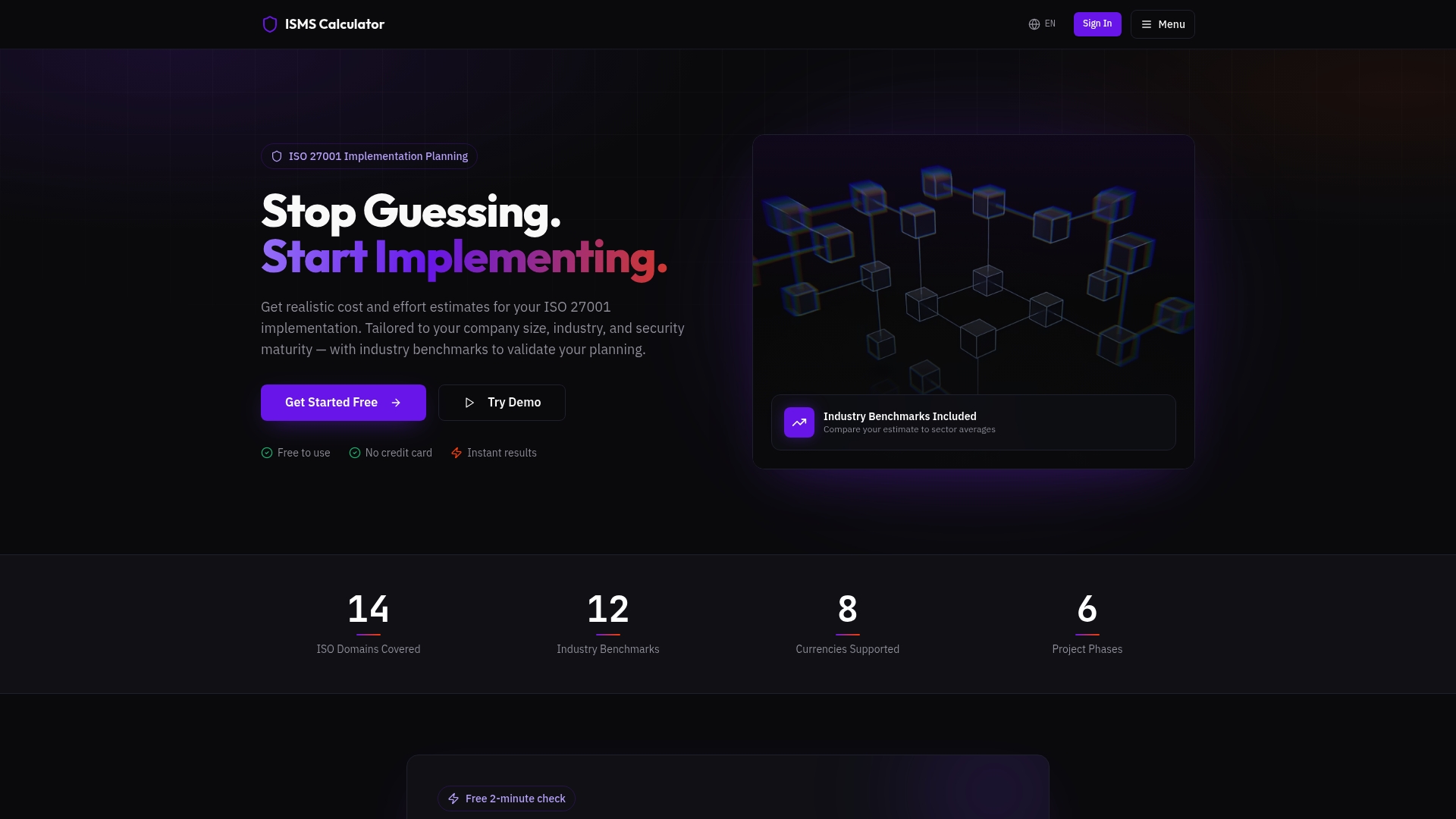
Pour la planification multi-sites spécifiquement, l'outil vous permet d'enregistrer et de comparer plusieurs estimations, afin de modéliser côte à côte la différence entre un pilote à 5 sites et un déploiement complet à 20 sites. Des comparaisons avec des modèles de référence vous permettent de valider vos chiffres avant de vous engager sur une date de certification.
Trois points que la plateforme clarifie rapidement :
- Combien l'écart de remédiation entre votre maturité actuelle et la maturité requise pour la certification coûtera en heures internes et en accompagnement externe.
- Si votre calendrier est réaliste compte tenu du nombre de sites et de la complexité informatique.
- Quels domaines ISO 27001 représentent la charge d'effort la plus élevée sur l'ensemble de vos sites.
Commencez par le diagnostic de préparation gratuit en 2 minutes pour obtenir une évaluation d'adéquation immédiate, ou lancez l'évaluation complète de préparation ISO 27001 pour une estimation détaillée avec plan de projet Gantt et options d'introduction à un consultant.
Sources
Pour toute personne souhaitant vérifier les règles d'audit, les formules d'échantillonnage ou la transférabilité des sous-certificats avant de solliciter un organisme de certification, voici les sources à consulter directement :
- What is Multi-Site Certification for ISO 27001?
- ISO 27001 Multi-Site Certification Costs: 8 Tactics That Cut Your Audit Spend 40 Percent
- ISO 27001 Scope Example for Multi-Entity Organizations
Confirmez toujours les pratiques spécifiques à votre juridiction directement auprès de votre organisme de certification accrédité. L'IAF MD 1 fixe le plancher ; les organismes de certification individuels peuvent appliquer des exigences supplémentaires ou des plafonds sur le nombre de sites.
Recommandé
- Combien coûte la certification ISO 27001 ? | ISMS Calculator
- Liste de contrôle de certification ISO 27001 : 80 étapes vers la certification | ISMS Calculator
- ISO 27001 vs SOC 2 : lequel vous faut-il ? | ISMS Calculator
- Erreurs courantes de budgétisation ISO 27001 et comment les corriger | ISMS Calculator