
La plupart des organisations doivent prévoir entre 15 000 et 50 000 dollars pour la première année, avec des périmètres réduits avoisinant les 10 000 dollars et des environnements complexes multi-sites dépassant les 60 000 dollars. Les facteurs de variation les plus importants sont la taille du périmètre et le nombre d'heures internes sous-estimées. Les coûts récurrents après la certification s'élèvent généralement entre 5 000 et 25 000 dollars par an. Avant de fixer un chiffre définitif, réalisez une analyse d'écarts ou utilisez le test de maturité du calculateur SMSI afin de convertir ces fourchettes en un montant propre à votre organisation.
En bref :
- Les petites organisations à périmètre bien délimité peuvent s'attendre à dépenser environ 10 000 dollars au démarrage, tandis que les projets complexes multi-sites dépassent souvent les 60 000 dollars.
- Les principaux facteurs de coût sont la complexité du périmètre, les heures de travail du personnel interne et le niveau de maturité en sécurité de l'organisation avant le lancement du projet.
- Les dépenses externes comprennent l'analyse d'écarts, le développement de la documentation, les outils, les tests d'intrusion, les audits et les audits de surveillance, qui varient selon le périmètre et la taille de l'organisation.
- Les coûts de main-d'œuvre interne, souvent sous-estimés, peuvent osciller entre 12 000 et 54 000 dollars selon les heures investies et doivent être suivis dès le début du projet.
- Le recours à des devis à périmètre fixe, la négociation et les plateformes d'automatisation permettent de maîtriser les coûts et d'éviter les dépassements budgétaires lors de la mise en œuvre.
Table des matières
- Que comprend réellement un budget de projet ISO 27001 ?
- Quels facteurs font varier le coût de mise en œuvre ISO 27001 ?
- Faire soi-même, recourir à un consultant ou à une plateforme : quelle approche correspond à votre budget ?
- Combien de temps cela prend-il et à quel moment faut-il dépenser l'argent ?
- Comment budgétiser les heures que votre équipe ne comptabilise pas ?
- À quoi doit ressembler votre feuille de calcul budgétaire ?
- Comment éviter les dépassements de budget ISO 27001 ?
- Créez votre propre modèle de budget par postes
- Que dire à la direction financière avant de valider le chiffre ?
- Obtenez un budget ISO 27001 personnalisé en deux minutes
- D'où proviennent ces chiffres ?
- Sources
Que comprend réellement un budget de projet ISO 27001 ?
Un budget de projet ISO 27001 se compose en réalité de huit ou neuf postes distincts, et non d'un forfait global unique. Certains sont des coûts ponctuels liés à l'obtention initiale de la certification. D'autres se répètent chaque année aussi longtemps que vous détenez le certificat. Les distinguer est ce qui permet de construire un chiffre défendable plutôt qu'une simple estimation.
La norme elle-même. Vous devez disposer d'un exemplaire sous licence de la norme ISO/IEC 27001 et, dans la plupart des cas, de l'ISO/IEC 27002 pour les conseils de mise en œuvre des mesures de sécurité. Ces deux documents coûtent ensemble environ 170 à 300 dollars, soit une dépense négligeable comparée au reste, mais négliger cette étape signifie que votre équipe met en œuvre à partir de résumés de seconde main plutôt que des exigences réelles.
Analyse d'écarts. Il s'agit d'une évaluation formelle comparant vos mesures actuelles aux 93 mesures de l'Annexe A. Prévoyez 2 000 à 10 000 dollars selon le périmètre, et considérez-la comme l'investissement le plus rentable, car elle révèle la véritable ampleur du projet avant que vous ne vous engagiez sur un budget plus important.
Développement de la documentation et des politiques. La rédaction des politiques du Système de Management de la Sécurité de l'Information (SMSI), du registre des risques, de la Déclaration d'Applicabilité et des procédures. Les organisations qui externalisent cette tâche paient généralement entre 5 000 et 20 000 dollars ; celles qui la réalisent en interne paient en heures de travail à la place (voir plus bas).
Outils et mesures techniques. Cela couvre les logiciels GRC, l'analyse des vulnérabilités, le chiffrement, la gestion des accès et les mises à niveau de journalisation nécessaires pour combler les écarts de contrôle. Très variable, souvent entre 3 000 et 25 000 dollars selon votre infrastructure existante.
Tests d'intrusion. La plupart des organismes de certification exigent des preuves de tests techniques. Un test d'intrusion coûte entre 4 000 et 15 000 dollars, tandis que l'analyse automatisée des vulnérabilités est plus proche de 1 000 à 5 000 dollars par an.
Audit interne. Composante obligatoire du SMSI, réalisé soit par du personnel formé, soit par un auditeur externalisé, pour un coût généralement compris entre 2 000 et 8 000 dollars par cycle.
Audits de certification de phase 1 et de phase 2. La phase 1 vérifie la conformité documentaire (souvent 1 à 2 jours d'audit) ; la phase 2 vérifie l'efficacité opérationnelle (généralement quelques jours supplémentaires). Au total, une entreprise de taille moyenne nécessite souvent 8 à 12 jours d'audit, avec des frais d'organisme de certification compris entre 12 000 et 22 000 dollars pour les deux phases.
Audits de surveillance. Visites annuelles de contrôle durant votre cycle de certification de trois ans, généralement entre 3 000 et 8 000 dollars par visite.
Compléments courants qui prennent les équipes par surprise : un contrat de RSSI virtuel (vCISO) à temps partiel pour la supervision continue, des frais d'échantillonnage supplémentaires pour les organisations multi-sites, et les dépenses de remédiation si l'analyse d'écarts révèle des défaillances majeures de mesures à corriger avant la phase 1.
Quels facteurs font varier le coût de mise en œuvre ISO 27001 ?
Deux organisations de même taille peuvent dépenser des montants très différents. L'écart tient presque toujours à quatre variables.
- Effectif. Les organismes de certification ajustent le nombre de jours d'audit en fonction de l'effectif, car un plus grand nombre de personnes signifie davantage de preuves à échantillonner et plus d'entretiens à mener. Une entreprise de 20 personnes peut nécessiter 5 à 6 jours d'audit ; une entreprise de 200 personnes en nécessite peut-être 12 ou plus.
- Complexité du périmètre. Chaque système, site, environnement cloud ou fournisseur critique supplémentaire élargit le périmètre d'audit. Une entreprise SaaS mono-site avec trois systèmes principaux s'audite plus rapidement qu'un industriel implanté sur cinq sites avec une infrastructure sur site héritée.
- Maturité en sécurité au démarrage. Un programme construit de zéro coûte bien plus cher, tant en heures qu'en honoraires de conseil, qu'un programme mature disposant déjà de revues d'accès, de cycles de correctifs et de journalisation des incidents.
- Organisme de certification et approche d'échantillonnage. Les différents organismes de certification accrédités appliquent des tarifs journaliers distincts et des méthodologies d'échantillonnage différentes pour les organisations multi-sites ; obtenir deux ou trois devis avant de signer est donc aussi important que de définir le périmètre des travaux.
Faire soi-même, recourir à un consultant ou à une plateforme : quelle approche correspond à votre budget ?
Chaque approche de mise en œuvre ISO 27001 implique un arbitrage entre dépenses externes et heures internes. Il n'existe pas d'option gratuite, seulement un choix quant à l'endroit où le coût se répercute.
- Faire soi-même (piloté en interne). Votre équipe construit le SMSI en s'appuyant sur la norme, des guides gratuits et la main-d'œuvre interne. Les dépenses externes restent faibles — souvent limitées aux frais d'audit et aux licences de la norme —, mais les heures internes représentent 200 à 600 heures sur l'ensemble du projet. Cette approche fonctionne lorsque vous disposez déjà d'un collaborateur compétent en sécurité ayant de la disponibilité, et elle échoue lorsque cette personne est déjà à plein temps sur autre chose.
- Piloté par un consultant. Un consultant externe ISO 27001 réalise l'analyse d'écarts, rédige la documentation et accompagne votre équipe tout au long de la mise en œuvre. Les missions complètes pour PME coûtent généralement entre 15 000 et 50 000 dollars, parfois facturées entre 150 et 300 dollars de l'heure. Vous gagnez en rapidité et en assurance de préparation à l'audit, au prix d'une facture plus élevée.
- Soutenu par une plateforme. Les plateformes GRC et d'automatisation de la conformité prennent en charge la collecte de preuves, les modèles de politiques et le suivi des mesures via un abonnement, généralement entre 7 000 et 30 000 dollars par an. Cela réduit les délais et diminue les heures internes qui seraient autrement consacrées à la collecte manuelle de preuves, sans pour autant éliminer le besoin d'une personne qui comprend la norme.
La plupart des équipes expérimentées optent pour une approche hybride : automatisation via une plateforme pour les preuves et le suivi, un consultant pour l'analyse d'écarts et l'accompagnement à l'audit, et le personnel interne pour les travaux de politique qu'eux seuls peuvent contextualiser correctement. Si votre organisation est cloud native, définir les outils autour de votre stack technique réel avant de choisir une approche évite de payer pour des fonctionnalités dont vous n'avez pas besoin.
Combien de temps cela prend-il et à quel moment faut-il dépenser l'argent ?
Un calendrier compressé de 3 mois est envisageable pour une très petite organisation mature, mais une durée de 6 à 9 mois est la fourchette réaliste pour la plupart des PME, et les périmètres complexes ou multi-sites s'étendent régulièrement sur 9 à 12 mois ou plus.
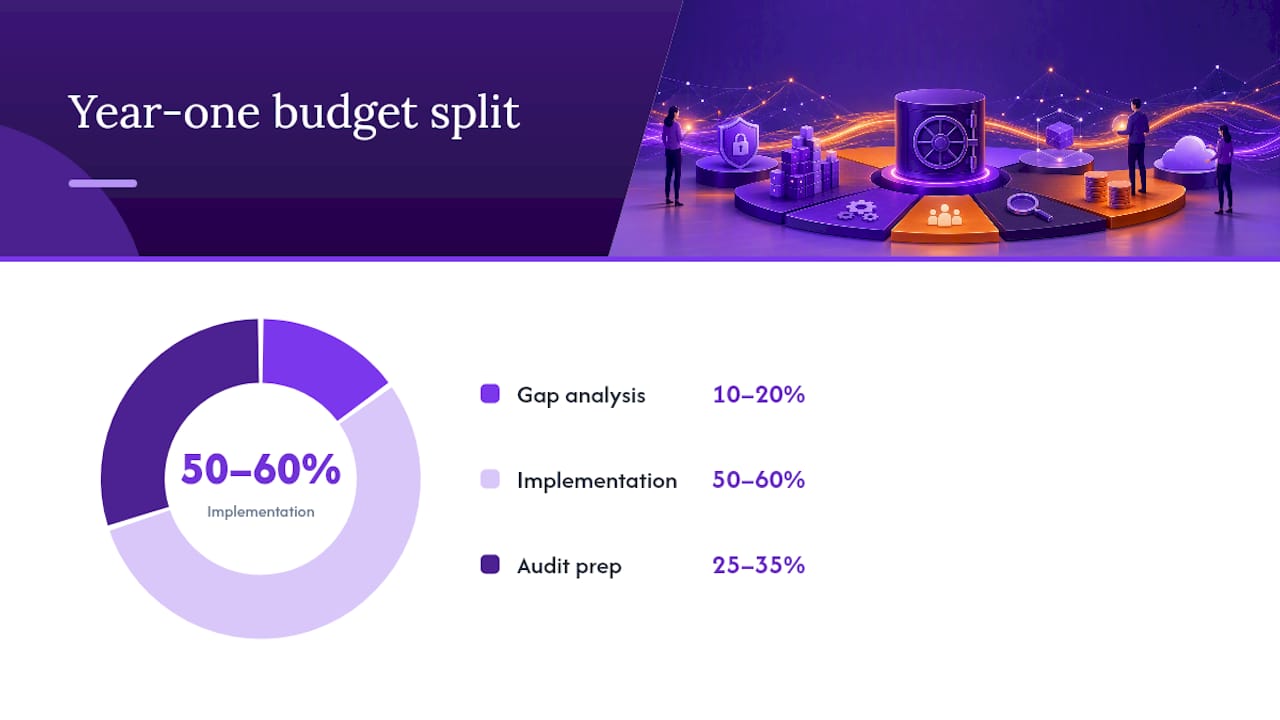
Les dépenses ne se répartissent pas uniformément sur cette période. Une ventilation approximative par phase du budget de première année se présente comme suit :
- Analyse d'écarts et démarrage (mois 1 à 2) : 10 à 20 % du budget de première année.
- Mise en œuvre, mesures et documentation (mois 2 à 6) : 50 à 60 % du budget de première année, la phase la plus lourde tant en honoraires de conseil qu'en heures internes.
- Préparation à l'audit et certification (mois 6 à 9) : 25 à 35 % du budget de première année, couvrant l'audit interne, la remédiation et les frais de phases 1 et 2.
Comprimer le calendrier ne réduit pas le total, il le concentre. Accélérer la mise en œuvre en trois mois signifie généralement payer des tarifs de consultant majorés et enchaîner les tests d'intrusion et les audits sans échelonnement, ce qui augmente le pic de décaissement même lorsque le budget total reste similaire.
Comment budgétiser les heures que votre équipe ne comptabilise pas ?
La main-d'œuvre interne est le coût que la plupart des responsables sécurité sous-estiment, et c'est généralement la raison pour laquelle les budgets dépassent les prévisions. La solution est une simple conversion : nombre total d'heures estimées multiplié par un taux horaire moyen pondéré selon les rôles impliqués, ce qui donne votre coût interne.
Les données des praticiens situent le travail interne de mise en œuvre à 200 à 600 heures, réparties entre le personnel sécurité, l'informatique, les RH et les responsables de service sollicités pour les preuves et les entretiens. À un taux moyen pondéré de 60 à 90 dollars de l'heure une fois le temps de management inclus, cela représente entre 12 000 et 54 000 dollars de coûts salariaux qui n'apparaissent jamais sur une facture fournisseur mais se répercutent absolument en perte de productivité par ailleurs.
Les postes les plus chronophages sont prévisibles :
- Rédaction des politiques et procédures.
- Collecte de preuves et documentation pour chaque mesure.
- Travaux de remédiation identifiés lors de l'analyse d'écarts.
- Temps de réunion lors des entretiens avec les parties prenantes et des cycles de révision.
Conseil pratique : Consignez les heures dans un journal partagé dès la première semaine, même approximativement. La plupart des équipes ne prennent conscience du temps consommé par ISO 27001 qu'après coup, quand il est trop tard pour renégocier le périmètre ou demander des ressources supplémentaires.
Vous pouvez réduire ce poste grâce à des modèles de politiques plutôt qu'une rédaction de zéro, à l'automatisation de la collecte de preuves, à des formations ciblées pour que moins de personnes aient besoin d'être guidées à travers la norme, et à un soutien ponctuel de prestataires externes spécifiquement lors du pic de documentation. Aucune de ces mesures n'élimine totalement les heures, mais chacune réduit réellement le total d'un certain pourcentage.
À quoi doit ressembler votre feuille de calcul budgétaire ?
Voici une feuille de calcul de départ que vous pouvez copier dans un tableur et adapter à votre périmètre réel. Utilisez la colonne basse pour une PME à périmètre réduit mono-site et sécurité mature ; la colonne typique pour une mise en œuvre standard de marché intermédiaire ; la colonne haute pour les périmètres entreprise, multi-sites ou à faible maturité de départ.
Ajustez la ligne de contingence en fonction de votre degré de confiance dans chaque donnée ; les chiffres issus d'un modèle de référence méritent une marge plus large qu'un devis signé en main. Si un poste ne s'applique pas à votre organisation, mettez-le à zéro plutôt que de supprimer la ligne, afin que la direction financière puisse voir ce qui a été considéré et exclu.
Comment éviter les dépassements de budget ISO 27001 ?
La maîtrise des coûts d'un projet ISO 27001 se joue à la table de négociation, pas après réception de la facture.
- Demandez aux organismes de certification une approche d'échantillonnage définie si vous avez plusieurs sites ; moins de sites échantillonnés signifie moins de jours d'audit facturables.
- Demandez aux cabinets de conseil des devis à périmètre fixe avec des plafonds de jours et des livrables nommés, plutôt que des estimations horaires ouvertes.
- Utilisez l'automatisation des plateformes spécifiquement pour réduire les heures internes récurrentes que les audits de surveillance exigent chaque année.
- Obtenez un prix écrit pour les audits de surveillance dès le départ, et pas uniquement le devis de certification initiale.
Conseil pratique : Tout devis ne citant que le chiffre de la première année et restant muet sur la tarification des audits de surveillance est un signal d'alarme. Il en va de même pour un énoncé de périmètre vague, l'absence de détail sur les jours d'auditeur, ou une facturation horaire sans plafond. Les erreurs de budgétisation courantes ont tendance à se reproduire d'un projet à l'autre, ce qui les rend faciles à détecter avant de signer quoi que ce soit. Une revue sécurité succincte réalisée par un partenaire comme Cost Beacon peut également identifier des dépenses technologiques que vous intégreriez sinon par défaut au budget ISO.
Créez votre propre modèle de budget par postes
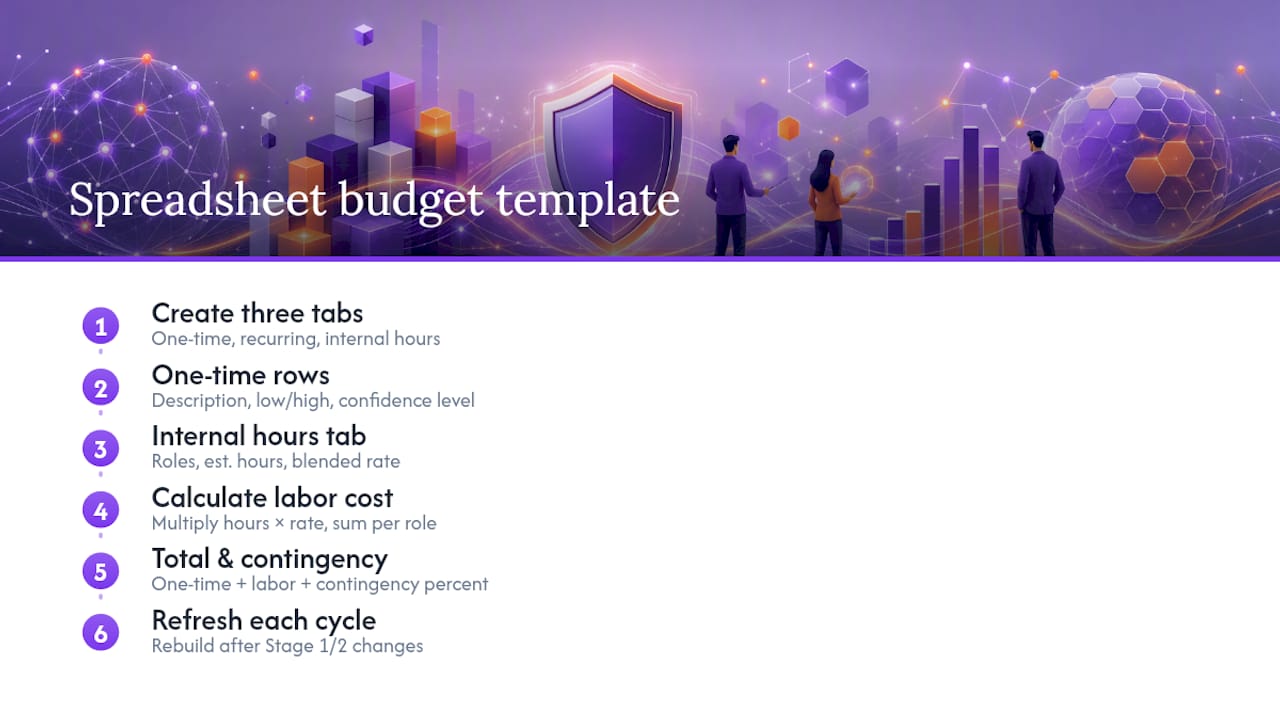
Commencez avec trois onglets dans un tableur : coûts ponctuels, coûts récurrents et heures internes. Chaque ligne de coût ponctuel nécessite quatre colonnes : description, estimation basse, estimation haute et niveau de confiance. Le niveau de confiance compte plus qu'on ne le croit généralement. Un devis que vous avez en main mérite une fourchette resserrée ; un chiffre publié issu d'un guide mérite une fourchette plus large, souvent de moins 25 % à plus 75 %, tant que vous n'avez pas de chiffre réel.
Pour l'onglet des heures internes, listez chaque rôle impliqué (responsable sécurité, administrateur informatique, RH, responsables de département), les heures estimées par rôle et un taux horaire moyen par rôle. Multipliez et additionnez pour obtenir votre coût total de main-d'œuvre. C'est l'onglet que la plupart des modèles omettent, et c'est celui qui vous évite une mauvaise surprise en cours de projet.
Ajoutez une ligne de formule qui totalise les coûts ponctuels plus les heures internes converties en euros plus un pourcentage de contingence, ce qui vous donne le chiffre que vous présentez réellement à la direction financière. Reconstruisez ce modèle à chaque cycle de certification plutôt que de réutiliser l'original, car votre niveau de maturité et votre périmètre évoluent une fois que vous avez traversé les phases 1 et 2 une première fois.
Que dire à la direction financière avant de valider le chiffre ?
Un argumentaire efficace auprès de votre DAF ressemble à ceci : « ISO 27001 coûte X euros la première année et Y euros annuellement ensuite, principalement déterminés par le périmètre et les heures internes ; une analyse d'écarts à 2 000–10 000 dollars affinera cette estimation avant tout engagement. » Suivez le délai d'obtention de la certification, le pourcentage de mesures opérationnelles et le coût prévisionnel des audits de surveillance comme KPI principaux, et faites approuver l'analyse d'écarts avant de présenter un chiffre définitif.
— Martin
Obtenez un budget ISO 27001 personnalisé en deux minutes
Toutes les fourchettes présentées dans cet article sont un point de départ, pas votre chiffre définitif. Votre montant réel dépend de votre effectif, de votre périmètre, de votre secteur d'activité et du niveau de maturité de vos mesures actuelles — ce qu'un guide budgétaire générique ne peut précisément pas vous indiquer. Un calculateur en temps réel peut combler cet écart : saisissez la taille de votre entreprise, votre secteur et votre maturité en sécurité, et il génère une estimation de coût et d'effort personnalisée, comparée à un modèle de référence transparent.
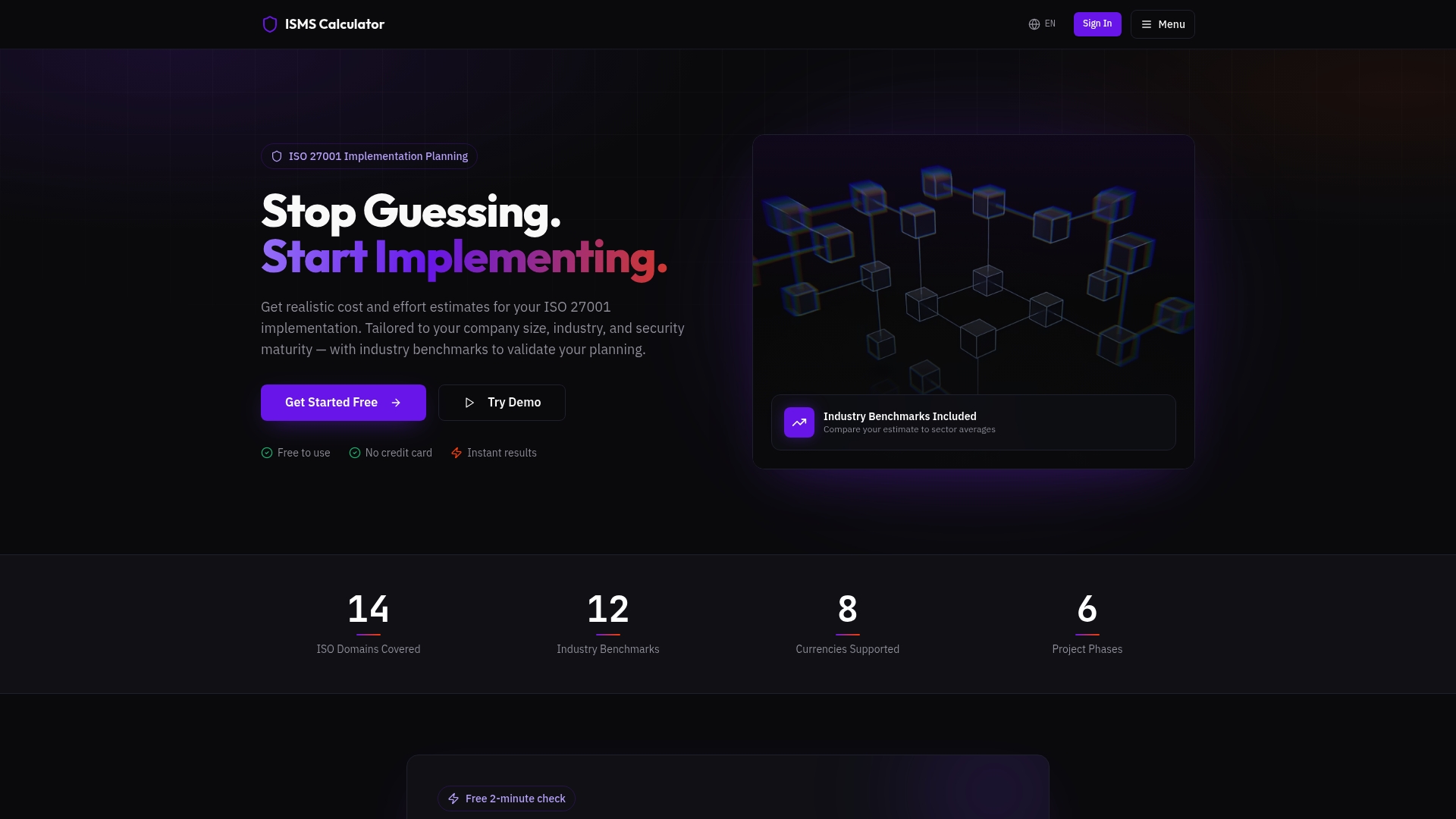
Au-delà de l'estimation elle-même, les fonctionnalités incluent souvent une évaluation de la maturité sur les quatre thèmes de mesures de l'ISO/IEC 27001:2022, un diagramme de Gantt personnalisable pour phasage de la mise en œuvre, et la possibilité de sauvegarder et comparer plusieurs scénarios budgétaires avant de les présenter à la direction financière. Si vous êtes encore en train de préparer votre analyse d'écarts, commencez par l'évaluation de maturité ISO 27001 gratuite — un test de deux minutes qui traduit les fourchettes de cet article en chiffres propres à votre organisation.
D'où proviennent ces chiffres ?
- La page certification de l'ISO confirme que les audits sont réalisés par des organismes de certification indépendants et accrédités, ce qui explique pourquoi les tarifs varient selon le prestataire plutôt que de suivre un barème ISO fixe.
- La ventilation des coûts de certification ISO 27001 a fourni l'essentiel des fourchettes de montants utilisées dans les sections relative aux coûts, à la feuille de calcul et aux approches de mise en œuvre.
- Le livre blanc de 27001Academy sur la budgétisation a fondé la méthode de conversion des heures internes et l'approche par niveau de confiance utilisée dans le modèle de feuille de calcul.
Sources
- Coût de la certification ISO 27001 en 2026 : ventilation complète
- How to Budget an ISO 27001 Implementation Project
- Certification — ISO