
ISO 27001 supplier management is the structured process of applying specific organizational controls to manage information security risks that arise from suppliers and third-party vendors. Under ISO 27001:2022, this process is governed by controls A.5.19 through A.5.23, covering everything from policy requirements to cloud service security. The organizational security perimeter now extends to every vendor with access to your systems or data. Compliance professionals and IT managers who treat supplier risk as an internal matter alone will fail audits and expose their organizations to preventable breaches.
What are the main ISO 27001 supplier management controls?
ISO 27001:2022 mandates five controls in the organizational theme specifically for supplier management, labeled A.5.19 through A.5.23. Each control targets a distinct phase of the supplier relationship lifecycle.
- A.5.19 — Information security in supplier relationships. This control requires a formal policy governing how your organization selects, engages, and manages suppliers. The policy must define minimum security expectations before any contract is signed.
- A.5.20 — Addressing information security within supplier agreements. Every supplier contract must contain specific, measurable security obligations. Vague language like “the supplier will maintain appropriate security” does not satisfy this control.
- A.5.21 — Managing information security in the ICT supply chain. This control targets the technology supply chain specifically, requiring you to assess security risks introduced by hardware, software, and service components from third parties. A compromised software library from a sub-vendor counts as your risk.
- A.5.22 — Monitoring, reviewing, and managing changes to supplier services. Security obligations do not end at contract signing. This control requires ongoing performance reviews, change management processes, and documented evidence of supplier compliance over time.
- A.5.23 — Information security for use of cloud services. Cloud suppliers introduce unique risks that standard supplier controls do not fully address. This control requires tailored contractual and monitoring safeguards specific to cloud environments.
Pro Tip: Map each of the five controls to a named internal owner. Controls without owners become paper-only compliance within six months of certification.
Understanding the ICT supply chain risk implications of A.5.21 is particularly critical for technology-heavy organizations. A single unvetted software dependency can introduce vulnerabilities that bypass every internal control you have built.

How do enforceable supplier security clauses work in ISO 27001 contracts?
Contracts must contain specific, measurable security obligations rather than aspirational language. Security clauses such as AES-256 encryption, breach notification timelines within 4 hours, and right-to-audit provisions transform high-level security goals into enforceable tasks. Without this specificity, a supplier can claim compliance while operating far below your required security baseline.
Typical clauses that satisfy A.5.20 include:
- Encryption standards. Specify the algorithm and key length required for data at rest and in transit. AES-256 is the accepted minimum for sensitive data.
- Incident notification timelines. Define the exact window within which a supplier must notify you of a breach. Four hours is a common contractual standard for critical suppliers.
- Right-to-audit. Reserve the right to conduct or commission security audits of the supplier’s environment. This clause is often contested during negotiations.
- Data handling and retention. Specify how the supplier must store, process, and delete your data, including what happens to data at contract termination.
- Sub-processor disclosure. Require the supplier to notify you before engaging any sub-contractor who will access your information.
Audit rights clauses are often contentious. When a vendor refuses to grant audit access, that refusal must be logged as a documented vulnerability in your risk register. This creates a defensible audit trail showing your organization recognized and recorded the gap.
Pro Tip: When a supplier refuses a specific clause, document the refusal, the risk it creates, and the compensating control you applied. Auditors accept managed risk far more readily than undocumented gaps.
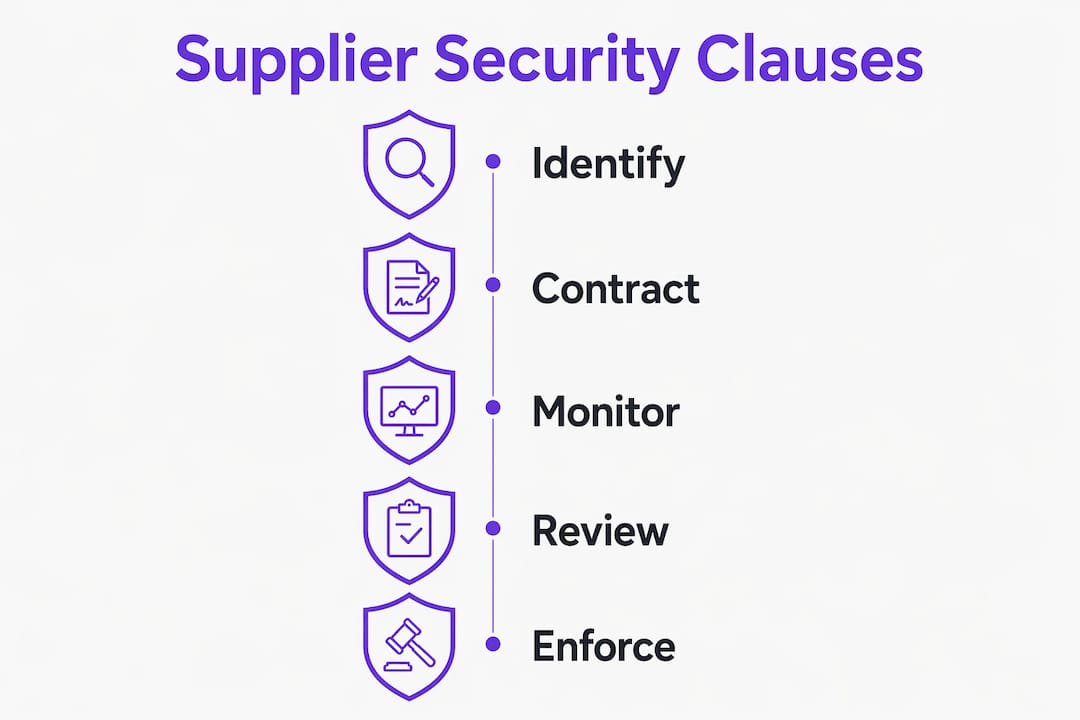
The goal of these clauses is accountability. They shift the relationship from a handshake agreement to a contractual mandate where non-compliance has defined consequences.
What is the process for identifying, classifying, and risk-assessing suppliers?
Effective vendor lifecycle management begins with a complete supplier inventory. You cannot manage risks you have not identified. Many organizations discover during their first ISO 27001 audit that they have dozens of active suppliers with data access that no one formally approved.
Follow these steps to build a defensible supplier risk classification system:
- Build a complete supplier inventory. List every third party with access to your systems, data, or physical premises. Include SaaS tools, cloud platforms, maintenance contractors, and professional services firms.
- Classify suppliers by risk tier. Group suppliers based on the sensitivity of data they access and the criticality of the services they provide. A payroll processor handling employee data sits in a different risk tier than a courier service.
- Conduct risk assessments tailored to each tier. High-risk suppliers require detailed security questionnaires, evidence reviews, and potentially on-site assessments. Low-risk suppliers may require only a self-certification form.
- Link the risk register to your Statement of Applicability. Supplier risk registers must connect directly to the Statement of Applicability and reflect active risk treatment, not just planned controls. Auditors check this linkage explicitly.
- Implement risk-based vetting before onboarding. Pre-engagement assessment prevents you from inheriting a supplier’s security weaknesses from day one. Vetting after onboarding is reactive and costly.
- Assign owners and review cadences. Every supplier record needs a named owner and a scheduled review date. Static documentation that no one updates is a common audit failure point.
Pro Tip: Conduct a 15-minute pre-onboarding call with every new supplier to review your minimum security requirements. Suppliers who push back at this stage are telling you something important about how they will behave under pressure.
Lean, living documentation with assigned owners and measurable acceptance criteria outperforms large static project files every time. Auditors look for records that match live operations, not records that describe what you planned to do two years ago.
How to implement ongoing monitoring and review of supplier security compliance
Signing a contract satisfies A.5.20. Monitoring what happens after signing satisfies A.5.22. The distinction matters because most security incidents involving suppliers occur months or years after the initial agreement, when attention has shifted elsewhere.
Effective ongoing monitoring includes these mechanisms:
- Scheduled performance reviews. Conduct formal reviews at least annually for all suppliers and quarterly for high-risk suppliers. Review security incident logs, patch management records, and any changes to their security posture.
- Change management controls. Require suppliers to notify you before making significant changes to their infrastructure, personnel, or sub-processors. Unannounced changes are a leading source of supply chain risk.
- Audit verification activities. Exercise your right-to-audit clauses periodically. Accepting a supplier’s ISO 27001 certificate as permanent proof of compliance without periodic verification is a gap auditors will flag.
- KPI tracking. Define measurable acceptance criteria for each supplier. Examples include patch cycle time, mean time to notify on incidents, and uptime against agreed service levels.
| Supplier tier | Review frequency | Verification method |
|---|---|---|
| Critical | Quarterly | On-site or third-party audit |
| High | Semi-annual | Security questionnaire plus evidence review |
| Medium | Annual | Self-certification with spot checks |
| Low | Biennial | Self-certification |
ISO 27001 audit success depends on demonstrating measured and maintained control operations rather than producing voluminous documentation. A single well-maintained supplier review log carries more weight with an auditor than a 200-page policy document that no one references.
Pro Tip: Set calendar reminders for every supplier review date at the start of each year. Missed reviews are one of the most common nonconformities raised during ISO 27001 surveillance audits.
What special considerations apply to cloud service suppliers under ISO 27001?
Control A.5.23 exists because cloud suppliers introduce unique risks that standard supplier controls do not fully address. The shared responsibility model is the central challenge. Cloud providers manage security of the cloud infrastructure, while you remain responsible for security in the cloud, meaning your data, configurations, and access controls.
Key considerations for cloud supplier management under ISO 27001 include:
- Clarify the shared responsibility boundary in writing. Your contract must specify exactly which security controls the cloud provider owns and which you own. Ambiguity here becomes your liability during an incident.
- Address data residency and sovereignty. Specify the geographic regions where your data may be stored and processed. This is particularly critical for organizations subject to GDPR or sector-specific data regulations.
- Require transparency on sub-processors. Major cloud platforms use dozens of sub-processors. Your contract must require disclosure of any sub-processor that handles your data.
- Define availability and recovery obligations. Cloud outages affect your operations. Contractual recovery time objectives and recovery point objectives protect you when availability fails.
- Monitor configuration drift. Cloud environments change rapidly. Automated configuration monitoring tools detect when security settings drift from your approved baseline.
The ISO 27001 readiness assessment process for cloud suppliers requires the same rigor as for on-premise vendors, with additional attention to the contractual boundaries that define where your responsibility begins.
Key takeaways
ISO 27001 supplier management requires five specific controls, enforceable contracts, risk-tiered assessments, and continuous monitoring to maintain audit readiness and protect information assets.
| Point | Details |
|---|---|
| Five core controls | ISO 27001:2022 controls A.5.19 through A.5.23 govern the full supplier management lifecycle. |
| Enforceable contract clauses | Contracts must specify encryption standards, breach notification timelines, and audit rights. |
| Risk-tiered supplier inventory | Classify all suppliers by data access and service criticality before assigning assessment depth. |
| Living documentation | Supplier risk registers must link to the Statement of Applicability and reflect active treatment. |
| Continuous monitoring | Schedule reviews by supplier tier and exercise audit rights periodically, not just at onboarding. |
What I’ve learned from watching supplier management audits go wrong
The most common failure I see is not a missing policy. It is a policy that exists but does not match what anyone actually does. An organization will have a supplier risk register listing 12 vendors, but their actual cloud and SaaS footprint includes 60. Auditors find this gap within the first hour of a stage-two audit, and it creates a nonconformity that delays certification by months.
The second pattern is treating contract signing as the finish line. Compliance professionals who negotiate strong clauses but never exercise audit rights or conduct performance reviews are building a paper fortress. The controls look correct on paper. The actual risk is unmanaged.
My practical advice is to start with your supplier inventory before you touch any policy document. Get the real list. Talk to procurement, finance, and IT operations separately, because each team knows about different vendors. Once you have the complete picture, classification and risk assessment become straightforward.
On contract negotiations, do not let perfect be the enemy of good. A supplier who refuses your right-to-audit clause is not automatically disqualified. Document the refusal, apply a compensating control such as requiring their ISO 27001 or SOC 2 certificate annually, and log the residual risk. That approach satisfies auditors far better than either abandoning the clause silently or walking away from a critical supplier relationship.
The organizations that pass supplier management audits cleanly are the ones who treat their vendor list as a living security asset, not an administrative record.
— Martin
How Ismscalculator supports your supplier management readiness
Supplier management is one of the most documentation-intensive areas of ISO 27001 implementation. Knowing where your gaps are before an auditor finds them is the difference between a clean certification and a costly remediation cycle.
Ismscalculator includes a free 2-minute readiness check that covers supplier management controls alongside all four ISO/IEC 27001:2022 control themes. The platform delivers tailored estimates based on your organization’s size, industry, and current security maturity. For teams that need deeper support, the independent consultant directory connects you with lead auditors and implementers who specialize in supplier risk management. Use Ismscalculator to validate your supplier management approach against real model reference comparisons before your certification audit.
FAQ
What controls govern ISO 27001 supplier management?
ISO 27001:2022 defines five supplier management controls: A.5.19 through A.5.23. These cover supplier policy, contractual security requirements, ICT supply chain risk, ongoing monitoring, and cloud service security.
What must be included in a supplier security contract clause?
Contracts must specify measurable obligations such as AES-256 encryption, breach notification timelines, right-to-audit provisions, and data handling requirements. Vague language does not satisfy control A.5.20.
How often should supplier security reviews be conducted?
Critical suppliers require quarterly reviews, high-risk suppliers require semi-annual reviews, and lower-risk suppliers require annual or biennial reviews. Review frequency should match the supplier’s risk tier and data access level.
What happens if a supplier refuses an audit rights clause?
Refusal must be logged as a documented risk in your risk register. A compensating control, such as requiring an annual ISO 27001 or SOC 2 certificate, should be applied and recorded to maintain a defensible audit trail.
How does ISO 27001 address cloud service suppliers specifically?
Control A.5.23 requires organizations to address information security in cloud supplier relationships through tailored contractual safeguards and ongoing monitoring. The shared responsibility model must be clearly defined in the contract.