
ISO/IEC 27001 est la norme internationale pour la mise en place d'un système de management de la sécurité de l'information (SMSI), et si vous planifiez sa mise en œuvre, le chiffre qui compte le plus n'est pas la date d'audit. C'est la période d'environ trois mois de preuves de fonctionnement que les organismes de certification exigent avant même de planifier votre audit de Phase 2. Cette seule exigence, plus que toute autre chose, détermine le calendrier de votre projet.
La plupart des organisations se situent entre 3 et 18 mois selon leur taille et leur maturité existante, et le certificat lui-même, une fois obtenu, reste valide pour une période pluriannuelle avec des contrôles de surveillance réguliers entre-temps.
Avant d'établir un budget, clarifiez trois postes de coûts :
- Les heures des responsables internes consacrées au périmètre, à la documentation et à la collecte de preuves.
- Les jours d'audit pour la Phase 1 et la Phase 2, facturés par un organisme de certification accrédité.
- Les dépenses éventuelles de conseil ou d'automatisation pour combler les écarts plus rapidement que votre équipe interne ne pourrait le faire seule.
Points clés à retenir
Le succès de la certification ISO 27001 repose sur le fait de considérer la fenêtre de trois mois de preuves de fonctionnement, et non le calendrier d'audit, comme le véritable pilote du calendrier.
| Point | Détails |
|---|---|
| Le délai de constitution des preuves conditionne le calendrier | Les organismes de certification attendent environ trois mois de preuves de fonctionnement avant les audits de Phase 2. |
| Le calendrier varie selon la maturité | Les petites équipes bien préparées peuvent être certifiées en 3 à 4 mois ; les grands projets multi-sites peuvent prendre 18 mois ou plus. |
| Budgétiser au-delà des frais d'audit | Les coûts totaux de première année pour une organisation de taille intermédiaire s'élèvent couramment de 73 500 $ à 208 000 $, incluant la main-d'œuvre, les consultants et les audits. |
| Réduire le périmètre diminue les coûts le plus rapidement | Un périmètre plus étroit signifie moins de mesures de l'Annexe A à mettre en œuvre et moins de preuves à échantillonner. |
| Réserver l'organisme de certification tôt | Planifiez votre organisme de certification accrédité au plus tard au 6e mois pour éviter les retards liés à la disponibilité des auditeurs. |
Sommaire
- Vue d'ensemble ISO 27001 : principes fondamentaux et la triade CID
- Ce que contient la norme et les modifications de l'Annexe A en 2022
- Combien de temps prend réellement la certification ISO 27001 ?
- Quel est le coût de la mise en œuvre d'ISO 27001 ?
- Votre liste de contrôle de préparation à ISO 27001
- Comment ISMS Calculator transforme ce résumé en chiffres concrets
- Vue d'ensemble et objectif de l'ISO 9001 comparés à ISO 27001
- Principes clés d'un système de management de la sécurité de l'information
- Exigences et preuves que les auditeurs vérifient réellement
- Avantages de la certification
- Où les projets ISO 27001 échouent généralement
- Pourquoi la plupart des calendriers ISO 27001 sont erronés dès le départ
- Sources
Vue d'ensemble ISO 27001 : principes fondamentaux et la triade CID
En faisant abstraction de la paperasse, ISO/IEC 27001 pose une seule question : que pourrait-il arriver à vos informations, et que faites-vous pour y remédier ? La norme est fondée sur les risques et descendante, ce qui signifie que la direction définit d'abord le périmètre et l'appétence au risque, puis les mesures découlent de cette évaluation plutôt que d'une liste de contrôle générique. Elle fonctionne également selon un cycle d'amélioration continue : évaluer, mettre en œuvre, vérifier, ajuster, recommencer.
Tout se rapporte à la triade confidentialité, intégrité et disponibilité, généralement abrégée en CID :
- La confidentialité signifie que seules les personnes autorisées accèdent aux données clients, appliquée via des contrôles d'accès et le chiffrement.
- L'intégrité signifie que les données n'ont pas été altérées, raison pour laquelle les journaux de modifications et les preuves d'inviolabilité sont importants pour les auditeurs.
- La disponibilité signifie que les systèmes et les sauvegardes fonctionnent réellement en cas de besoin, et pas seulement qu'une politique de sauvegarde existe sur le papier.
Conseil pratique : Définissez vos priorités CID avant d'aborder l'Annexe A. Si la disponibilité est primordiale pour votre activité (par exemple, si vous exploitez des infrastructures), votre collecte de preuves devrait s'orienter vers les journaux de disponibilité et les tests de basculement, et pas seulement vers les revues d'accès.
Ces trois principes déterminent les limites de votre périmètre, les types de preuves que les auditeurs vont échantillonner, et finalement les mesures que vous sélectionnez et pouvez justifier.
Ce que contient la norme et les modifications de l'Annexe A en 2022
ISO/IEC 27001 se divise en deux parties : les articles principaux (4 à 10) et l'Annexe A, le catalogue des mesures de sécurité. Les articles suivent un schéma de système de management familier :
- Articles 4 à 5 : Contexte de l'organisation et engagement de la direction.
- Article 6 : Planification, incluant l'appréciation et le traitement des risques.
- Article 7 : Support : ressources, compétences, sensibilisation, documentation.
- Article 8 : Fonctionnement, où les mesures sont réellement appliquées.
- Articles 9 à 10 : Évaluation des performances et amélioration continue.
La révision de 2022 a remanié significativement l'Annexe A, réduisant 114 mesures à 93 et les regroupant en quatre thèmes : organisationnelles, relatives aux personnes, physiques et technologiques. Onze nouvelles mesures sont apparues, notamment la veille sur les menaces, la configuration de la sécurité cloud et le masquage des données, reflétant l'évolution considérable des infrastructures cloud depuis la version de 2013.
Ce qu'il faut retenir en pratique : votre Déclaration d'Applicabilité (DdA) est le document qui relie tout cela. Elle répertorie chaque mesure de l'Annexe A, indique si elle s'applique à votre organisation et justifie pourquoi. Les auditeurs traitent la DdA comme la carte de l'ensemble de votre SMSI, aussi construisez-la tôt plutôt que de la traiter comme une formalité administrative à terminer à la fin.
Combien de temps prend réellement la certification ISO 27001 ?
La certification se déroule en deux phases d'audit distinctes, et comprendre la différence change la façon dont vous planifiez votre calendrier.
- La Phase 1 est une revue documentaire. L'auditeur vérifie que le périmètre de votre SMSI, l'appréciation des risques, la DdA et les politiques existent et s'articulent de manière logique. Cela peut souvent avoir lieu relativement tôt, une fois vos documents fondamentaux rédigés.
- La Phase 2 vérifie que les mesures fonctionnent réellement comme documenté. Les auditeurs échantillonnent des preuves : journaux d'accès, registres de formations, tickets d'incidents, revues de fournisseurs. Ils veulent la preuve que le SMSI a été en fonctionnement, pas seulement conçu.
C'est pourquoi le délai de constitution des preuves de fonctionnement est si important. Les organismes de certification attendent généralement environ trois mois de fonctionnement démontré avant la Phase 2, car il est impossible d'échantillonner des preuves de choses qui n'ont commencé que la semaine dernière. Cela signifie que la capacité de votre équipe de mise en œuvre à générer des preuves continues et datées, et non le nombre de jours d'audit au calendrier, est généralement ce qui conditionne réellement votre calendrier.
Trois variables influencent le plus votre délai :
- Périmètre et taille. Une seule équipe produit couvrant un environnement AWS avance plus vite qu'une grande entreprise multi-sites avec des systèmes legacy.
- Maturité existante. Les organisations qui détiennent déjà une conformité SOC 2 ou HIPAA peuvent réutiliser une part significative de leurs politiques et preuves, réduisant le calendrier de plusieurs mois.
- Modèle de déploiement. Les équipes internes qui construisent tout de zéro prennent généralement plus de temps que les équipes utilisant un service géré ou une plateforme d'automatisation pour pré-alimenter les preuves.
Compte tenu de tout cela, une règle de planification pratique mérite d'être inscrite dans votre plan de projet : réservez votre organisme de certification au plus tard au 6e mois. Les agendas des auditeurs se remplissent vite, et une réservation tardive peut repousser votre date de Phase 2 de plusieurs semaines même si vos preuves sont prêtes. Les organismes de certification accrédités délivrent également des certificats valides pour trois ans, avec des audits de surveillance annuels pour maintenir le niveau en cours de route.
Quel est le coût de la mise en œuvre d'ISO 27001 ?
Pour une organisation de taille intermédiaire, le coût total de la première année s'élève couramment de 73 500 $ à 208 000 $, et cet écart dépend fortement de la part de travail externalisée par rapport à celle traitée en interne. Les budgets doivent tenir compte des composantes suivantes :
- Analyse des écarts : identification des pratiques actuelles ne répondant pas aux exigences de l'Annexe A, généralement la première prestation payante.
- Honoraires de conseil ou d'assistance : si vous ne construisez pas le SMSI avec une expertise interne.
- Main-d'œuvre interne : le coût caché que la plupart des budgets sous-estiment, car votre personnel de sécurité et informatique consacrera de nombreuses heures à la rédaction de politiques et à la collecte de preuves.
- Frais d'audit de Phase 1 et Phase 2 : versés à l'organisme de certification accrédité, calculés en fonction de la taille et du périmètre de l'organisation.
- Outils et formations : plateformes GRC, formations de sensibilisation à la sécurité et certifications du personnel.
Les programmes de conformité existants réduisent rapidement cette facture. Si vous détenez déjà une certification SOC 2, une part significative de vos preuves de contrôle d'accès et de gestion des fournisseurs est directement transférable, réduisant à la fois les heures de conseil et le temps de préparation à l'audit. Les outils d'automatisation qui collectent en continu des preuves depuis les environnements cloud réduisent également le travail manuel qui occupe autrement le personnel interne pendant des mois.
Conseil pratique : Obtenez des devis d'au moins deux organismes de certification accrédités avant de vous engager. Les tarifs journaliers des auditeurs varient plus que les gens ne le pensent, et l'offre la moins chère n'est pas toujours la plus rapide, car les contraintes de disponibilité peuvent importer plus que le prix.
Une dernière remarque sur l'accréditation : assurez-vous que l'organisme de certification que vous choisissez est bien accrédité par un organisme national d'accréditation reconnu. Un certificat délivré par un organisme non accrédité a beaucoup moins de valeur auprès des clients et des régulateurs, quelle que soit la rigueur de l'audit.
Votre liste de contrôle de préparation à ISO 27001
Transformer ce résumé en un véritable plan de projet se résume à cinq étapes séquentielles :
- Nommer un responsable unique. Les projets SMSI qui s'enlisent manquent généralement d'une seule personne ayant l'autorité de prendre les décisions relatives au périmètre et aux mesures.
- Définir le périmètre de manière précise. Un périmètre plus étroit — une ligne de produits ou un environnement cloud — signifie moins de mesures à mettre en œuvre et moins de preuves à échantillonner par la suite.
- Réaliser une analyse des écarts et une appréciation des risques. Cela produit votre projet de DdA et vous indique exactement quelles mesures de l'Annexe A s'appliquent.
- Décider entre faire en interne ou externaliser. Évaluez la mise en œuvre interne par rapport aux consultants ou à un service géré, et envisagez l'automatisation pour démarrer votre compteur de preuves plus tôt plutôt que plus tard.
- Planifier l'audit interne, la revue de direction et votre organisme de certification. Réservez l'organisme de certification au plus tard au 6e mois pour éviter de vous retrouver bloqué derrière les calendriers d'audit d'autres entreprises.
Des listes de contrôle plus détaillées et des conseils spécifiques au périmètre sont disponibles sur le blog d'ISMS Calculator si vous souhaitez approfondir l'une de ces étapes.
Comment ISMS Calculator transforme ce résumé en chiffres concrets
Un résumé vous dit ce qu'ISO 27001 exige. Il ne vous dit pas ce que votre organisation, spécifiquement, dépensera ni combien de temps votre équipe aura besoin. C'est précisément cet écart que l'outil d'estimation d'ISMS Calculator est conçu pour combler.
- Estimateur de coûts et d'efforts en temps réel : saisissez la taille de votre entreprise, votre secteur d'activité et votre maturité en sécurité actuelle, et obtenez une fourchette personnalisée plutôt qu'un chiffre générique de marché intermédiaire.
- Bilan de préparation gratuit en 2 minutes : un moyen rapide et sans engagement de voir où se situent vos lacunes avant d'engager un budget.
- Comparaisons avec des modèles de référence : comparez votre estimation à ce modèle de référence pour savoir si votre plan est réaliste ou optimiste.
- Évaluation de la maturité sur les quatre thèmes de mesures de l'Annexe A : identifie précisément quelles familles de mesures nécessitent le plus de travail.
- Diagrammes de Gantt personnalisables : transformez la liste de contrôle ci-dessus en un véritable calendrier de mise en œuvre avec des phases et des dépendances.
Une fourchette de délai générique vous indique ce qui est typique. Une estimation personnalisée vous indique ce que votre organisation devrait réellement prévoir, en fonction de votre taille, de votre secteur et de votre point de départ.
Conseil pratique : Effectuez le bilan de préparation gratuit avant d'approcher votre conseil d'administration pour l'approbation du budget. Un chiffre précis et référencé est bien plus convaincant que « quelque part entre trois et douze mois ».
Vue d'ensemble et objectif de l'ISO 9001 comparés à ISO 27001
Les responsables conformité qui définissent le périmètre d'un projet ISO 27001 sont parfois orientés vers des ressources sur l'ISO 9001, et il vaut la peine d'être précis sur la différence afin que votre demande de budget cible la bonne norme. L'ISO 9001 régit les systèmes de management de la qualité, axés sur la cohérence de la livraison des produits et services, la satisfaction client et la maîtrise des processus. Elle répond à des questions telles que « notre processus de fabrication satisfait-il de manière fiable aux spécifications ? »
ISO/IEC 27001, en revanche, régit spécifiquement la sécurité de l'information : protéger la confidentialité, l'intégrité et la disponibilité des données contre des menaces telles que les violations, les accès non autorisés et les pannes de systèmes. Si votre projet implique la protection des données clients, la réponse à un questionnaire de sécurité fournisseur, ou la conclusion de contrats d'entreprise nécessitant une certification de sécurité, ISO 27001 est la norme autour de laquelle votre budget et votre calendrier doivent être construits, et non l'ISO 9001.
Certaines organisations détiennent les deux certifications, notamment les fabricants ou prestataires de services pour lesquels la qualité des produits et la sécurité des données importent aux clients. Mais les deux normes ont des structures d'articles différentes, les auditeurs se spécialisent souvent dans l'une ou l'autre, et les preuves collectées pour l'une satisfont rarement les exigences de l'autre. Si votre mandat est de protéger les actifs informationnels, et surtout si un client ou un régulateur vous interroge sur les mesures de sécurité, ISO 27001 est votre norme.
Principes clés d'un système de management de la sécurité de l'information
L'ensemble de principes qui sous-tend ISO 27001 diffère de la pensée en matière de management de la qualité sur un point crucial : il part du principe que les menaces sont actives et adversariales, et pas seulement le résultat d'une dérive des processus. Trois principes façonnent tout le reste de la norme.
La responsabilité des risques incombe à la direction, et non à la seule équipe sécurité. La direction générale doit définir l'appétence au risque, approuver la DdA et examiner les performances, ce qui explique pourquoi l'Article 5 fait de l'engagement de la direction une exigence de certification plutôt qu'un élément souhaitable.
Les mesures sont sélectionnées, non imposées dans leur totalité. Contrairement à certains référentiels de conformité qui exigent chaque mesure indépendamment du contexte, ISO 27001 attend de vous que vous évaluiez vos risques spécifiques, puis que vous justifiiez dans votre DdA pourquoi chaque mesure de l'Annexe A s'applique ou non. Exclure une mesure n'est pas une non-conformité tant que votre appréciation des risques étaye la décision.
L'amélioration est continue, non ponctuelle. La certification n'est pas une ligne d'arrivée. L'Article 10 exige des actions correctives et des améliorations continues, et les audits de surveillance annuels qui suivent la certification existent précisément pour vérifier que ce cycle fonctionne encore, et pas seulement qu'il existait le jour où vous avez passé la Phase 2.
Ces principes expliquent pourquoi deux organisations de taille similaire peuvent aboutir à des ensembles de mesures significativement différents et passer toutes les deux la certification de manière légitime.
Exigences et preuves que les auditeurs vérifient réellement
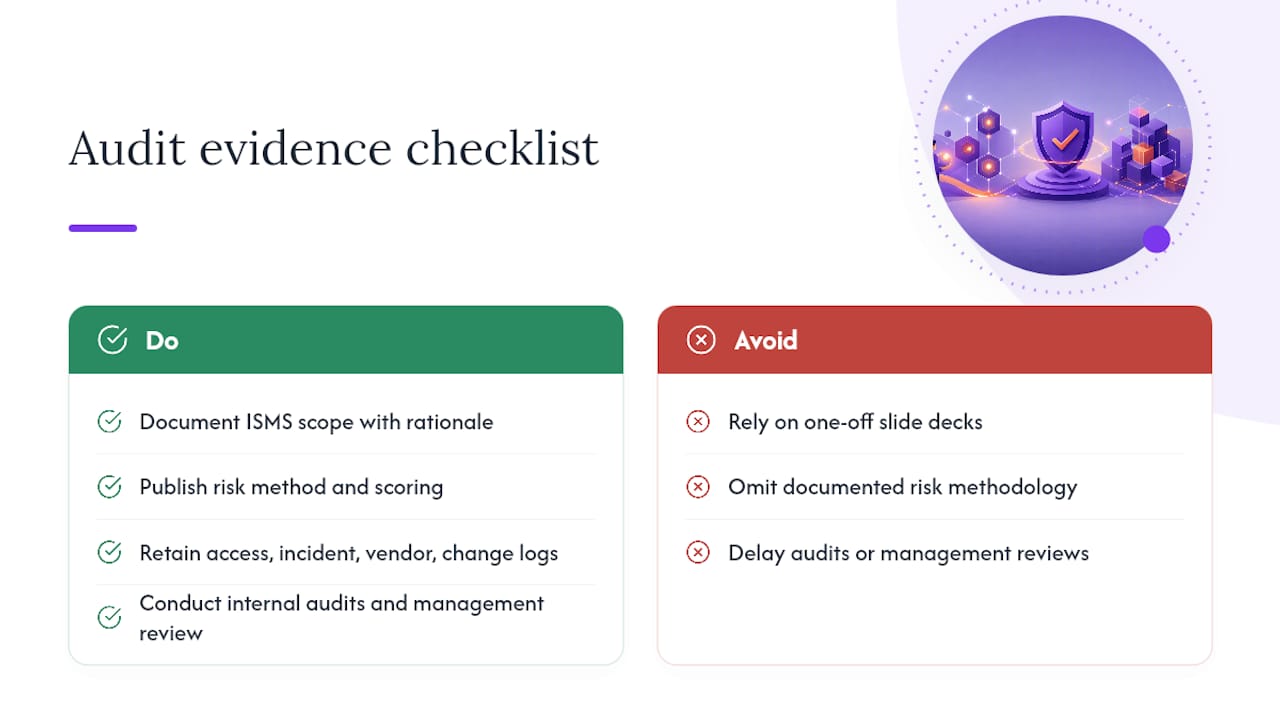
Au-delà de la structure des articles présentée précédemment, les auditeurs se concentrent sur des exigences spécifiques et vérifiables lorsqu'ils examinent votre SMSI. Le contexte et le périmètre (Article 4) exigent une déclaration documentée de ce qui est inclus et exclu de votre périmètre SMSI, liée à une justification métier réelle plutôt qu'à une limite arbitraire.
L'appréciation et le traitement des risques (Article 6) exigent une méthodologie documentée, et pas seulement un tableur d'estimations. Les auditeurs veulent voir comment vous avez évalué les risques, pourquoi vous avez choisi des traitements spécifiques, et comment cela est relié à votre DdA.
Les compétences et la sensibilisation (Article 7) exigent des preuves que le personnel comprend réellement ses responsabilités en matière de sécurité, généralement des registres de formation et des accusés de réception de politiques spécifiques aux rôles, et pas seulement une présentation envoyée une seule fois.
La planification opérationnelle (Article 8) est là où la plupart de vos preuves de Phase 2 sont générées : les revues d'accès, les registres de réponse aux incidents, les évaluations de sécurité des fournisseurs et les journaux de gestion des changements y figurent tous.
L'évaluation des performances (Article 9) exige des audits internes et une réunion de revue de direction, qui doivent tous deux avoir eu lieu et être documentés avant votre audit externe, car les auditeurs demanderont à voir les comptes rendus et les constats.
L'absence de l'un de ces cinq domaines est la raison la plus fréquente pour laquelle une organisation par ailleurs bien préparée échoue à la Phase 1.
Avantages de la certification
L'avantage le plus immédiat se manifeste dans les cycles de vente : les clients grands comptes exigent de plus en plus la certification ISO 27001, ou à tout le moins un questionnaire de sécurité complété qu'un SMSI certifié permet de renseigner en quelques minutes plutôt qu'en plusieurs semaines. Cela seul justifie souvent le coût pour les éditeurs SaaS B2B qui concluent des contrats plus importants.
Au-delà des ventes, la certification impose un niveau de rigueur interne dont la plupart des organisations manquent avant d'entamer le processus. Les plans de réponse aux incidents sont testés plutôt que simplement rédigés. Le risque fournisseur est évalué de manière systématique plutôt qu'au cas par cas. Les revues d'accès ont lieu selon un calendrier plutôt que lorsque quelqu'un s'en souvient.
Il existe également une réduction réelle de l'exposition aux violations, non pas parce que la certification est magique, mais parce que l'ensemble de mesures cible spécifiquement les points de défaillance — systèmes non mis à jour, accès excessifs, sauvegardes non testées — qui sont à l'origine de la plupart des incidents réels. Les assureurs en cyber-risques commencent également à le remarquer, et certaines polices d'assurance cyber offrent de meilleures conditions aux organisations certifiées.
Enfin, la certification vous donne une réponse défendable lorsque quelque chose tourne mal. Les régulateurs et les clients réagissent très différemment à « nous avions un SMSI documenté et audité, et cet incident s'est produit malgré tout » qu'à « nous n'avions aucun programme de sécurité formel ».
Où les projets ISO 27001 échouent généralement
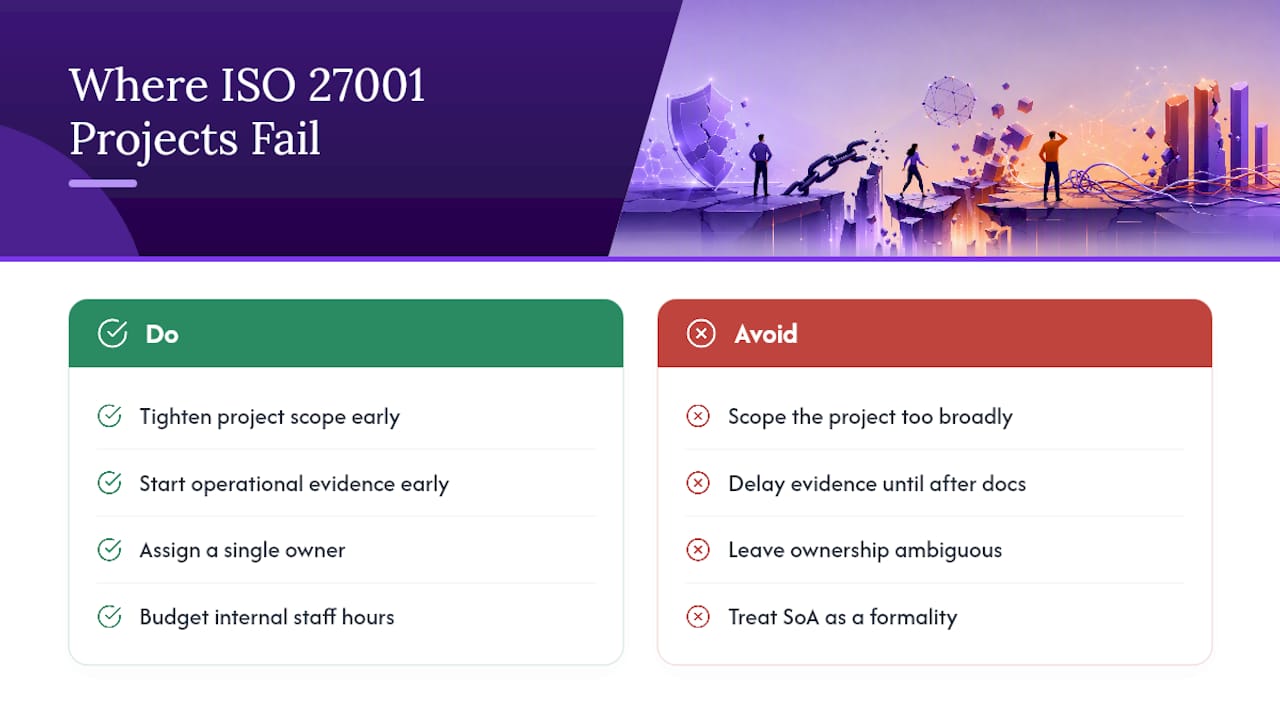
Le principal schéma d'échec est l'élargissement du périmètre dans le sens inverse : les organisations définissent un périmètre trop large par instinct de « tout couvrir », puis manquent de budget et de temps pour mettre en œuvre des mesures sur des systèmes qui n'auraient pas dû être dans le périmètre. Réduire le périmètre, comme mentionné précédemment, est l'un des leviers les plus sous-utilisés pour diminuer à la fois les coûts et les délais.
Le deuxième écueil courant est de démarrer le compteur de preuves trop tard. Les équipes passent des mois à rédiger des politiques, puis réalisent que la Phase 2 nécessite trois mois de preuves opérationnelles en plus de cela, ajoutant un trimestre au calendrier qui aurait pu se dérouler en parallèle avec le travail de documentation.
L'ambiguïté des responsabilités tue l'élan presque aussi souvent. Lorsqu'aucune personne n'a l'autorité sur les décisions de périmètre et de mesures, les projets dérivent entre les départements et s'enlisent en attente de validations.
Sous-estimer la main-d'œuvre interne est une erreur de budgétisation spécifique. Les honoraires de conseil et les coûts d'audit sont des postes visibles ; les centaines d'heures internes consacrées à la collecte de preuves ne le sont souvent pas, et cet écart provoque de réels dépassements de budget lorsque le projet est déjà en cours.
Enfin, certaines équipes traitent la DdA comme une formalité à compléter juste avant la Phase 1 plutôt que comme un document de planification vivant. Élaborée tôt, elle pilote l'intégralité de votre feuille de route de mise en œuvre. Élaborée tardivement, elle devient une course pour justifier rétrospectivement des décisions prises de manière informelle.
Pourquoi la plupart des calendriers ISO 27001 sont erronés dès le départ
La plupart des estimations de calendrier échouent pour une seule raison : elles sont construites autour de la planification de l'audit plutôt que de la génération de preuves. Les dirigeants demandent « combien de jours durera l'audit ? » alors que la vraie question est « combien de mois faudra-t-il pour générer trois mois consécutifs de preuves probantes ? » Ce seul changement de perspective permettrait à lui seul de corriger la plupart des dépassements de budget que j'ai vus évoqués dans les guides de mise en œuvre.
Les conseils habituels — réduire le périmètre, recruter un consultant, acheter un outil GRC — ne sont pas faux. Ils sont simplement incomplets sans un chiffre associé. Dire à un directeur financier « quelque part entre 3 et 18 mois » n'est pas un plan, c'est un haussement d'épaules. Les organisations qui avancent le plus vite sont celles qui obtiennent une estimation personnalisée tôt, basée sur leur taille et leur maturité réelles, puis qui travaillent à rebours à partir d'une date de Phase 2 réelle.
Mon avis : ne commencez pas la rédaction des politiques avant d'avoir défini le périmètre et réalisé une estimation. Chaque semaine passée à documenter une mesure que vous supprimerez ensuite de votre DdA est une semaine que vous ne récupérerez pas. Obtenez l'estimation en premier, puis construisez.
— Martin
Sources
- ISO/IEC 27001:2022 - Systèmes de management de la sécurité de l'information — Exigences
- Combien de temps prend la certification ISO 27001 ? (2026) | Konfirmity
- Calendrier ISO 27001 : combien de temps prend la certification ?
- Coût de la certification ISO 27001:2022 : feuille de route sur 12 mois