
This SDLC security checklist maps software development controls clause by clause to ISO/IEC 27001:2022 Annex A, specifically the A.8.25–A.8.34 cluster and related controls, so compliance officers, IT managers, and security leaders can specify applicable controls in their Statement of Applicability, collect auditable evidence, and budget the implementation work with confidence. Read on for clause-level tasks, evidence examples, and Ismscalculator planning links.
What you get from this checklist:
- Clause-by-clause mapping of SDLC controls to ISO 27001 Annex A (A.8.25–A.8.34, A.5.23, A.8.8, A.8.9)
- Concrete checklist tasks with minimum evidence requirements and owner roles
- Audit red flags and quick internal checks before Stage 2
- Effort bands and a sample Gantt breakdown for budgeting
- Links to Ismscalculator tools for tailored cost and timeline estimates
Table of Contents
- What does the SDLC security checklist cover under ISO 27001?
- How do you collect and present evidence for each checklist item?
- Who owns what? Governance for SDLC controls under the ISMS
- How long does SDLC control implementation take, and what does it cost?
- Where can you get a checklist template and adapt it for your organization?
- Key Takeaways
- The part most teams get wrong about SDLC controls
- Ismscalculator turns this checklist into a budget and a project plan
- Useful sources and further reading
What does the SDLC security checklist cover under ISO 27001?
ISO/IEC 27001:2022 reorganized Annex A and made application security explicit. The 2022 revision consolidated controls and introduced new ones covering the full software development lifecycle, with the transition to the 2022 baseline completed October 31, 2025. Ten controls in the technological theme (A.8.25 through A.8.34) plus A.5.23, A.8.9, and A.8.16 form a 13-control AppSec cluster that auditors commonly walk through during Stage 2 audits.
The table below maps each primary clause to checklist tasks, minimum evidence, and a suggested owner.
| ISO Clause | Checklist Task | Minimum Evidence | Owner |
|---|---|---|---|
| Secure development lifecycle | Document and apply rules for planning, design, coding, testing, deployment, and maintenance | Secure development policy, signed by ISMS owner; procedure document with version history | ISMS Manager / Product Owner |
| Application security requirements | Define and document security requirements before development begins | Requirements specification with security acceptance criteria; threat model or risk register entry | Product Owner / Security Engineer |
| Secure system architecture and engineering | Apply secure design principles (least privilege, defense in depth, fail-safe defaults) | Architecture review record; design sign-off with security engineer approval | Security Engineer / Dev Lead |
| Secure coding | Adopt and enforce a secure coding standard (e.g., OWASP ASVS, SEI CERT) | Secure coding standard document; SAST scan results linked to commits; code review records | Dev Lead |
| Security testing in development | Integrate security testing into the development pipeline | SAST/DAST scan reports tied to build IDs; test plan with security test cases; pass/fail records | QA Lead / DevOps Lead |
| Outsourced development | Apply security requirements to third-party and outsourced code | Supplier security clauses in contracts; evidence of supplier code review or SAST results | Supplier Owner / ISMS Manager |
| Separation of development, test, and production | Enforce environment isolation; prohibit production data in test environments | Environment topology diagram; access control logs; test data anonymization records | DevOps Lead |
| Change management | Control changes to systems through a formal process | Change request records with approvals; pipeline approval gate logs; rollback procedures | Dev Lead / Change Manager |
| Test information | Protect test data; avoid using live personal data in testing | Test data policy; anonymization or synthetic data generation records | QA Lead / Data Protection Officer |
| Protection of information systems during audit testing | Restrict and log access during audit or penetration testing | Penetration test scope agreement; access logs during test window; findings report with remediation | ISMS Manager / Security Engineer |
| Information security for cloud services | Apply security requirements to cloud-hosted development environments | Cloud service agreement with security clauses; shared responsibility matrix | ISMS Manager / Supplier Owner |
| Management of technical vulnerabilities | Maintain a vulnerability management process covering SDLC outputs | Vulnerability triage log with dates and severity; SBOM records; remediation tickets with SLA tracking | Security Engineer |
| Configuration management | Manage secure configurations for development tooling and infrastructure | Configuration baseline documents; IaC templates with version control; drift detection logs | DevOps Lead |
The AppSec control cluster requires a documented procedure, a named owner, and a sample of evidence covering at least one audit period (typically 3–12 months). Controls A.8.25, A.8.26, A.8.27, and A.8.28 have different purposes and must be explicitly addressed even if implemented via a single process document.
Minimum evidence auditors typically accept:
- Git-linked SAST results showing finding, commit hash, and remediation date
- SBOM records generated per release with timestamps
- Pipeline approval gate logs showing mandatory security stage completion
- Environment isolation logs or access control records
- Vulnerability triage tickets with severity, date opened, and date closed
How do you collect and present evidence for each checklist item?
Auditors focus on traceability: a named control, a piece of evidence, and a date. Abstract process descriptions fail. Each checklist item should produce 3–5 reproducible artifacts.
Secure development policy: The policy document needs an owner name, approval date, version number, and a review date. Store it in your document management system with a version history. The filename convention SDev-Policy-v1.2-2025-09-01.pdf gives an auditor the date and version at a glance.
Environment separation: A topology diagram alone is not enough. Pair it with access control logs showing no developer accounts in production, and a dated record of any exception with a risk acceptance sign-off. CI/CD pipelines must enforce mandatory security testing stages, approval gates, and immutable audit trails to satisfy A.14 sub-controls, and those pipeline logs serve as the immutable record.
Vulnerability triage records (A.8.8): A spreadsheet with no dates is a red flag. Use your ticketing system (Jira, Linear, or equivalent) so every finding has a created timestamp, severity, assignee, and closed date. Export a filtered view covering the audit period as your evidence artifact.
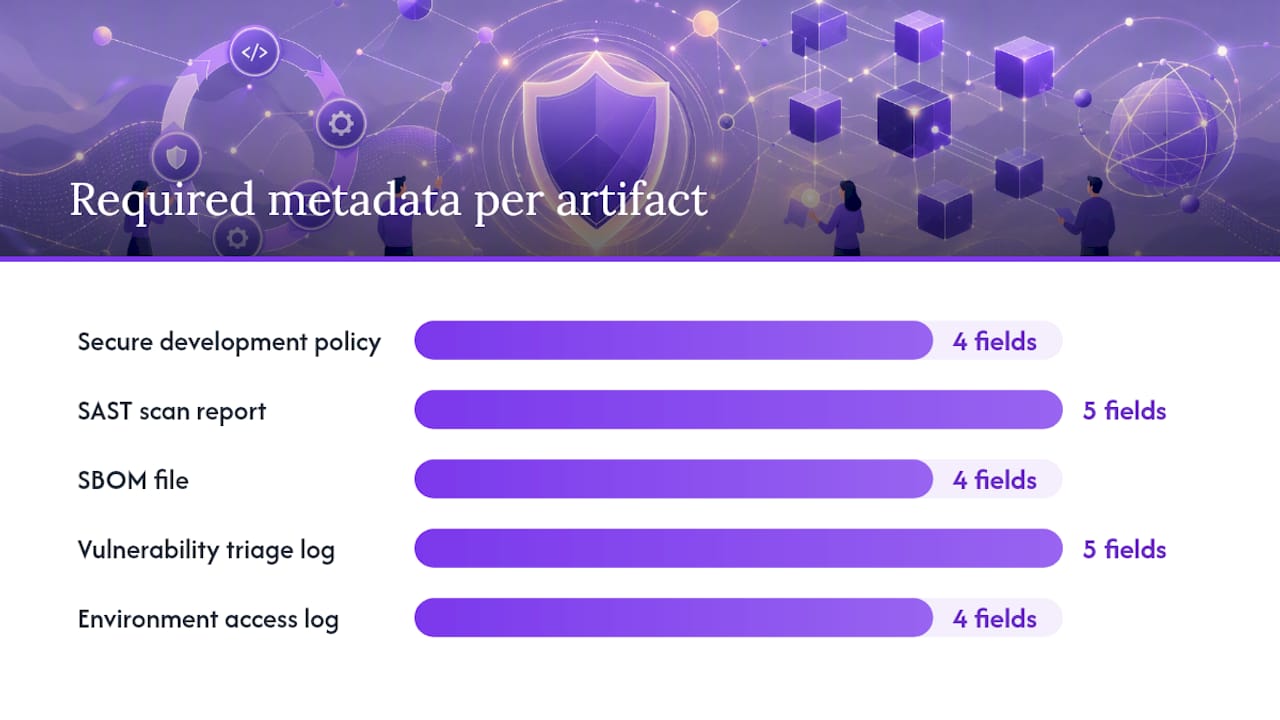
| Artifact | Required Metadata | Storage Location | Auditor Verification Method |
|---|---|---|---|
| Secure development policy | Owner, version, approval date, review date | Document management system (version-controlled) | Check version history; confirm signatory authority |
| SAST scan report | Build ID, commit hash, tool name, scan date, finding count | CI/CD artifact store (immutable) | Cross-reference commit hash in source control |
| SBOM file | Release version, generation date, tool name, component list | Artifact registry or secure file store | Verify generation date matches release date |
| Vulnerability triage log | Finding ID, severity, date opened, assignee, date closed | Issue tracker (Jira, Linear, etc.) | Filter by audit period; check SLA compliance |
| Environment access log | User, action, timestamp, environment name | SIEM or cloud access log service | Confirm no cross-environment access without approval |
Pro Tip: Auditors increasingly ask for git-linked evidence rather than periodic reports. Configure your CI/CD pipeline to attach the SAST report as a build artifact with the commit SHA embedded in the filename. That single step eliminates the most common evidence authenticity challenge.
Who owns what? Governance for SDLC controls under the ISMS
Clear accountability is what separates a functioning ISMS from a compliance exercise. The governance model below assigns roles across the six functions auditors expect to see.
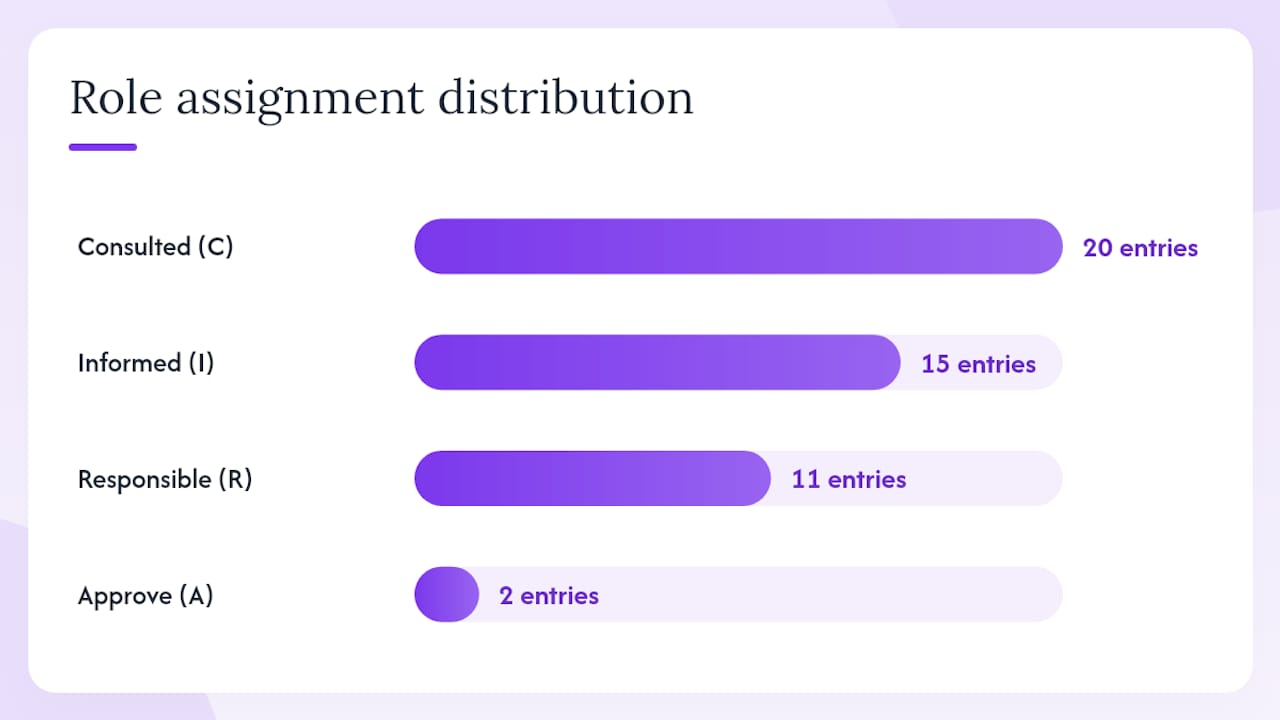
| Control Area | ISMS Owner | Control Owner | Dev Lead | Security Engineer | QA Lead | Supplier Owner |
|---|---|---|---|---|---|---|
| Secure development policy | A (Approve) | R (Responsible) | C (Consulted) | C | I (Informed) | I |
| Security requirements | I | C | R | C | C | C |
| Secure architecture | I | C | C | R | I | I |
| Secure coding standard | I | C | R | R | C | C |
| Security testing | I | C | C | C | R | I |
| Outsourced development | A | R | I | C | I | R |
| Environment separation | I | C | R | C | I | I |
| Vulnerability management | I | R | C | R | C | C |
Required executive signoffs include: initial policy approval by the ISMS owner, SoA sign-off confirming each control’s applicability and justification, and an annual management review that samples evidence from the prior period. Evidence sampling frequency should be at least quarterly for high-risk controls (A.8.28, A.8.29, A.8.8) and semi-annually for lower-risk ones.
How long does SDLC control implementation take, and what does it cost?
Effort varies by maturity. The table below gives realistic bands for a U.S. organization implementing SDLC controls as part of a broader ISO 27001 project.
| Maturity Band | Phase | Typical Duration | Resource Profile |
|---|---|---|---|
| Minimal (ad hoc processes, no formal SDLC policy) | Policy drafting and SoA mapping | 3–4 weeks | — |
| Minimal | Tooling setup (SAST, SBOM, pipeline gates) | 4–6 weeks | 1 FTE DevOps + — |
| Moderate (some policies exist, inconsistent evidence) | Gap remediation and evidence collection | 4–6 weeks | — |
| Moderate | Internal audit and pre-audit review | 2–3 weeks | 0.5 FTE ISMS Manager |
| Full (mature DevSecOps, documented controls) | Evidence packaging and SoA finalization | 2–3 weeks | 0.25 FTE ISMS Manager + 0.25 FTE Dev Lead |
A sample Gantt breakdown for the SDLC workstream in a moderate-maturity organization: weeks 1–3 for policy and procedure drafting; weeks 4–8 for tooling integration and pipeline gate configuration; weeks 9–12 for evidence collection across a sample audit period; weeks 13–14 for internal evidence audit and gap closure; week 15 for SoA update and audit preparation.
Pro Tip: Run the Ismscalculator 2-minute readiness check before committing to a timeline. It maps your current maturity across all four ISO/IEC 27001:2022 control themes and flags which SDLC controls will consume the most effort, so you can front-load the right work.
The full readiness assessment converts those effort bands into a tailored cost estimate and a downloadable Gantt chart, which is exactly what you need for a budget approval conversation.
Where can you get a checklist template and adapt it for your organization?
A practical checklist template for this control set should contain these columns: ISO clause, checklist task, evidence artifact type, artifact filename convention, owner role, current status (Not Started / In Progress / Complete), and a link to the sample artifact.
Adaptation steps by organization type:
- SaaS and tech companies: Add a column for the CI/CD pipeline stage where each control is enforced. The ISO 27001 for SaaS & Tech Companies guide covers SDLC-specific templates and implementation notes directly applicable here.
- Regulated sectors (finance, healthcare): Cross-reference each SDLC control against your sector’s specific requirements (SOC 2, HIPAA, PCI DSS). The financial data security standards comparison maps ISO 27001 controls to U.S. financial regulations.
Pro Tip: Keep your checklist in a version-controlled document (Confluence, Notion, or a Git-hosted markdown file). Every status change becomes a dated audit trail automatically, and you can export a snapshot for the auditor without creating a separate evidence package.
Policy skeletons, sample SBOM templates, and test plan snippets are available through Ismscalculator’s ISO 27001 Annex A controls guidance, which maps each control to practical evidence items.
Key Takeaways
An auditable SDLC security checklist requires a named owner, a dated artifact, and a traceable link between each ISO 27001 Annex A control and its evidence before Stage 2 begins.
| Point | Details |
|---|---|
| Map every SDLC control explicitly | List A.8.25–A.8.34, A.5.23, A.8.8, and A.8.9 individually in your SoA with a procedure and evidence for each. |
| Link evidence to builds and commits | Attach SAST reports and SBOMs to build IDs and commit hashes so auditors can verify authenticity. |
| Assign named owners, not teams | Every procedure and checklist item needs a specific role title as owner, not “the development team.” |
| Run an internal trace test first | Pull a random build and trace it through SAST, approval gate, SBOM, and triage records before Stage 2. |
| Use Ismscalculator for effort planning | The readiness check and full assessment convert SDLC control gaps into a budgeted timeline and Gantt export. |
The part most teams get wrong about SDLC controls
Most organizations spend their first two months writing policies and almost nothing on evidence infrastructure. That is the wrong order. A polished secure development policy with no pipeline-linked SAST results or dated SBOMs will produce a major nonconformity at Stage 2, regardless of how well-written the document is.
The controls that trip teams up most are not the complex ones. A.8.31 (environment separation) and A.8.8 (vulnerability management) fail audits constantly, not because the controls are hard to implement, but because the evidence is scattered or undated. Fix the evidence chain before you refine the policy prose.
One practical priority: automate SBOM generation at the point of release, not as a manual quarterly task. A dated SBOM per release, stored with the release artifact, satisfies A.8.8 evidence requirements and gives you a dependency audit trail that covers multiple controls simultaneously. That single pipeline step pays off across at least four checklist items.
Ismscalculator turns this checklist into a budget and a project plan
Mapping SDLC controls to ISO 27001 is one thing. Knowing what it will cost your organization and how long it will take is what gets a project approved.
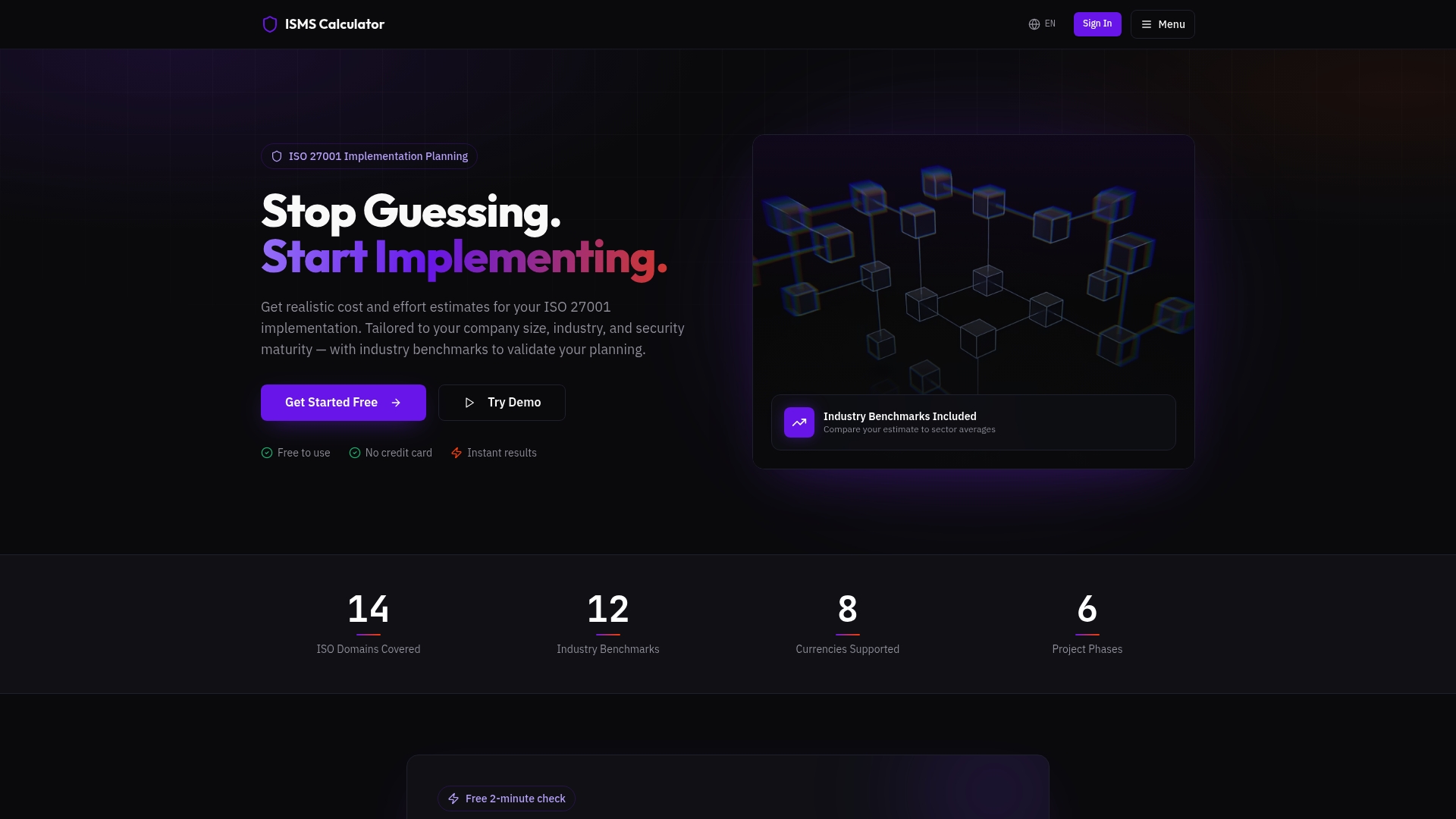
Ismscalculator takes your company size, industry, and current security maturity and produces a tailored cost and effort estimate for your full ISO 27001 implementation, including the SDLC control workstream. The platform covers all four ISO/IEC 27001:2022 control themes, generates a customizable Gantt chart you can share with stakeholders, and exports a PDF report built for budget approval conversations. The 2-minute readiness check gives you an instant maturity snapshot at no cost. When you are ready to go deeper, the full ISO 27001 readiness assessment converts your checklist gaps into a phased project plan with model reference comparisons so you know exactly where you stand against the model reference.
Useful sources and further reading
The sources below support specific sections of this checklist. Use them to verify clause text, review auditor expectations, and adapt the checklist for your environment.
- ISO 27001 Application Security: Annex A Controls Guide (2022)
- ISO 27001 Application Security: Full Control Mapping
- ISO 27001 Secure SDLC: Key Requirements, Steps, and Templates (2026) | Konfirmity
- ISO 27001 A.14 Deep Dive — System Development and Maintenance in CI/CD - Regulated DevSecOps
- ICT Institute | ISO 27001 technological controls for software development
- Free ISO 27001 Readiness Check — 2-Minute Self-Assessment | ISMS Calculator
- ISO 27001 for SaaS & Tech Companies: A Practical Guide | ISMS Calculator