
ISO 27001 project risks fall into five core categories: human, technical, organizational, physical, and third-party. Each category maps directly to the ISO/IEC 27001:2022 standard’s Annex A controls and shapes how auditors evaluate your Information Security Management System (ISMS). Project managers and compliance officers who understand these types of ISO 27001 project risks early can build a risk register that satisfies certification requirements and holds up under audit scrutiny. Risk assessment methodologies must be consistent, reproducible, and produce comparable results to meet ISO 27001 requirements.
1. Human-related risks in ISO 27001 projects
Human risks such as phishing and social engineering consistently rank as the highest-priority category in ISO 27001 assessments. They outrank technical failures because a single successful phishing attack can bypass every firewall and encryption control you have in place. Weak passwords, accidental data disclosure, and insider threats all belong in this category. The damage from a human error can be immediate and reputational, not just operational.
Common human risk types include:
- Phishing and spear-phishing attacks targeting employees with access to sensitive systems
- Social engineering that manipulates staff into bypassing security procedures
- Weak or reused passwords across critical business applications
- Accidental data leaks through misdirected emails or unsecured file sharing
- Insider threats from disgruntled or negligent employees
Mitigation centers on ISO 27001 Annex A control 6.3, which requires ongoing security awareness training aligned with identified human risks. Phishing simulations, role-based training, and documented training records all satisfy auditor expectations. Auditors look for evidence that mitigation is active, not theoretical.
Pro Tip: Run phishing simulations quarterly and log the results in your risk register. Auditors treat simulation data as direct evidence that your human risk controls are operational.

2. Technical risks and their impact on ISO 27001 implementation
Technical risks stem from failures in the systems and infrastructure that your ISMS depends on. Common technical risks include unpatched software vulnerabilities, hardware failures, capacity bottlenecks, and misconfigurations. These risks score high on both likelihood and impact when patch cycles are irregular or monitoring is absent. Linking each technical risk to a specific Annex A control is not optional. Auditors expect a direct line from the risk entry to the treatment and then to the control.
Key technical risk areas to document in your risk register:
- Unpatched software vulnerabilities that expose systems to known exploits
- Hardware failures affecting data availability and business continuity
- Misconfigured cloud services creating unintended public access to sensitive data
- Capacity and performance issues that degrade system availability
- Inadequate logging and monitoring that prevents timely incident detection
The table below shows how technical risks map to treatment approaches and Annex A controls:
| Technical Risk | Treatment Approach | Annex A Control |
|---|---|---|
| Unpatched vulnerabilities | Automated patch management cycle | 8.8 Management of technical vulnerabilities |
| Misconfigured systems | Configuration baseline and change control | 8.9 Configuration management |
| Hardware failure | Redundancy and documented recovery procedures | 8.14 Redundancy of information processing |
| Inadequate monitoring | SIEM deployment and alert thresholds | 8.16 Monitoring activities |
Each treatment action needs a defined metric and deadline. An entry that says “implement MFA” without an owner, a deadline, and a verification method will be flagged during audit.
3. Organizational and process-related risks in ISO 27001 projects
Organizational risks are the category most often underestimated by project managers. Successful ISO 27001 implementations require business stakeholders in risk impact evaluation because IT teams alone lack the business context needed to score reputational and regulatory impacts accurately. A risk assessment conducted entirely within the IT department produces a skewed picture. Finance, legal, HR, and operations all hold context that changes how you score impact.
Specific organizational risks to capture include inadequate segregation of duties, incomplete or unapproved policies, and risk acceptance criteria that management has never formally signed off on. All material risks must link to treatment options within the risk register, and risks missing owners or acceptance criteria are flagged by auditors. Management approval of the risk acceptance threshold is a certification requirement, not a best practice.
The risk register itself is an organizational risk when treated as a static document. The register must be a living document updated with new findings such as vendor incidents, penetration test results, and threat intelligence. Quarterly reviews at minimum keep the register credible.
Pro Tip: Schedule a 30-minute risk register review with a senior business stakeholder every quarter. Their sign-off on impact scores transforms a technical document into a management-owned compliance asset.
4. Physical and environmental risks within ISO 27001
Physical risks are real threats to information security, not just a checkbox category. Fire, theft, flooding, power failure, and unauthorized physical access all belong in your ISO 27001 risk register. Organizations that scope their ISMS to cloud-only environments sometimes dismiss physical risks, but data centers, office locations, and even employee laptops remain in scope for most certifications.
Physical risk types to include:
- Unauthorized physical access to server rooms or workstations
- Fire and flood damage to on-premises infrastructure
- Power failure causing data loss or extended downtime
- Theft of devices containing unencrypted sensitive data
- Environmental hazards such as extreme temperatures affecting hardware
Treatment options for physical risks include business continuity planning, device encryption, physical access controls, and insurance. Integrating business continuity risks into the primary risk register rather than maintaining a separate BCP document simplifies auditor review and reduces maintenance overhead. Auditors expect to trace a physical threat through the register to a documented control, not hunt across multiple spreadsheets.
5. Third-party and supply chain risks in ISO 27001 project management
Third-party risks have grown significantly since the ISO 27001:2022 revision. Vendor failures, cloud service outages, and supply chain attacks now represent a distinct and auditable risk category. Third-party risk management under ISO 27001 involves applying controls from Annex A 5.19 through 5.22, monitoring vendor security annually, and embedding supplier risks directly in the risk register.
Third-party risks to document and manage:
- Cloud provider outages affecting data availability and SLA compliance
- Vendor security breaches that expose your data held by third parties
- Supply chain attacks targeting software dependencies or hardware components
- Inadequate supplier contracts lacking security requirements or audit rights
- Shadow IT where staff use unapproved third-party services
Best practices for managing supplier risks include contractual security clauses, annual supplier security reviews, and SLA monitoring. When a vendor incident occurs, the risk register entry for that supplier must be updated promptly. The register’s dynamic maintenance with timely vendor incident updates meets evolving threat demands and auditor scrutiny. For a deeper look at structuring this process, the ISO 27001 supplier management guide from Ismscalculator covers contractual and monitoring requirements in detail.
Pro Tip: Create a supplier risk tier system. Tier 1 suppliers with access to sensitive data get annual security assessments. Tier 2 suppliers get questionnaire-based reviews. Document the criteria so auditors see a repeatable process.
6. Risk documentation and audit readiness
Documentation quality determines whether your risk management passes or fails audit. Effective risk assessments specify the threat actor, the targeted asset, the exploited vulnerability, and the business impact. A risk labeled “data breach” tells an auditor nothing. A risk labeled “external attacker exploiting unpatched Apache vulnerability on the customer database server, resulting in regulatory fines under GDPR” tells them everything.
Auditors conduct vertical testing on sampled high-risk entries by tracing risk identifiers through actual system configurations, tickets, and documented approvals. This means your risk treatments must exist in reality, not just on paper. A treatment action of “implement MFA” requires a ticket, a completion date, a configuration screenshot, and a management approval record. Teams that treat the risk register as a compliance document rather than an operational tool consistently fail this test.
Avoid the common ISO 27001 implementation mistakes that project managers make when building their first risk register. Generic labels, missing owners, and static documents are the three most common audit findings across all five risk categories.
Key takeaways
ISO 27001 project risk management succeeds when each risk category has documented owners, specific treatment actions, and traceable evidence linking the register to real operational controls.
| Point | Details |
|---|---|
| Human risks are highest priority | Phishing, social engineering, and insider threats require continuous mitigation, not one-time training. |
| Technical risks need Annex A links | Every technical risk entry must map to a specific Annex A control with a defined treatment deadline. |
| Organizational risks require management | Business stakeholders must co-own impact scores; IT-only assessments produce incomplete risk pictures. |
| Physical risks belong in the main register | Integrating BCP and physical threats into one register simplifies audits and reduces maintenance. |
| Third-party risks follow Annex A 5.19–5.22 | Supplier risks need contractual controls, annual reviews, and prompt updates after vendor incidents. |
What I’ve learned about ISO 27001 risk management after years in the field
The single biggest mistake I see project managers make is treating risk categories as a checklist rather than a diagnostic tool. They fill in one row per category, label it “phishing risk” or “vendor risk,” assign a score, and call it done. Auditors see this pattern immediately. It signals that the risk assessment was built to satisfy a requirement, not to actually understand the threat environment.
The teams that pass certification on the first attempt share one habit: they describe risks with enough specificity that a new employee could read the register and understand exactly what could go wrong, why it matters to the business, and what is being done about it. Granularity in risk documentation is not bureaucratic overhead. It is the difference between a register that guides decisions and one that collects dust.
The other pattern I consistently see is the IT-only risk assessment. A project manager pulls together the security team, they score 40 risks over two days, and they present the register to management for sign-off. Management signs without reading it. Six months later, an auditor asks the CFO to explain the business impact of a specific risk, and the CFO has no idea it exists. Business stakeholder inclusion is not a soft recommendation. It is a structural requirement for a credible risk assessment.
My honest advice: run your first risk workshop with IT and one senior business leader in the room at the same time. The conversation that happens when a technical risk gets translated into a financial or reputational impact is the most valuable hour you will spend on the entire ISO 27001 project.
— Martin
How Ismscalculator supports ISO 27001 risk management
Managing the full range of ISO 27001 risk categories is complex, especially when you are building a risk register from scratch while also tracking implementation timelines and budget.
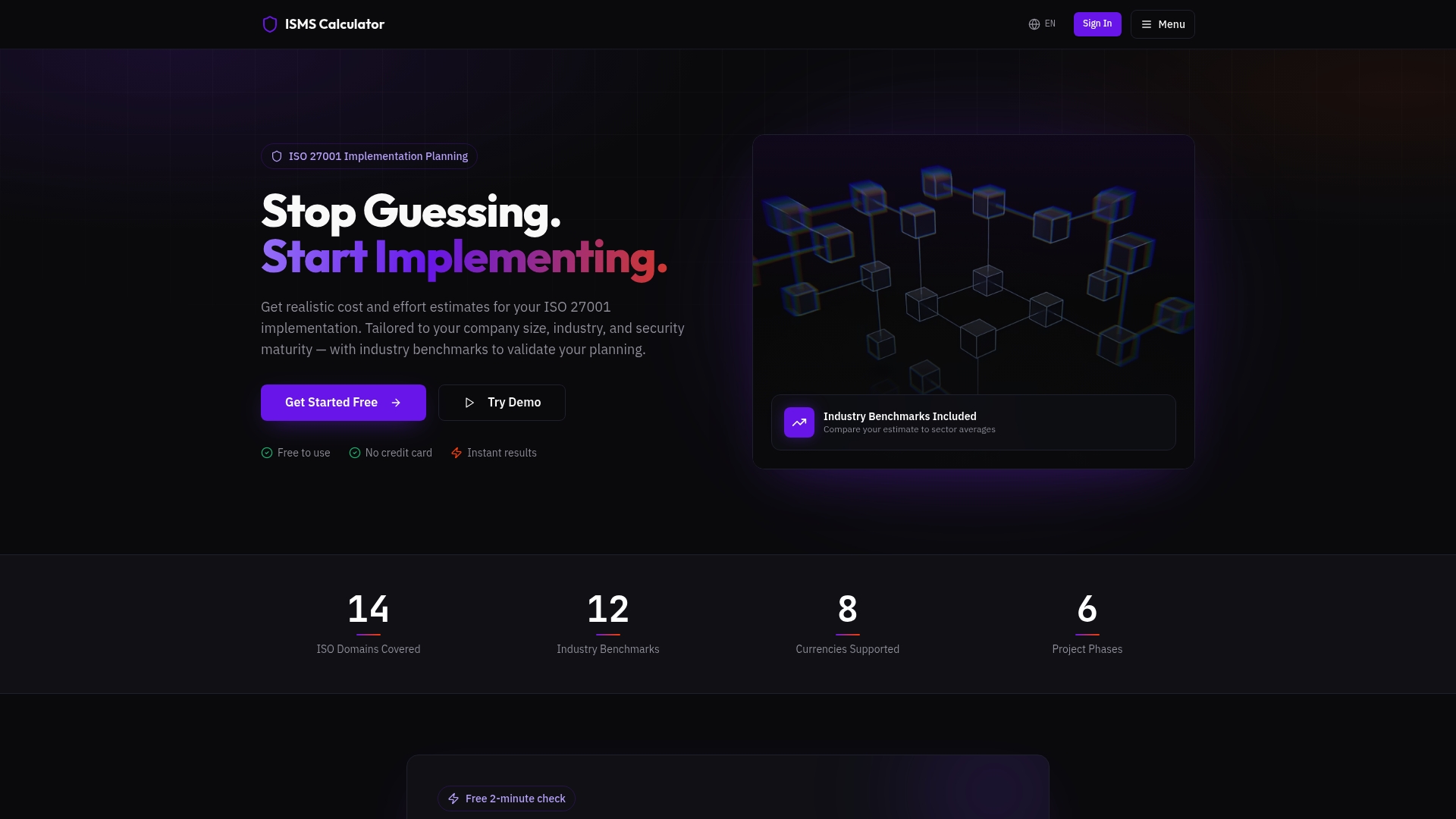
Ismscalculator gives project managers and compliance officers a structured starting point. The platform’s ISO 27001 readiness assessment maps your current security posture across all four ISO/IEC 27001:2022 control themes and flags gaps that translate directly into risk register entries. The free 2-minute readiness check gives you an immediate view of where your organization stands before you commit to a full implementation plan. With maturity assessments, Gantt chart templates, and model reference comparisons built in, Ismscalculator turns a complex compliance process into a manageable project with clear milestones.
FAQ
What are the main types of ISO 27001 project risks?
The five main ISO 27001 risk categories are human, technical, organizational, physical, and third-party risks. Each category maps to specific Annex A controls and requires documented treatment actions in the risk register.
Why do human risks rank higher than technical risks in ISO 27001?
Human risks such as phishing and social engineering often surpass technical failures in severity because they can bypass technical controls entirely. A single successful social engineering attack can compromise systems that no vulnerability scan would flag.
How often should an ISO 27001 risk register be updated?
The risk register must be updated whenever a significant change occurs, such as a vendor incident, a penetration test finding, or a new threat intelligence report. Quarterly reviews are the minimum standard most auditors expect to see documented.
What does “vertical testing” mean in an ISO 27001 audit?
Vertical testing is when an auditor traces a specific risk entry from the register through actual system configurations, change tickets, and management approval records to verify the treatment is real. Risk treatments that exist only on paper will fail this test.
How do Annex A controls 5.19 to 5.22 apply to third-party risks?
Annex A controls 5.19 through 5.22 govern information security in supplier relationships, covering supplier agreements, security requirements in contracts, and monitoring of third-party service delivery. Organizations must document supplier risks in the main risk register and review them at least annually.