
An Information Security Management System, or ISMS, is a structured framework of policies, controls, and processes designed to protect sensitive information from unauthorized access, loss, and regulatory breach. To build ISMS for financial data protection means applying that framework specifically to the high-stakes environment of financial institutions, FinTechs, and regulated data managers. The standard that defines this framework is ISO 27001:2022, which includes 93 controls organized across technical, organizational, and physical domains. Alongside ISO 27001, financial organizations must now align with the updated GLBA Safeguards Rule, the Digital Operational Resilience Act (DORA), and regional regulations like GDPR and FINMA. Getting this right in 2026 is not optional. It is a legal and operational baseline.
What prerequisites do you need to build ISMS for financial data protection?
Before writing a single policy, you need a clear picture of what you are protecting and who regulates you. Skipping this step is the most common reason financial ISMS projects fail at audit.
Start with these foundational prerequisites:
- Regulatory scope mapping. Identify which frameworks apply: ISO 27001:2022, GLBA Safeguards Rule, DORA, GDPR, FADP, or FINMA. Each carries distinct documentation and control obligations.
- Core documentation. You need a Statement of Applicability (SoA), a Risk Register, and a Risk Treatment Plan before any certification body will take you seriously.
- Asset inventory. Catalog every system, database, and third-party integration that touches financial data. This is the foundation of your risk assessment.
- Data classification policy. Label data by sensitivity level. A data classification framework determines which controls apply to which assets, and auditors check this first.
- Technical tooling. Deploy tools for identity and access management (IAM), vulnerability scanning, secret scanning, and static/dynamic application security testing (SAST and DAST). These are not optional extras. Embedding security tools in your development pipeline reduces rework and satisfies auditor evidence requirements.
- Qualified personnel. The updated GLBA Safeguards Rule requires a designated Qualified Individual to oversee your Written Information Security Program (WISP).
Pro Tip: Map your regulatory obligations before you define your ISMS scope. A FinTech processing payments under DORA and GLBA simultaneously needs a scope statement that explicitly names both frameworks. Auditors from each body will look for it.
How to conduct risk assessment and implement controls for financial data

Risk assessment is the engine of any ISMS. For financial data, the stakes of getting it wrong include regulatory fines, breach liability, and loss of operating licenses.
Follow this sequence:
- Identify assets and threats. List every financial data asset, then map realistic threats: ransomware, insider misuse, third-party compromise, and API exposure.
- Analyze risk using likelihood times impact. Score each threat scenario. This produces a ranked Risk Register that drives your control selection.
- Select controls from ISO 27001 Annex A. Match controls to your highest-scored risks. For financial data, the non-negotiable controls are encryption at rest and in transit, multi-factor authentication (MFA), centralized logging, and regular penetration testing.
- Align controls with regulatory requirements. The GLBA Safeguards Rule mandates MFA, encryption, vulnerability assessments, penetration testing, and annual board-level reporting. DORA requires documented ICT risk management with identification, protection, detection, response, and recovery phases, all approved by senior leadership.
- Integrate security into your development pipeline. Use SAST, DAST, and infrastructure as code (IaC) scanning to catch vulnerabilities before they reach production. This approach treats ISO 27001 as an engineering discipline rather than a paperwork exercise.
- Document your Statement of Applicability. Record every Annex A control, whether you apply it, and why. This document is the primary artifact auditors review.
The table below shows how key controls map across the three major frameworks financial organizations face in 2026.
| Control | ISO 27001:2022 | GLBA Safeguards Rule | DORA |
|---|---|---|---|
| Encryption at rest and in transit | Annex A 8.24 | Required | Required |
| Multi-factor authentication | Annex A 8.5 | Mandatory | Required |
| Penetration testing | Annex A 8.8 | Annual requirement | Threat-led testing for significant entities |
| Logging and monitoring | Annex A 8.15 | Required | Continuous monitoring required |
| Third-party risk management | Annex A 5.19 | Vendor oversight required | ICT contract registers required |
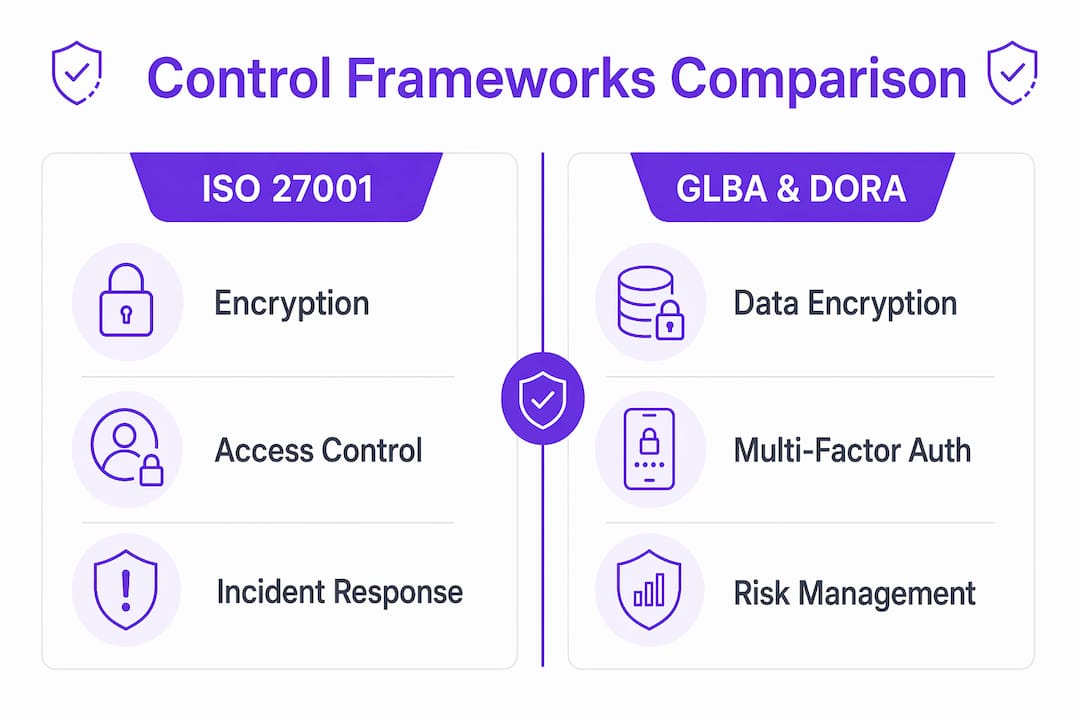
Pro Tip: Do not build separate control sets for each regulation. Map all requirements to a single Annex A control list. One control, properly documented, can satisfy ISO 27001, GLBA, and DORA simultaneously. This saves months of rework.
What are the common pitfalls when building ISMS for financial data?
The most expensive ISMS mistakes in financial services are not technical. They are structural and procedural errors that surface only at audit or after a breach.
- Mis-scoping your regulatory role. Confusing processor and controller roles under GDPR or FADP leads to audit failures. A FinTech that processes payments for a bank is a processor, not a controller. That distinction changes which controls apply and how your scope statement reads.
- Disjointed incident response timelines. ISO 27001 has its own incident documentation requirements. DORA has notification timelines. GLBA has breach reporting obligations. Running three separate incident processes is the costliest ISMS failure in regulated financial firms. The fix is a unified incident process that produces all audit and regulatory outputs from a single workflow.
- Alert fatigue from continuous monitoring. Financial systems generate enormous log volumes. Security teams that rely on manual log review miss real threats inside the noise. AI-driven triage tools filter logs and surface genuine threats, reducing the risk of a critical alert being buried.
- Treating ISMS as a one-time project. An ISMS that passes its initial audit but is never updated will fail its surveillance audit. Regulations change, threats evolve, and your asset inventory grows. Build review cycles into your calendar from day one.
“Mapping multiple overlapping regulatory requirements to a unified control framework reduces audit fatigue and closes compliance gaps that isolated frameworks leave open.” — NIST SP 800-53 Rev 5 mapping guidance for financial services.
The scoping error and the triple-stack incident response failure are the two issues that most often blindside compliance teams. Both are preventable with upfront planning.
How do you maintain and continuously improve a financial ISMS?
A certified ISMS requires ongoing attention. Certification is not the finish line. It is the starting point for a continuous improvement cycle.
- Run quarterly risk register reviews. New products, acquisitions, and regulatory changes all introduce new risks. Update your Risk Register and Risk Treatment Plan each quarter, not just at annual audit time.
- Conduct internal audits before external ones. Schedule internal audits six to eight weeks before your surveillance or recertification audit. Use the ISO 27001 audit prep process to identify control gaps before the external auditor does.
- Enforce least privilege through IAM automation. Identity and access management is the central pillar of modern data protection. Automate access reviews, revoke stale permissions, and enforce role-based access controls across all financial systems.
- Adopt zero-trust principles. Zero-trust data protection eliminates implicit trust by verifying every access request continuously. This limits data exposure and simplifies compliance evidence collection.
- Prepare board-level reporting. The GLBA Safeguards Rule requires annual reporting to the board on your security program. Build a reporting template that translates technical metrics into business risk language. Boards respond to financial exposure figures, not control counts.
The table below shows a practical maintenance schedule for a financial ISMS.
| Activity | Frequency | Owner |
|---|---|---|
| Risk register review | Quarterly | CISO or Qualified Individual |
| Internal audit | Annually (pre-surveillance) | Internal audit team |
| Penetration testing | Annually (GLBA/DORA requirement) | External vendor |
| Access rights review | Quarterly | IAM team |
| Board security report | Annually | CISO |
| Policy review and update | Annually or after major change | Compliance team |
CISOs across financial services are shifting from isolated compliance to integrated data protection strategies driven by AI threats and data volume growth. That shift means your ISMS must absorb new technology risks, including AI model access to financial data and zero-trust architecture changes, as they emerge.
Key Takeaways
Building an effective ISMS for financial data protection requires scoping across all applicable regulations, implementing unified controls, and running a continuous improvement cycle rather than treating certification as a one-time event.
| Point | Details |
|---|---|
| Scope before you build | Map all applicable regulations (ISO 27001, GLBA, DORA, GDPR) before defining your ISMS scope. |
| Unify your controls | Map ISO 27001 Annex A controls to all regulatory requirements to avoid duplicate effort and audit gaps. |
| Fix incident response first | Build one unified incident process that satisfies ISO, GLBA, and DORA timelines simultaneously. |
| Automate access management | Use IAM tools to enforce least privilege and run automated access reviews across all financial systems. |
| Treat ISMS as ongoing | Schedule quarterly risk reviews and internal audits to keep your ISMS current between certification cycles. |
Why most financial ISMS projects stall in the middle
The pattern I see most often is a compliance team that launches an ISMS project with energy, completes the scope document and risk register, and then stalls when it hits the control implementation phase. The reason is almost always the same. The team treats ISO 27001 as a documentation exercise rather than an engineering one.
The organizations that get through implementation fastest are the ones that pull their development and infrastructure teams in early. When your DevOps engineers own the IaC scanning and SAST integration, you get real security evidence that auditors can verify. When compliance owns it alone, you get policy documents that describe controls no one has actually deployed.
The second stall point is incident response. I have watched financial firms spend months building beautiful ISO-aligned incident procedures, only to discover at their first real incident that those procedures do not align with their DORA notification timeline or their GLBA breach reporting obligation. The triple-stack failure is real, and it is expensive. Design your incident process once, with all three outputs built in from the start.
My honest advice: treat your ISMS like a product, not a project. It needs an owner, a backlog, and a release cycle. Compliance teams that adopt that mindset ship certifications faster and maintain them with far less pain.
— Martin
How Ismscalculator can accelerate your ISMS build
Estimating the cost and effort of implementing ISO 27001 for financial data protection is one of the hardest parts of getting started. Ismscalculator solves that problem with a real-time calculator that delivers tailored estimates based on your company size, industry, and current security maturity.
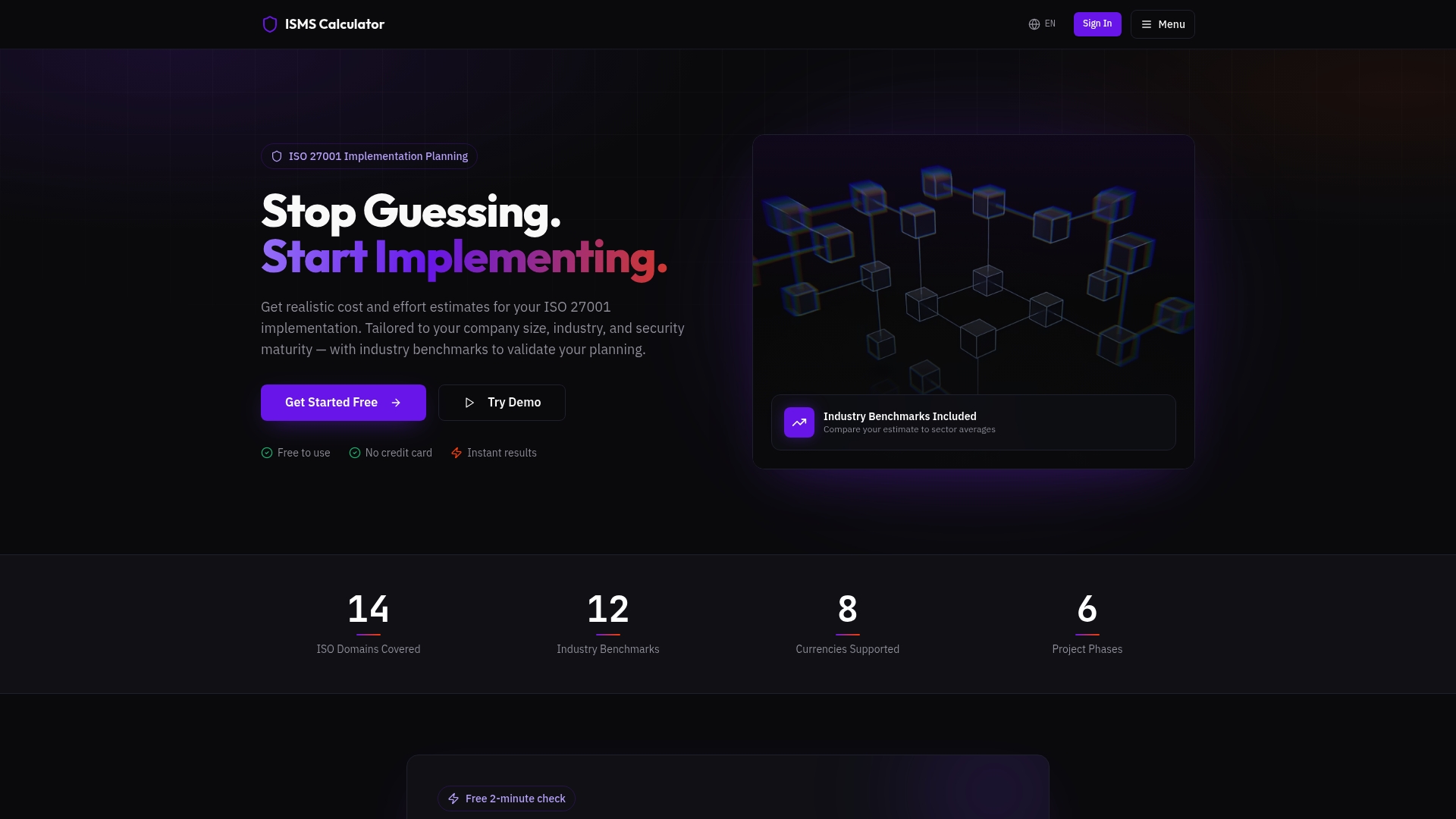
Start with the free 2-minute readiness check to identify your biggest compliance gaps immediately. When you are ready for a full picture, the ISO 27001 readiness assessment covers all four ISO/IEC 27001:2022 control themes and benchmarks your results against model reference values. If you need hands-on support, Ismscalculator’s directory of independent ISO 27001 consultants connects you with implementers and lead auditors who specialize in financial services.
FAQ
What is an ISMS in the context of financial data protection?
An ISMS is a structured system of policies, controls, and processes that protects sensitive information from risk and regulatory breach. For financial institutions, it is built on ISO 27001:2022 and aligned with regulations like GLBA, DORA, and GDPR.
How long does it take to build an ISMS for a financial institution?
Implementation timelines vary by organization size and existing security maturity. Most financial institutions complete their initial ISO 27001 certification within 9–18 months when they have dedicated resources and executive support.
What controls are mandatory for financial data protection under GLBA?
The updated GLBA Safeguards Rule mandates encryption, MFA, penetration testing, vulnerability assessments, and annual board-level reporting as part of a Written Information Security Program.
How does DORA affect ISMS requirements for financial entities?
DORA requires financial entities to maintain documented ICT risk management frameworks covering identification, protection, detection, response, and recovery, with senior leadership approval and registers of all third-party ICT contracts.
What is the biggest mistake financial firms make when building an ISMS?
The costliest error is running separate incident response processes for ISO, regulatory, and statutory reporting. Unifying those processes into a single workflow eliminates the triple-stack failure that derails audits and inflates breach response costs.