
A compliant information transfer policy under ISO 27001 must define scope and data classification, name the permitted transfer methods and encryption requirements for each, and require logging and monitoring that produces audit evidence. Without those four elements, auditors have nothing to test against, and staff default to whatever channel feels convenient. Treat the policy document, its supporting procedures, and a transfer register as the minimum paper trail before certification.
TL;DR:
- Map each policy clause to an Annex A control number, cite ISO/IEC 27002 for implementation guidance, and retain approval, version, and staff communication records.
- Require email TLS 1.2+, S/MIME, or OpenPGP for sensitive attachments; use FIPS validated cryptography for regulated data tools and combine DLP and CASB detection.
- Assess transfer risks, map each classification tier to approved methods, then pilot those channels with the team handling the most sensitive information.
- Logs should capture sender, recipient, timestamp, classification, method, and outcome, remain available for at least one audit cycle, and support checks against actual transfers.
- Encrypt removable media at rest, require signed chain of custody for courier transfers, and approve cloud or personal device channels only after vendor due diligence.
Table of Contents
- Policy essentials: scope, objectives, definitions, roles and approvals
- Mapping policy clauses to ISO/IEC 27001 and Annex A
- Secure transfer methods and recommended technical controls
- Implementation checklist and prioritized sequence
- Policy template and copyable clauses
- Monitoring, detection, and audit evidence
- Preparing for audit and continual improvement
- How ISMS Calculator supports policy implementation planning
- Author perspective: common pitfalls and practical fixes
- Start planning: run the readiness check and get an implementation estimate
- FAQ
- Sources
Policy essentials: scope, objectives, definitions, roles and approvals
A transfer policy earns its place in the ISMS only when it states what it covers and why. Scope should name the systems, data types, and transfer directions it governs (internal, external, cross-border) rather than a vague reference to “all company data.” The objective section should tie directly to the risk treatment plan: the policy exists to reduce specific identified risks, not to satisfy a checklist item.
Definitions matter more than teams expect. “Sensitive data,” “confidential,” and “transfer” need precise meanings that match the organization’s data classification scheme, or enforcement becomes arguable during an incident review.
- Scope statements should list covered systems, data categories, and transfer directions explicitly.
- Objectives should reference the risk treatment plan, not stand alone.
- Definitions must align with the existing data classification policy.
- Roles should name who approves exceptions and who owns enforcement day to day.
The approval structure usually includes a policy owner (often the ISMS manager), a technical approver for new transfer methods, and business unit leads who sign off on their team’s usage.
Mapping policy clauses to ISO/IEC 27001 and Annex A
Every clause in a transfer policy should trace back to a specific control, or an auditor has no basis to accept it as evidence. ISO/IEC 27001 defines the ISMS requirements and the Annex A control set that preserves confidentiality, integrity, and availability, and transfer-related clauses typically map to the information transfer control and related cryptography and access controls within Annex A. Our Annex A controls guide breaks down how each control group connects to policy language.
- Record which Annex A control each policy clause supports, by control number.
- Reference ISO/IEC 27002 for implementation detail, since it uses the same numbering as Annex A and offers practical guidance.
- Keep version history and approval sign-off dates on the policy document itself.
- Store evidence that the policy was communicated to staff, not just published.
Auditors look for a document trail: who drafted it, who approved it, when it was last reviewed, and whether the review followed an actual incident or risk reassessment rather than a calendar reminder alone.
Secure transfer methods and recommended technical controls
The policy needs to name specific methods per sensitivity tier, not a generic instruction to “use secure channels.” For email, NIST’s Trustworthy Email guidance recommends TLS 1.2 or higher for transport security, S/MIME or OpenPGP for message-level content protection, and SPF, DKIM, and DMARC to authenticate sending domains and reduce spoofing.
For managed file transfer (MFT) and secure portals, require centralized logging, access controls, and link expiry policies. NIST’s ITL Bulletin on exchanging files over the internet notes that organizations should rely on FIPS-validated cryptographic implementations when cryptography is required for protection, and that MFT tools are purpose-built to manage, automate, and log transfers, which makes them useful for compliance evidence.
- Require TLS 1.2+ for all email transport and S/MIME or OpenPGP for sensitive attachments.
- Mandate FIPS-validated cryptography for MFT and cloud sharing tools handling regulated data.
- Encrypt removable media at rest and require signed chain-of-custody for courier transfers.
- Apply vendor due diligence before approving any cloud sharing or BYOD channel.
**The same bulletin recommends combining DLP and CASB methods to detect inadequately protected file exchanges across email, cloud services, and endpoints, since no single tool catches every workaround.
Implementation checklist and prioritized sequence
Rolling out a transfer policy works best as a sequence rather than a single release. Start with a risk assessment focused specifically on transfer scenarios, then map each data classification tier to its allowed methods before writing procedures.
- Run a risk assessment on transfer scenarios and map classification tiers to approved methods.
- Pilot a secure solution for each sensitivity tier and document the rationale for the choice.
- Draft procedures, copyable templates, and an exception-request workflow.
- Train the highest-risk user groups first, then expand monitoring coverage.
- Maintain a transfer register, incident log, and approval records as ongoing evidence.
Pro Tip: Pilot with the team that handles your most sensitive data first. If the controls survive their workflow, the rest of the rollout gets easier.
Recordkeeping is not optional: a transfer register that logs who sent what, through which channel, and when gives auditors a direct line from policy to practice.
Policy template and copyable clauses
A usable policy document needs plain paragraphs your team can adapt without a rewrite. Below is a starting structure.
Purpose: This policy governs how information is transferred internally and externally to protect confidentiality, integrity, and availability during transit.
Scope: This policy applies to all employees, contractors, and third parties who transmit organizational data, regardless of transfer method.
Permitted methods: Transfers of confidential or restricted data must use approved channels only: corporate email with TLS 1.2+ and S/MIME/OpenPGP for attachments, the sanctioned MFT platform, or approved cloud sharing tools with encryption at rest and in transit.
Encryption requirements: Any transfer of restricted data over an untrusted network must use encryption meeting current organizational standards; unencrypted transfer of restricted data is prohibited.
Exceptions: Any deviation requires written approval from the ISMS owner and must be logged in the exception register with a remediation date.

For emailing classified data: confirm recipient identity, apply the encryption add-in, and verify delivery receipt before closing the ticket using a service that ensures secure fax or email transmission. For third-party transfers, require a signed data processing agreement that specifies transfer method, encryption standard, and breach notification timeline. Our password policy template follows the same clause structure if you need a model for formatting.
Monitoring, detection, and audit evidence
Logs need to capture sender, recipient, timestamp, data classification, transfer method, and outcome at minimum, retained long enough to cover at least one audit cycle. NIST’s file exchange guidance lists DLP and CASB among the detection methods organizations should combine for broader coverage across email, cloud, and endpoints.
- Log sender, recipient, timestamp, classification, and method for every monitored transfer.
- Map DLP and CASB alerts to a documented nonconformity and corrective action process.
- Review transfer volume, exception count, and incident count at each management review.
These metrics give management review something concrete to act on instead of a policy nobody has revisited.
Preparing for audit and continual improvement
Internal audits should specifically test whether staff actually use the approved channels, not just whether the policy exists on paper.
- Sample a set of actual transfers against the transfer register to check for gaps.
- Verify exception approvals were logged and reviewed within the stated timeframe.
- Confirm the last management review addressed transfer-related incidents, if any occurred.
Feed incident data back into the risk assessment. A pattern of exceptions for one department usually means the approved method does not fit their workflow, not that the staff are careless.
How ISMS Calculator supports policy implementation planning
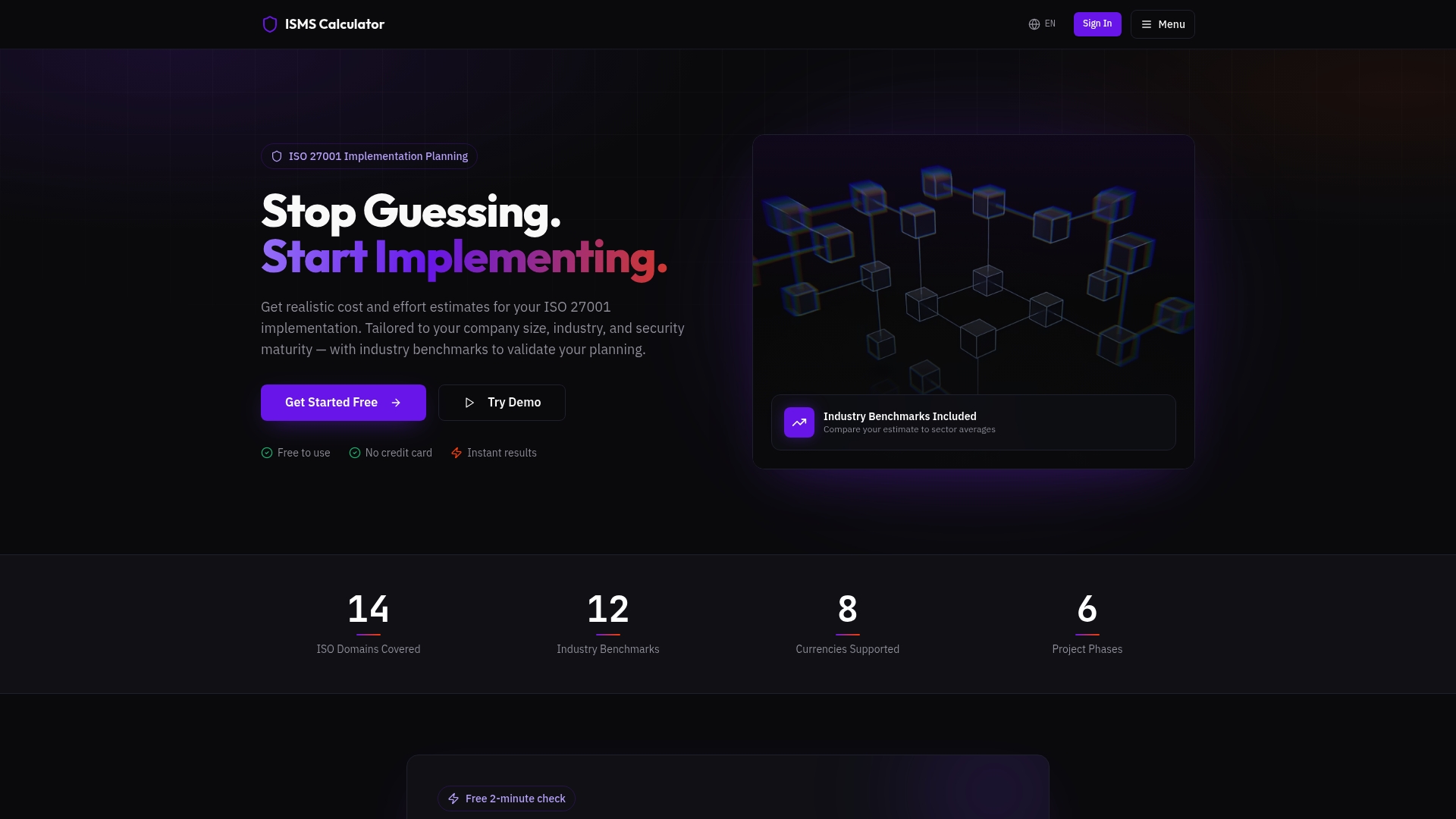
Planning the resourcing behind a transfer policy, not just the wording, is where most teams get stuck. We offer a tool that gives real-time cost and effort estimates tailored to company size, industry, and security maturity, along with model reference comparisons, a maturity assessment across multiple ISO domains, and customizable Gantt charts for sequencing work like the steps above.

Author perspective: common pitfalls and practical fixes
Usability gaps push employees toward unsanctioned channels faster than any policy memo can stop them. Treat transfer policy as an organization-wide process, not an IT checklist, and pilot with your highest-risk group before a full rollout.
— Martin
Start planning: run the readiness check and get an implementation estimate
Turning a transfer policy from a document into an audited control takes budget and a realistic timeline, and most teams underestimate both. We recommend starting with our free 2-minute check to surface where policy gaps sit relative to your overall ISO 27001 readiness, then moving to our ISO 27001 Cost Calculator for a tailored estimate you can export for project planning.
Our readiness assessment goes deeper if you want a fuller picture before committing resources, and our certification checklist lays out the 80 steps most teams need to reach certification, transfer policy included.
| Tool | What it delivers | Best used for |
|---|---|---|
| Free 2-minute check | Instant readiness snapshot | Spotting policy gaps quickly |
| ISO 27001 Cost Calculator | Tailored cost and effort estimate | Budgeting the full implementation |
| Readiness Assessment | Deeper review with benchmarks | Planning before committing resources |
Run the check first, export your estimate, and bring both into your next ISMS planning meeting.
FAQ
What must an ISO 27001 information transfer policy include?
It must define scope and data classification, name permitted transfer methods and their required encryption, and establish logging and monitoring to produce audit evidence. Roles for approval and enforcement need to be explicit, and the policy should tie back to the organization’s risk treatment plan.
Which Annex A controls does the transfer policy map to?
The transfer policy primarily demonstrates the information transfer control within ISO/IEC 27001 Annex A, along with related cryptography and access control clauses. ISO/IEC 27002 provides the practical implementation guidance for each of these using matching control numbers.
What email controls does NIST recommend for secure transfers?
NIST’s Trustworthy Email guidance recommends TLS 1.2 or higher for transport, S/MIME or OpenPGP for message content, and SPF, DKIM, and DMARC to authenticate sending domains. These controls reduce spoofing risk and support the integrity of transferred content.
How do I estimate the cost of implementing a transfer policy?
Effort and cost depend on company size, industry, and current security maturity, so a generic figure will not hold across organizations. Our ISO 27001 Cost Calculator gives a tailored, editable estimate based on those factors, with model reference comparisons to validate the result.
Does the policy need to cover physical media transfers?
Yes, removable media and courier transfers fall within the policy’s scope whenever they carry classified or restricted data. Controls should require encryption at rest on the media itself and a signed chain-of-custody record confirming receipt.
Sources
- Trustworthy Email | NIST
- Security Considerations for Exchanging Files Over the Internet (NIST ITL Bulletin)
- ISO/IEC 27001:2022 - Information security management systems