
There is no ISO 27001:2026. The current edition is ISO/IEC 27001:2022, published October 25, 2022 and amended once in 2024, and the 2013 edition it replaced is withdrawn. The comparison that matters in 2026 is 2013 against 2022: the main clauses barely moved, Annex A was rebuilt from 114 controls to 93, and every 2013 certificate passed its deadline on October 31, 2025. If you are budgeting for certification now, you are budgeting for the 2022 edition, and for a full initial audit if an old certificate lapsed.
This guide shows the differences in plain terms, explains what each one means for your gap analysis, Statement of Applicability and audit, and how to size the effort before you commit budget.
TL;DR
- No “2026 edition” exists. ISO/IEC 27001:2022 is current, with a small 2024 amendment on climate change.
- Clauses 4 to 10 changed lightly. Annex A changed a lot: 114 controls in 14 domains became 93 controls in four themes, with 11 new controls.
- The transition window closed on October 31, 2025. A lapsed 2013 certificate means a new Stage 1 and Stage 2 audit against 2022.
- Your work now centers on a gap analysis, a re-mapped Statement of Applicability, updated risk treatment plans and evidence that new controls work.
- Effort depends on company size, industry and security maturity, so estimate it before you plan.
Table of Contents
- Why people search for a “2026 version”
- What changed in the main clauses
- Annex A: from 114 controls to 93
- What happened to 2013 certificates
- What to change when you move from 2013 to 2022
- Estimating time and effort for your size
- Put numbers on your own plan
- Our view: the edition is not the hard part
- FAQ
- Sources
Why people search for a “2026 version”
The confusion has a simple source. ISO standards are reviewed on a schedule, and related documents keep appearing. The overview standard ISO/IEC 27000 was reissued in 2026, and other guidance documents in the 27000 family are being published too. None of that replaces the requirements standard you certify against.
The edition history is short:
- 2005: the first edition, based on BS 7799, which introduced risk management into the standard.
- 2013: the second edition, which adopted the High-Level Structure shared with other ISO management system standards and added consideration of context and stakeholders.
- 2022: the third edition, which updated the security measures and clarified risk management and performance evaluation requirements.
- 2024: Amendment 1, a short climate-related change.
That sequence comes from AFNOR’s overview of the standard’s history. The practical takeaway: when a vendor, customer questionnaire or auditor says “latest ISO 27001,” they mean ISO/IEC 27001:2022 including Amendment 1:2024.
What changed in the main clauses
The management system clauses, numbered 4 to 10, are the part of the standard you cannot tick off with a control list. They cover context, leadership, planning, support, operation, performance evaluation and improvement. Between 2013 and 2022 they stayed close to identical. ANAB’s comparison describes minimal new requirements here, with one notable addition: clause 4.4 now asks you to establish, implement, maintain and continually improve the processes of your ISMS and how they interact.
What this means in practice:
- Your documented ISMS scope and processes need a second look. If your 2013 documentation described policies but not how processes connect, that is the gap clause 4.4 exposes.
- Clause wording was tightened more than it was expanded. Expect edits to your documents, not a rewrite.
- The 2024 amendment adds a climate lens. The amendment is listed on ISO’s page and asks you to consider climate change when you define your context and interested parties. Most organizations record a short, reasoned conclusion in their context documentation.
If you already run a healthy ISMS, the clause side of the move is a modest editing exercise. The heavy lifting is in Annex A.
Annex A: from 114 controls to 93
The controls are where 2013 and 2022 differ most. The 2013 Annex A listed 114 controls in 14 domains (A.5 to A.18). The 2022 edition replaces it with 93 controls in four themes: Organizational, People, Physical and Technological. ISACA’s 2024 journal article confirms the new structure and the control count, and Schellman’s summary of IAF MD 26 notes the 93 controls from ISO/IEC 27002:2022 now sit in the new Annex A.
| ISO 27001:2013 | ISO 27001:2022 | |
|---|---|---|
| Annex A controls | 114 | 93 |
| Organization | the four Annex A control themes (A.5 to A.18) | 4 themes: Organizational, People, Physical, Technological |
| New controls | n/a | 11 |
| Existing controls | n/a | Merged, renamed and updated |
| Status | Withdrawn; certificates invalid after Oct 31, 2025 | Current, with Amd 1:2024 |
The reduction from 114 to 93 is mostly consolidation, not removal of protection. ABS Quality Evaluations reports that existing controls were merged into 24 and 23 were renamed, alongside the 11 additions. Baker Tilly’s breakdown adds that 58 controls were updated in wording.
The 11 new controls
The new controls reflect how organizations actually run today:
- Threat intelligence
- Information security for use of cloud services
- Web filtering
- Data leakage prevention
- Secure coding
The other six cover areas such as ICT readiness for business continuity, physical security monitoring, configuration management, information deletion, data masking and monitoring activities. For technology teams, the new technological controls are the ones that need evidence of real operation. If your engineers need a way to confirm that controls hold up in production, this explanation of technical validation for B2B SaaS shows how that kind of evidence is built.
For a control-by-control walkthrough, see our guide to Annex A controls explained.
Annex A is a reference list, not a checklist
The Statement of Applicability (SoA) is the document that lists every Annex A control, says whether you apply it, and explains why. ISACA describes it as the main link between your risk assessment and your risk treatment, with each entry recording status, the decision to include or exclude, and the rationale. The 2022 edition makes this logic more visible. You are not asked to adopt all 93 controls. You are asked to show that your selection follows from your risks, and that anything excluded is excluded for a reason. Our Statement of Applicability guide covers the format line by line.

What happened to 2013 certificates
The transition period ran from November 1, 2022 to October 31, 2025. NQA’s US transition plan states that 2013 certificates would no longer be valid after October 31, 2025. TÜV SÜD’s US page adds the milestones: after April 30, 2024, all initial and recertification audits had to be against 2022, and surveillance audits could stay on their cycle but had to be transitioned by the deadline.
Certificates issued during the window did not get the usual three years. SGS USA explains that 2013 certificates issued or reissued in that period carried October 31, 2025 as the expiry date, and that an organization whose 2013 certification expired is treated as a new client with a full initial audit.
The consequences today:
- No valid 2013 certificates remain. Any certificate still referencing the 2013 edition is no longer a usable proof for customers or procurement teams.
- A lapsed certificate means starting over. Plan for the full Stage 1 and Stage 2 audit cycle against 2022, as described in Ciphers Security’s 2026 cost roadmap.
- If you transitioned on time, your certificate was reissued against 2022. RINA notes that a successful transition audit kept the same identification number and the current cycle’s expiry.
For US companies answering vendor security reviews, this matters immediately: a questionnaire that asks for ISO 27001:2013 evidence is asking for something that no longer exists. The right answer cites the 2022 edition and your current certificate.
What to change when you move from 2013 to 2022
Whether you are rebuilding after a lapse or tightening an ISMS that was transitioned, the work follows the four objectives of the IAF transition rules. Mastermind Assurance summarizes them and the sequence below follows them.
Step 1: Run a gap analysis against 2022
Compare your current documents, controls and evidence with the 2022 requirements. A self-assessment is acceptable, but internal audit should verify it, not perform it. Look first at clause 4.4, the 11 new controls, and any control you merged mentally from two old ones. Where it goes wrong: teams map old control numbers to new ones and stop, without checking whether the merged wording asks for more. Our gap analysis guide gives the method. If you want a fast baseline first, the free 2-minute check gives you a readiness picture without a project.
Step 2: Re-map the Statement of Applicability
Rebuild the SoA on the 93-control list. For each of the 11 new controls, record whether it applies, why, and its implementation status under clause 6.1.3(d). ISACA’s advice is to discuss every entry internally to produce a defensible SoA, and that an outside consultant should not formalize it for you because ownership and context knowledge sit with your team. Where it goes wrong: copying a template SoA where every control reads “applicable” with no rationale.
Step 3: Re-map risk treatment
Open risk treatment plans that point to 2013 control numbers must be re-mapped to 2022 controls. This is quiet work that auditors check. Use the risk treatment plan template and the auditor-ready risk treatment guide to keep the chain from risk to control to evidence intact.
Step 4: Implement, audit internally and review
New or changed controls need objective evidence that they are implemented and effective. Then complete an internal audit against the 2022 edition and a management review. NQA’s plan requires both before a transition audit. Walk your team through our list of auditor questions so the evidence is ready when they ask.
What the audit itself adds
For organizations still in the transition process, the added audit time was modest. Both NQA and Schellman describe roughly 0.5 auditor days when the transition is combined with a recertification and 1.0 day when it is combined with a surveillance audit or run separately. A new initial audit has no such shortcut, which is why the estimate matters.
Estimating time and effort for your size
The standard tells you what must exist. It does not tell you how long that takes in a 25-person startup versus a 2,000-person financial services firm. Three variables drive the answer:
- Company size. More people, systems and sites mean more scope, more evidence and more training.
- Industry. A finance firm carries regulatory overlays and customer due diligence that a small software team may not face yet.
- Security maturity. Organizations with existing risk registers, access reviews, incident processes and supplier controls start closer to the finish line.
The most common planning mistake is borrowing a single number from a blog post. A startup without prior experience and a company with SOC 2 already in place do not share a timeline. If you already hold SOC 2, the controls mapping to SOC 2 shows where work overlaps. For the phases and sequence, the implementation timeline and the certification checklist lay out what to expect.
Put numbers on your own plan
The ISO 27001 Cost Calculator produces a real-time estimate from your company size, industry and security maturity. The initial calculation does not require signup, the assumptions are editable, and the methodology is documented and versioned, so you can see how a figure was built and challenge it. Model reference comparisons let you check your plan against that reference, and you can save and compare several scenarios, view results in multiple currencies, export a PDF report or share a link with your finance lead.
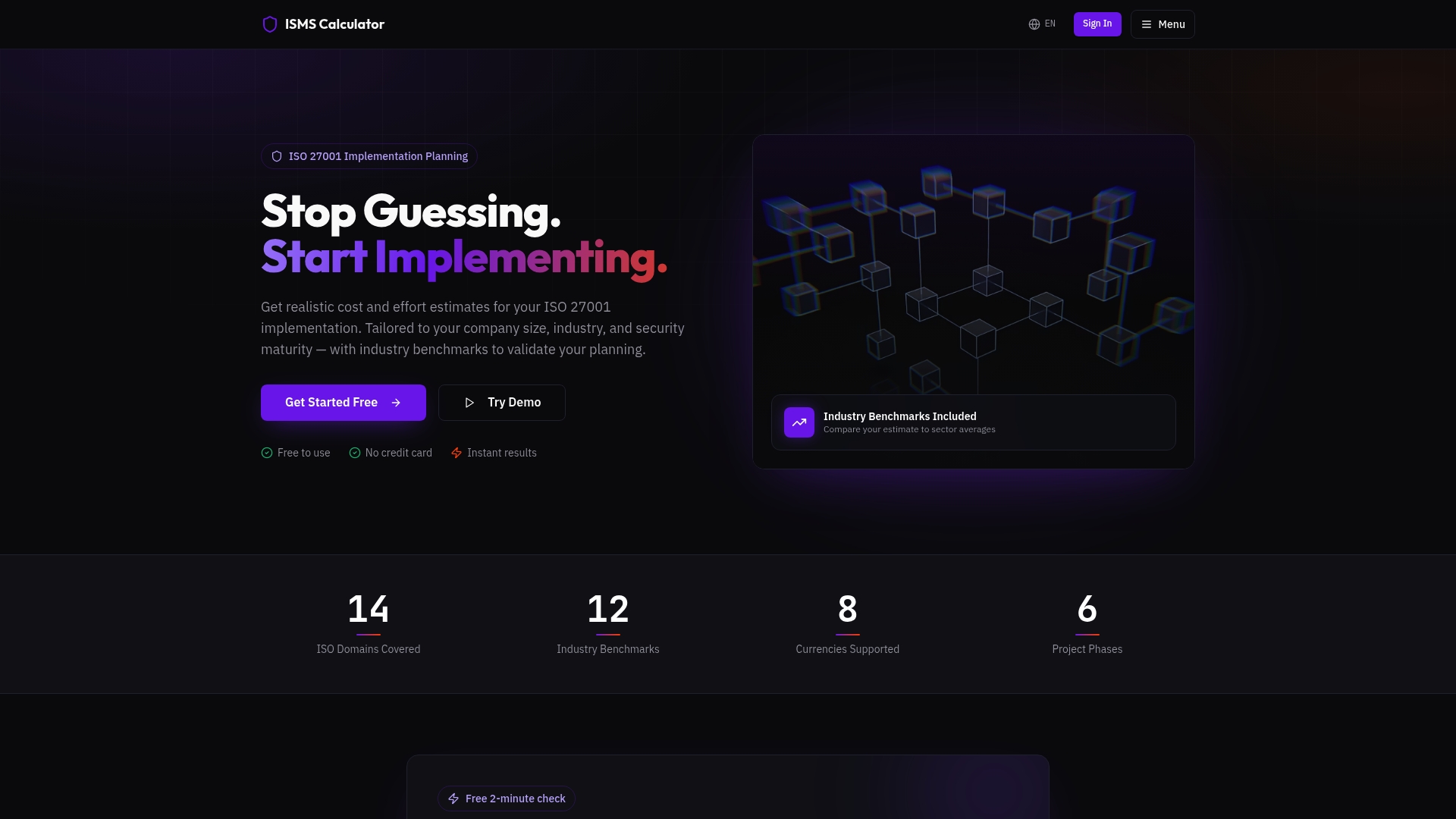
For gap work, the ISO 27001 Readiness Assessment covers maturity across the four Annex A control themes and feeds customizable Gantt charts for the implementation phases. If you only need a starting signal, the free 2-minute check is the fastest way in.
Our view: the edition is not the hard part
The 2013 to 2022 change is easy to explain and easy to underestimate. Clauses 4 to 10 barely moved, and 93 controls sound simpler than 114. So teams assume the transition is a renumbering exercise.
It is not. The 2022 structure asks you to show your working: why a control applies, why another does not, and what evidence proves it runs. That takes planning, and planning takes an honest estimate of effort.
This is why we built the calculator around size, industry and maturity, with assumptions you can edit and a methodology you can trace. A compliance officer should be able to take a figure to the CFO and explain every line of it. A startup with no prior ISO experience should see what the work involves before committing to it.
Start with the readiness check, put your numbers into the calculator, compare two or three scenarios, and walk into your audit planning with a budget and a timeline you can defend.
Martin
FAQ
What is the difference between ISO 27001:2013 and ISO 27001:2022?
The main clauses 4 to 10 changed only slightly, with clause 4.4 adding a process requirement. Annex A moved from 114 controls in 14 domains to 93 controls in four themes, including 11 new controls. The 2022 edition is the only one in force.
Is there an ISO 27001:2026?
No. ISO’s standard page lists ISO/IEC 27001:2022 as the current edition, with Amendment 1:2024. Articles that mention 2026 usually refer to the year you are certifying in, or to the reissued ISO/IEC 27000 overview document.
Is my ISO 27001:2013 certificate still valid?
No. Certifiers set October 31, 2025 as the end of the transition period, and 2013 certificates were no longer valid after it. If yours lapsed, you need a full initial audit against the 2022 edition.
Is ISO 27001 outdated?
No. The 2022 edition was published in October 2022 and updated by an amendment in 2024. It remains the standard organizations certify against, and customers ask for it in security reviews.
Sources
- ISO/IEC 27001:2022, ISO standard page
- ISO/IEC 27001:2013, withdrawn edition page
- ISO 27001: A Partner to CIOs for Twenty Years, AFNOR
- ISO/IEC 27001:2013 and 2022 Comparison, ANAB
- Navigating the ISO/IEC 27001 2022 Transition, ISACA Journal
- How to Prepare for ISO 27001:2022, Schellman
- ABS QE ISO/IEC 27001:2022 accreditation news
- New ISO/IEC 27001 Standard and Controls, Baker Tilly
- USA ISO 27001:2022 Transition Plan, NQA
- Transition to ISO/IEC 27001:2022, TÜV SÜD
- ISO/IEC 27001 Transition: What You Should Know, SGS USA
- ISO 27001 2022 Certification Cost: 12-Month Roadmap, Ciphers Security
- ISO/IEC 27001 new edition, RINA
- 4 Steps to Transition to ISO 27001:2022, Mastermind Assurance