
For most mid-market and enterprise organizations, hiring ISO 27001 consultancy is the fastest route to certification — provided you pick the right delivery model and go in with a scoped RFP. The shortest path: run a free readiness check on Ismscalculator to get a baseline estimate, then use that output to shortlist consultants and write a tighter scope of work.
Three approaches worth considering:
- Consultant-led engagement — A certified Lead Implementer owns the project end-to-end. Best for organizations with limited internal security bandwidth or a hard certification deadline.
- Hybrid / software-assisted — A consultant handles strategy, risk, and audit prep while automation handles evidence collection. Software-assisted approaches typically cut time-to-certification roughly in half compared with fully manual processes.
- Ismscalculator-assisted procurement — Use the platform’s real-time cost estimator, 14-domain maturity assessment, and independent consultant introductions to scope the engagement before you spend a dollar on consulting fees.
Table of Contents
- Which ISO 27001 consultancy delivery model fits your situation?
- What does an ISO 27001 consultant actually deliver?
- What does ISO 27001 consultancy cost, and how long does it take?
- How do you choose the right ISO 27001 consultant?
- What does a consultant-led ISO 27001 roadmap look like?
- Why Ismscalculator belongs in your procurement process
- Your 30–60–90 day procurement and implementation starter plan
- When is the right time to bring in a consultant?
- Key contractual terms and SLAs to include in your consultant agreement
- Key Takeaways
- The part of ISO 27001 procurement most guides skip
- Ismscalculator gives you a head start before the first consultant call
- Useful sources and further reading
Which ISO 27001 consultancy delivery model fits your situation?
Not every organization needs the same level of hands-on support. The table below maps delivery models to the dimensions that matter most in procurement, describing typical timelines without specifying exact month or week counts.
Which model fits which profile:
- Startup or early-stage SaaS: Software-assisted or hybrid. Lower cost, faster cycle, and the SaaS-specific guidance on Ismscalculator is worth reading before you scope anything.
- Scale-up with an existing security team: Hybrid. Your team owns controls; the consultant owns audit prep and documentation quality.
- Regulated enterprise (healthcare, finance, defense): Consultant-led with certified Lead Implementers and Lead Auditors on the engagement team.
- Multi-region or multi-framework organization: Hybrid with explicit cross-framework mapping (ISO 27001 + SOC 2 + NIST CSF) to avoid duplicating evidence collection across programs.
What does an ISO 27001 consultant actually deliver?
The ISO/IEC 27001:2022 standard structures implementation around mandatory clauses and Annex A controls. A consultant’s job is to translate that framework into a working information security management system (ISMS) for your specific environment. Here is what a scoped engagement typically covers:
Core services:
- Scope definition and context-of-the-organization workshop
- Gap analysis against all Annex A controls
- Risk assessment methodology and risk treatment plan
- Statement of Applicability (SoA) — the document auditors scrutinize most
- Policy and procedure writing (or review of existing documents)
- Control implementation support (technical and organizational)
- Internal audit execution
- Stage 1 and Stage 2 audit support
- Staff awareness training
- Optional vCISO retainer for post-certification maintenance
Deliverables your RFP should require:
- Complete ISMS document set (policies, procedures, records)
- Annex A gap analysis report with remediation priorities
- Signed-off SoA with justifications for exclusions
- Risk register and risk treatment plan
- Internal audit report with nonconformity log
- Evidence packages organized by control domain
- Remediation plan with owner assignments and target dates
Pro Tip: Ask every candidate how their documentation reflects actual practice. A consultant who produces a polished policy set but leaves control implementation to you is selling paperwork, not certification readiness. Auditors test whether controls work, not whether documents exist.
What does ISO 27001 consultancy cost, and how long does it take?

Budget and timeline expectations vary significantly by organization size, scope complexity, and delivery model. Here is a realistic picture.
| Timeline track | Duration | Typical scenario | Key constraint |
|---|---|---|---|
| Rapid | 8–12 weeks | Small org, narrow scope, dedicated internal resource | Internal stakeholder availability |
| Standard | 3–12 months | Mid-market, moderate scope, hybrid delivery | Evidence collection, policy sign-off |
| Extended | 12+ months | Enterprise, multi-site, complex risk environment | Organizational change, resource contention |
Pricing models you will encounter:
- Fixed-fee project: Most common for scoped engagements. You know the total cost upfront; scope changes trigger change orders.
- Retainer / time-and-materials: Common for vCISO arrangements or ongoing post-certification support.
- Subscription (software-assisted): Monthly or annual fee covering platform access plus some consultant hours.
- Per-scope / modular: Pay for individual phases (gap analysis only, internal audit only). Useful when you have internal capacity for some phases.
Pro Tip: The two most common under-budget items are evidence collection time and internal resource availability. Your team will need to gather logs, screenshots, and configuration exports for dozens of controls. Build at least 20% contingency into your internal effort estimate, and use a tool like Ismscalculator’s implementation timeline guide to pressure-test your schedule before you sign a contract.
How do you choose the right ISO 27001 consultant?
Selection criteria matter more than price. A consultant who charges less but delivers a documentation-only ISMS will cost you a failed audit and a second engagement.
Ranked selection criteria:
- Certified Lead Implementers and Lead Auditors on staff — Engagements led by certified ISO/IEC Lead Implementers produce defensible SoAs and risk methodologies. Ask for staff certifications by name, not just company-level claims.
- Documented first-attempt pass rate — Any pass rate a consultant quotes should come with client references you can call. Ask for this figure in writing.
- Industry-specific experience — A consultant who has certified three healthcare organizations understands HIPAA overlap and likely has reusable control templates. Generic experience is worth less.
- Cross-framework capability — If you are pursuing SOC 2, NIST CSF, or NIS2 alongside ISO 27001, cross-framework mapping reduces duplicate evidence effort significantly.
- Clear deliverables and milestones — Every phase should have a named deliverable and a defined acceptance criterion. Vague statements like “we will help you get certified” are a red flag.
Questions to include in your RFI/RFP:
| Question | What you are evaluating |
|---|---|
| Describe your gap analysis methodology and how you prioritize remediation. | Rigor and practicality of their approach |
| How do you organize evidence for Stage 1 and Stage 2 audits? | Audit-readiness discipline |
| Who performs the internal audit — the same consultant or a separate auditor? | Independence and objectivity |
| What post-certification support do you offer, and at what cost? | Long-term partnership viability |
| Provide two client references from organizations in our industry. | Verifiable track record |
| Are you affiliated with or financially connected to any certification body? | Conflict-of-interest check |
Red flags to walk away from:
- Template-only approach with no hands-on control implementation support
- Inability to name the Lead Implementer who will own your engagement
- Unclear or missing deliverables list in the proposal
- Any financial relationship with the certifying body they recommend
- No case studies or verifiable client references
One clarification worth putting in your RFP: consultants prepare you for audits, but only an accredited certification body issues the certificate after Stage 1 and Stage 2 audits. Any proposal that conflates the two roles is a warning sign.
What does a consultant-led ISO 27001 roadmap look like?
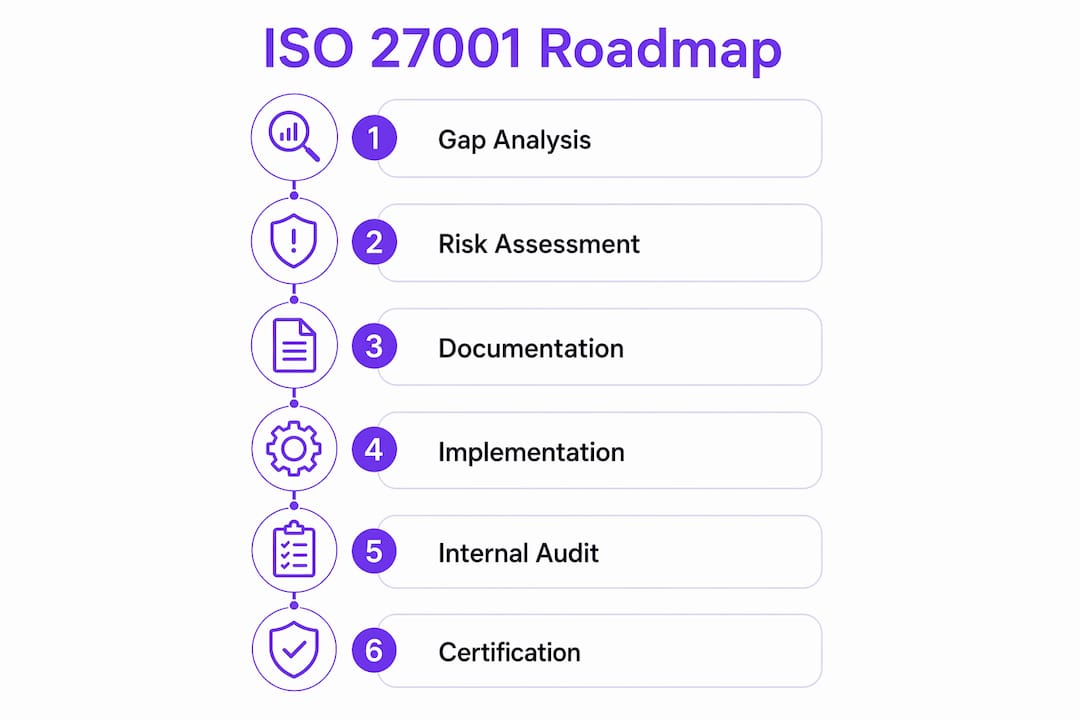
A well-run engagement follows a predictable phase structure. The table below shows typical durations, deliverables, and who owns each phase.
A typical engagement phase structure includes scoping, gap analysis, risk assessment, policy development, control implementation, internal audit, and certification audit support, each lasting several weeks depending on scope and client involvement.
A few things that shift the timeline:
- Scope creep is the most common delay. Define the ISMS boundary in writing during Phase 1 and require a formal change order for any expansion.
- Internal resource availability during control implementation is the second most common bottleneck. Assign a named internal project owner before the engagement starts.
- Organizations pursuing a step-by-step gap analysis before engaging a consultant typically enter Phase 2 two to three weeks ahead of those who skip it.
Why Ismscalculator belongs in your procurement process
Before you send a single RFP, you need two things: a realistic cost estimate and a baseline maturity score. Ismscalculator gives you both in minutes.
What the platform does for procurement teams:
- Generates a real-time cost and effort estimate tailored to your company size, industry, and security maturity
- Runs a maturity assessment across all four ISO/IEC 27001:2022 control themes so you know exactly where your gaps are before a consultant tells you
- Produces a customizable Gantt chart you can attach to an RFP as a draft project schedule
- Exports a PDF report you can share with procurement, legal, and the board
- Connects you to independent ISO 27001 implementers and Lead Auditors through its consultant introduction service
- Lets you save and compare multiple estimates as your scope evolves
Run the free readiness assessment before your first consultant call. It takes less time than reading most RFP templates.
Your 30–60–90 day procurement and implementation starter plan
A concrete schedule prevents the most common failure mode: months of planning with no certification progress.
Days 1–30: Assess and scope
- Run the Ismscalculator 2-minute readiness check and save your baseline estimate.
- Define your ISMS scope in writing — which systems, locations, and business processes are in.
- Identify your internal project owner (typically the IT manager or compliance officer).
- Assemble a shortlist of three to five consultants using the Ismscalculator consultant directory.
- Issue RFIs to shortlisted consultants with your scope statement attached.
Days 31–60: Evaluate and select
- Score RFI responses against the selection criteria above (certifications, pass rate, deliverables, references).
- Conduct reference calls with at least two clients per finalist.
- Request fixed-fee proposals from the top two candidates.
- Involve legal to review contract terms and SLAs before signing.
- Select your consultant and agree on a project kick-off date.
Days 61–90: Launch and gap remediation
- Complete the scoping workshop with your consultant.
- Run the full gap analysis (consultant-led or using the gap analysis guide as a parallel check).
- Prioritize the top 10 remediation items by audit risk.
- Assign control owners across IT, HR, legal, and operations.
- Schedule the internal audit for approximately 60 days before your target certification audit date.
Stakeholder involvement by phase:
- Procurement and legal: Days 1–60 for contract review and vendor selection.
- IT operations and security: Days 1–90 for gap analysis, control implementation, and evidence collection.
- Business unit owners: Days 30–90 for policy sign-off and control ownership.
- Executive sponsor: Days 1–30 for scope approval; Days 60–90 for certification audit sign-off.
When is the right time to bring in a consultant?
The earlier, the better — but the answer depends on where you are in the project.

Bring in a consultant at the very start if you have no existing ISMS, no internal security expertise, or a hard certification deadline within six months. Starting without one and then hiring mid-project is the most expensive path: you pay to undo documentation that does not meet auditor expectations.
If you have an existing security program, a consultant is most valuable at three specific points: the initial gap analysis (to get an objective baseline), the internal audit (to get an independent assessment before the real one), and Stage 2 audit preparation (to organize evidence and coach your team on auditor interactions). Organizations with strong internal teams sometimes handle policy writing and control implementation themselves, then bring in a consultant only for the internal audit and certification support phases. That model works, but only when the internal team has genuine ISO 27001 experience, not just general security knowledge.
For accounting and financial services firms, the overlap between ISO 27001 controls and client data protection practices is substantial enough that a consultant with financial-sector experience will cut implementation time noticeably compared with a generalist.
Key contractual terms and SLAs to include in your consultant agreement
A well-drafted contract protects you from scope creep, unclear deliverables, and a consultant who disappears after the documentation phase.
Terms to include:
- Scope definition clause: A written ISMS boundary statement that requires a formal change order for any expansion. This is the single most important clause for budget control.
- Named personnel: Specify the Lead Implementer by name. Contracts that allow the firm to substitute staff without your approval frequently result in junior consultants doing the work.
- Deliverables schedule: Each phase deliverable listed with an acceptance criterion and a due date. “Reasonable efforts” language is not acceptable.
- Internal audit independence: Confirm whether the internal audit is performed by the same consultant or a separate auditor. Independence is preferable; if the same firm does both, require a different individual.
- Certification body neutrality: The consultant must not receive referral fees or have financial relationships with the certification body they recommend.
- Post-certification support terms: Define what is included after the certificate is issued — surveillance audit prep, policy updates, staff training refreshers — and at what cost.
SLAs worth specifying:
- Response time for queries during the engagement (48 hours is a reasonable standard).
- Turnaround time for document revisions after client review (five business days is typical).
- Availability commitment for audit support dates — your Stage 2 audit date is fixed; your consultant must be there.
- Remediation support window after a nonconformity finding (30 days is standard for minor nonconformities).
One practical note: many consultancies offer a free scoping consultation before issuing a fixed-fee proposal. Use that call to test their methodology and ask the RFP questions above before you commit to a full proposal process.
Key Takeaways
Hiring ISO 27001 consultancy is the fastest route to certification for most organizations, provided you scope the engagement with a readiness assessment before issuing an RFP.
| Point | Details |
|---|---|
| Match delivery model to your profile | Consultant-led for regulated enterprises; hybrid for scale-ups; software-assisted for SaaS and resource-constrained teams. |
| Timeline ranges from 8–12 weeks to 12+ months | Rapid-track engagements can reach audit-ready status in 8–12 weeks for tightly scoped projects, while standard and extended timelines may take anywhere from 3–12 months or longer depending on complexity. |
| Require certifications and a pass rate | Ask for named Lead Implementers on staff and a documented first-attempt pass rate — plus client references that back it up. |
| Scope the contract tightly | Include named personnel, a deliverables schedule, and a scope-change clause to prevent budget overruns. |
| Ismscalculator accelerates procurement | Run the free readiness assessment to get a cost estimate and maturity baseline before your first consultant call. |
The part of ISO 27001 procurement most guides skip
The conventional advice is to find a certified consultant, check their references, and sign a contract. That is necessary but not sufficient. The gap most organizations fall into is not picking the wrong consultant — it is arriving at the scoping call without a defined ISMS boundary.
When you cannot tell a consultant exactly which systems, locations, and processes are in scope, you hand them the power to define it for you. A broader scope means more billable hours. That is not cynicism; it is how fixed-fee proposals get written. The consultant scopes generously to protect their margin, and you end up paying for controls that do not apply to your environment.
The practical fix is to do your own scoping work first. A 14-domain maturity assessment takes less than an hour and gives you enough information to write a scope statement that reflects your actual environment. Bring that to the first consultant call and the dynamic shifts: you are evaluating their proposal against a known baseline, not accepting their framing of the problem.
One more thing worth saying plainly: the internal audit is not a formality. Organizations that treat it as a box-checking exercise before the real audit consistently find nonconformities during Stage 2 that could have been caught and fixed. Require your consultant to run the internal audit as a genuine adversarial review, not a friendly walkthrough.
Ismscalculator gives you a head start before the first consultant call
Before you spend time on RFPs and reference calls, you need a number: what will ISO 27001 implementation actually cost for your organization, and where are your biggest gaps? Ismscalculator answers both questions in minutes.
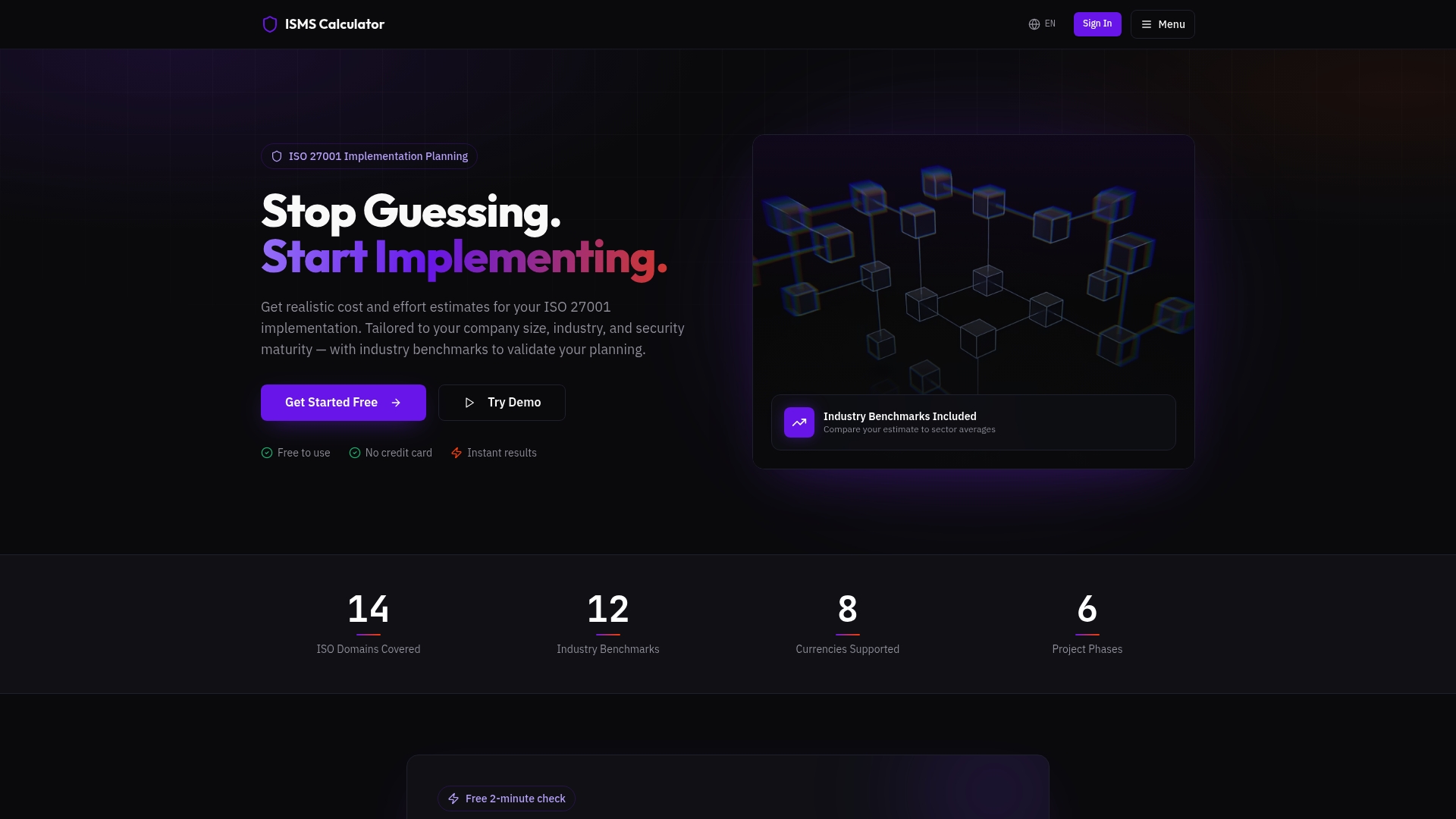
The platform generates a real-time cost and effort estimate tailored to your company size, industry, and current security maturity. Its 14-domain maturity assessment pinpoints exactly which ISO 27001 domains need the most work, so your RFP scope reflects reality rather than guesswork from a vendor. You can export the results as a PDF, attach the Gantt output to your RFP as a draft project schedule, and share the estimate directly with your procurement team or board.
When you are ready to move from planning to execution, Ismscalculator connects you to independent ISO 27001 implementers and Lead Auditors whose credentials you can review yourself. No cold outreach, no blind RFPs.
Start with the free 2-minute readiness check — it costs nothing and gives you the baseline you need to run a sharper procurement process.
Useful sources and further reading
For procurement teams:
- ISO 27001:2022 standard overview — The authoritative source for understanding what the standard requires. Read the scope and Annex A sections before writing your RFP.
- ISO 27001 Certification Checklist: 80 Steps to Certification — A detailed implementation checklist you can attach to an RFP or use as an internal project plan.
- ISO 27001 Readiness Assessment — Run this before your first consultant call to generate a scoped cost estimate and maturity baseline.
- Find an independent ISO 27001 consultant — Ismscalculator’s consultant introduction service for organizations ready to solicit proposals.
- Client financial data handling best practices — Relevant for financial services and accounting firms mapping ISO 27001 controls to existing data-handling obligations.
For technical leads and implementation teams:
- ISO 27001 Gap Analysis: A Step-by-Step Guide — Detailed walkthrough of how to run a gap analysis against Annex A controls.
- ISO 27001 Implementation Timeline: What to Expect — Milestone guidance for planning your project schedule.
- ISO 27001 for SaaS & Tech Companies — Practical guidance for technology organizations with cloud-native environments.
- Why IT Managers Lead ISMS Implementation — Useful for clarifying internal role responsibilities before the consultant engagement starts.
- NQA ISO 27001 Certification guidance — A registrar’s perspective on what the certification process involves and how accredited bodies issue certificates.