
IT managers lead ISMS implementation because they hold the technical knowledge required to deploy controls, manage assets, and produce the operational evidence that auditors actually check. An Information Security Management System, or ISMS, is the formal framework defined by ISO 27001 for protecting organizational information through policies, processes, and controls. While top management holds ultimate accountability under ISO 27001 Clause 5, IT managers are the ones who translate governance decisions into working security systems. Understanding why IT managers lead ISMS implementation clarifies both the scope of the role and the organizational support it requires.
Why IT managers lead ISMS implementation
IT managers lead ISMS implementation because they are the only people in most organizations who can accurately define scope, map assets, and verify that controls actually work. The ISMS scope determines which systems, locations, and processes fall under ISO 27001 certification. Get it wrong, and incorrect scope definition becomes the leading cause of audit failure. That single fact explains why a non-technical manager cannot effectively own this work.
ISO 27001 is the international standard for information security management, and its complete guide gives IT managers a solid foundation before they start. The standard requires a Statement of Applicability (SoA), a risk assessment, and documented evidence that selected controls are operating. Each of those outputs depends on technical judgment. A CEO can endorse the policy. Only an IT manager can confirm that multi-factor authentication is enforced across every in-scope system.

The 2022 revision of ISO 27001 consolidated Annex A controls from 114 down to 93, grouped into four themes: organizational, people, physical, and technological. That consolidation reduced complexity but increased the precision required in control selection. IT managers must now map each selected control to a specific risk, document the justification, and show evidence of deployment. That is a technical and analytical task, not a policy exercise.
What specific responsibilities do IT managers hold in ISMS implementation?
IT managers carry the operational weight of ISMS implementation across several distinct areas. Each area requires both technical skill and documentation discipline.
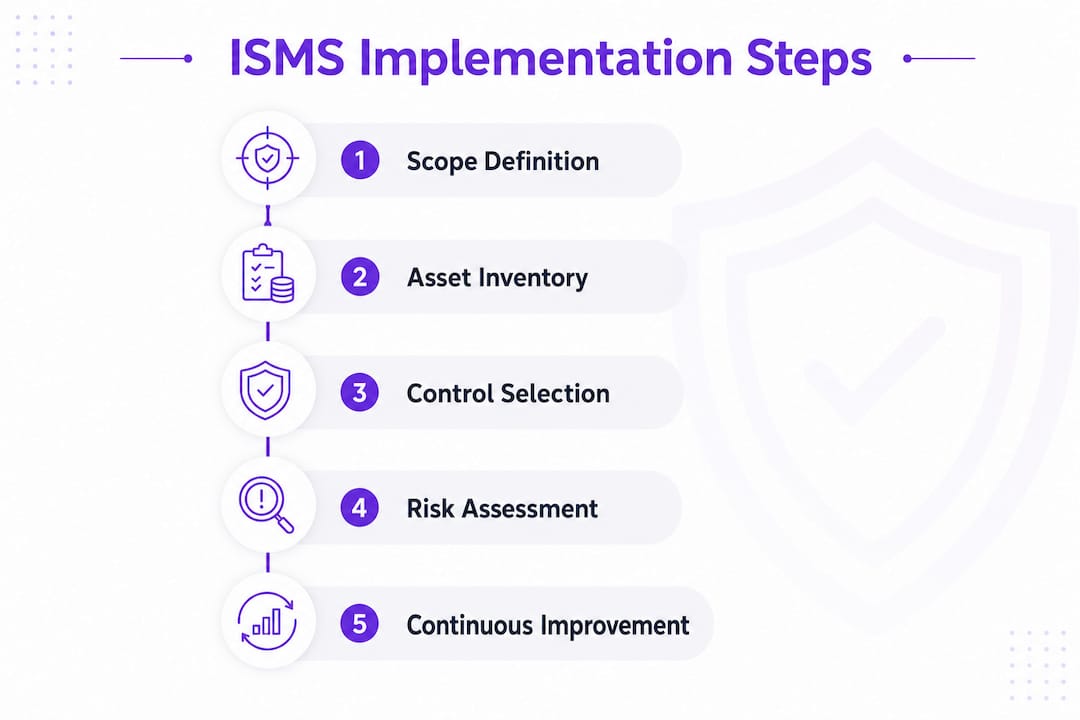
- Scope definition: IT managers identify which systems, data flows, and locations fall within the ISMS boundary. Scope creep, where the boundary expands without formal approval, is a primary audit risk.
- Asset inventory and risk assessment: ISO 27001 Clause 6.1.2 requires a comprehensive risk assessment and SoA formulation as foundational steps. IT managers build and maintain the asset register that feeds this process.
- Control selection and deployment: Under the 2022 Annex A structure, IT managers select controls from the technological theme, including privileged access management (PAM), multi-factor authentication (MFA), and role-based access control (RBAC). These are not checkbox items. They require configuration, testing, and ongoing monitoring.
- Statement of Applicability: The SoA documents which controls apply, which are excluded, and why. A complete SoA guide helps IT managers structure this document correctly so it survives Stage 2 audit scrutiny.
- Operational evidence: Policies alone do not satisfy auditors. IT managers must produce logs, access reports, change records, and test results that prove controls are active.
- Infrastructure tooling: Configuration Management Databases (CMDB) and observability tools maintain real-time asset inventory and detect control drift before auditors do.
Pro Tip: Map every Annex A control you select directly to a named risk in your risk register. Auditors check this linkage first. A control without a documented risk justification is a nonconformity waiting to happen.
The Annex A controls explained resource breaks down each of the 93 controls by theme, which makes the selection process faster and more defensible.
How do IT managers collaborate with top management and other departments?
ISO 27001 is fundamentally a governance program, not a purely technical project. IT managers who treat it as an IT-only task consistently hit walls when they need budget, policy sign-off, or cooperation from HR and procurement. The ISMS only works when the whole organization participates.
Top management must visibly commit to the ISMS through resource allocation, policy endorsement, and attendance at management reviews. ISO 27001 Clause 5 makes this mandatory, not optional. When leadership shows up to audits and signs the security policy, it signals organizational commitment. Auditors notice when they do not.
“Treating ISO 27001 as an IT project is the single most reliable way to fail certification. HR owns onboarding and offboarding controls. Procurement owns supplier risk. Facilities owns physical access. IT managers cannot implement those controls alone, and auditors will ask for evidence from each department.”
The cross-departmental responsibilities IT managers must coordinate include:
- HR: Onboarding and offboarding procedures, background checks, and security awareness training
- Procurement: Supplier due diligence and third-party risk assessments
- Facilities: Physical access controls, clean desk policies, and equipment disposal
- Legal and compliance: Data classification, retention policies, and regulatory alignment
Engaging non-technical departments as risk owners and control implementers is critical. IT managers who assign ownership to department heads get better compliance and stronger audit evidence. Department heads who own a control tend to maintain it. IT managers who own everything tend to burn out and leave gaps.
The relationship between ISO 27001 and GDPR illustrates this well. GDPR compliance requires legal, HR, and IT working together. An ISMS that covers both frameworks forces exactly the cross-functional collaboration that makes certification sustainable.
What are common challenges IT managers face leading ISMS implementations?
The three most damaging challenges in ISMS implementation are scope creep, the “paper ISMS” syndrome, and management disengagement. Each one is avoidable with the right approach.
-
Scope creep. The ISMS scope expands informally when new systems or departments get added without a formal scope change process. Scope creep and policy-only approaches are the most frequent causes of audit failure. Fix this by requiring a written scope change request for any addition, reviewed and approved before implementation begins.
-
The paper ISMS. Policies exist. Evidence does not. Auditors require proof that controls are actively functioning within daily workflows. A firewall policy document does not prove the firewall is configured correctly. Logs, screenshots, and change records do. Build evidence collection into your operational processes from day one, not two weeks before the audit.
-
Management disengagement. When leadership stops attending management reviews or delays resource approvals, the ISMS stalls. Top management attendance at management reviews demonstrates engagement and is a specific auditor checkpoint. IT managers should schedule these reviews as fixed calendar events with executive sponsors, not ad hoc meetings.
-
Staff awareness gaps. Controls fail when staff do not understand their roles. Auditors interview employees during Stage 2 audits. If a staff member cannot explain the clean desk policy or how to report a security incident, that is a nonconformity.
Pro Tip: Run a quarterly internal audit six weeks before your certification audit. Use it to collect missing evidence, close gaps, and brief staff on what auditors will ask. This single practice eliminates most Stage 2 surprises.
The ISO 27001 implementation timeline resource helps IT managers set realistic milestones and avoid the last-minute evidence scramble that causes most audit failures.
How has the 2022 ISO 27001 revision changed IT managers’ responsibilities?
The 2022 revision changed what IT managers must do, not just how many controls they manage. The reduction from 114 to 93 Annex A controls sounds like less work. It is not. Consolidation means each remaining control is broader, and the justification for inclusion or exclusion in the SoA must be more precise.
| Area of change | Pre-2022 requirement | Post-2022 requirement |
|---|---|---|
| Annex A structure | 14 domains, 114 controls | 4 themes, 93 controls |
| Technological controls | Broad categories | Specific controls including zero standing privilege and just-in-time access |
| Risk-based thinking | Recommended | Explicitly required under Clause 6.1.2 |
| Asset management | Asset register | CMDB integration and real-time drift detection |
| PDCA cycle | Implied | Formally embedded in continual improvement requirements |
Zero standing privilege and just-in-time access are now explicit technical control expectations under the 2022 revision. These require modern identity and access management platforms, not just policy documents. IT managers who have not updated their access control architecture since 2013 face a significant gap.
The PDCA cycle (Plan, Do, Check, Act) is now formally embedded in the standard’s continual improvement requirements. IT managers must schedule regular control reviews, not just implement controls once and move on. This shifts the role from a project mindset to an ongoing operational discipline.
Key Takeaways
IT managers lead ISMS implementation because they are the only people in most organizations who can deploy controls, produce operational evidence, and maintain the technical infrastructure that ISO 27001 certification requires.
| Point | Details |
|---|---|
| IT managers own technical execution | Scope definition, asset inventory, control deployment, and SoA preparation all require technical judgment. |
| Top management must formally commit | ISO 27001 Clause 5 requires leadership to allocate resources and attend management reviews. |
| Cross-departmental collaboration is mandatory | HR, procurement, and facilities each own controls that IT managers cannot implement alone. |
| Operational evidence beats policy documents | Auditors check logs, access reports, and change records, not just written policies. |
| The 2022 revision raised the technical bar | Zero standing privilege, just-in-time access, and CMDB integration are now explicit expectations. |
The governance gap most IT managers never see coming
I have watched technically excellent IT managers fail ISO 27001 audits not because their controls were wrong, but because they never built the governance layer around them. They configured PAM, enforced MFA, and documented every Annex A control. Then the auditor asked the HR director about the offboarding procedure and got a blank stare. Major nonconformity. Certification delayed by four months.
The uncomfortable truth is that IT managers who lead ISMS implementations need to become part-time organizational change managers. The technical work is the easier half. Getting a procurement manager to complete supplier risk assessments on time, or convincing a CFO that management review attendance is not optional, requires a different skill set entirely.
What actually works is assigning formal ownership. When a department head signs their name to a control, they take it seriously. When IT owns everything, everyone else assumes IT will handle it. Distribute ownership early, document it in the SoA, and make it visible to leadership. That one structural change prevents more audit failures than any technical tool.
The IT managers I have seen succeed at ISMS leadership are the ones who treat every management review as a board presentation. They bring metrics, risk trends, and clear asks for resources. They make leadership feel informed and in control. That is how you keep executive engagement alive through a 12-month implementation.
— Martin
How Ismscalculator supports IT managers through ISO 27001 implementation
IT managers leading an ISMS implementation need more than a checklist. They need a clear picture of where their organization stands before committing to a timeline or a budget.
Ismscalculator gives IT managers a free 2-minute readiness check that surfaces gaps across all four ISO/IEC 27001:2022 control themes before the formal implementation begins. The platform’s real-time calculator then generates tailored cost and effort estimates based on company size, industry, and current security maturity. For IT managers who need a deeper baseline, the full ISO 27001 readiness assessment maps your organization against model reference comparisons and produces a prioritized gap report. That report becomes the foundation for your project plan, your SoA, and your first conversation with top management about resources.
FAQ
Why do IT managers lead ISMS implementation rather than the CISO?
IT managers lead ISMS implementation because they have direct control over the technical infrastructure where controls are deployed. In organizations without a dedicated CISO, the IT manager is the most qualified person to own scope definition, asset management, and control evidence.
What does ISO 27001 Clause 5 require from top management?
ISO 27001 Clause 5 requires top management to demonstrate visible commitment through resource allocation, policy endorsement, and participation in management reviews. This is a mandatory audit checkpoint, not a recommendation.
What is a “paper ISMS” and why does it cause audit failures?
A paper ISMS is one where policies exist but operational evidence does not. Auditors require proof that controls are actively functioning, such as logs, access reports, and test results. Policies alone result in major nonconformities during Stage 2 audits.
How did the 2022 ISO 27001 revision affect IT managers’ workload?
The 2022 revision consolidated Annex A controls from 114 to 93 and introduced explicit technical requirements like zero standing privilege and just-in-time access. IT managers must now justify each control selection more precisely and maintain real-time asset management through tools like CMDB.
How can IT managers keep top management engaged throughout ISMS implementation?
IT managers should schedule management reviews as fixed calendar events with executive sponsors and present them as structured briefings with metrics and risk trends. Formal ownership assignments documented in the SoA also distribute accountability beyond the IT team and maintain leadership visibility.