
Management review in an ISMS is defined as a formal, evidence-based evaluation conducted by top management to assess whether the Information Security Management System remains suitable, adequate, and effective. ISO 27001 Clause 9.3 mandates this review as a non-negotiable leadership obligation, not a task that can be delegated to a compliance analyst or IT manager alone. The review connects operational security data directly to executive decision-making, making it one of the most consequential activities in the entire ISO 27001 framework. Organizations that treat it as a checkbox exercise consistently underperform in audits and fail to close real security gaps.
What is the management review process in an ISMS?
The management review process is a structured leadership evaluation of ISMS performance, conducted at planned intervals to verify the system still serves its purpose. ISO 27001 does not fix a rigid schedule. Review frequency is risk-profile-dependent, so most organizations conduct the review annually at minimum, with additional sessions triggered by significant incidents, organizational changes, or new regulatory requirements. A company that just completed a major cloud migration, for example, should not wait until its annual cycle to reassess its ISMS posture.
The process begins with gathering the right inputs. ISO standards specify these inputs must be reviewed, not just acknowledged in a slide deck. Required inputs under Clause 9.3 include:
- Results of internal audits and previous management review actions
- Risk assessment outcomes and the current status of the risk treatment plan
- Security incident data, including near-misses and response effectiveness
- Performance metrics against information security objectives
- Feedback from interested parties, including customers and regulators
- Changes in the internal and external context that affect the ISMS
- Opportunities for continual improvement
Each input item should arrive at the meeting backed by actual data, not summaries written by the person who wants to look good. Top management must engage with the evidence directly, ask questions, and challenge assumptions. That active engagement is what separates a genuine management review from an administrative ritual.
Pro Tip: Assign a dedicated review coordinator three to four weeks before the meeting. That person collects and validates all input data, so the meeting itself focuses on decisions rather than data retrieval.

What are the required outputs of an ISMS management review?
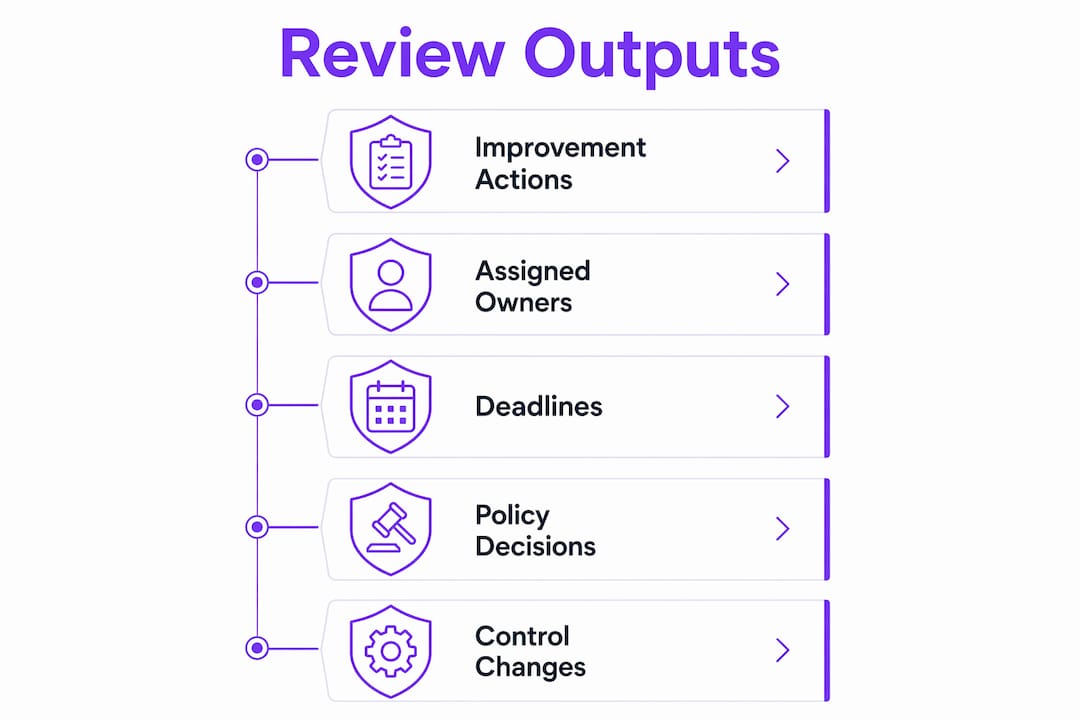
Outputs are where management review produces its real value. Documentation and evidence retention are critical for audit readiness, and auditors will look specifically for documented decisions, not just meeting minutes. The required outputs of a compliant management review include:
- Improvement actions. Each identified gap must produce a specific corrective or improvement action, not a vague intention. “Improve patch management” is not an output. “Reduce mean time to patch critical vulnerabilities from 14 days to 7 days by March 31, with the IT operations lead as owner” is an output.
- Changes to policies or controls. If the review reveals that an existing control is no longer adequate, the output must include a decision to update it, with a timeline.
- Resource decisions. Management must formally commit resources, whether budget, personnel, or tools, to close identified gaps. Verbal commitments made in a meeting that never appear in documentation are worthless in an audit.
- Updates to information security objectives. If business strategy has shifted, the ISMS objectives must shift with it. The review is the formal mechanism for making that alignment explicit.
- Follow-up assignments. Effective reviews produce concrete, tracked action items with assigned owners and deadlines. Every action from the previous review should appear as a status update in the next one.
The quality of these outputs determines whether the review actually improves the ISMS. A meeting that produces five vague action items with no owners is worse than no meeting at all, because it creates false confidence. Proper audit-ready documentation of outputs is what gives the review its teeth during certification audits.
Why is management review important for ISMS effectiveness?
Management reviews are mandatory for ISO 27001 certification, and failure to perform them properly weakens both ISMS credibility and audit readiness. That is the compliance floor. The strategic ceiling is much higher.
Effective management reviews force leadership accountability. When the CEO or CISO must sit in a room and review incident trends, audit findings, and risk treatment progress, they cannot remain disconnected from security realities. That accountability drives resource commitment. Security teams that struggle to get budget approved often find that a well-run management review, with clear data showing unacceptable risk exposure, produces faster decisions than months of internal lobbying.
The significance of management review lies in the decisions it produces and the leadership accountability it enforces. A review that generates no decisions has failed, regardless of how thorough the agenda appeared.
Management review also serves as the backbone for governance and continual improvement in an ISMS, connecting system performance data to strategic business objectives. That connection matters because information security risks do not exist in isolation. A new product launch, a merger, or a shift to remote work all change the threat surface. The management review is the formal mechanism for recognizing those changes and adjusting the ISMS accordingly.
Pro Tip: Frame management review outputs in business risk terms, not technical terms. “Three critical vulnerabilities remain unpatched” lands differently than “We face a potential $2.4M regulatory exposure if these gaps are exploited before remediation.” Translate security data into language that drives executive decisions.
Avoiding common ISO 27001 implementation mistakes starts with taking the management review seriously as a governance tool rather than a compliance formality.
How to conduct an effective management review meeting
Effective management review meetings require deliberate planning. Focused agendas and clear outcomes lead to better engagement and results, and the agenda structure is the single biggest lever you control before the meeting starts.
The most common mistake compliance professionals make is building an agenda that is 90% data presentation. Auditors look for evidence of strategic discussion, with roughly 30% of time spent on data presentation and 70% on decision-making. Flip your agenda to reflect that ratio. Present the key metrics in the first third of the meeting, then spend the majority of the time on discussion, decisions, and action assignment.
Agenda structure that works
A practical management review agenda for an ISMS covers these areas in sequence:
- Opening and context. Confirm the scope of the review, note any significant changes since the last session, and state the objectives for this meeting.
- Input review. Walk through audit results, risk status, incident data, and performance metrics. Keep this section tight. Dashboards and one-page summaries work better than 40-slide decks.
- Previous action review. Report the status of every action from the last management review. Closed, in progress, or overdue. No exceptions.
- Strategic discussion. This is the 70% zone. What does the data mean for the organization’s risk posture? What decisions need to be made today?
- Output assignment. Assign owners, deadlines, and resources to every decision made during the discussion.
- Close and documentation. Confirm the record of decisions and schedule the next review.
Common pitfalls to avoid
| Pitfall | Why it fails | Better approach |
|---|---|---|
| No top management attendance | Violates Clause 9.3 and signals low priority | Require C-level or designated senior leader attendance |
| Data dump agenda | Leaves no time for decisions | Cap data presentation at 30% of meeting time |
| Vague action items | Cannot be tracked or audited | Every action needs an owner, deadline, and success measure |
| No link to business strategy | ISMS becomes isolated from organizational goals | Map each ISMS objective to a business risk or strategic priority |
| Missing documentation | Fails audit evidence requirements | Produce formal minutes within 48 hours of the meeting |
The ISMS maturity assessment framework across ISO 27001’s the four Annex A control themes gives compliance teams a structured way to measure progress between review cycles and bring meaningful data to each session.
Key Takeaways
Management review in an ISMS is a mandatory, evidence-based leadership process under ISO 27001 Clause 9.3 that drives continual improvement, resource accountability, and strategic alignment across the entire security management system.
| Point | Details |
|---|---|
| Clause 9.3 is non-negotiable | Top management must personally conduct the review; it cannot be delegated to IT or compliance staff. |
| Inputs must be data-backed | Audit results, risk status, incidents, and performance metrics must be reviewed with actual evidence, not summaries. |
| Outputs require owners and deadlines | Every improvement action must have an assigned owner, a deadline, and a measurable success criterion. |
| 70% discussion, 30% data | Effective meetings spend most time on decisions, not presentations, which is what auditors look for. |
| Frequency follows risk | Annual reviews are the minimum; significant changes in context or incidents should trigger additional sessions. |
Management review as a leadership test, not a compliance task
Most compliance teams I have worked with dread the management review. They spend weeks preparing slide decks, only to sit through a 90-minute meeting where executives nod politely and sign the attendance sheet. Nothing changes. The next review looks identical.
The problem is not the process. The problem is framing. When you present management review as a compliance requirement, leadership treats it as one. When you present it as the one meeting where they get a clear, honest picture of the organization’s security risk and the power to fix it, the dynamic shifts.
The reviews that actually improve ISMS maturity share one trait: the people in the room make real decisions with real consequences. They approve budget. They close programs that are not working. They hold specific leaders accountable for overdue actions. That accountability loop is what ISO 27001 was designed to create, and the management review is the mechanism that enforces it.
IT managers often struggle to engage non-technical leadership in these discussions. The fix is translation, not simplification. Executives understand revenue risk, regulatory exposure, and reputational damage. Map your ISMS data to those categories before you walk into the room. A risk treatment plan that is 60% complete is not a technical metric. It is a liability that the board needs to understand.
— Martin
How Ismscalculator supports your management review preparation
Preparing for a management review takes weeks of data collection, formatting, and gap analysis. Ismscalculator cuts that preparation time significantly by giving compliance teams structured tools to assess ISMS readiness, track performance across ISO 27001’s the four Annex A control themes, and generate the evidence-backed reports that management reviews require.
The platform’s maturity assessment covers every domain relevant to Clause 9.3 inputs, so you arrive at the review with organized, auditor-ready data rather than a last-minute scramble. Ismscalculator also provides customizable Gantt charts for tracking improvement actions between review cycles, which closes the accountability gap that undermines most ISMS programs. Start with the ISO 27001 readiness assessment to identify your current gaps and build a management review agenda grounded in real performance data.
FAQ
What is management review in an ISMS?
Management review in an ISMS is a formal evaluation conducted by top management under ISO 27001 Clause 9.3 to assess whether the Information Security Management System remains suitable, adequate, and effective. It connects security performance data to executive decision-making and resource allocation.
How often should an ISMS management review be conducted?
ISO 27001 requires management reviews at planned intervals, with annual reviews being the standard minimum. Organizations should conduct additional reviews when significant changes occur, such as major incidents, new regulatory requirements, or structural changes to the business.
What inputs are required for an ISMS management review?
Required inputs include internal audit results, risk assessment outcomes, security incident data, performance metrics against objectives, previous review action status, and changes in internal or external context. All inputs must be supported by actual evidence, not just summaries.
What outputs must an ISMS management review produce?
Outputs must include documented improvement actions with assigned owners and deadlines, decisions on policy or control changes, resource commitments, and updates to information security objectives. Undocumented verbal decisions do not satisfy ISO 27001 audit requirements.
Can an IT manager run the ISMS management review alone?
No. ISO 27001 Clause 9.3 requires top management to conduct the review. An IT manager can coordinate preparation and facilitate the meeting, but senior leadership must be present, engaged, and accountable for the decisions produced.
Recommended
- ISMS Maturity Assessment: A 2026 Guide for Compliance Teams | ISMS Calculator
- Privileged Access Management in ISMS: A Security Guide | ISMS Calculator
- Fraud Prevention in ISMS: A 2026 Guide for Compliance Teams | ISMS Calculator
- Build an ISMS for Financial Data Protection: 2026 Guide | ISMS Calculator