
Continual improvement in an ISMS is defined as the ongoing, documented process of enhancing the suitability, adequacy, and effectiveness of an information security management system over time. ISO 27001 Clause 10.1 makes this a formal requirement, not a best practice. The standard operationalizes it through the PDCA (Plan-Do-Check-Act) cycle, which turns audit results, management reviews, and corrective actions into structured advancement. Compliance professionals who treat continual improvement as a checkbox risk audit nonconformities. Those who embed it into every PDCA phase build an ISMS that actually matures.
What does continual improvement mean in ISMS, and why does Clause 10.1 require it?
Continual improvement in an ISMS means an organization must actively and repeatedly raise the performance of its information security controls, not just maintain them. ISO 27001 Clause 10.1 states this obligation plainly: the organization shall continually improve the suitability, adequacy, and effectiveness of the ISMS. That single sentence carries significant audit weight.
The standard treats the ISMS as a living system, never a one-time project. Certification does not end the obligation. Surveillance audits and recertification audits both examine whether the organization has made traceable, documented improvements since the last review cycle.

Three inputs drive Clause 10.1 in practice: audit findings, risk assessment updates, and management review outputs. Each one surfaces gaps. Continual improvement is the structured response to those gaps. Without it, an ISMS stagnates and drifts out of alignment with the threat environment.
How does the PDCA cycle drive continual improvement?
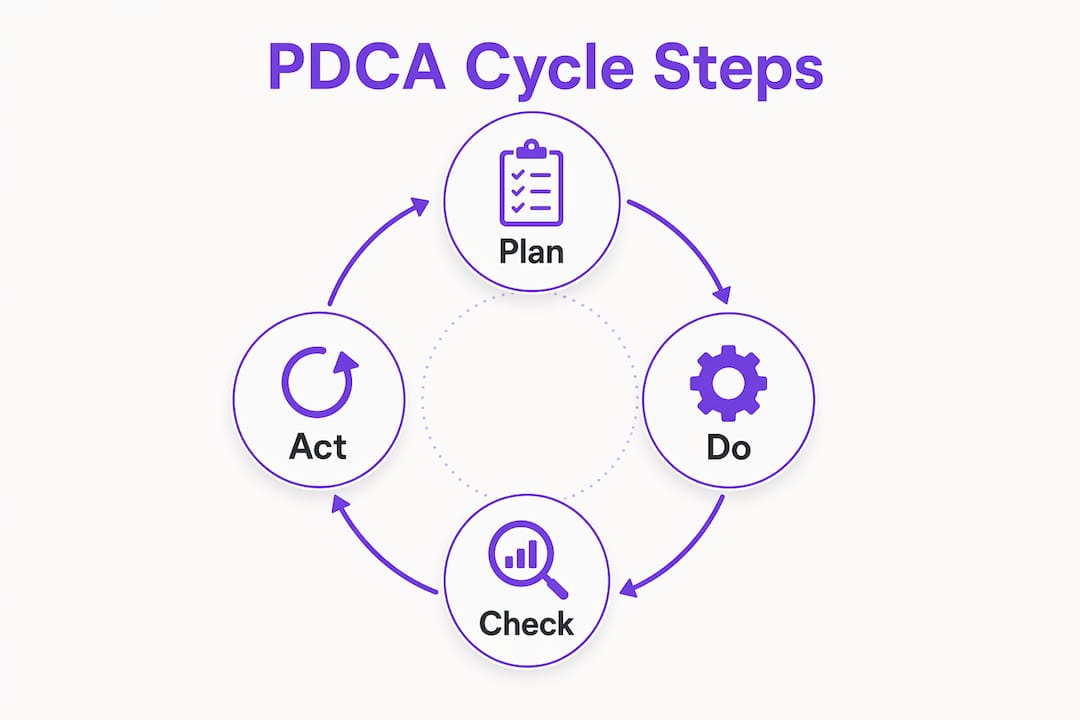
The PDCA cycle is the mechanism ISO 27001 uses to achieve continual improvement. Each phase maps directly to specific clauses in the standard.
The four phases and their ISO 27001 clauses
- Plan (Clauses 4–6): Define the ISMS scope, conduct risk assessments, set security objectives, and select controls from Annex A. This phase establishes what the organization intends to achieve and how it will measure success.
- Do (Clauses 7–8): Implement the controls, allocate resources, train staff, and execute the risk treatment plan. This is where policy meets practice.
- Check (Clause 9): Monitor, measure, and audit. Internal audits, performance evaluations, and management reviews all belong here. The Check phase generates the evidence that feeds improvement decisions.
- Act (Clause 10): Address nonconformities, implement corrective actions, and formally record continual improvement decisions. This phase closes the loop and restarts the cycle.
| PDCA Phase | ISO 27001 Clauses | Key Activity |
|---|---|---|
| Plan | 4, 5, 6 | Risk assessment, objectives, control selection |
| Do | 7, 8 | Implementation, training, risk treatment |
| Check | 9 | Audits, monitoring, management review |
| Act | 10 | Corrective actions, improvement decisions |
The PDCA cycle repeats indefinitely, with each cycle’s outputs feeding the next Plan phase. That iterative structure is what sustains a mature ISMS over years, not just months.
Pro Tip: Document the link between each corrective action and the specific audit finding or risk assessment that triggered it. Auditors trace this chain directly, and a broken link is a common source of nonconformities.
What is the difference between continual and continuous improvement?
The terminology distinction matters more than most compliance teams realize. Continual improvement involves deliberate, stepwise progress with built-in reflection pauses. Continuous improvement is an uninterrupted flow with no structured stopping points.
ISO 27001 deliberately uses “continual” rather than “continuous.” The reason is practical: security management requires organizations to assess what happened, decide what to change, and then act. Autopilot improvement without reflection produces activity, not advancement.
“The deliberate pauses in continual improvement cycles enforce thoughtful reflection and conscious decision-making. Without those pauses, organizations run on momentum rather than evidence, which is exactly what ISO auditors are trained to detect.”
| Term | Definition | ISO Preference |
|---|---|---|
| Continual improvement | Stepwise progress with reflection between cycles | Yes. Required by ISO 27001 Clause 10.1 |
| Continuous improvement | Uninterrupted, ongoing flow of changes | No. Better suited to DevOps or manufacturing |
| Constant improvement | Fixed rate of change regardless of context | No. Incompatible with risk-based thinking |
Understanding this distinction directly affects audit readiness. An auditor who sees a log of constant activity but no evidence of structured review and decision will flag the absence of genuine continual improvement. The reflection point is the evidence.
How do you demonstrate continual improvement for an ISO 27001 audit?
Demonstrating continual improvement requires documented evidence, not verbal assurances. Auditors examine specific records, and gaps in those records produce nonconformities.
Management review inputs must include audit results, corrective actions, and stakeholder feedback. The outputs must document specific improvement decisions. A management review that concludes with “no changes needed” without supporting evidence is a red flag for any auditor.
The core evidence set compliance teams need includes:
- Internal audit reports with findings linked to specific controls and clauses
- Corrective action records showing root cause analysis and verified closure
- Management review minutes with explicit improvement decisions and owners
- Risk assessment updates reflecting changes in the threat environment or business context
- Performance metrics showing trend data across monitoring periods
- Nonconformity logs with status tracking from identification through resolution
Many organizations fail audits because their improvement decisions are not traceable back to previous assessments and findings. The fix is straightforward: every improvement action needs a reference number that links it to the finding that triggered it.
Pro Tip: Build a simple improvement register in a spreadsheet or your GRC platform. Columns should include: source (audit, review, or risk assessment), finding reference, improvement action, owner, target date, and closure evidence. Auditors love a well-maintained register because it shows the system is working.
A common pitfall is treating the management review as a formality. The management review process is one of the most audited elements of an ISMS. Minutes that lack specific decisions, owners, and timelines fail the traceability test every time.
Why is continual improvement critical for long-term ISMS effectiveness?
Continual improvement is a cornerstone of ISO 27001 because the threat environment never stands still. A control set that was adequate in 2023 may be insufficient in 2026. The ISMS must evolve with it.
An ISMS that stops improving is an ISMS that starts failing. The reasons are structural:
- Threats change. New attack vectors, regulatory requirements, and business changes create gaps that static controls cannot address.
- Controls degrade. Staff turnover, technology changes, and process drift erode the effectiveness of controls that were once well-implemented.
- Auditors look for trends. A surveillance audit examines not just current compliance but whether the organization has improved since the last cycle. Flat performance is a warning sign.
- Certification depends on it. ISO 27001 recertification requires evidence of ongoing improvement. An organization that cannot show a pattern of documented enhancements risks losing its certificate.
The ISMS’s true value comes from its ability to adapt and mature through structured continual improvement, not from static procedural compliance. Organizations that understand this shift their mindset from “passing the audit” to “building a system that works.” That shift is visible in the quality of their documentation, the depth of their management reviews, and the speed at which they close nonconformities.
Tracking ISMS maturity across ISO domains gives compliance teams a measurable baseline. Without a baseline, improvement is anecdotal. With one, it is provable.
Key Takeaways
Continual improvement in an ISMS requires structured, documented, and traceable enhancements driven by the PDCA cycle, management reviews, and audit findings at every stage of the ISO 27001 compliance lifecycle.
| Point | Details |
|---|---|
| Clause 10.1 is mandatory | ISO 27001 requires formal, documented continual improvement, not optional best practice. |
| PDCA is the engine | Each PDCA phase maps to specific clauses and generates evidence that feeds the next cycle. |
| “Continual” is not “continuous” | ISO standards require reflection pauses between improvement cycles, not uninterrupted change. |
| Documentation is the proof | Auditors trace improvement decisions back to findings; undocumented decisions do not count. |
| ISMS maturity depends on iteration | Each improvement cycle strengthens controls and reduces the risk of audit nonconformities. |
The mindset shift that makes continual improvement actually work
Most compliance teams I have worked with treat Clause 10.1 as the last item on a long implementation checklist. They document a few corrective actions, produce management review minutes, and consider the obligation met. That approach passes a first-time certification audit. It rarely survives a surveillance audit two years later.
The real problem is framing. When you treat continual improvement as a documentation task, you produce documentation. When you treat it as a management discipline, you produce a better ISMS. The difference shows up in the quality of your management review discussions, the specificity of your corrective actions, and the speed at which your team closes findings.
One pattern I have seen work consistently is assigning a named owner to every improvement action before the management review meeting ends. Not a team, not a department. A person. That single practice eliminates the most common failure mode: improvement decisions that everyone agreed to and nobody implemented.
The other insight worth carrying is that audit nonconformities are not failures. They are the raw material of continual improvement. Organizations that treat every finding as an embarrassment to minimize tend to produce shallow corrective actions. Organizations that treat findings as data tend to produce systemic fixes that prevent recurrence. Auditors notice the difference immediately.
Build the habit of asking one question after every audit, review, or incident: “What does this tell us about the system, not just the symptom?” That question is the foundation of genuine continual improvement.
— Martin
How Ismscalculator supports your continual improvement process
Ismscalculator gives compliance teams a structured starting point for measuring and tracking ISMS improvement over time. The platform covers maturity assessments across all four ISO/IEC 27001:2022 control themes, so you can see exactly where your controls stand before an auditor does.
The ISO 27001 readiness assessment maps your current posture against certification requirements and surfaces specific improvement gaps with priority rankings. For teams earlier in the process, the 2-minute readiness check gives an immediate snapshot of where continual improvement work is most needed. Both tools produce outputs you can take directly into your next management review.
FAQ
What is continual improvement in ISO 27001?
Continual improvement in ISO 27001 is the formal requirement under Clause 10.1 for organizations to systematically enhance the suitability, adequacy, and effectiveness of their ISMS over time. It is operationalized through the PDCA cycle and documented through management reviews, audits, and corrective actions.
How is continual improvement different from continuous improvement?
Continual improvement involves deliberate, stepwise progress with structured reflection between cycles, while continuous improvement is an uninterrupted flow of change. ISO 27001 requires the continual model because security decisions must be based on evidence and conscious review, not automatic momentum.
What evidence do auditors look for to verify continual improvement?
Auditors examine management review minutes, internal audit reports, corrective action records, and risk assessment updates. Each improvement decision must be traceable back to a specific finding or assessment, with a named owner and documented closure evidence.
What happens if an organization cannot demonstrate continual improvement?
Failure to demonstrate continual improvement is a common source of ISO 27001 nonconformities. Without traceable, documented improvement decisions linked to audit findings and management reviews, an organization risks a major nonconformity that can delay or prevent recertification.
How often should continual improvement activities be reviewed?
ISO 27001 does not specify a fixed frequency, but management reviews typically occur at least annually, with internal audits scheduled throughout the year. Each review cycle generates new improvement inputs, so the PDCA loop should run continuously across the certification period.