
Vulnerability management in an ISMS is defined as the continuous, risk-based process of identifying, assessing, prioritizing, and treating technical weaknesses across an organization’s information assets. This practice sits at the core of ISO 27001:2022 Control A.8.8, which requires organizations to maintain a documented, repeatable process for managing technical vulnerabilities. The average global data breach cost reached $4.88 million in 2025. That number reflects what happens when vulnerability management is treated as an afterthought rather than a structured program. Security professionals and compliance officers who conflate vulnerability management with simple scanning or patch cycles consistently underperform on both risk reduction and audit readiness.
What is vulnerability management in ISMS, and how does it work?
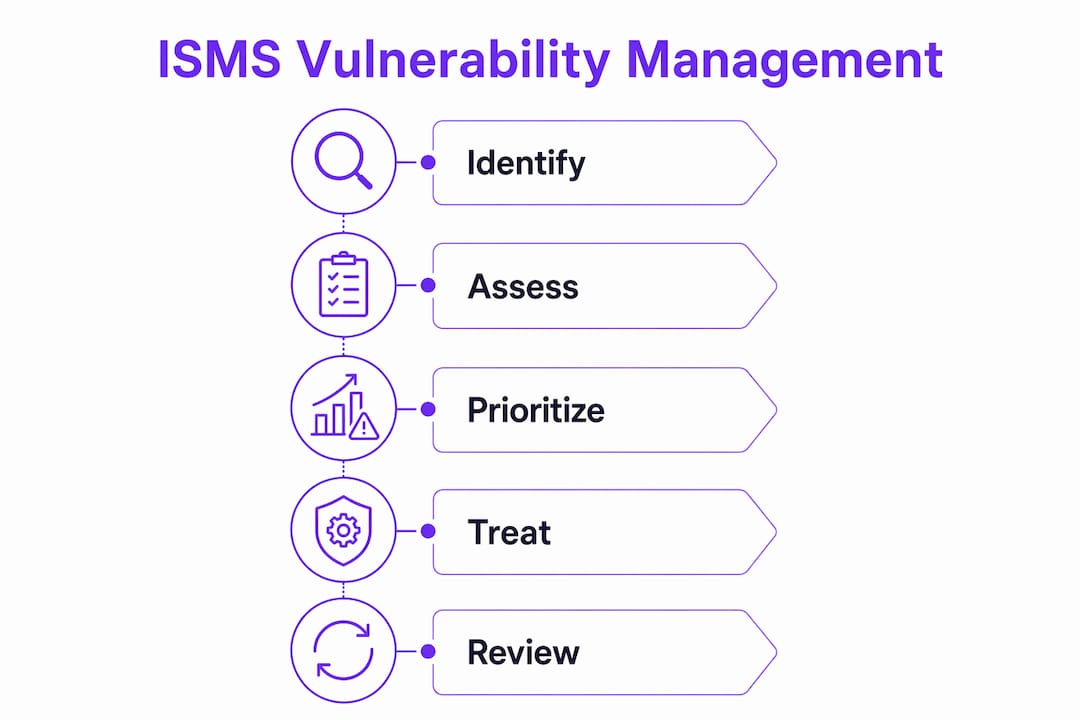
Vulnerability management in an ISMS is not a single scan or a quarterly patching sprint. It is a structured lifecycle that repeats continuously, feeding findings back into the organization’s broader risk management process. ISO 27001:2022 Control A.8.8 defines the requirement explicitly: organizations must identify, evaluate, and treat technical vulnerabilities in a documented, risk-informed way.
The lifecycle follows six core steps:
-
Asset inventory. Every vulnerability management program starts with knowing what you own. Without an accurate asset inventory, you cannot assess exposure. Systems not in scope get missed; systems incorrectly scoped generate noise.
-
Scheduled vulnerability identification. Automated scanning tools run against in-scope assets on a defined schedule. The output is a raw list of detected weaknesses, each tagged with a CVE identifier and a base severity score.
-
Risk-based prioritization. Raw scan output is not a remediation queue. Effective teams prioritize roughly 3% of vulnerabilities that pose the highest operational risk. That figure reflects the reality that most detected vulnerabilities are low-exploitability issues on non-critical assets.
-
Treatment selection. Three options exist: remediate (apply a patch or configuration fix), mitigate (add a compensating control that reduces exposure without patching), or formally accept the risk. Each decision requires documentation.
-
Closure verification. After treatment, a follow-up scan or manual check confirms the vulnerability is resolved or the compensating control is functioning. Verification evidence belongs in your audit record.
-
Audit-ready documentation. Every step generates records: scan logs, risk decisions, treatment actions, and verification results. These records are what auditors review.
Pro Tip: Risk ownership for vulnerability decisions must sit with a business or system owner, not the scanning analyst. The analyst identifies and scores the risk. The owner decides what to do with it. Mixing these roles produces technically correct decisions that ignore business context entirely.
How does vulnerability management satisfy ISO 27001 audit requirements?

ISO 27001:2022 auditors do not expect a zero-vulnerability environment. They expect a documented, repeatable process with evidence that risk decisions were made deliberately. This distinction matters enormously for compliance officers preparing for certification or surveillance audits.
The audit evidence requirements for Control A.8.8 include:
- A written vulnerability management policy that defines scope, frequency, roles, and escalation paths
- Scan logs showing scheduled assessments were conducted across in-scope assets
- Per-vulnerability risk decisions documenting why each issue was remediated, mitigated, or accepted
- Signed risk acceptance forms with expiry or review dates for any accepted risks
- Continuous monitoring metrics showing trend data over time, not just point-in-time snapshots
Auditors prioritize documented risk decisions over a 100% patch success rate. An organization that patches everything but keeps no records fails the audit. An organization with 20 open vulnerabilities, each with a signed risk acceptance and a review date, passes. The program demonstrates ISMS maturity through process discipline, not technical perfection.
Vulnerability management also supports the broader ISMS by feeding risk data into the Statement of Applicability, the Risk Treatment Plan, and management review meetings. For a full breakdown of how Control A.8.8 fits within the Annex A control set, the ISO 27001 Annex A controls overview provides useful context.
What are common challenges and misconceptions in ISMS vulnerability management?
The most damaging misconception is that vulnerability management equals vulnerability scanning. Scanning is one step in a much larger process. Organizations that stop at scanning produce reports nobody acts on, with no risk decisions, no treatment records, and no audit trail.
Other common pitfalls include:
- Treating all vulnerabilities equally. When every finding gets the same urgency, teams burn out chasing low-risk issues while critical exposures sit open. Alert fatigue is the direct result, and it causes the most dangerous vulnerabilities to get lost in the noise.
- No defined risk owners. Scanning analysts should not make business risk decisions. Without designated system or asset owners who carry formal accountability, treatment decisions get delayed or made by the wrong person.
- Disconnecting vulnerability data from business context. A critical vulnerability on a decommissioned test server is not the same risk as the same vulnerability on a customer-facing payment system. Asset criticality and exposure context must inform every prioritization decision.
- No integration with the broader ISMS. Vulnerability findings that never reach the Risk Register or the Risk Treatment Plan exist in a silo. They cannot inform management reviews, resource allocation, or control improvements.
Pro Tip: If your vulnerability management process produces scan reports but no documented risk decisions, you are running a scanning program, not a vulnerability management program. The difference is exactly what ISO 27001 auditors are trained to spot.
How to prioritize and treat vulnerabilities in a risk-based ISMS environment
Prioritization is where vulnerability management programs succeed or fail. Raw CVSS scores alone are a poor guide. A CVSS 9.8 vulnerability with no public exploit on an isolated internal system is far less urgent than a CVSS 6.5 vulnerability actively listed in the CISA Known Exploited Vulnerabilities catalog on an internet-facing server.
The most effective prioritization model combines three inputs: the Exploit Prediction Scoring System (EPSS) score, which estimates the probability of exploitation within 30 days; active exploit intelligence from sources like the CISA KEV catalog; and asset criticality, which reflects the business impact of compromise. Together, these inputs let security teams focus remediation effort where it actually reduces risk.
Once prioritization is complete, three treatment paths are available:
| Treatment option | What it means | Audit consideration |
|---|---|---|
| Remediation | Apply a patch, update, or configuration fix to eliminate the vulnerability | Requires verification scan as evidence of closure |
| Mitigation | Add a compensating control (firewall rule, network segmentation, WAF) that reduces exploitability without patching | Requires documented control description and effectiveness rationale |
| Risk acceptance | Formally accept the residual risk when remediation and mitigation are not feasible or proportionate | Requires signed acceptance form, business justification, expiry date, and management sign-off |
Formal risk acceptance documentation including expiry and review dates is a non-negotiable audit requirement. Accepted risks without review timelines are open-ended liabilities that auditors flag immediately. A well-run program treats risk acceptance as a deliberate, time-bounded decision, not a way to close tickets.
A unified risk-based process also satisfies multiple compliance frameworks simultaneously. The same documented vulnerability management program that satisfies ISO 27001 Control A.8.8 can fulfill SOC 2 Security criteria, HIPAA security safeguard requirements, and GDPR proportionality obligations. That efficiency matters when compliance teams are managing multiple frameworks with limited resources.
Key Takeaways
Effective vulnerability management in an ISMS requires a documented, risk-based lifecycle covering asset inventory, prioritization, treatment, and verified closure, with evidence at every step to satisfy ISO 27001 Control A.8.8 audits.
| Point | Details |
|---|---|
| It is a continuous process | Vulnerability management repeats cyclically, not as a one-time scan or annual patch cycle. |
| Prioritize the critical 3% | Focus remediation on the roughly 3% of vulnerabilities with the highest exploitability and asset exposure. |
| Documentation beats perfection | Auditors accept documented risk decisions over 100% patch rates as proof of ISMS maturity. |
| Separate risk ownership | Business or system owners must make treatment decisions, not scanning analysts. |
| Multi-framework efficiency | A single documented program can satisfy ISO 27001, SOC 2, HIPAA, and GDPR requirements simultaneously. |
Why vulnerability management is the backbone of a credible ISMS
I have reviewed a lot of ISMS programs that looked complete on paper but collapsed under audit scrutiny. The failure point is almost always the same: vulnerability management treated as a technical task rather than a governance function. Teams run scans, generate reports, and patch what they can. Nobody signs off on accepted risks. Nobody owns the assets formally. The audit arrives and the evidence trail simply does not exist.
The programs that hold up are the ones where vulnerability management is wired into the organization’s risk governance. Findings go into the Risk Register. Accepted risks get management sign-off. Metrics appear in quarterly management reviews. When vulnerability data aligns with business risk, security leaders can actually talk to executives in terms they understand: business impact, exposure windows, and resource trade-offs. That conversation changes how security gets funded.
The other thing I have seen consistently is that documentation discipline separates mature programs from immature ones faster than any technical capability. You can have the best scanning tools available and still fail an ISO 27001 audit if you cannot show a signed risk acceptance form with a review date. Conversely, a modest program with clear process documentation and accountable owners will pass every time. Treat vulnerability management as a continuous improvement cycle, not a compliance checkbox, and the audit results take care of themselves.
— Martin
Strengthen your ISO 27001 vulnerability management program
Knowing the process is one thing. Knowing where your current program stands against ISO 27001 requirements is another.
Ismscalculator provides a structured ISO 27001 readiness assessment that evaluates your program across all four ISO/IEC 27001:2022 control themes, including Control A.8.8 vulnerability management. The platform delivers tailored estimates based on your organization’s size, industry, and current security maturity, so you can see exactly where gaps exist before an auditor does. If you need hands-on guidance, the Ismscalculator consultant directory connects you with independent ISO 27001 implementers and lead auditors who specialize in building audit-ready vulnerability management programs.
FAQ
What is vulnerability management in an ISMS?
Vulnerability management in an ISMS is the continuous, documented process of identifying, assessing, prioritizing, and treating technical weaknesses in information assets. ISO 27001:2022 Control A.8.8 defines this as a formal, risk-based requirement, not a discretionary practice.
How is vulnerability management different from vulnerability scanning?
Scanning is one step in the vulnerability management lifecycle. Vulnerability management also includes risk-based prioritization, treatment decisions, formal risk acceptance documentation, and verified closure, all of which scanning alone does not provide.
What evidence do ISO 27001 auditors require for vulnerability management?
Auditors require scan logs, per-vulnerability risk decisions, signed risk acceptance forms with review dates, and continuous monitoring metrics. Documented risk decisions carry more weight than a perfect patch rate.
How do teams decide which vulnerabilities to fix first?
Effective teams combine EPSS exploitability scores, active exploit intelligence from sources like the CISA KEV catalog, and asset criticality to focus remediation on the roughly 3% of vulnerabilities that pose the highest real-world risk.
Can one vulnerability management program satisfy multiple compliance frameworks?
A single risk-based vulnerability management program can simultaneously satisfy ISO 27001 Control A.8.8, SOC 2 Security criteria, HIPAA security safeguard requirements, and GDPR proportionality obligations, reducing duplicated compliance effort across frameworks.