
An audit trail in ISO 27001 is defined as a chronological record of security-relevant events that proves information security controls are operating as intended. The audit trail purpose in ISO 27001 goes beyond simple logging. It creates verifiable evidence that your ISMS controls function continuously, not just on the day of a certification audit. Annex A control 8.15 is the specific foundation for this requirement, mandating that organizations produce, store, protect, and analyze logs covering user activities, system faults, and security events. For compliance professionals and IT managers, understanding this distinction between collecting logs and governing them is the difference between passing and failing a Stage 2 audit.
What is the audit trail purpose in ISO 27001?
ISO 27001 treats logging as evidence of continuous control operation, not just a forensic tool you activate after an incident. That framing changes everything about how you build and manage your logging program.
The purpose of audit trails in ISO 27001 is threefold. First, they demonstrate that controls are active and functioning. Second, they provide the raw material for incident investigation and reconstruction. Third, they give auditors a traceable chain of events linking security activities to documented policies and outcomes.

Without governed audit trails, your ISMS is a set of policies with no operational proof behind them. Auditors at certification bodies like BSI, Bureau Veritas, and DNV do not take your word for it. They sample logs, check review records, and verify that someone acted on what those logs revealed.
How does ISO 27001 annex a control 8.15 define logging requirements?
Control 8.15 in ISO/IEC 27001:2022 requires organizations to produce, store, protect, and analyze logs that record activities, exceptions, faults, and security events. This is the technical and governance backbone of your audit trail program.
The event types that must be captured include user logins and logouts, privilege escalations, access to sensitive systems, configuration changes, failed authentication attempts, and system faults. Each of these categories must appear in your logging policy with defined review responsibilities.
Control A.8.17, which covers clock synchronization, directly supports 8.15. Unsynchronized system clocks impair sequence verification, making it impossible to reconstruct a reliable timeline of events. This is a technical requirement that many organizations overlook until an auditor flags it.
The table below summarizes the key ISO 27001 controls that govern audit trail requirements and their scope.
| Control | Scope | Audit Trail Relevance |
|---|---|---|
| A.8.15 Logging | Event capture, storage, protection, analysis | Core audit trail requirement |
| A.8.17 Clock Synchronization | System time accuracy across all logging sources | Enables reliable event sequencing |
| A.8.16 Monitoring Activities | Ongoing review of logs and anomaly detection | Proves continuous control operation |
| A.5.33 Protection of Records | Retention, integrity, and access control for logs | Prevents tampering and data loss |
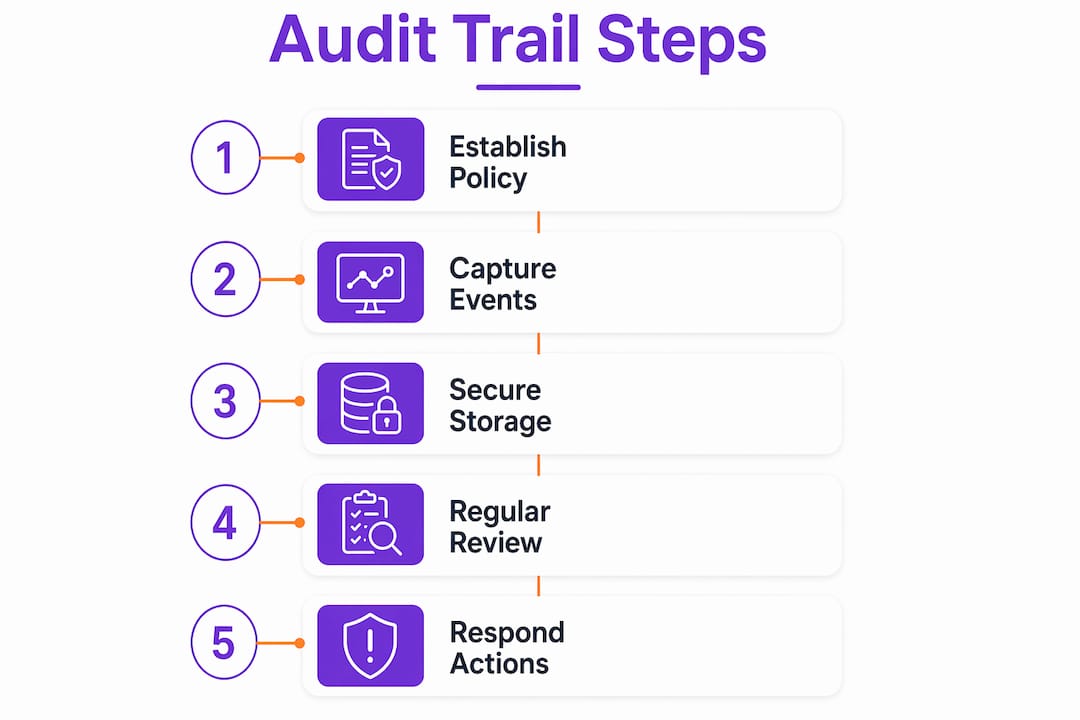
Pro Tip: Define your logging policy as a standalone document that maps each Annex A control to specific event types, retention periods, and review owners. Auditors from certification bodies look for this level of traceability, and it saves significant time during evidence requests.
Why are audit trails critical evidence in ISO 27001 certification audits?
ISO 27001 certification follows a two-stage audit process. Stage 1 reviews your documentation for completeness. Stage 2 verifies that your controls actually work. Audit trails are the primary evidence type in Stage 2.
During Stage 2, auditors sample logs and review records to confirm that controls operate as documented. They are not looking for perfect logs. They are looking for a defensible chain of evidence showing detection, review, and response. A log file sitting in storage with no review record attached to it fails this test.
The following sequence describes what auditors typically verify during a Stage 2 audit of your logging controls:
- Log generation: Are the required event types being captured across all in-scope systems?
- Log protection: Are logs stored securely and protected against tampering or deletion?
- Review records: Is there documented evidence that logs were reviewed on a scheduled basis?
- Triage and escalation: Were anomalies investigated, and are those investigations documented?
- Corrective action linkage: Did identified issues lead to formal corrective actions within your ISMS?
“Audit trails must represent a full lifecycle from detection to response and corrective action to be effective evidence under ISO 27001, not just raw logs.” — ISO 27001 Audit Evidence: Six Areas Enterprises Fail
Surveillance audits, which occur annually after initial certification, apply the same scrutiny. Continuous log collection, internal audits, and management reviews must produce a consistent evidence trail so auditors can reconstruct control operations across the full certification period.
What are the biggest audit trail implementation challenges?
Most organizations collect logs. Far fewer govern them well enough to satisfy ISO 27001 audit requirements. The gap between the two is where most nonconformities originate.
The most common implementation failures include:
- No review evidence: Logs exist but there is no documented record of who reviewed them, when, and what was done. This is the single most cited audit finding in logging-related nonconformities.
- Incomplete event coverage: Critical event types such as privilege escalations or configuration changes are missing from log sources, leaving gaps in the audit trail.
- Timestamp problems: System clocks across servers, firewalls, and applications are not synchronized, making event correlation unreliable.
- No retention policy: Logs are overwritten before the retention period required by your policy or applicable regulations.
- Siloed log management: Logs from cloud platforms, on-premises servers, and SaaS applications are stored separately with no unified review process.
Best practices to address these gaps follow a clear structure. Align each control with exact event types to capture, defined retention periods, and documented sampling methods. This organization makes evidence reconstruction fast and defensible. Use centralized log management platforms to aggregate sources and apply consistent review workflows. Tools that support centralized log aggregation reduce the manual effort of cross-system correlation significantly.
Pro Tip: Build a “log-to-control” mapping document that links each Annex A control to the specific log sources and event types that prove it is operating. When an auditor asks for evidence of access control effectiveness, you can pull the relevant logs in minutes rather than hours.
Protecting logs against tampering is non-negotiable. Cryptographic hashing, write-once storage, and access restrictions on log repositories all qualify as protective measures under A.5.33. Document which method you use and why.
How do audit trails support incident management and ISMS improvement?
Audit trails serve a governance function that extends well beyond certification readiness. Identity-related events visible in near real-time support defensible reconstruction and act as quality signals for your entire governance program.
The operational benefits of a well-governed audit trail program include:
- Incident detection: Anomalous patterns in login attempts, privilege use, or data access trigger alerts before incidents escalate.
- Forensic reconstruction: When a security event occurs, logs provide the timeline needed to determine scope, affected systems, and root cause.
- Fraud prevention: Administrator activity logs and access records create accountability that deters insider threats and unauthorized access.
- Corrective action traceability: Linking log findings to formal corrective actions within your ISMS creates a documented improvement cycle that auditors value.
- Management review input: Aggregated log review summaries feed directly into ISO 27001 management reviews, satisfying Clause 9.3 requirements for performance data.
Organizations that treat audit trails as a governance quality signal, rather than just a security tool, consistently perform better in surveillance audits. The reason is straightforward. Their logs tell a coherent story about how the ISMS operates day to day, not just what happened during an incident.
Connecting your information security policy to specific logging requirements for identity, access, and privilege changes creates the policy-to-evidence chain that ISO 27001 auditors follow during their review.
Key takeaways
Audit trail compliance under ISO 27001 requires governed review and documented response, not just log collection.
| Point | Details |
|---|---|
| Control 8.15 is the foundation | ISO 27001 Annex A control 8.15 mandates log production, storage, protection, and analysis for all in-scope systems. |
| Review evidence is mandatory | Logs without documented review records fail Stage 2 audits; triage and corrective action linkage are required. |
| Clock synchronization matters | Unsynchronized system clocks break event sequencing and undermine audit trail credibility under A.8.17. |
| Map controls to event types | Aligning each Annex A control to specific log sources and event types makes evidence reconstruction fast and defensible. |
| Audit trails drive ISMS improvement | Linking log findings to corrective actions and management reviews satisfies Clause 9.3 and strengthens continuous improvement. |
Why most audit trail programs fail before the auditor arrives
I have reviewed ISO 27001 implementations across organizations ranging from 50-person SaaS companies to multinational manufacturers. The pattern that causes audit trail failures is almost always the same. Teams build technically sound logging infrastructure and then treat the review process as an afterthought.
The uncomfortable truth is that ISO 27001 auditors care more about your review records than your log volume. A SIEM platform ingesting 10 million events per day with no documented triage process is weaker evidence than a simple spreadsheet log review completed weekly with clear escalation notes. The standard rewards governance discipline, not technical sophistication.
What actually works is embedding log review into existing operational rhythms. Weekly security operations meetings that include a standing agenda item for log anomalies. Monthly summaries that feed directly into management review packs. Incident tickets that automatically reference the log evidence used to investigate them. These habits create the evidence chain auditors follow.
The coordination piece is also underrated. IT teams own the log sources. Security teams own the review process. Compliance officers own the documentation. When these three groups operate in silos, you end up with logs that exist but cannot be connected to any governance outcome. A shared logging policy with named owners for each control area solves this faster than any tool purchase.
Automated tooling matters, but it is not a substitute for human review accountability. Use automation to aggregate, alert, and report. Use your people to document decisions, escalate anomalies, and close the loop with corrective actions. That combination is what passes audits consistently.
— Martin
Check your audit trail readiness before your next audit
Audit trail gaps are among the most common reasons ISO 27001 certification audits result in nonconformities. The good news is that most gaps are identifiable and fixable before an auditor walks through the door.
Ismscalculator provides a structured ISO 27001 readiness assessment that covers audit trail requirements across all four ISO/IEC 27001:2022 control themes, including logging, monitoring, and records protection. The assessment maps your current maturity against ISO 27001 requirements and identifies specific gaps in your evidence pipeline. If you want a faster starting point, the free 2-minute readiness check gives you an immediate view of where your audit trail program stands relative to certification requirements.
FAQ
What is the audit trail purpose in ISO 27001?
The audit trail purpose in ISO 27001 is to provide verifiable evidence that information security controls are operating continuously and effectively. Annex A control 8.15 requires organizations to produce, protect, and analyze logs that auditors can sample to confirm control operation.
Which ISO 27001 control specifically governs audit trails?
Control A.8.15 in ISO/IEC 27001:2022 is the primary control governing audit trails. It requires organizations to log activities, exceptions, faults, and security events, and to protect and analyze those logs as part of ISMS operation.
What event types must ISO 27001 audit trails capture?
ISO 27001 requires audit trails to capture user logins, privilege escalations, access to sensitive systems, configuration changes, failed authentication attempts, and system faults. These event types must be defined in a documented logging policy with assigned review responsibilities.
How do auditors verify audit trail compliance during a stage 2 audit?
Stage 2 auditors sample log files and review records to confirm that logs are being generated, reviewed, and acted upon. They look for documented triage outcomes and corrective action linkages, not just the existence of log data.
What is the most common audit trail nonconformity in ISO 27001 audits?
The most common finding is that organizations collect logs but have no documented evidence of who reviewed them or what actions were taken. Linking logs to review records and corrective actions is required to satisfy ISO 27001 audit trail compliance.