
An Information Security Management System, or ISMS, is defined as a documented framework of policies, processes, and controls that protects an organization’s information assets. For startups, building an ISMS from scratch means implementing ISO 27001, the international standard that certifies your security program is real and auditable. Most startups build a functional ISMS in 8–14 weeks when they focus on a right-sized scope, followed by a 4–6 week audit window. SaaS and tech founders increasingly need this certification to close enterprise deals and satisfy investor due diligence. This startup guide for ISMS development walks you through every step, from scope definition to certification day.
How to build an ISMS from scratch: the startup roadmap
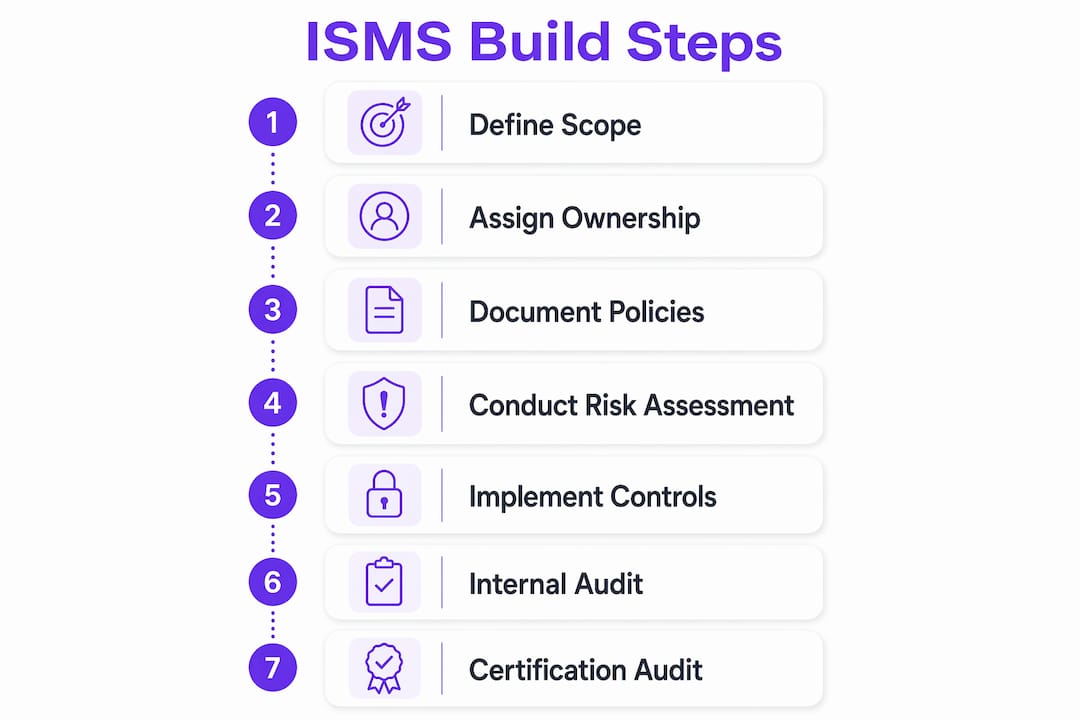
The fastest path to ISO 27001 certification is a lean, sequential build. You define scope first, assign ownership second, write minimal documentation third, and collect evidence continuously. Skipping steps or running them in parallel creates rework. ISO 27001 certifications grow 20% annually, driven largely by startup demand for security maturity proofs that satisfy enterprise procurement teams. That growth rate tells you this is no longer optional for B2B SaaS companies.

The full timeline for a 10–30 person startup runs approximately 5.5 to 10.5 months from scratch, including implementation and audit. The wide range reflects scope complexity and team bandwidth. Founders who treat ISMS development as a part-time project alongside product work land closer to the 10-month end. Founders who assign protected time land closer to 5.5 months.
How do you define the right scope for your startup ISMS?
Scope is the boundary that tells auditors exactly which systems, people, and processes your ISMS covers. Over-scoping is the primary reason startups fail certification or delay implementation. That single fact should anchor every scope decision you make.
A tight scope for a SaaS startup typically covers:
- The production application and its hosting environment (AWS, GCP, or Azure)
- The code repository and CI/CD pipeline
- Customer data processing and storage systems
- The team members who access production systems
A scope statement does not need to be long. One page describing the included systems, physical locations (or “cloud-hosted only”), and excluded systems is sufficient. Pair it with a simple architecture diagram that shows data flows between in-scope components. Auditors use this diagram constantly during stage 1 review.
The risk of a scope that is too narrow is real but manageable. If you exclude a system that processes customer data, an auditor will flag it. Review your data flow before finalizing scope to catch obvious gaps.
Pro Tip: Start with your production SaaS platform and the team members who have direct access to it. You can expand scope in a later certification cycle once the core program is running.
Setting up ISMS ownership without adding headcount
ISO 27001 does not require a dedicated compliance manager for startups. Part-time ownership assigned to existing employees satisfies the standard. This is one of the most misunderstood facts about ISMS development for new businesses.
The roles you need to fill are:
- ISMS owner or driver: Coordinates the overall program, tracks evidence, and prepares for audits. This is typically a CTO, engineering lead, or operations manager.
- Risk owner: Reviews and approves the risk register. Usually the CEO or CTO.
- Control owners: Individual team members responsible for specific controls. A developer owns secure development practices; an IT lead owns access management.
- Management reviewer: A senior leader who signs off on management review outputs quarterly.
Clear ownership prevents the most common startup failure mode: everyone assumes someone else is handling compliance. When a control has a named owner, evidence gets collected. When it does not, it gets skipped.
Pro Tip: Give your ISMS driver at least four hours per week of protected time. Treating ISMS work as a background task is how startups miss audit deadlines.
What core documentation does a startup ISMS need?
ISO 27001 is risk-based, not a checklist. You apply controls relevant to your identified risks and justify exclusions in a Statement of Applicability. That principle keeps your documentation set lean.
The minimum viable document set for a startup ISMS includes:
| Document | Purpose |
|---|---|
| Information security policy | States management commitment and security objectives |
| Risk assessment and treatment plan | Identifies risks, scores them, and maps controls |
| Statement of Applicability (SoA) | Lists all Annex A controls with inclusion or exclusion justification |
| Access control policy | Defines who can access what and how access is granted or revoked |
| Incident response plan | Documents how to detect, respond to, and report security incidents |
| Supplier management policy | Covers security requirements for third-party vendors |
| Internal audit records | Logs findings and corrective actions from internal reviews |
Avoid the enterprise trap of creating 40-page policy binders. A two-page access control policy that your team actually follows beats a 20-page document nobody reads. Startups that store evidence in familiar tools like SharePoint or Notion maintain compliance far more consistently than those who build separate compliance platforms.
Cloud providers manage infrastructure security at the physical and network layer. Your job is to configure those services correctly, manage access tightly, and document your choices. That division of responsibility cuts implementation effort significantly for SaaS startups.
Pro Tip: Create a shared folder called “ISMS Evidence” in your existing workspace tool. Every policy, screenshot, and log goes there. Auditors appreciate organized, accessible evidence far more than elaborate compliance software.
How do you run risk assessment and collect evidence continuously?
A startup-appropriate risk assessment methodology scores each risk on two dimensions: likelihood and impact. Use a simple 1–5 scale for each. Multiply the scores to get a risk rating. Risks above a threshold get treated with controls; risks below it get accepted and documented.
Your risk register is a living spreadsheet. Each row contains a risk description, likelihood score, impact score, risk rating, assigned control, control owner, and current status. Build it once and update it quarterly. The register is one of the first documents an auditor requests.
Mapping controls to risks closes the loop between your risk assessment and your SoA. Every control in your SoA should trace back to at least one risk in your register. Controls with no linked risk are candidates for exclusion.
Evidence collection works best as a monthly habit rather than a pre-audit scramble. Collecting evidence monthly in small batches is far more sustainable than last-minute documentation dumps. A practical monthly cadence looks like this:
- Pull access review logs and confirm no unauthorized accounts exist.
- Screenshot your backup completion reports for the month.
- Log any security incidents or near-misses, even if the outcome was benign.
- Confirm patch status on all in-scope systems.
- Review one or two controls from your SoA and note their current status.
Quarterly, review the full risk register with your risk owner and update scores based on any changes to your product or infrastructure. This quarterly review also feeds your management review meeting.
Pro Tip: Automate evidence capture wherever possible. AWS CloudTrail logs, GitHub audit logs, and identity provider access reports can be exported automatically. Automation removes the human memory dependency from compliance.
How do you prepare for internal and certification audits?
Internal audits serve one purpose: finding problems before your external auditor does. Auditing 6–10 controls per month with documented corrective actions keeps the workload manageable and catches issues early. This micro-audit approach replaces the traditional annual internal audit, which tends to surface too many findings at once.
A management review is a formal meeting where leadership reviews ISMS performance. You need at least one before your certification audit. The agenda should cover audit findings, risk register status, security incidents, and any changes to the business that affect the ISMS scope.
Certification audits run in two stages. Stage 1 is a documentation review. The auditor checks that your policies, risk register, SoA, and scope statement are complete and coherent. Stage 2 is an evidence review. The auditor samples your controls and verifies that you are actually doing what your policies say.
Audit preparation checklist:
- All policies are approved, dated, and version-controlled
- Risk register is current and reviewed within the last quarter
- SoA is complete with justifications for every exclusion
- Internal audit records show at least one full cycle of control reviews
- Management review minutes are signed and filed
- Corrective actions from internal audits are closed or have documented remediation plans
- Evidence packs for key controls are organized and accessible
Pro Tip: Address every nonconformity from your internal audits before your stage 2 date. Auditors expect to see corrective action records. An open finding with no action plan is a red flag that can delay certification.
The ISO 27001 certification checklist from Ismscalculator covers 80 sequenced steps and is worth reviewing before you schedule your stage 1 audit. It surfaces sequencing errors that founders commonly miss.
Key Takeaways
Building a startup ISMS requires a lean, sequenced approach: tight scope, clear ownership, minimal documentation, and continuous evidence collection are the four non-negotiable foundations of ISO 27001 certification.
| Point | Details |
|---|---|
| Scope tightly from day one | Limit your ISMS to the production platform and direct access team to avoid delays. |
| Assign named control owners | Every control needs one person responsible; shared ownership means no ownership. |
| Keep documentation minimal | Write short, usable policies and store evidence in tools your team already uses. |
| Collect evidence monthly | Small monthly batches beat last-minute audit scrambles every time. |
| Run micro-audits continuously | Reviewing 6–10 controls per month catches problems before your external auditor does. |
What I’ve learned watching startups build their ISMS
Most founders I’ve seen approach ISMS development with one of two wrong assumptions. The first is that they need enterprise-grade documentation to impress auditors. The second is that they can treat compliance as a weekend project. Both assumptions cost time and money.
The startups that certify fastest do one thing differently: they treat the ISMS as a product. They assign an owner, set a roadmap, and ship incrementally. They do not wait until the documentation is perfect before collecting evidence. They start collecting on day one.
The other insight worth sharing is that a lean ISMS is not a weak ISMS. A risk-based approach focused on actual workflows prevents unnecessary documentation overhead without reducing security. Auditors care that your controls match your risks. They do not care how thick your policy binder is.
The ISMS you build now will grow with your company. Build it to be maintainable, not impressive. The founders who embed ISMS habits into daily engineering and operations workflows find that certification renewals take a fraction of the original effort.
— Martin
Ismscalculator tools that accelerate your ISMS build
Starting an ISMS build without knowing where you stand wastes weeks of effort. Ismscalculator offers a free 2-minute readiness check that shows you exactly which ISO 27001 domains need the most attention before you write a single policy.
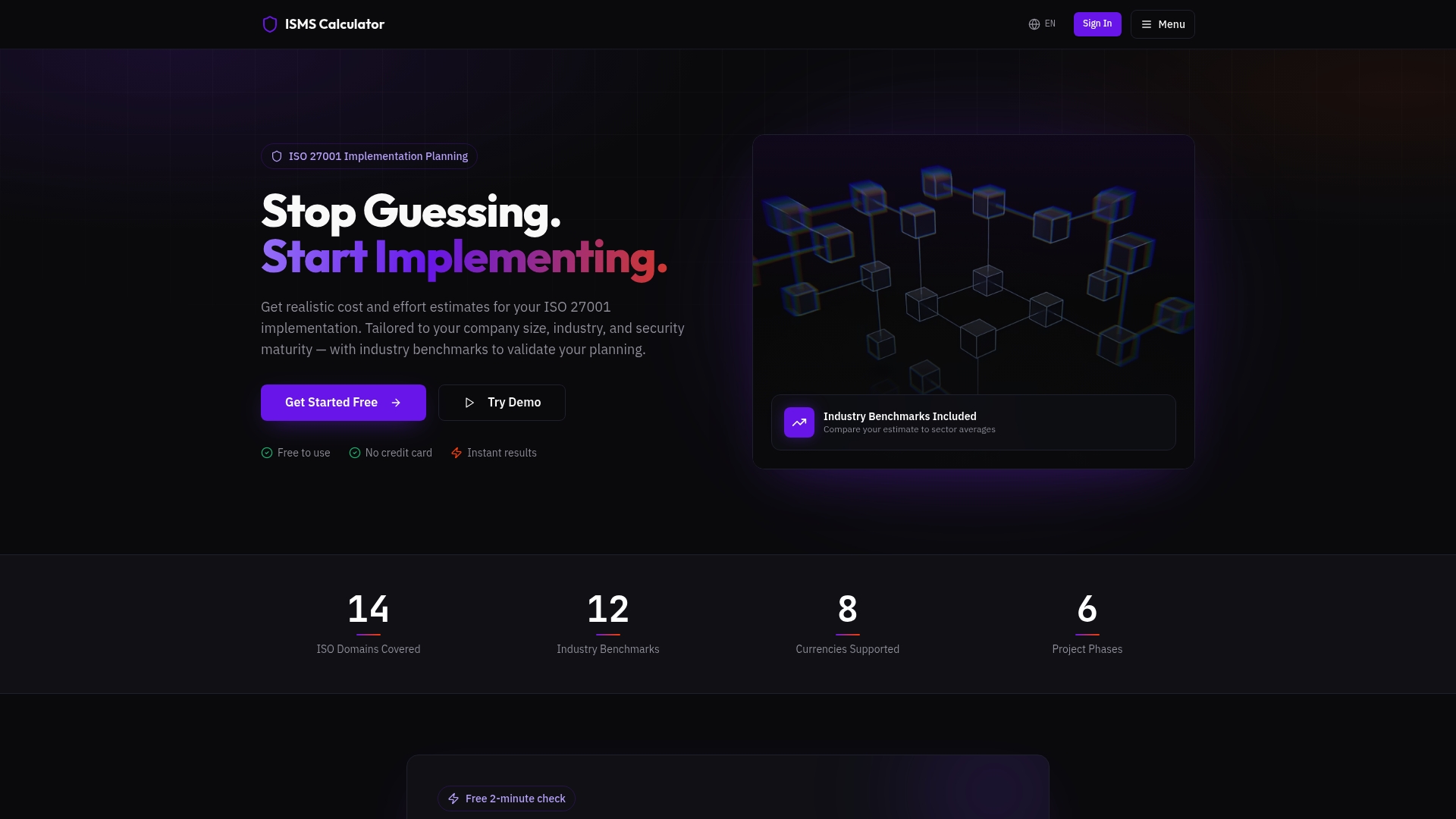
For founders who want a deeper picture, the full ISO 27001 readiness assessment delivers tailored estimates based on your company size, industry, and current security maturity. The platform also includes a independent consultant directory where you can find ISO 27001 implementers who specialize in startups, cutting months off your timeline by avoiding trial and error. If you are serious about certification, these tools remove the guesswork from planning and budgeting.
FAQ
How long does it take to build an ISMS from scratch?
Most startups complete the implementation phase in 8–14 weeks, followed by a 4–6 week audit window. Total time from scratch to certification typically runs 5.5 to 10.5 months depending on scope and team bandwidth.
Do startups need a full-time compliance manager for ISO 27001?
No. ISO 27001 does not require dedicated compliance staff. Part-time ownership assigned to existing team members, with clear accountability and protected time, satisfies the standard.
What is the most common reason startups fail ISO 27001 certification?
Over-scoping the ISMS is the primary cause of certification failure or delay. Limiting scope to the production platform and directly related systems gives startups the best chance of certifying on schedule.
How many controls does a startup actually need to implement?
Focusing on 12 critical controls covers most auditor requirements for initial certification. ISO 27001 requires you to implement controls relevant to your assessed risks, not every control in Annex A.
What documents does an auditor check first in a stage 1 audit?
Auditors typically review the scope statement, information security policy, risk register, and Statement of Applicability first. These four documents establish whether your ISMS is coherent before the evidence review begins.