
Compliance project scope definition is the formal process of identifying exactly which systems, data, processes, and people fall under a specific set of regulatory requirements, then documenting the boundaries, objectives, deliverables, and exclusions that will govern the project from kickoff to audit. Get it right, and every downstream decision, from resource allocation to control selection, has a clear reference point. Get it wrong, and you spend months building controls around the wrong assets while auditors flag the gaps you missed.
A well-constructed scope statement typically covers five core elements:
- Objectives: What the project must achieve, tied directly to regulatory requirements and business goals
- Deliverables: The specific outputs, policies, controls, or certifications the project will produce
- Acceptance criteria: Measurable conditions that confirm each deliverable is complete
- Constraints: Budget, timeline, technology, or organizational limits that shape what is feasible
- Exclusions: Explicitly named systems, processes, or locations that fall outside the project boundary
The strategic value goes beyond organization. Compliance scope definition, recognized as a strategic mapping exercise vital for risk mitigation and governance, determines where you implement controls, conduct audits, and maintain documentation. A compliance project is also fundamentally time-bound with defined controls and audit benchmarks, which separates it from ongoing continuous compliance programs. That time-bound nature makes precise scope boundaries even more critical. Scope creep in a compliance project does not just delay delivery; it can push you past a certification deadline or leave a control gap open during an active audit window.
What makes compliance project scoping so difficult?
Defining scope sounds straightforward until you sit down to do it. The reality is that compliance projects carry a specific set of pressures that general project management frameworks do not fully address.
- Too broad versus too narrow: Cast the net too wide and you waste resources protecting systems that carry no regulatory risk. Draw it too tight and auditors will find the assets you left out. Neither error is cheap.
- Stakeholder misalignment: Legal, IT, operations, and finance each read regulatory requirements through a different lens. Without early, structured input from all of them, the scope document reflects one department’s interpretation rather than the organization’s actual risk surface.
- Multi-cloud and hybrid IT complexity: Modern organizations run hundreds of interconnected systems across cloud providers, on-premises data centers, and SaaS applications. Data flows through APIs, microservices, and third-party integrations that were never part of the original architecture diagrams. Tracing regulated data through that environment is genuinely hard.
- Evolving regulations: Frameworks like HIPAA, SOX, PCI DSS, and ISO 27001 update their guidance, and new state-level privacy laws in the U.S. continue to emerge. A scope document written against last year’s requirements may already be incomplete.
- Scope creep: Without a formal change control process, well-meaning additions accumulate. Each one feels minor in isolation; collectively they can double the project’s workload without a corresponding increase in budget or timeline.
- Static scope documents: Many teams treat scope as something you define at kickoff and file away. When processes change, new applications launch, or infrastructure shifts, that document becomes a liability rather than a guide.
The clear boundaries that prevent project confusion and scope creep only hold if the document stays current and the team actively enforces it.

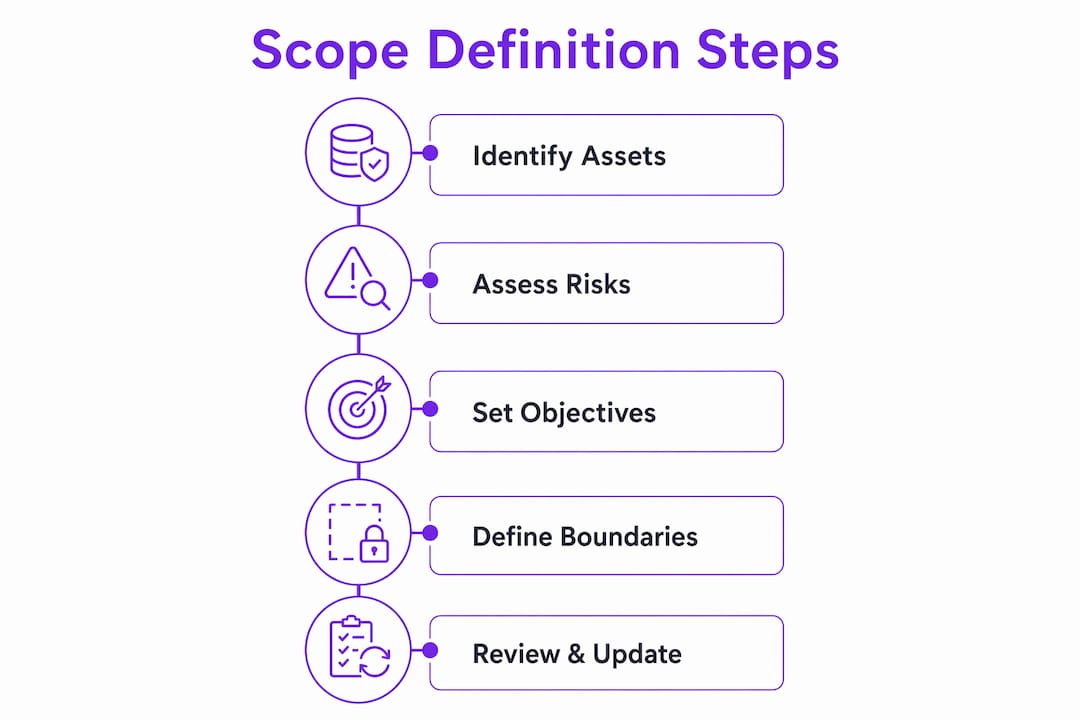
How to define compliance project scope and objectives step by step
A repeatable process matters here. The steps below apply whether you are scoping an ISO 27001 implementation, a SOC 2 readiness project, or a HIPAA compliance initiative.
-
Conduct a regulatory and risk assessment first. Before you write a single scope boundary, identify every applicable regulation, framework, or contractual requirement. Map the specific controls each one demands. This assessment tells you what the scope must cover at minimum and where the highest-risk gaps sit.
-
Engage cross-functional stakeholders early. Pull in IT, legal, HR, finance, and operations before the scope document takes shape. Each group owns data or processes that may fall under regulatory requirements. Their input prevents the common failure mode of scoping a project around what the compliance team already knows rather than what the organization actually does.
-
Map affected systems, data, processes, and interfaces explicitly. List every system, data store, and process that touches regulated information. Then list everything that does not. Both lists belong in the scope document. Failing to map interfaces between in-scope and out-of-scope processes is one of the most common causes of audit findings, because auditors scrutinize exactly those boundaries for data leaks.
-
Write objectives using SMART criteria. Vague objectives like “achieve compliance” produce vague projects. SMART objectives tied to organizational goals drive success. A well-formed objective reads: “Implement access control policies covering all production systems handling cardholder data by September 30, 2026, meeting PCI DSS Requirement 7.” That sentence is specific, measurable, achievable, relevant, and time-bound.
-
Document deliverables and acceptance criteria together. Every deliverable needs a corresponding acceptance criterion. “Risk register completed” is a deliverable. “Risk register reviewed and signed off by the CISO and external auditor by project close” is an acceptance criterion. The four essential components of a project scope statement, including objectives, deliverables, acceptance criteria, and exclusions, only function as a management tool when all four are present.
-
Formalize the scope statement and get stakeholder sign-off. A scope document that has not been approved is just a draft. Formal sign-off from key stakeholders, including the project sponsor and relevant department heads, creates accountability and gives the project manager authority to push back on out-of-scope requests.
-
Establish version control and a review cadence. Assign a version number to the scope document on day one. Define the triggers that require a formal review: a new application entering the environment, a regulatory update, a merger, or a significant infrastructure change. Without this structure, the document drifts from reality quietly and dangerously.
Pro Tip: Use risk-based prioritization when you first map your scope. Start with the assets and processes that carry the highest regulatory and operational risk, get those boundaries locked, then work outward. This prevents the common trap of spending the first month debating low-risk edge cases while the high-risk core remains undefined.
Best practices for managing scope throughout a compliance project
Defining scope well at the start is necessary but not sufficient. The practices below keep that definition valid through the full project lifecycle.
- Implement formal change control. Every proposed scope addition or removal should go through a documented change request process. The request should capture the reason for the change, the impact on timeline and budget, and who approved it. This creates an audit trail and forces deliberate decisions rather than casual additions.
- Revalidate scope continuously with stakeholders. Schedule brief scope reviews at each major project milestone. Ask whether any new systems have been deployed, whether any regulatory guidance has changed, and whether the original exclusions still hold. This keeps the scope document from becoming a historical artifact.
- Use measurable objectives to track progress. Objectives written with SMART criteria give you a clear signal of completion. When an objective is ambiguous, teams argue about whether it is done rather than moving to the next task.
- Document excluded items with the same rigor as inclusions. An exclusion that is not written down is not enforced. When a stakeholder later asks why a particular system was not covered, a documented exclusion with a rationale protects the project team and clarifies the audit boundary.
- Require auditor review for standards like ISO 27001 and SOC 2. Internal teams define scope, but auditors must approve boundaries for frameworks like SOC 2 and ISO 27001 to protect sensitive data effectively. Engaging your auditor during scope definition, not just at the end, catches boundary problems before they become findings. For a detailed look at how ISO 27001 and SOC 2 scope requirements differ, the ISO 27001 vs SOC 2 comparison from Ismscalculator breaks down the auditor approval process for each.
- Treat the scope statement as a living document. Version control and periodic updates triggered by business or technological changes are the practical mechanism for keeping scope valid. A scope document that has not been touched since kickoff is almost certainly out of date.
- Use templates and automated tools to maintain audit trails. Manual scope documentation in shared drives invites version conflicts and lost approvals. Purpose-built compliance tools that track changes, capture approvals, and timestamp updates give you a defensible record. For teams working through a vendor compliance requirements checklist, integrating scope documentation into that workflow keeps all boundary decisions in one place.
The biggest mistake in compliance project scoping is not aligning objectives with business strategy, which turns compliance into a check-the-box exercise rather than a project that delivers real risk reduction. Scope management and objective alignment are inseparable.

Why a risk-based approach to scoping changes the outcome
Risk-based scoping means you do not start by asking “what could possibly be in scope?” You start by asking “where is the regulated data, and what happens if it is compromised?” That reframe changes everything about how you draw the boundary.
- Map data flows before drawing boundaries. Follow regulated data from its entry point through every system, process, and interface it touches. Payment card data, protected health information, and personally identifiable information each have distinct flow patterns. The scope boundary should wrap around those flows, not around organizational charts or IT infrastructure diagrams.
- Prioritize by risk, not by convenience. High-risk assets, those that store or process the most sensitive data or face the most credible threats, belong in scope regardless of how difficult they are to control. Low-risk systems that happen to be easy to document should not consume disproportionate project resources.
- Control boundary leaks at process interfaces. The point where an in-scope system hands data to an out-of-scope system is where auditors look hardest. Risk-based scoping focuses on critical regulated data flows and high-risk areas, avoiding scope creep and wasted resources, but only if those interface points are explicitly mapped and controlled.
- Use the risk assessment to defend scope decisions. When a stakeholder pushes to exclude a system that your risk assessment flagged as high-risk, the documented assessment gives you the evidence to push back. Scope decisions made without a risk basis are hard to defend in an audit.
- Revisit risk ratings when the environment changes. A system that was low-risk last year may have become high-risk after a new integration or a change in data handling practices. Risk-based scope is not a one-time exercise.
For ISO 27001 projects specifically, Ismscalculator’s maturity assessments across all four ISO/IEC 27001:2022 control themes give teams a structured way to identify where their highest-risk gaps sit before they finalize scope. The ISO 27001 gap analysis guide walks through exactly how to use that kind of assessment to inform scope boundaries rather than guessing at them. Ismscalculator’s real-time cost and effort estimator also lets teams model different scope configurations and see how each one affects implementation complexity, which makes the risk-based scoping conversation with leadership much more concrete.
Key insight: Engaging auditors early in the risk-based scoping process, not just at the end, elevates scope validity and reduces the likelihood of findings. Auditors are the ultimate reviewers of scope boundaries for frameworks like ISO 27001 and SOC 2, and their perspective on where the boundary should sit often differs from what internal teams assume.
How Ismscalculator supports your compliance project scope
Getting scope right from the start is exactly the kind of problem Ismscalculator was built to address. The platform’s free 2-minute readiness check gives you an immediate read on where your scope definition stands before you commit to a full implementation plan.
For teams ready to go deeper, the ISO 27001 readiness assessment covers maturity across all four ISO/IEC 27001:2022 control themes, produces model reference comparisons, and generates a customizable Gantt chart that maps implementation phases against your defined scope. If you need expert guidance on a complex multi-cloud environment or a regulated industry with overlapping frameworks, the independent consultant directory connects you with lead auditors and implementers who specialize in exactly that kind of scoping work.
Key Takeaways
Effective compliance project scope definition requires precise boundaries, SMART objectives, continuous stakeholder alignment, and a risk-based approach that keeps the scope document valid through every phase of the project lifecycle.
| Point | Details |
|---|---|
| Define all five scope elements | Every scope statement needs objectives, deliverables, acceptance criteria, constraints, and exclusions documented and approved. |
| Engage auditors during scoping | For ISO 27001 and SOC 2, auditors must approve scope boundaries, not just review them at the end. |
| Map interfaces between in-scope and out-of-scope processes | These boundary points are where audit findings most commonly originate and require explicit controls. |
| Use SMART objectives tied to business goals | Objectives linked to organizational strategy prevent check-the-box compliance and give teams a measurable completion signal. |
| Treat scope as a living document | Version control and milestone-triggered reviews keep scope valid as technology, processes, and regulations change. |