
Early ISO 27001 adoption is defined as implementing an Information Security Management System (ISMS) before a customer contract, regulatory deadline, or security incident forces your hand. Organizations that build toward certification 12–24 months ahead of their target market entry consistently outperform those that scramble at the last minute. The benefits of early ISO 27001 adoption include lower breach exposure, faster sales cycles, and a certification process that doesn’t collapse under time pressure. With the average data breach costing $4.45 million, the financial case for acting early is not theoretical.
1. the core benefits of early ISO 27001 adoption
Early adoption of ISO 27001 delivers advantages across risk management, revenue, and operations simultaneously. No other information security standard offers the same combination of market credibility and internal discipline.
The main advantages break down into five categories:
- Risk reduction: A mature ISMS identifies and treats threats before they become incidents.
- Market access: ISO 27001 is a procurement gate for many European enterprise buyers and financial institutions in 2026. Starting early means you qualify sooner.
- Cost savings: Insurance premium reductions and avoided breach costs offset certification investment within the first year for most mid-sized firms.
- Operational efficiency: Certification replaces lengthy security questionnaires in enterprise sales cycles, reducing overhead for both sales and security teams.
- Audit readiness: Annual surveillance audits are far less disruptive when evidence collection is embedded in daily operations from the start.
Pro Tip: Map your top three target customers or markets before starting your ISMS. If any of them require ISO 27001 for contract eligibility, that timeline becomes your implementation deadline, and working backward from it reveals exactly how early you need to start.
2. how early adoption reduces cyber risk

ISO 27001’s risk management framework is most effective when organizations have time to mature their controls before an incident tests them. Rushing to certification compresses the time available for gap remediation and staff training.
A systematic ISMS requires organizations to identify assets, assess threats, and apply controls across 14 security domains. When that process starts early, teams have time to test controls, run internal audits, and fix weaknesses before the Stage 1 external audit. The Stage 1 audit checks ISMS coherence and the Statement of Applicability, not just documentation. Early starters can address corrective actions from Stage 1 before Stage 2 verification begins.
The financial stakes make timing critical. IBM’s breach cost analysis shows that organizations with mature ISMS controls experience lower breach impact because detection and containment are faster. A company that starts ISO 27001 implementation 18 months before a breach is far better positioned than one that started 3 months before.
“Continuous readiness between ISO 27001 audits is less stressful and more cost-efficient than periodic scramble audits.” — ISO 27001 Audit: A Roadmap for SaaS Founders
Pro Tip: Prioritize your highest-risk areas in the first 90 days of implementation. Access control, incident management, and supplier security consistently produce the most corrective actions during Stage 1 audits. Addressing them first gives you the longest runway to close findings.
3. how ISO 27001 accelerates sales and cuts overhead
ISO 27001 certification directly reduces the time and cost of closing enterprise deals. Sales teams at certified organizations spend less time on security questionnaires and more time advancing opportunities.
Certification and the Statement of Applicability replace most of the back-and-forth with enterprise procurement teams. A deal that previously required four weeks of security review documentation can move to contract stage in days. That compression compounds across a full sales pipeline.
The financial benefits extend beyond revenue. The table below shows the primary cost categories where early ISO 27001 adoption delivers measurable returns:
| Benefit Category | What Changes | Typical Impact |
|---|---|---|
| Insurance premiums | Demonstrated controls reduce insurer risk | Significant annual savings for mid-sized firms |
| Sales cycle length | Certification replaces security questionnaires | Faster deal progression |
| Breach cost exposure | Mature ISMS limits incident impact | Reduced financial and reputational damage |
| Audit preparation | Embedded evidence collection | Lower internal labor cost per audit cycle |
| Contract eligibility | Meets procurement requirements | Access to enterprise and regulated markets |
The ROI case is direct. A single contract win that required ISO 27001 certification can recover the entire Year 1 certification cost. For companies targeting European enterprise or healthcare clients, that scenario is not unusual. It is the expected outcome.
4. phased rollout: a practical early adoption strategy
A phased ISO 27001 rollout spreads cost and builds organizational momentum. It is not a shortcut. It is a structured way to prove value incrementally and secure internal buy-in before committing to full scope certification.
Prioritizing highest-risk areas first in a staged rollout improves both security outcomes and organizational approval. Teams see tangible improvements early, which reduces resistance to the broader program. Finance stakeholders see controlled spending rather than a large upfront commitment.
The tradeoffs are real and worth acknowledging:
- Scope limitations: A phased scope means some systems or processes remain outside the certified boundary during early stages. That exposure must be documented and managed.
- Procurement risk: Some enterprise buyers require full-scope certification. A phased certificate may not satisfy their requirements.
- Momentum dependency: Phased programs stall when leadership attention shifts. Early wins must be communicated consistently to maintain support.
Pro Tip: Define your ISMS scope boundary in writing before you start. Scope creep is the most common reason phased implementations run over budget and timeline. A clear boundary also makes your Stage 1 audit more predictable.
The benefits of a phased ISO 27001 rollout outweigh these risks for most growing organizations. The key is treating each phase as a genuine security improvement, not just a documentation exercise.
5. organizational culture and ongoing compliance
ISO 27001 certification is not a one-time achievement. The certification cycle includes annual surveillance audits and full recertification every three years. Organizations that adopt early build the habits and systems that make this cycle manageable.
Early adopters embed evidence collection into daily operations. They assign control ownership to specific roles. They run internal audits on a schedule rather than in a panic before external review. That operational rhythm is the real long-term advantage of early adoption.
Late adopters face a different reality. They rebuild controls and documentation before each audit cycle. Their teams experience certification as a disruption rather than a routine. The cost and stress of periodic scramble audits accumulates over time and erodes the financial case for certification.
Customer demand from international clients is the primary driver for pursuing ISO 27001 early. Organizations that respond to that demand proactively, rather than reactively, build a compliance culture that scales with their growth. They also avoid the reputational risk of losing a deal because certification wasn’t ready in time.
6. timeline and audit readiness: why starting early matters
The ISO 27001 certification process takes 3–6 months from audit readiness to certificate issuance. That window does not include the time required to build and mature the ISMS. Total implementation time for most organizations runs 9–18 months.
Starting early gives organizations time to close gaps without compressing quality. A company that begins implementation 18 months before a target certification date can run a full internal audit cycle, address findings, and enter Stage 1 with confidence. A company that starts 6 months before the same target is forced to cut corners.
The Stage 1 audit is a readiness review, not a formality. Auditors verify that the risk methodology is coherent and that the Statement of Applicability accurately reflects the organization’s control decisions. Organizations that treat Stage 1 as a genuine checkpoint, rather than a paperwork exercise, use it to identify and close gaps before Stage 2. Early starters have the time to do exactly that.
Pro Tip: Use your ISO 27001 readiness assessment results to build a realistic Gantt chart for your implementation. Knowing your current maturity level across all four ISO/IEC 27001:2022 control themes tells you where your longest remediation timelines will be, and those are the areas to start on first.
Key takeaways
Early ISO 27001 adoption reduces breach risk, accelerates enterprise sales, and builds a compliance culture that makes every subsequent audit cycle less costly and less disruptive.
| Point | Details |
|---|---|
| Start before pressure forces you | Organizations that begin 12–18 months early avoid compressed timelines and quality shortcuts. |
| Certification pays for itself | A single qualifying contract win can recover full Year 1 certification costs. |
| Phased rollout is a valid strategy | Prioritizing high-risk areas first builds momentum and spreads cost without sacrificing security intent. |
| Audit culture compounds over time | Early adopters embed evidence collection into operations, making surveillance audits routine rather than disruptive. |
| Market access depends on timing | ISO 27001 is a procurement requirement for many enterprise and regulated-market buyers in 2026. |
The case for acting before you have to
I’ve worked with organizations at every stage of the ISO 27001 process, and the pattern is consistent. The ones who start because a customer asked for it last quarter are always behind. The ones who started because they saw it coming 18 months out are always ahead.
The most common mistake I see is treating ISO 27001 as a compliance checkbox rather than a business capability. Teams rush to get the certificate, then neglect the ISMS until the next surveillance audit. That approach costs more in the long run and delivers less value. The certificate alone does not reduce your breach risk. The mature, embedded ISMS does.
The organizations I’ve seen get the most value from certification are the ones that used the implementation process to genuinely fix their security posture. They identified real gaps, assigned real ownership, and built real processes. Their surveillance audits are calm. Their sales teams use the certificate confidently. Their insurance brokers notice.
My advice is direct: if you’re planning to enter a regulated market, target enterprise clients, or expand internationally in the next two years, start your ISO 27001 implementation now. The ISO 27001 knowledge base at Ismscalculator is a practical starting point for understanding what that implementation actually involves. Don’t wait for a customer to make it urgent. By then, you’re already late.
— Martin
Plan your ISO 27001 adoption with Ismscalculator
Understanding the benefits of early ISO 27001 adoption is the first step. Knowing exactly what it will cost and how long it will take for your specific organization is what turns intent into a plan.
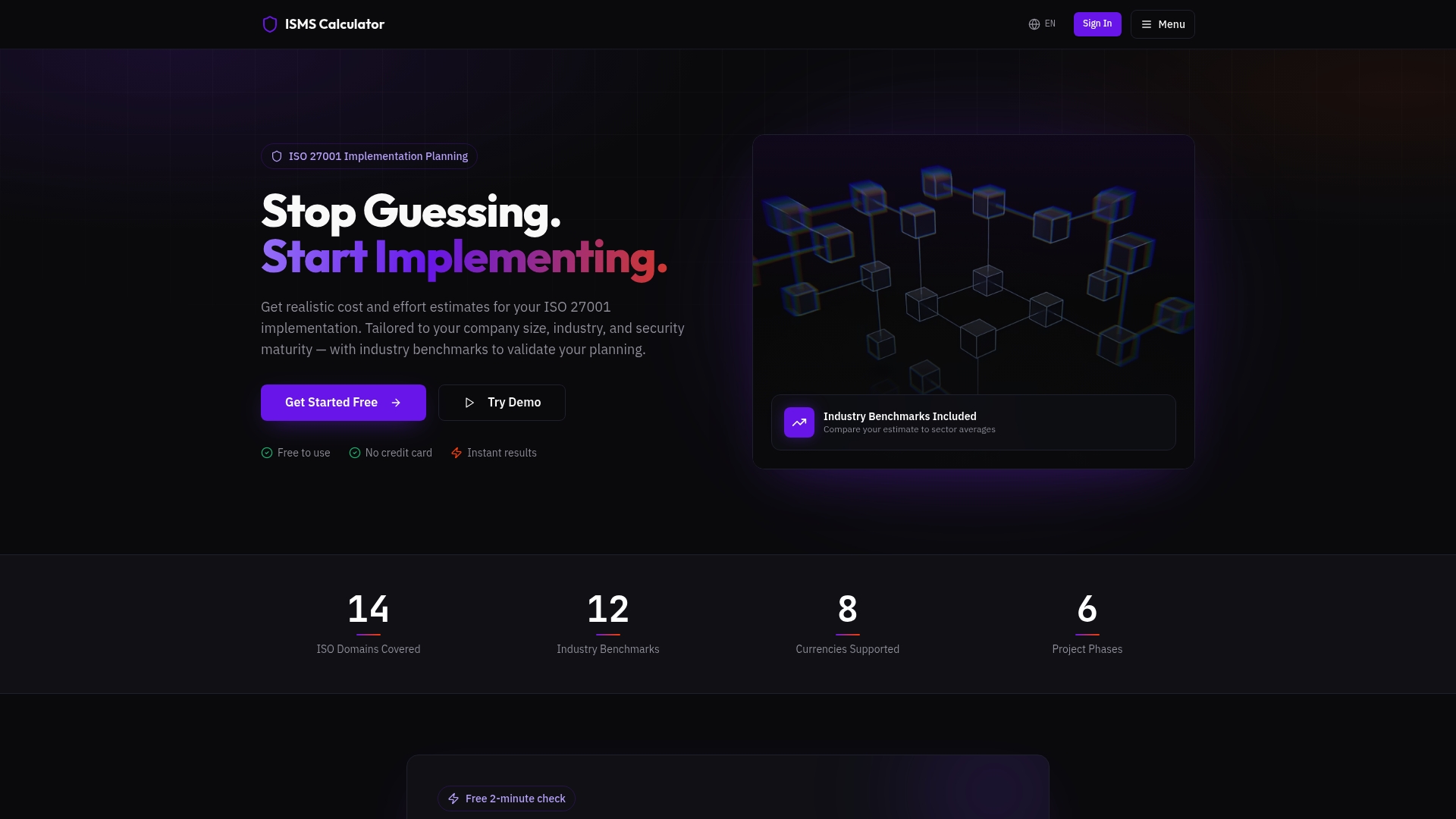
Ismscalculator provides a real-time cost and effort estimator tailored to your company size, industry, and current security maturity. The platform covers all four ISO/IEC 27001:2022 control themes and includes customizable Gantt charts for phased implementation planning. Start with the free 2-minute readiness check to identify your biggest gaps immediately, or use the full ISO 27001 readiness assessment to benchmark your maturity against model reference values and build a realistic adoption timeline.
FAQ
What is the main benefit of early ISO 27001 adoption?
Early adoption gives organizations time to mature their ISMS controls before a breach, a customer requirement, or an audit deadline creates pressure. That maturity reduces both breach risk and certification cost.
How long does ISO 27001 certification take?
The certification process takes 3–6 months from audit readiness to certificate issuance. Total implementation time, including ISMS build-out, typically runs 9–18 months for most organizations.
Does ISO 27001 certification reduce insurance premiums?
Yes. Demonstrated ISMS controls reduce insurer risk assessments, and mid-sized firms typically see meaningful annual premium reductions after certification.
What is a phased ISO 27001 rollout?
A phased rollout implements ISO 27001 controls in stages, starting with the highest-risk areas. It spreads cost and builds organizational buy-in, though it requires careful scope management to avoid leaving unmitigated exposure outside the certified boundary.
Is ISO 27001 required for enterprise sales?
ISO 27001 is effectively a procurement requirement for many European enterprise buyers, financial institutions, and healthcare clients in 2026. Without it, organizations may be disqualified from contract consideration before a sales conversation begins.