
Yes, NIST publishes an official OLIR mapping between ISO/IEC 27001:2022 and CSF 2.0. Your first move should be downloading that export and importing it into a single control inventory rather than building a crosswalk from scratch. The practical payoff follows a simple sequence: map once, implement once, evidence once.
TL;DR:
- Preserve OLIR mapping identifiers, relationship flags, notes, version, and publication date during import; these details show whether each link represents overlap, subset, or partial alignment.
- Scope the crosswalk to controls included in your Statement of Applicability and CSF Profile; prioritize overlap areas such as access control and incident response.
- Treat subset and partial mappings as incomplete, not equivalent; record evidence gaps when one ISO control covers only part of a CSF outcome.
- Store each policy, log, or screenshot once against the unified record, tag it with both framework IDs and a timestamp, then create separate SoA and Profile exports.
- Assign an owner and review the versioned crosswalk at least annually, or whenever either framework, your Statement of Applicability, or CSF Profile changes.
Table of Contents
- What the NIST OLIR mapping actually contains
- How ISO 27001 and NIST CSF actually differ
- Step-by-step: map once, implement once, evidence once
- Sample Annex A to CSF subcategory mappings
- Working with the CSF reference tool and OLIR exports
- Sizing the work before you start mapping
- Aligning frameworks across organizations of different sizes
- When scope and terminology differences throw off a crosswalk
- Keeping the crosswalk synchronized over time
- A pragmatic starting point worth adopting
- Turn your crosswalk into a scoped implementation plan
- FAQ
- Sources
What the NIST OLIR mapping actually contains
The Online Informative References (OLIR) program is how NIST catalogs relationships between its own frameworks and outside standards. The specific entry you want is listed in the NIST OLIR catalog as ISO/IEC-27001:2022-to-CSFv2.0, version 1.0.0, with its own revision history and metadata.
An OLIR export typically includes:
- Mapping identifiers linking each Annex A control to one or more CSF subcategories
- Relationship flags showing whether the mapping is an overlap, a subset, or a partial match
- Descriptive notes explaining the nature of the alignment
- Machine-readable formats (CSV or JSON) suited for import into a spreadsheet or GRC platform
It’s worth being clear about what this mapping is not. NIST treats informative references as a starting point meant to evolve with community feedback, not as a fixed or legally binding requirement. Treat the OLIR as guidance you adapt to your environment, not a checklist you follow blindly.
How ISO 27001 and NIST CSF actually differ
ISO 27001 and the NIST Cybersecurity Framework solve a similar problem with different machinery. ISO 27001 is a certifiable management system: clauses 4 through 10 define governance requirements, and Annex A supplies a fixed list of controls you select and document in a Statement of Applicability. NIST CSF works differently. It organizes outcomes into Functions, Categories, and Subcategories, and organizations build Profiles that describe current and target states rather than pursuing a pass or fail certificate.
The practical overlap is strongest in a handful of areas:
- Risk assessment and risk treatment processes
- Access control and identity management
- Incident response and recovery planning
- Supplier and third-party risk management
Gaps tend to show up where ISO’s Annex A is more prescriptive about documentation and where CSF subcategories describe an outcome without specifying a control mechanism. For audits and procurement, this matters: a vendor can hand you an ISO 27001 certificate as binary proof of conformance, while a CSF response is a maturity profile that requires more context to interpret. Our comparison of ISO 27001 and NIST CSF goes deeper into choosing between the two when you’re still deciding which framework to lead with.
Step-by-step: map once, implement once, evidence once
Turning the OLIR mapping into something an auditor can use takes five steps.
- Pull the OLIR export. Download the CSV or JSON file from the NIST OLIR catalog and keep the version number and publication date with the file. Mappings get revised, and you need to know which version you worked from.
- Normalize identifiers. Annex A numbering changed in the 2022 revision, and CSF 2.0 renumbered several subcategories from CSF 1.1. Build one inventory where each row carries both a stable Annex A ID and a CSF subcategory ID, linked in both directions.
- Prioritize overlap controls first. Start evidence collection on the controls where ISO and CSF agree closely, such as access control and incident response. These give you reusable evidence fastest.
- Attach artifacts once, tag twice. Every policy, log, or screenshot gets stored against the unified control record, tagged with both framework identifiers and a timestamp. One piece of evidence now satisfies two audits.
- Export filtered packages on demand. Generate an SoA-filtered package for your ISO 27001 auditor and a Profile-filtered package for a CSF-based assessment, both pulled from the same underlying inventory.
Pro Tip: Store the OLIR version number inside your control inventory metadata, not just in a separate changelog, so anyone auditing the crosswalk later can see exactly which mapping revision justified each link.
NIST’s own SP.1347 quick-start guide walks through this kind of filtering and export process with worked examples, including a use case for organizations running both CSF and ISO simultaneously.
Sample Annex A to CSF subcategory mappings
Seeing a few mappings in context makes the pattern obvious before you touch the full OLIR file. These are illustrative, not exhaustive. The complete set lives in the NIST OLIR catalog entry.
- Annex A 5.15 (Access control) aligns with CSF subcategory PR.AA, covering identity management and access permissions.
- Annex A 5.24 (Incident management planning) aligns with CSF subcategories under RS.MA, which cover incident handling and response.
- Annex A 5.30 (ICT readiness for business continuity) aligns with CSF subcategories under RC.RP, covering recovery planning.
- Annex A 5.19 (Supplier relationships) aligns with CSF subcategory GV.SC, covering supply chain risk governance.
- Annex A 8.8 (Management of technical vulnerabilities) aligns with CSF subcategory ID.RA, covering risk identification and assessment.
Tag each evidence artifact with both IDs, for example “A.5.15 / PR.AA,” so a single log export or policy document satisfies both auditors without duplicate filing.
Working with the CSF reference tool and OLIR exports
NIST’s informative references hub is where you find the live catalog of OLIR entries, including the ISO 27001 to CSF 2.0 mapping, along with an explanation of how source and focal documents relate.
When exporting, keep these fields intact:
- Mapping and relationship IDs, not just control names
- Overlap or gap flags for each row
- Descriptive notes explaining the relationship type
- Version and publication date of the OLIR entry you pulled
Common pitfalls include losing the version number during a copy-paste into a spreadsheet and failing to reconcile old Annex A numbering with the 2022 revision. Once imported cleanly, the same file becomes the source for both an SoA-filtered ISO package and a Profile-filtered CSF package.
Sizing the work before you start mapping
Crosswalking every control is wasted effort if you map low-priority items first. Our ISO 27001 Cost Calculator gives a real-time estimate of implementation cost and effort based on company size, industry, and current security maturity, which tells you roughly how much work the full ISMS will take before you decide where mapping pays off fastest.
Pairing that estimate with a maturity assessment across the four Annex A control themes shows which domains are furthest behind. Those weak domains are usually where CSF and ISO overlap controls need attention first, since they carry both the highest audit risk and the most reusable evidence once addressed. Running the free 2-minute check is enough to get a directional read before committing analyst time to a full mapping exercise.
Aligning frameworks across organizations of different sizes
A ten-person SaaS company and a multinational manufacturer both need the same OLIR mapping, but the right starting point differs. Smaller organizations typically have fewer systems and a shorter list of Annex A controls marked applicable in their Statement of Applicability, so a full crosswalk is manageable in days rather than weeks. Larger organizations often run multiple business units with separate scopes, which means the same CSF subcategory might map to different Annex A implementations depending on the division.
Industry also shapes which overlap controls matter most. A healthcare provider leans heavily on access control and incident response mappings because of patient data exposure, while a manufacturer with operational technology may prioritize asset management and supply chain subcategories. Regulated industries often already have a NIST SP 800-53 or SP 800-171 baseline in place, which the SP 800-53 controls catalog documents in detail; in that case, the ISO crosswalk becomes a second layer mapped on top of an existing control set rather than a greenfield exercise.
The practical rule holds regardless of size: scope the crosswalk to what’s actually in your SoA and your CSF Profile, not to every control either framework defines. Our ISMS framework guide covers how clause 4 through 10 scoping decisions affect what belongs in that SoA in the first place.

When scope and terminology differences throw off a crosswalk
The biggest source of crosswalk error isn’t a missing mapping, it’s a mismatch in what each framework means by a given term. ISO 27001’s Annex A control for “access control” is a single, bounded requirement with specific sub-clauses. CSF’s PR.AA category spans several subcategories covering identity proofing, authentication, and access revocation, each with its own outcome statement. A one-to-one mapping between the two can overstate how much a single ISO control actually satisfies.
Scope mismatches compound the problem. An Annex A control might apply to your entire ISMS scope, while the equivalent CSF subcategory is evaluated per Profile, which could be narrower or broader depending on how you’ve defined your current and target states. When a mapping entry flags a relationship as “subset” rather than “equivalent,” that flag exists precisely because the scopes don’t line up cleanly, and treating it as a full match will understate your evidence gap.
The fix is mechanical: never collapse a subset or partial relationship into a full equivalence in your control inventory. Carry the relationship type from the OLIR export into your own tooling, and when evidence satisfies only part of a CSF subcategory, note that explicitly rather than marking the row complete. Auditors notice the difference, and so will the next person who inherits your crosswalk.

Keeping the crosswalk synchronized over time
Frameworks revise on different schedules. CSF 2.0 replaced CSF 1.1 with renumbered subcategories, and ISO 27001:2022 reorganized Annex A from the 2013 structure. An OLIR mapping built against one version of either framework drifts out of sync the moment either side publishes a revision, and the OLIR catalog itself gets updated to reflect that.
The most common failure mode is a control inventory that was accurate at creation but never revisited after a framework update, leaving stale mappings that still look correct on paper. A second common issue is inconsistent identifier formatting between teams, where one analyst uses “A.5.15” and another uses “5.15,” breaking any automated reconciliation.
Best practice is to treat the crosswalk as a versioned artifact with an owner, reviewed on a fixed cadence (annually at minimum, or whenever either framework revises) and whenever your SoA or CSF Profile changes. Store the OLIR version number alongside your inventory so a reviewer can tell at a glance whether the mapping predates a framework update. Our gap analysis guide covers how to fold these periodic reviews into a broader ISO 27001 maintenance cycle rather than treating them as a one-time project.
A pragmatic starting point worth adopting
Start with overlap controls, assign a named owner to each, and automate evidence collection wherever you can. Treat the crosswalk as a living, versioned artifact, never a spreadsheet you build once and forget.
— Martin
Turn your crosswalk into a scoped implementation plan
Once you know which Annex A controls deserve attention first, the next question is how much time and budget the surrounding ISMS work will take. We built the ISO 27001 Cost Calculator to answer that in minutes rather than weeks, using your company size, industry, and current maturity to generate a tailored estimate you can adjust as assumptions change.
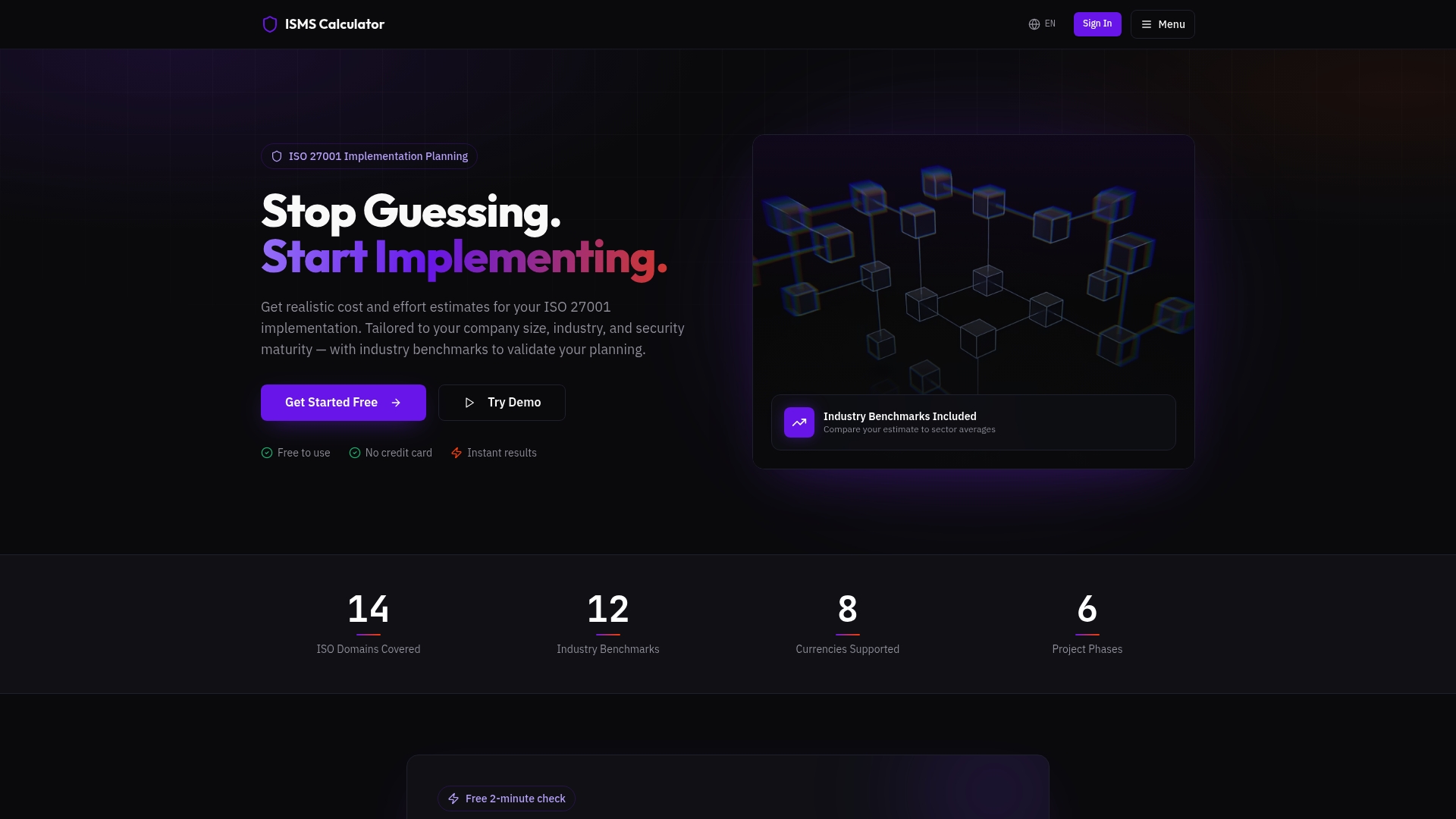
- Run the free 2-minute check to get a directional readiness read before committing analyst time.
- Use our readiness assessment to score maturity across all four ISO/IEC 27001:2022 control themes and see where crosswalk work pays off fastest.
- Save and compare estimates, then export a Gantt-style timeline your auditors or project sponsors can review alongside the OLIR-based control inventory.
For organizations also tracking expected implementation costs against vendor quotes, the 11 Steps to ISO 27001 for US Orgs guide offers a complementary look at sequencing and typical spend ranges from a managed services perspective.
FAQ
What is the difference between ISO 27001 and NIST?
ISO 27001 is a certifiable management system standard with mandatory clauses and a fixed Annex A control list, while NIST CSF is a voluntary outcomes framework organized around Functions and Profiles rather than a pass or fail certificate. The two overlap heavily in areas like access control and incident response, but they use different structures and different proof mechanisms, which is why the official OLIR mapping exists to connect them.
What are the five pillars of NIST CSF?
NIST CSF 2.0 organizes its guidance around core Functions rather than pillars, including Govern, Identify, Protect, Detect, Respond, and Recover. Each Function breaks down into Categories and Subcategories that map to specific outcomes, some of which align directly to ISO 27001 Annex A controls through the NIST informative references hub.
Is the ISO 27001 exam difficult?
Difficulty depends on the certification scheme and your background, since ISO 27001 lead auditor and lead implementer exams test both clause-by-clause knowledge and practical application. Candidates with prior experience in information security management or internal audit generally find the material manageable, while those new to management systems may need dedicated study time.
What is the ISO 27001 cybersecurity framework?
ISO 27001 is formally an information security management system standard, not a cybersecurity framework in the NIST sense, since it defines governance clauses and a control set (Annex A) that organizations certify against through an accredited external audit. It’s often compared to the NIST Cybersecurity Framework because both address similar risk domains, which is why a crosswalk like the OLIR mapping is useful for teams working with both.
Sources
- ISO/IEC-27001:2022-to-Cybersecurity-Framework-v2.0 — NIST OLIR catalog
- CSF 2.0 Informative References — NIST
- NIST SP.1347 — Informative References Quick-Start Guide