
Most mid-sized organizations should budget $15,000 to $45,000 in first-year costs and plan for a 6- to 9-month timeline to certification, though small teams with narrow scope can spend under $10,000 and complex, multi-site environments can push past $80,000. The single biggest driver isn’t headcount; it’s scope: how many systems, sites, and business units fall inside the ISMS boundary. Before you lock a budget, run a gap assessment against your actual starting maturity, not the maturity you assume you have.
TL;DR:
- Certification costs for most mid-sized organizations range from $15,000 to $45,000 in the first year, with higher expenses for complex or multi-site environments.
- The certification timeline typically spans 6 to 9 months, but larger or multi-site projects can take over a year, depending on scope and maturity.
- Internal effort, often overlooked, accounts for roughly 105 to 340 person-days for a 50-person scope, significantly influencing the total cost.
- Surveillance audits in years two and three add approximately $3,000 to $5,000 annually, plus ongoing tooling and internal labor costs.
- Accurate budgeting requires a scope and gap assessment upfront, and using tailored calculators helps produce defendable estimates based on specific company factors.
Table of Contents
- What Drives an ISO 27001 Effort Estimate by Organization Size?
- How Long Does ISO 27001 Certification Usually Take?
- How Many Person-Hours Does ISO 27001 Actually Take?
- What’s the Real Three-Year Cost of ISO 27001?
- Which Scope Factors Change the Estimate the Most?
- How Do You Build a Reliable ISO 27001 Estimate?
- Common Estimating Mistakes and What Actually Fixes Them
- Get Your Tailored ISO 27001 Estimate in Two Minutes
- Sources
- FAQ
What Drives an ISO 27001 Effort Estimate by Organization Size?
Company size is the fastest proxy for cost, but it’s a rough one. Two 40-person companies can land $20,000 apart depending on whether they’re SaaS-only or running a mix of cloud and legacy on-premises infrastructure across three offices.
Here’s how the ranges typically break down for a first certification cycle, assuming mid-level starting maturity (some policies exist, but controls aren’t consistently documented or enforced):
| Organization size | Typical first-year cost | What’s usually included |
|---|---|---|
| Micro (1–10 employees) | $6,000–$15,000 | Light consulting, templated policies, self-managed audit prep |
| Small (10–25 employees) | $15,000–$45,000 | Part-time consultant support, basic tooling, one audit cycle |
| Mid-sized (25–50 employees) | $20,000–$54,000 | Dedicated project lead, risk assessment support, audit fees, compliance software |
| Mid-large (more than 50 employees) | $45,000–$80,000+ | Multi-team coordination, penetration testing, formal internal audit program |
Industry breakdowns of the ISO 27001 process put common first-year totals for small-to-mid organizations roughly between $6,000 and $54,000, which lines up closely with what most consultants quote in practice.
Several factors influence costs within each band, including audit fees depending on employee and site count, choice between consultants or internal staff and tools, and often underestimated internal labor costs.

How Long Does ISO 27001 Certification Usually Take?
Certification runs on two clocks: the work you can compress and the calendar time you can’t. You can throw more consultants at writing policies. You cannot force an auditor to see six months of security logs in three weeks.
Here’s the typical phase breakdown for a mid-market implementation:
- Scope and project planning (2–4 weeks): defining ISMS boundaries, appointing an owner, securing budget sign-off.
- Gap analysis against Annex A controls (1–3 weeks): identifying what’s already in place versus what needs building.
- Risk assessment and treatment planning (3–5 weeks): cataloging assets, scoring risks, deciding which controls address them.
- Controls implementation and documentation (4–12 weeks): writing policies, configuring technical controls, training staff.
- Records accumulation and internal audit (8–12+ weeks): running the ISMS long enough to generate real evidence, then auditing it internally.
- Stage 1 to Stage 2 gap (4–8 weeks): a structural pause between the documentation review and the on-site audit.
ISO’s own certification guidance confirms this two-stage structure: Stage 1 reviews your documentation, Stage 2 audits whether you actually follow it. Published timelines show fast implementations closing in 3 to 4 months, standard ones landing at 6 to 9 months, and extended projects (multi-site, low starting maturity, part-time ownership) stretching past a year.
Book your Stage 2 audit slot early. Certification bodies routinely have multi-month waitlists, and a late booking can add weeks you never planned for.
How Many Person-Hours Does ISO 27001 Actually Take?
Dollar figures hide the real cost, which is internal time. Someone has to write the risk register, chase evidence, and sit through the audit. Converting that time into person-days per role gives you a more honest resource estimate than a lump-sum quote.
For a typical 50-person scope, expect roughly:
- Project lead / ISMS owner: 40–120 person-days across the project
- Security engineer or IT architect: 30–90 person-days
- IT operations staff: 20–80 person-days, mostly during controls implementation
- HR and training coordinators: 10–30 person-days for awareness training and onboarding updates
- Legal or compliance staff: 5–20 person-days reviewing contracts and regulatory mapping
Summed together, that’s roughly 105 to 340 person-days for a 50-person organization, which is why many companies underestimate cost by a factor of two: they price the consultant invoice and forget the internal hours entirely. A survey-based effort model for ISMS implementation backs this pattern, showing effort concentrated heavily in the project lead and technical roles rather than spread evenly across staff.
A part-time owner splitting attention with another job typically doubles the calendar time, even if the total person-days stay similar.
Pro Tip: If you can’t dedicate a full-time owner, at minimum protect a fixed block of hours each week. Fragmented, interrupted ISMS work is the single biggest cause of stalled certification timelines.

What’s the Real Three-Year Cost of ISO 27001?
First-year cost gets all the attention, but certification isn’t a one-time expense. It’s a recurring commitment with surveillance audits in years two and three, plus ongoing tooling and internal labor.
Industry cost breakdowns consistently flag internal labor and opportunity cost, not audit fees, as the largest hidden expense across a three-year ISO 27001 cycle.
A worked example: if your first-year cost lands at $15,000, expect:
- Year 2 (surveillance audit): roughly $2,250–$3,750
- Year 3 (surveillance plus early recertification prep): roughly $3,000–$5,000
- Tooling and licensing renewals: often $2,000–$6,000 annually depending on platform choice
- Internal labor: ongoing, typically 10–20 person-days per year for maintenance
That puts a realistic three-year TCO for a $15,000 first-year project somewhere between $25,000 and $35,000, once you add surveillance audits and tooling. Skipping this math is how organizations blow their compliance budget in year two.
Which Scope Factors Change the Estimate the Most?
Scope decisions made in week one ripple through the entire project. A few factors move estimates more than anything else:
- Scope breadth: certifying one product line costs far less than certifying the entire company.
- Number of sites: each additional physical location typically adds audit days and coordination overhead.
- Cloud versus legacy infrastructure: on-premises systems usually require more manual evidence collection than cloud platforms with built-in logging.
- Existing certifications: organizations already holding SOC 2 or ISO 9001 often reuse policies and risk documentation, cutting weeks off the timeline.
- Executive support: a dedicated owner with real authority moves faster than a committee without one.
Treat any scope change mid-project as a formal change request, not a quiet expansion. Scope creep is the fastest way to blow both budget and timeline.
How Do You Build a Reliable ISO 27001 Estimate?
A defensible estimate follows a sequence, not a guess. Skipping steps is how organizations end up $20,000 over budget by month four.
- Run a gap or readiness assessment first. This tells you your actual starting maturity, not your assumed one, and flags which Annex A controls are missing entirely.
- Lock scope and identify required controls. Decide which systems, sites, and business units fall inside the ISMS boundary before pricing anything.
- Map roles to person-hours, then layer in consultant and audit costs. Use the role-based estimates above as your internal labor baseline.
- Validate against benchmarks and convert to a three-year TCO. A consultant is worth the cost when your team lacks Annex A experience; a self-serve calculator works well when you already have internal security expertise and just need numbers to defend a budget.
A 12-week project plan is a useful sanity check against whatever timeline your consultant or internal team proposes.
Common Estimating Mistakes and What Actually Fixes Them
Most estimates fail for two reasons: teams undercount internal hours, treating consultant fees as the whole cost, and they ignore surveillance audits entirely, budgeting year one and forgetting years two and three exist. Appoint a dedicated owner and budget the full three-year TCO before you start, not after your first invoice surprises you.
— Martin
Get Your Tailored ISO 27001 Estimate in Two Minutes
Generic benchmarks get you close. A tailored number gets you a budget you can actually defend to a CFO. A calculator built specifically to close that gap factors in your company size, industry, and current security maturity to produce a cost and timeline estimate that reflects your actual starting point, not a generic one.
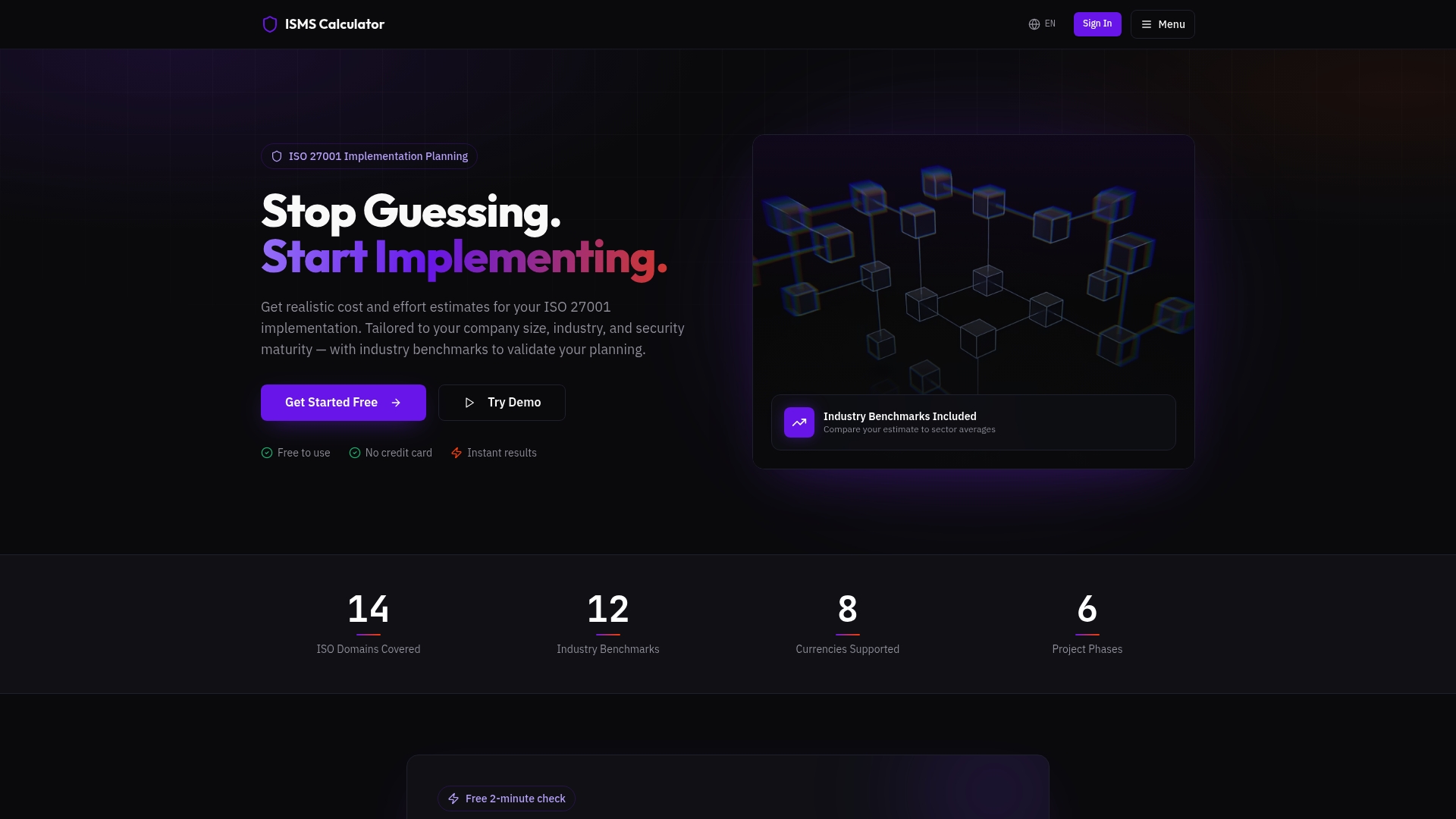
Enter your company size, scope, and maturity level, and the calculator returns a cost range, a projected timeline, and an exportable Gantt chart you can hand straight to leadership as a project plan. It also scores you across the four Annex A control themes so you know exactly where your gaps sit before a consultant ever quotes you a number. The free readiness check takes about two minutes, and you can save multiple scenarios to compare, say, a lean single-product scope against a company-wide certification, before committing budget to either one.
Sources
For primary guidance on the certification process itself, see ISO’s certification overview. For a US-focused budgeting walkthrough, see this partner breakdown of certification costs.
- ISO — Certification (how certification works)
- ISO 27001 Timeline: How Long Does Certification Take? | GovernanceDocs
- Using survey to estimate the effort of setting up an ISMS (IEEE)
- ISO 27001 Certification Cost: Full Breakdown | Cycore
FAQ
How Much Does an ISO 27001 Audit Typically Cost?
Certification body audit fees alone (excluding consulting and internal labor) typically run $3,000 to $15,000 for small-to-mid organizations, scaling with employee count and number of sites, according to industry cost breakdowns.
Is the ISO 27001 Certification Process Difficult?
The standard itself isn’t technically complex, but the effort of documenting controls consistently and gathering months of operational evidence trips up most first-time organizations, especially those without a dedicated ISMS owner.
How Do You Implement ISO 27001 Step by Step?
Start with a gap analysis, lock your scope, complete a risk assessment, implement and document Annex A controls, run an internal audit, then move through Stage 1 and Stage 2 certification audits, following the ISO-defined certification process.
How Long Does It Take to Achieve ISO 27001 Certification?
Most mid-sized organizations complete certification in 6 to 9 months, though fast-track projects with narrow scope can finish in 3 to 4 months and complex, multi-site implementations can take over a year.
What’s the Fastest Way to Get a Reliable Cost Estimate?
Running a readiness assessment like the one from ISMS Calculator gives you a tailored cost and timeline range based on your actual size, industry, and maturity, rather than a generic model reference value.