
Yes, ISO 27001 requires visible executive sponsorship. Clause 5.1 obligates top management to demonstrate active leadership, and auditors verify this through a named sponsor, an executive-signed policy, management review minutes, and approved ISMS funding. Skip any of these, and certification stalls or the auditor flags a nonconformity. Get them in place early, and both your timeline and your resource requests get noticeably easier.
TL;DR:
- Effective executive sponsorship involves signed policies, documented management reviews, and clear funding, which auditors verify through specific evidence and attendance records.
- Building a strong business case with concrete numbers, phased plans, and clear decision points helps secure rapid approval from leadership.
- Maintaining ongoing sponsorship requires regular governance reviews, KPI tracking, and embedding responsibilities into job descriptions to ensure accountability survives organizational changes.
- Using tools like the ISMS Calculator can turn organizational data into ready-to-submit estimates, decreasing approval stalls caused by vague requests.
- Fixing common pitfalls such as no named sponsor, unstructured management reviews, and reliance on verbal decisions can significantly accelerate ISO 27001 certification efforts.
Table of Contents
- Why Executive Sponsorship Determines Your ISO 27001 Outcome
- The Audit Evidence Checklist Every Sponsor Should Know
- How to Build a Business Case Executives Will Actually Sign
- Keeping Leadership Engaged After the Kickoff Meeting
- Turning Vague Budget Guesses Into Numbers Executives Trust
- What Executive Sponsorship Actually Looks Like When It Works
- Common Pitfalls and Quick Wins for Implementers
- Let ISMS Calculator Turn Your Sponsorship Ask Into Numbers
- Sources
- FAQ
Why Executive Sponsorship Determines Your ISO 27001 Outcome
Clause 5.1 of ISO/IEC 27001 doesn’t ask for a signature on a memo. It requires top management to demonstrate leadership and commitment through actions an auditor can independently verify: setting policy, allocating resources, and integrating security into business decisions. Clause 9.3 builds on that by mandating management review, a recurring session where leadership examines ISMS performance and makes documented decisions. These two clauses are the backbone of executive involvement in ISO standards, and assessors treat them as inseparable.
The business case for taking this seriously goes past compliance theater. Certification can accelerate procurement and sales cycles, strengthen operational resilience, and support better risk-based decisions when leadership actually owns the outcome instead of delegating it entirely to IT. Enterprise buyers increasingly treat ISO 27001 as a procurement gate, and a security team that can point to real executive accountability closes deals faster than one presenting a binder nobody senior has read.
Weak sponsorship shows up in predictable ways:
- Management reviews get skipped or delegated to someone without budget authority.
- Auditors ask for evidence of leadership involvement and get a policy nobody senior signed.
- Remediation stalls because nobody with funding power owns the risk register.
- Certification timelines slip by months while the security team chases approvals informally.
None of this is theoretical.
The Audit Evidence Checklist Every Sponsor Should Know
Certification bodies don’t take your word for executive commitment. They ask for documented resource commitments and management review minutes that prove leadership showed up, made decisions, and paid for the work. Missing evidence here is one of the most frequently cited nonconformities in Stage 1 and Stage 2 audits.
Here’s what your evidence file needs, in the order auditors typically ask for it:
- A signed information security policy with version history and, ideally, an executive foreword explaining why the organization pursued certification.
- Management review minutes naming which executives attended, what was decided, and who owns each resulting action.
- Approved ISMS budget records tied to specific objectives, not a vague line item buried in an IT budget.
- Role and responsibility matrices showing who owns risk acceptance, policy approval, and escalation.
- Documented executive communications, like an all-hands email or intranet post, showing visible support beyond the audit room.
Pro Tip: Keep a single running folder (digital, timestamped) of every management review agenda, attendance list, and decision log from day one. Auditors consistently ask for at least two review cycles of history before certification, and reconstructing that after the fact is far harder than logging it as you go.
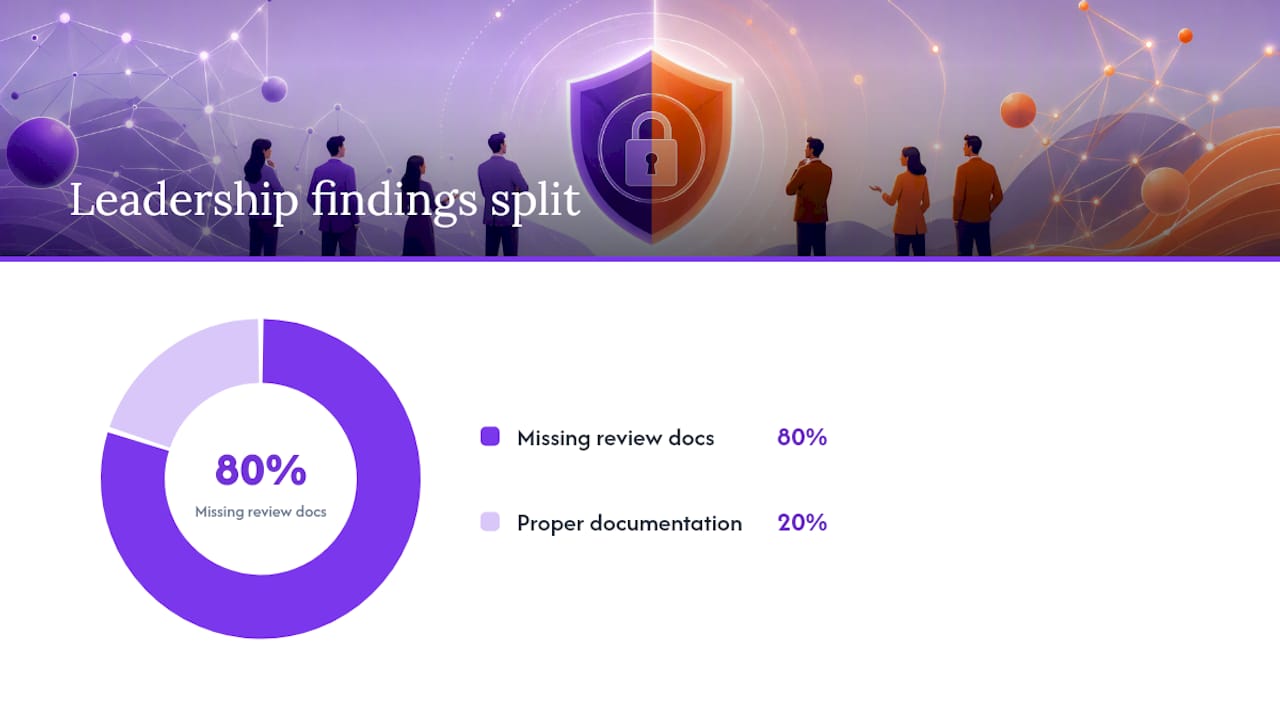
Roughly 80% of ISO 27001 audit findings related to leadership trace back to missing or informal management review documentation rather than an actual absence of executive involvement. In other words, the leadership commitment is often real. It just isn’t written down anywhere an assessor can check.
How to Build a Business Case Executives Will Actually Sign
Winning ISO 27001 management buy-in isn’t about pleading for attention in a budget meeting. It’s about giving decision-makers a package they can approve in fifteen minutes.
Start with strategic framing, not compliance framing. ISO 27001 shortens procurement cycles with enterprise buyers, reduces the friction of security questionnaires, and gives leadership a defensible answer when a client or regulator asks how the organization manages risk. That’s the strategic asset angle, and it lands better with a CFO than “the standard says we have to.”
Before you request anything, map your stakeholders:
- The sponsor — the executive with budget and organizational authority to remove blockers.
- The decision authority — sometimes the same person, sometimes a board or risk committee that needs a formal recommendation.
- The influencers — legal, sales, and operations leaders who will either support or quietly slow-walk the initiative depending on what they think it costs them.
Each of these people needs something different to say yes. A sponsor needs to see the risk of doing nothing. Sales leadership needs to see the deals blocked by missing certification. Legal needs to see reduced breach liability.
Build a single briefing slide, not a deck. One slide, three sections: the ask (name a sponsor, approve initial budget), the timeline (phased, with a first milestone in 60 to 90 days), and the recommended decision points (what you need approved today versus later). Executives skim decks. They read one slide carefully.
Propose a phased approach rather than a full-scope rollout. A pilot covering one business unit or one critical system produces visible progress in weeks instead of quarters, and it keeps the initial resource ask small enough that a single executive can approve it without a committee. Consultancies that specialize in ISO 27001 rollouts consistently point to narrow pilot scopes and a named sponsor as the two factors that separate programs that stall from ones that build momentum.
Ask for something specific in the briefing itself: a named sponsor, a scheduled first management review, and a defined budget range. Vague commitments (“we’ll figure out the details later”) tend to evaporate once the meeting ends.
Finally, prepare for the three objections you’ll hear every time. Cost gets countered with procurement and deal-velocity data. Disruption gets countered with the phased pilot plan. Timing gets countered by pointing out that delay itself has a cost, usually measured in stalled sales cycles or renewed audit findings from the prior year.
Keeping Leadership Engaged After the Kickoff Meeting
Sponsorship secured at kickoff has a way of quietly evaporating by month six unless it’s built into a recurring structure. Governance is what keeps executive commitment to ISO 27001 alive past the initial enthusiasm.
The mechanism that does this work is the management review required under Clause 9.3. Governance oversight clarifies executive accountability by explicitly linking strategy, risk acceptance, policy approval, and performance monitoring to specific named leaders rather than leaving them as shared, diffuse responsibilities.
A working governance cadence looks like this:
- Set a review cadence tied to risk profile. Quarterly for higher-risk or regulated organizations, biannual for lower-risk ones, but never less than twice a year if you want a credible audit trail.
- Track a short KPI set executives can actually use: current risk exposure, count of active critical findings, remediation velocity, and ISMS budget spend against plan. Four numbers, not forty.
- Build a one-page dashboard, not a technical report. Executives need enough detail to make a decision, not enough to audit the SOC team’s ticket queue.
- Embed ISMS ownership into job descriptions for the sponsor and any delegated compliance lead, so the responsibility survives a reorg or a departure.
- Set explicit escalation thresholds for risk acceptance and spending. Below a certain dollar amount or risk score, the compliance lead decides. Above it, it goes to the sponsor automatically.
This is the difference between sponsorship that survives a leadership change and sponsorship that dies with whoever championed it originally.
Turning Vague Budget Guesses Into Numbers Executives Trust
Executives don’t sign off on “it depends.” They sign off on ranges tied to specifics: company size, industry, current security maturity, and scope. Those four inputs drive most of the variance in ISO 27001 program funding, and putting real numbers behind them changes the tone of a sponsorship conversation entirely.
A maturity assessment across the four Annex A control themes, paired with model reference comparisons, gives you a starting readiness score instead of a guess. From there, a Gantt-style implementation timeline turns an abstract “several months” into a phased schedule with named milestones, and a budget range gives your sponsor something concrete to approve rather than an open-ended request.
- A free, short readiness check can produce an immediate leave-behind, something you hand to an executive before the formal budget ask.
- A saved PDF summary works as a one-page artifact for the sponsorship briefing itself, no slide deck required.
- Multiple saved estimates let you show how scope changes shift the budget and timeline side by side.
Treat every estimate as a planning input, not a guarantee. Actual cost and duration still depend heavily on your organization’s real scope and maturity, which is exactly why a phased, evidence-driven plan beats a single fixed number presented as certain.
What Executive Sponsorship Actually Looks Like When It Works
The pattern that shows up again and again in successful ISO 27001 programs isn’t complicated: a named executive sponsor with real budget authority, paired with a compliance lead who has direct access to that person rather than working through three layers of management.
Consultancies that track implementation outcomes point to this sponsor-plus-champion structure as one of the clearest predictors of a program that finishes on schedule versus one that drags for eighteen months. The sponsor’s job isn’t technical; it’s removing blockers, approving budget quickly, and showing up to management reviews consistently enough that the rest of the organization takes the ISMS seriously.
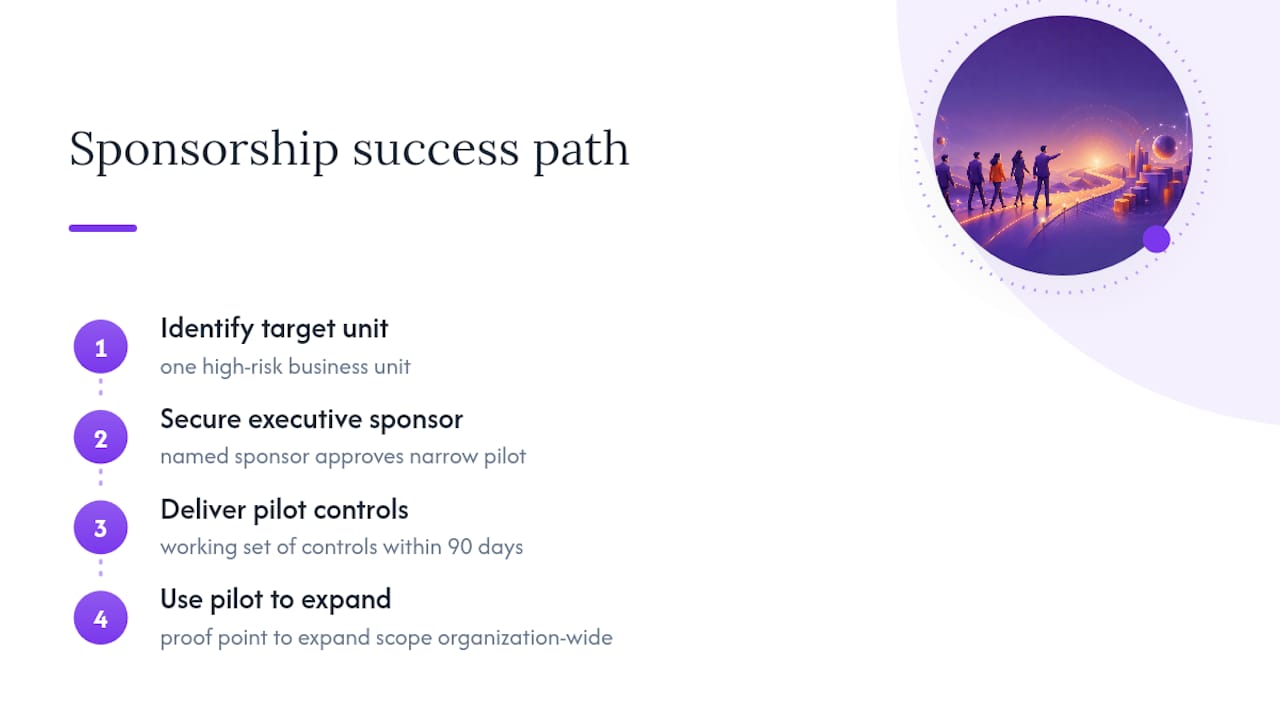
A common early win looks like this: a compliance lead identifies a single high-risk business unit, gets a named sponsor to approve a narrow pilot, and delivers a working set of controls in that unit within 90 days. That pilot becomes the proof point used to expand scope to the rest of the organization, because the sponsor now has a concrete result to point to in the next budget cycle rather than a promise.
Contrast that with programs where sponsorship exists on paper only. The policy gets signed once at the start and never referenced again. Management reviews happen sporadically, minus attendance records, minus assigned actions. When the Stage 2 audit arrives, the paperwork tells a story of leadership involvement that nobody senior can actually corroborate in the interview room. That gap between claimed and demonstrated commitment is exactly what a good auditor is trained to find.
Common Pitfalls and Quick Wins for Implementers
Three mistakes account for most stalled sponsorships: no named sponsor (just “leadership support” in the abstract), no fixed management review cadence, and decisions made verbally with nothing written down. Any one of these will surface as an audit finding eventually.
Fix them in the first 60 days. Name a specific sponsor by title and name, get an executive signature on the security policy, and schedule the first management review before you’re asked for one. For a starter metric, track the percentage of critical controls with a named remediation owner and a target date. It’s a simple number, and it exposes accountability gaps faster than almost anything else you could measure in the first quarter.
— Martin
Let ISMS Calculator Turn Your Sponsorship Ask Into Numbers
Most sponsorship conversations fail on vagueness, not resistance. Executives rarely say no to ISO 27001 outright. They stall when the ask has no number attached to it. The ISMS Calculator fixes that by turning company size, industry, and current maturity into a readiness score, a phased Gantt timeline, and a budget range you can put in front of a sponsor without hand waving.
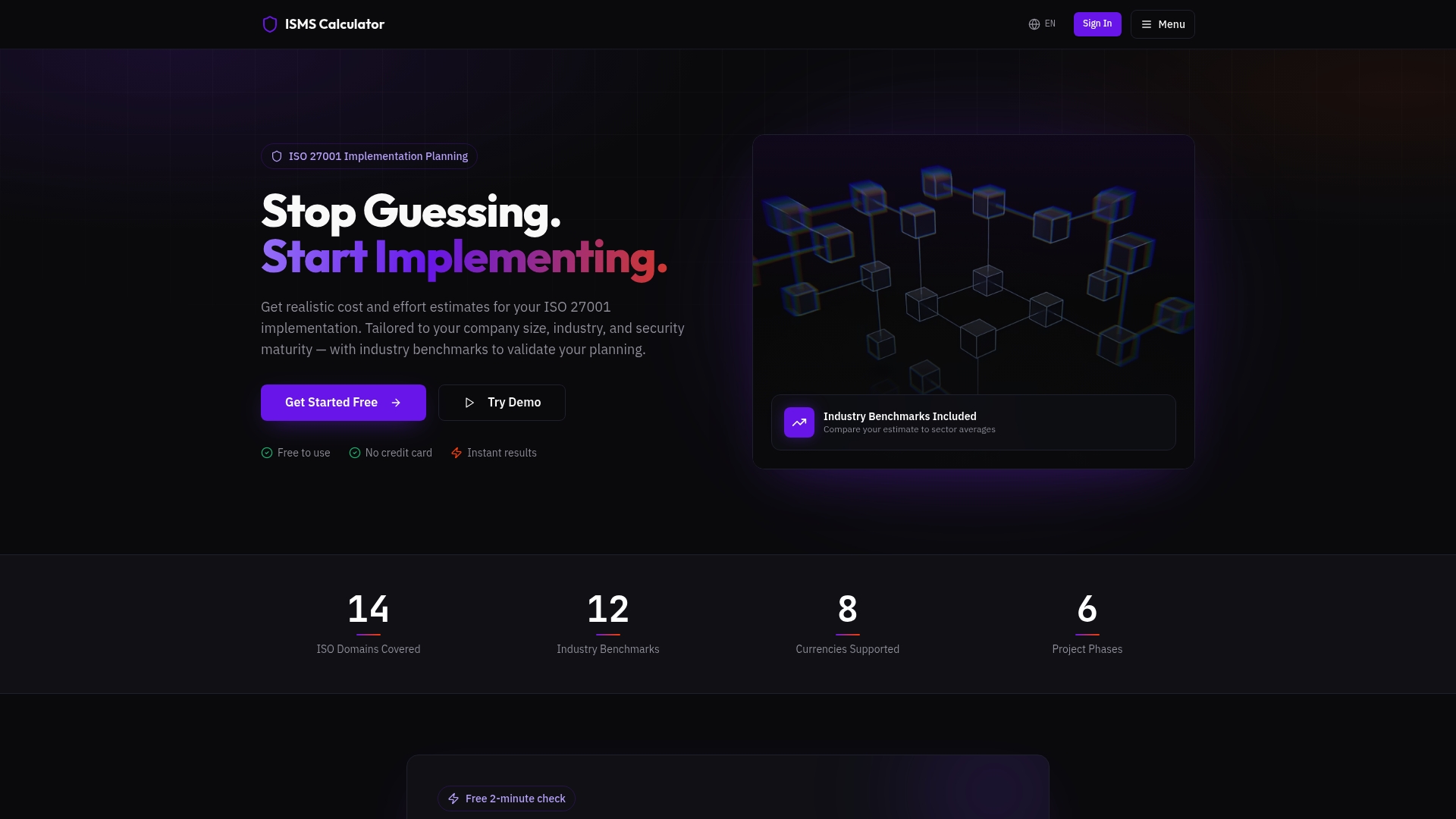
Run the free 2-minute readiness check before your next executive briefing. It produces an instant summary you can save as a PDF and attach directly to your sponsorship request, giving the executive something concrete to approve instead of an open-ended commitment. If you want a deeper, saved comparison across multiple scope options before that meeting, the full readiness assessment walks through the same the four Annex A control themes in more detail and lets you save and compare estimates side by side.
Sources
- Five ways ISO 27001 certification can be a strategic asset — Smithers (2026)
- ISO 27001 Clause 5.1: Leadership and Commitment Explained — URM Consulting
FAQ
Is ISO 27001 Certification Difficult to Get?
It’s manageable with the right preparation, but weak executive sponsorship is one of the most common reasons programs stall or fail their first audit attempt. Organizations with a named sponsor, documented management reviews, and approved funding typically move through certification far more smoothly than those relying on IT alone.
How Much Does ISO 27001 Certification Cost?
Cost varies widely based on company size, scope, industry, and current security maturity, so there’s no single fixed number. Tools like the ISMS Calculator generate a tailored budget range using those specific factors rather than a generic estimate.
Who Can Get ISO 27001 Certification?
Any organization, regardless of size or industry, can pursue ISO 27001 certification, since the standard applies to any information security management system. What varies is scope, meaning which systems, teams, and processes fall under the certified ISMS.
Is ISO 27001 Certification Free?
No. Certification itself involves auditor fees, internal resource time, and often consultant or tooling costs, though a readiness check like the free 2-minute self-assessment costs nothing and helps estimate what the full process will require.
What Is the Executive’s Role in ISO 27001 Implementation?
The executive sponsor approves budget, attends management reviews, signs the security policy, and removes organizational blockers, functioning as the accountable decision-maker rather than a technical contributor.