
ISO 27001 remediation prioritization is defined as the structured process of ranking identified security gaps by risk level, implementation complexity, and business impact before assigning resources to fix them. The industry standard approach uses a four-tier risk model: Critical, High, Medium, and Low. Compliance and IT professionals who apply this model to their ISO 27001 remediation priority examples close certification gaps faster, allocate budget more accurately, and avoid the common trap of fixing easy issues while critical vulnerabilities remain open.
1. What are the four ISO 27001 remediation priority levels?
The four-tier model is the foundation of every effective corrective action process for ISO 27001. Each tier carries a different risk weight and a different expected response time.
Critical priority covers gaps that directly expose sensitive data or could cause immediate regulatory harm. Examples include missing privileged access reviews, no tested restore procedure for backups, and absent encryption on data in transit. These gaps block certification and must be resolved before any audit date is set.

High priority covers major vulnerabilities that do not yet represent active exposure but create significant risk if left unaddressed. Examples include unpatched critical CVEs older than 30 days, incomplete risk registers, and absent incident response exercises. High-priority items typically require resolution within 30–60 days.
Medium priority covers moderate risks that reduce your security posture but do not threaten immediate compliance. Examples include inconsistent access recertification schedules, partially documented supplier agreements, and gaps in security awareness training records. These items fit into a 60–90 day remediation window.
Low priority covers minor documentation improvements and process refinements. Examples include outdated policy version numbers, missing review signatures on older records, and informal procedures that need formal write-ups. Low-priority items are addressed last but must still be closed before certification.
| Priority | Example gap | Typical remediation window |
|---|---|---|
| Critical | No privileged access review process | Immediate, before audit scheduling |
| High | Unpatched critical CVEs, absent IR exercises | 30–60 days |
| Medium | Inconsistent access recertification | 60–90 days |
| Low | Outdated policy version numbers | 90+ days or pre-audit sweep |
2. How to group and prioritize remediation tasks beyond risk level
Risk level alone does not determine the order in which you execute fixes. Grouping gaps by implementation type and resource requirements significantly improves efficiency. An organization that clusters all policy rewrites into one sprint, then moves to technical controls, avoids the context-switching cost of jumping between unrelated fixes.
Common remediation task categories include:
- Policy and documentation tasks: Rewriting acceptable use policies, updating the information security policy, formalizing procedures
- Technical controls: Patching, MFA deployment, encryption configuration, backup testing
- Training and awareness: Phishing simulations, role-based security training, onboarding updates
- Third-party and supplier management: Reviewing supplier contracts, issuing information security questionnaires, updating data processing agreements
Balancing quick wins against complex fixes matters for team morale and management confidence. A quick win, such as enabling MFA on a cloud admin account, takes hours and closes a Critical gap. A complex fix, such as rebuilding a legacy access control system, may take months. Running both tracks in parallel keeps momentum without stalling on hard problems.
Pro Tip: Map each remediation task to a specific ISO 27001 Annex A control reference before grouping. This prevents duplicate effort and makes it easy to show auditors exactly which control each fix addresses.
3. What are best practices for the ISO 27001 corrective action workflow?
The corrective action process for ISO 27001 requires five distinct steps: root cause analysis, action assignment, evidence collection, verification, and closure. Skipping root cause analysis is the most common failure point. Teams that patch a symptom without understanding why the gap existed will see the same finding reappear at the next audit.
A well-structured corrective action register (CAR) contains these fields for every finding:
- Finding ID linked to the audit report
- Root cause statement (not just a description of the symptom)
- Assigned owner with name and department
- Target closure date
- Evidence reference (file path, SharePoint link, or Jira ticket ID)
- Verification method and verifier name
- Closure date and final status
Maintaining an evidence vault indexed by finding ID is the single most important practice for audit success. Organizations regularly fail surveillance audits because a corrective action shows “closed” in the register but no supporting evidence exists. A screenshot, a policy PDF with a version date, or a system-generated access log all qualify as objective evidence. The key is that the evidence must be retrievable in under two minutes during an audit.
Integrating your CAR with tools like SharePoint or Jira creates an authoritative, timestamped record that auditors trust. Manual spreadsheets work for small organizations but break down when multiple owners update the same file.
Pro Tip: Set a calendar reminder 14 days before each corrective action closure deadline. Use that window to verify evidence quality, not just completion status. Auditors check evidence quality, not just the “closed” checkbox.
4. Which ISO 27001 control areas need the highest remediation priority?
Six control areas consistently produce the most Critical and High-priority gaps across ISO 27001 implementations. These areas require focused attention before any other Annex A controls.
| Control area | Example gap | Remediation impact |
|---|---|---|
| Identity and access management | No formal privileged access review | Closes Critical finding; directly affects certification |
| Vulnerability management | Unpatched critical CVEs older than 30 days | Reduces breach risk; required for High-priority closure |
| Backup and recovery | No documented restore test results | Addresses Critical gap; required for business continuity |
| Incident response | No tabletop exercise completed | Closes High-priority gap; required for Clause 8 evidence |
| Cloud security | Misconfigured storage bucket permissions | Closes Critical or High gap depending on data sensitivity |
| Data protection | No data classification scheme in place | Enables downstream controls; Medium to High priority |
Each of these areas maps directly to ISO 27001 Annex A controls and Clause 8 operational requirements. Fixing identity and access management gaps first pays dividends across multiple controls because access rights underpin nearly every other security domain.
Common remediation actions by area:
- Identity and access management: Implement a quarterly access review cycle, enforce MFA on all privileged accounts, document role-based access matrices
- Vulnerability management: Deploy a scanning tool, establish a patch SLA by severity, assign a patch owner per system
- Backup and recovery: Schedule and document monthly restore tests, store results in the evidence vault
- Incident response: Run a tabletop exercise, document lessons learned, update the incident response plan
5. How to tailor remediation prioritization to your organization’s context
No two organizations face identical remediation challenges. Common obstacles include skills gaps, legacy systems, competing project priorities, and inconsistent management commitment. Acknowledging these constraints upfront prevents unrealistic timelines and costly rework.
Practical obstacles and mitigation tactics:
- Skills gaps: Assign a named owner to each control area. If internal expertise is missing, bring in a specialist for that specific task rather than delaying the entire workstream.
- Legacy systems: Document compensating controls where a legacy system cannot meet a requirement directly. Auditors accept compensating controls when they are formally documented and risk-accepted.
- Competing priorities: Use the four-tier model to defend prioritization decisions to leadership. A Critical gap outranks any non-security project.
- Management commitment: Present remediation progress as a risk reduction metric, not a compliance checkbox. Boards respond to risk language.
Assigning specific owners with measurable objectives and hard deadlines is the single most reliable predictor of on-time remediation. Vague ownership, such as “the IT team,” produces delays. Named ownership with a deadline produces results.
Pro Tip: Schedule a 15-minute weekly remediation stand-up with all control owners. Short, frequent check-ins catch blockers before they become missed deadlines. Monthly reviews are too infrequent to prevent slippage.
You can also use the IT team roles guide from Ismscalculator to clarify ownership across technical and compliance functions before assigning remediation tasks.
Key takeaways
Effective ISO 27001 remediation requires a four-tier risk model, grouped task execution, and an evidence vault that auditors can verify in real time.
| Point | Details |
|---|---|
| Use the four-tier model | Classify every gap as Critical, High, Medium, or Low before assigning any resources. |
| Group tasks by type | Cluster policy, technical, training, and supplier tasks into separate workstreams to reduce context-switching. |
| Root cause analysis is non-negotiable | Fixing symptoms without identifying root causes guarantees repeat findings at the next audit. |
| Evidence vault beats a status field | A “closed” status without retrievable evidence will fail a surveillance audit. |
| Named ownership drives results | Assign a specific person, not a team, to each corrective action with a hard deadline. |
Where most remediation plans actually break down
The four-tier model is well understood. What compliance and IT professionals consistently underestimate is the gap between “remediated” and “audit-ready.”
I have reviewed remediation registers where every action showed “closed” three weeks before a certification audit, yet the organization still received major nonconformities. The reason is almost always the same: evidence was either missing, undated, or stored in a personal drive that no one else could access. The corrective action workflow looked correct on paper. The evidence vault did not exist in practice.
The second pattern I see repeatedly is organizations that prioritize by effort rather than risk. They close 40 Low-priority documentation gaps in the first month because it feels productive. Meanwhile, the missing privileged access review, a Critical gap, sits unaddressed because it requires cross-team coordination. Auditors do not grade on volume. One unresolved Critical finding can stop certification entirely.
The ISO 27001 post-audit remediation process in regulated sectors adds another layer: regulators sometimes review your corrective action register independently of your certification body. That means your evidence standards need to satisfy two audiences simultaneously.
My practical advice: treat your evidence vault as the primary deliverable, not the remediation task itself. The task proves you fixed something. The evidence proves it to someone who was not in the room.
— Martin
Ismscalculator makes remediation planning measurable
Estimating how long your remediation plan will take, and what it will cost, is one of the hardest parts of ISO 27001 implementation. Ismscalculator gives compliance and IT professionals a real-time picture of their readiness across all four ISO/IEC 27001:2022 control themes.
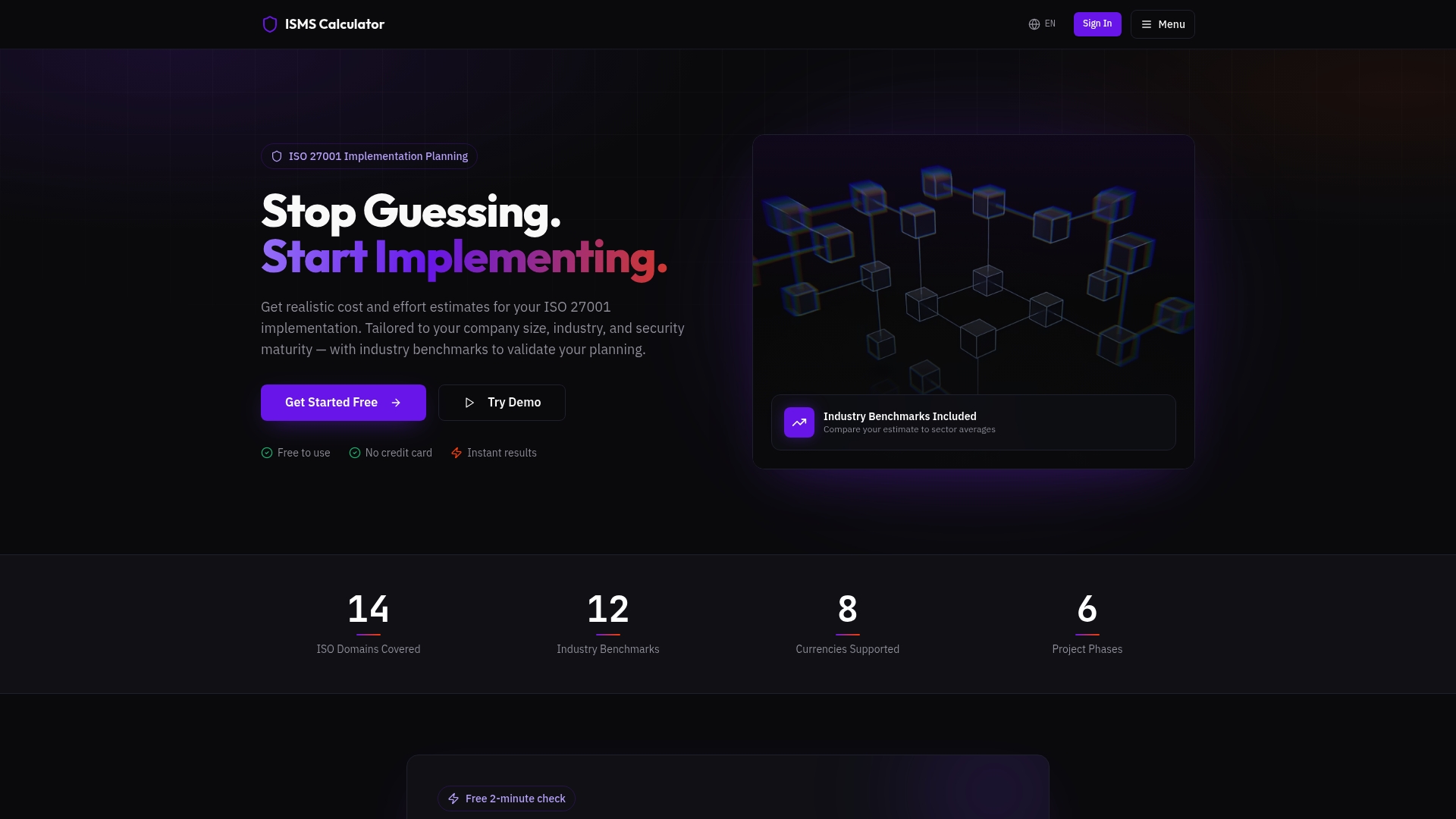
The ISO 27001 readiness assessment maps your current gaps against model reference comparisons and generates a prioritized remediation view based on your organization’s size, sector, and security maturity. You can also run the free 2-minute readiness check to identify your highest-priority gaps before committing to a full implementation plan. If you need expert support, the consultant finder connects you with independent ISO 27001 implementers who specialize in remediation planning.
FAQ
What is ISO 27001 remediation prioritization?
ISO 27001 remediation prioritization is the process of ranking identified security gaps by risk level before allocating resources to fix them. The standard approach uses a four-tier model: Critical, High, Medium, and Low.
How long does ISO 27001 post-audit remediation take?
Timeline depends on the number and severity of findings. Critical gaps require immediate action, High-priority gaps typically close within 30–60 days, and Medium gaps within 60–90 days.
What makes a corrective action “closed” for ISO 27001 purposes?
A corrective action is closed when the root cause has been addressed, the fix has been verified, and objective evidence is stored in a retrievable location linked to the original finding ID.
Which ISO 27001 control areas produce the most Critical gaps?
Identity and access management, vulnerability management, backup and recovery, and incident response consistently produce the highest concentration of Critical and High-priority gaps across implementations.
How do you prioritize ISO 27001 gap remediation with limited resources?
Address Critical gaps first regardless of complexity, then group High-priority tasks by type to reduce execution overhead. Assign named owners with hard deadlines to prevent slippage on the most impactful fixes.