
Your ISO 27001 risk appetite is the amount and type of information security risk your organization is willing to accept in pursuit of its objectives. Under ISO/IEC 27001:2022 clause 6.1.2(a), you are required to establish information security risk criteria, and risk acceptance criteria specifically, as part of your ISMS risk assessment process. Risk appetite is what makes those criteria defensible rather than arbitrary.
The immediate action sequence looks like this:
- Set appetite: Get board or senior management to agree on appetite levels by risk category (confidentiality, integrity, availability, compliance, financial, third-party).
- Derive acceptance criteria: Translate each appetite level into measurable thresholds (e.g., residual risk score ≤ 6 on a 5×5 matrix, or an explicitly defined maximum tolerable downtime).
- Embed in risk assessment: Apply those thresholds consistently when scoring and prioritizing risks in your risk register.
- Govern approvals: Document who can accept risks within appetite, who must escalate, and capture signed approvals as ISMS documented information.
ISO 27001 does not require a document titled “Risk Appetite Statement,” but auditors will expect to see documented criteria, approval records, and evidence that your risk assessment results align with those criteria. Getting the foundation right here saves significant rework during certification.
Key Takeaways
Defining ISO 27001 risk appetite is a governance decision, not a documentation exercise: it requires board approval, measurable thresholds per risk category, and a review cycle tied to organizational context changes.
| Point | Details |
|---|---|
| Clause 6.1.2(a) is the anchor | ISO 27001:2022 requires documented risk acceptance criteria before any risk assessment begins. |
| Appetite, tolerance, and criteria are distinct | Appetite is strategic; tolerance is operational; acceptance criteria are the assessment-level thresholds risk owners apply. |
| Thresholds must be category-specific | Set separate acceptance thresholds for confidentiality, integrity, availability, compliance, financial, and third-party risks. |
| Review is mandatory, not optional | ISO/IEC 27005 requires updating acceptance criteria when organizational context changes; annual review is the minimum cadence. |
| Ismscalculator maps appetite to implementation | The readiness assessment and cost estimator translate your appetite position into a costed, phased ISO 27001 implementation plan. |
Table of Contents
- What is ISO 27001 risk appetite, and how does it differ from tolerance and acceptance criteria?
- Where do risk appetite and acceptance criteria sit in ISO 27001:2026 and ISO/IEC 27005?
- How do you determine your organization’s risk appetite?
- How do you translate risk appetite into measurable acceptance criteria and thresholds?
- How do you apply risk appetite in your ISMS workflows, approvals, and risk register?
- When and how should you review your risk appetite?
- What are the most common mistakes when defining and using risk appetite?
- How to run a single-session workshop to set your risk appetite
- A practitioner’s perspective on what actually makes risk appetite work
- How Ismscalculator helps you move from appetite to implementation plan
- Sources
What is ISO 27001 risk appetite, and how does it differ from tolerance and acceptance criteria?
These three terms travel together in most ISMS documentation, and confusing them is one of the most common errors auditors flag. Each operates at a different level of the organization.
Risk appetite is strategic. It expresses the board’s or senior leadership’s high-level position on how much risk the organization is willing to pursue or retain in a given category. It answers the question: “How much risk are we philosophically comfortable with?” A healthcare organization subject to HIPAA might state a near-zero appetite for confidentiality failures involving protected health information, while a SaaS startup competing on speed might accept a moderate appetite for availability risk during non-peak hours.
Risk tolerance is operational. It sets the measurable limits within which the organization can deviate from its appetite before action is required. Think of it as the acceptable variation band around the appetite position. According to Wolters Kluwer’s GRC guidance, appetite defines the amount and type of risk an organization is willing to take, while tolerance defines the specific limits and boundaries within which it will operate. A company with a “low” appetite for data breach risk might tolerate a small number of minor access-control incidents within a defined period before escalating to the board.
Risk acceptance criteria are the assessment-level thresholds used during risk evaluation to decide whether a specific identified risk requires treatment or can be accepted as-is. These are the numbers your risk owners actually apply when scoring risks in the register.
Here is how the three terms map to decisions and documentation:
- Appetite: Board-approved policy statement (“We maintain a low appetite for unauthorized disclosure of customer data”).
- Tolerance: Operational limit defined by the CISO or risk committee (“No more than three medium-severity access-control findings open beyond 30 days”).
- Acceptance criteria: Assessment threshold applied by risk owners (“Risks scoring ≤ 6 on a 5×5 likelihood-consequence matrix may be accepted without escalation”).
The practical test: if a risk owner asks “can I accept this risk?”, the acceptance criteria give the answer. If the CISO asks “are we within our risk position?”, tolerance metrics give the answer. If the board asks “what kind of risk are we taking?”, the appetite statement gives the answer.
Where do risk appetite and acceptance criteria sit in ISO 27001:2026 and ISO/IEC 27005?
The full ISO/IEC 27001:2022 standard places the requirement for risk criteria squarely in clause 6.1.2(a): the organization shall define and apply an information security risk assessment process that includes criteria for performing risk assessments and, critically, risk acceptance criteria. These criteria must be established before any risk assessment is conducted, not derived from it afterward.
The standard is explicit that risk acceptance criteria may be absolute or conditional, and that they should consider likelihood and consequence independently rather than relying solely on a combined risk score. A risk with low likelihood but catastrophic consequence may need to be treated even if its combined score sits below your threshold.
ISO/IEC 27001:2022, clause 6.1.2(a): The organization shall define and apply an information security risk assessment process that establishes and maintains information security risk criteria including the risk acceptance criteria.
ISO/IEC 27005:2022 provides the operational bridge. It links acceptance criteria back to organizational objectives and context, and it explicitly recommends updating criteria when context changes, such as after a merger, a new product launch, or a shift in regulatory requirements. The guidance confirms that acceptance criteria should be derived from risk appetite, not invented independently by risk owners.
What auditors actually look for during a Stage 2 audit:
- A documented risk appetite position, approved by top management, traceable to organizational objectives.
- Documented risk acceptance criteria that are specific enough to produce consistent assessment results across different risk owners.
- Evidence that the criteria were applied during the risk assessment (i.e., the risk register shows how each risk was scored against the criteria).
- Approval records for risks accepted above the standard threshold, signed by the appropriate authority.
- A review cycle showing the criteria have been revisited, not just set once at implementation.
The IRM’s risk appetite framework guidance reinforces this governance structure, noting that a complete appetite framework includes a statement, defined limits, clear roles and responsibilities, and a monitoring mechanism. All four elements need to be present for an auditor to consider the framework complete.
How do you determine your organization’s risk appetite?
Appetite is not something the CISO sets alone. It is a governance decision that requires input from multiple stakeholders and must reflect the organization’s strategic context, regulatory environment, and financial capacity.
Who needs to be in the room
- Board or top management: Own the appetite decision and must formally approve the final position. Without their sign-off, the appetite statement has no governance weight.
- CISO or CRO: Provides technical context on the threat landscape, current control maturity, and what different appetite levels mean operationally.
- Legal and compliance: Flags regulatory floors (HIPAA, the Bank Secrecy Act, sector-specific requirements) that create non-negotiable appetite constraints.
- Risk owners (department heads, IT leads): Translate strategic appetite into operational reality; they know where the actual exposure sits.
- Finance: Quantifies the financial impact of different risk scenarios and sets the financial-loss thresholds that inform appetite levels.
Factors that shape the appetite decision
| Factor | What to assess | Typical influence on appetite |
|---|---|---|
| Business objectives | Growth targets, competitive strategy, innovation pace | Higher growth ambition often raises appetite for operational risk |
| Regulatory environment | HIPAA, PCI DSS, SOC 2, state privacy laws | Compliance risk appetite is often forced to very low |
| Financial capacity | Maximum tolerable loss, insurance coverage | Sets the upper bound on financial-impact thresholds |
| Technology maturity | Current control effectiveness across ISO domains | Low maturity = lower appetite until controls improve |
| Third-party exposure | Number and criticality of suppliers, cloud dependencies | High dependency raises appetite sensitivity for supply chain risk |
| Incident history | Past breaches, near-misses, audit findings | Recent incidents typically push appetite downward |
Categorical appetite levels
Most organizations find it practical to define appetite separately for each risk category rather than applying a single organization-wide level. A common scale runs from very low through low, moderate, and high. Category-based templates are widely used in ISMS documentation precisely because they give risk owners clear guidance without requiring them to re-interpret a single vague statement for every risk type.
A typical mapping might include very low appetite for compliance and confidentiality risks involving regulated data; low appetite for integrity risks affecting financial systems; moderate appetite for availability risks on non-critical internal tools; and a higher appetite for innovation-related operational risks where speed is a competitive priority, adjusting levels based on organizational strategy.
Pro Tip: Run the appetite discussion before you finalize your risk assessment methodology. If you set scoring scales and treatment thresholds first, you will almost certainly find that the appetite conversation gets captured by whoever built the spreadsheet rather than by the people who should own the decision.
How do you translate risk appetite into measurable acceptance criteria and thresholds?
High-level appetite statements are only useful once they become numbers risk owners can apply. The translation process moves from qualitative position to quantitative threshold in three steps: define the appetite level per category, set the likelihood and consequence scales, then derive the acceptance threshold from the intersection.
Risk appetite statement template
A well-formed appetite statement for ISMS documentation follows this structure:
Adapt the threshold and approving authority to each category. The statement should reference your scoring scale explicitly so there is no ambiguity about what “residual risk score of 6” means in practice.

Sample threshold table
The table below shows how appetite levels translate into acceptance thresholds across common ISO 27001 risk categories, using a 5×5 likelihood-consequence matrix where the maximum score is 25.
| Risk category | Appetite level | Max acceptable residual score | Escalation trigger | Approving authority |
|---|---|---|---|---|
| Confidentiality (regulated data) | Very low | 4 | Score > 4 | CISO + Legal |
| Integrity (financial systems) | Low | 6 | Score > 6 | CISO |
| Availability (critical services) | Low | 6 | Score > 6 | CISO + Operations |
| Availability (non-critical tools) | Moderate | 6 | Score > 6 | IT Risk Owner |
| Compliance (regulatory) | Very low | 3 | Any finding | Legal + Compliance |
| Third-party / supply chain | Low | 6 | Score > 6 | CISO + Procurement |
| Financial impact | Moderate | 10 | Score > 10 | CFO + CISO |
The implementation guidance from Acato reinforces that acceptance criteria must align with strategic objectives and external requirements, not just internal scoring preferences. If your regulatory environment mandates near-zero tolerance for certain data types, that constraint overrides any internally derived threshold.
A few practical notes on building these thresholds:
- Set likelihood and consequence thresholds independently. A risk with a likelihood score of 1 and a consequence score of 5 (catastrophic) should not automatically be accepted just because its combined score of 5 falls below a threshold of 6.
- Document the rationale for each threshold in the policy, not just the number. Auditors want to see that the threshold reflects a deliberate decision, not a default.
- Version-control the threshold table. When you update it, the previous version should remain accessible so you can demonstrate how criteria have evolved.
How do you apply risk appetite in your ISMS workflows, approvals, and risk register?
Embedding appetite into the ISMS is where most implementations either succeed or quietly fall apart. The criteria need to be wired into the risk assessment process so that every risk owner applies them consistently, not just the people who were in the original appetite workshop.
How acceptance criteria change risk assessment scoring
When a risk owner completes a risk assessment, the acceptance criteria determine three things: whether the risk requires treatment, what level of treatment is sufficient, and who needs to approve the decision. Without documented criteria, each risk owner makes a judgment call, and your risk register becomes a collection of inconsistent opinions rather than a governed dataset.
A risk register entry that reflects appetite properly looks something like this:
| Field | Example value |
|---|---|
| Risk ID | R-047 |
| Risk description | Unauthorized access to customer PII via misconfigured cloud storage |
| Likelihood score | 3 (possible) |
| Consequence score | 5 (catastrophic) |
| Inherent risk score | 15 |
| Controls applied | Access control policy, MFA, bucket-level permissions review |
| Residual risk score | 6 |
| Appetite category | Confidentiality (regulated data) |
| Acceptance threshold | 4 |
| Decision | Escalate — residual score exceeds threshold |
| Approver | CISO + Legal |
| Approval date | March 14, 2025 |
| Next review | September 14, 2025 |
Escalation and approval workflow
A two-tier approval structure works well for most organizations:
Routine acceptance (within appetite):
- Risk owner scores the risk using the agreed methodology.
- Residual score falls at or below the category threshold.
- Risk owner documents the rationale in the risk register.
- Risk owner signs off and records the acceptance date and next review date.
- Risk register is updated; no further escalation required.
Exceptional acceptance (above appetite):
- Risk owner identifies that residual score exceeds the category threshold.
- Risk owner prepares a risk acceptance request, including treatment options considered and reasons for accepting rather than treating.
- Request is submitted to the designated approving authority (CISO, Legal, CFO, depending on category).
- Approving authority reviews, approves or rejects, and signs the record.
- Approved exceptions are flagged in the risk register with a mandatory review date, typically 90 days.
- Exceptions trending upward trigger a review of the appetite threshold itself.
For ISO 27001 risk assessment methodology alignment, the scoring scales used in the risk register must match the scales referenced in your acceptance criteria documentation. Mismatches between the two are a common audit finding.
When and how should you review your risk appetite?
Risk appetite is not a policy you set at implementation and revisit at the next certification cycle. ISO/IEC 27005 guidance explicitly warns against treating appetite statements as static, recommending review whenever organizational context changes.
Suggested review cadence
A minimum annual review, timed to coincide with the management review required under ISO 27001 clause 9.3, is the baseline. Many organizations with active threat environments or rapid growth review appetite semi-annually.
Events that require immediate review
- A material security incident or data breach, even if contained.
- A merger, acquisition, or significant organizational restructuring.
- Entry into a new regulated market or adoption of a new regulatory framework.
- A major change in technology infrastructure (cloud migration, new SaaS platform, significant third-party dependency).
- A significant shift in the threat landscape, such as a sector-wide ransomware campaign.
- A material change in financial capacity that affects the organization’s ability to absorb risk.
Monitoring metrics and KPIs
Tracking these indicators between formal reviews gives you early warning that appetite may need adjustment:
- Trend of residual risk scores: Are scores creeping upward across a category? That may signal that controls are degrading or that the threat environment has shifted.
- Number of accepted risks above threshold: A rising count of exceptions suggests either the threshold is set too low or controls are not keeping pace.
- Control performance metrics: Patch cycle times, access review completion rates, incident response times. Deteriorating control performance erodes the basis for the appetite position.
- Audit findings: Internal and external audit findings that cluster in a particular risk category are a signal to revisit appetite for that category.
- Third-party risk events: Supplier incidents, contract changes, or new dependencies that affect your supply chain risk exposure.
Review checklist
- Pull the current appetite statement and compare it against the organization’s current strategic objectives.
- Review the exception log: how many risks were accepted above threshold in the past period, and why?
- Check control performance data against the assumptions that underpinned the original appetite decision.
- Confirm that regulatory requirements have not changed in ways that affect compliance appetite floors.
- Present findings to top management and obtain formal approval for any changes.
- Update the risk acceptance criteria documentation and version-control the change.
- Communicate changes to risk owners before the next assessment cycle begins.
What are the most common mistakes when defining and using risk appetite?
Most appetite frameworks fail not because the concept is wrong but because the implementation skips steps that seem administrative and turn out to be critical.
Confusing appetite with tolerance. This is the single most frequent error. Teams write a tolerance limit (“no more than five open high-severity findings”) and call it an appetite statement. The two serve different functions. Appetite is the strategic position; tolerance is the operational guardrail. Conflating them produces a document that satisfies neither purpose. The corrective action is to write the appetite statement first, in plain language approved by top management, and then derive tolerance limits from it separately.
Leaving appetite statements too vague. “We maintain a low appetite for cybersecurity risk” tells a risk owner nothing actionable. They cannot use it to decide whether to accept a specific risk. Every appetite statement needs a corresponding threshold in the acceptance criteria. If you cannot attach a number or a specific condition to the statement, it is not finished.
Failing to tie appetite to business objectives. Appetite that floats free of strategy is just a compliance artifact. The business case for ISO 27001 is strongest when risk appetite reflects real strategic trade-offs, such as accepting higher operational risk to move faster, or accepting lower availability risk tolerance to protect a premium service reputation. Auditors increasingly look for this alignment, and so do boards.
Setting appetite once and never updating it. Organizations that implement ISO 27001, set their appetite, and then treat it as permanent documentation tend to find that their risk register drifts out of alignment with reality. The appetite statement should carry an explicit review date and an owner.
Excluding the right stakeholders. An appetite statement drafted by the security team alone, without board approval, lacks governance authority. Risk owners will not take it seriously, and auditors will note the gap. The approval chain matters as much as the content.
Using appetite to justify inaction. Some teams use a “moderate” appetite statement as a blanket justification for not treating risks that genuinely need attention. Appetite is not a shield against accountability. It is a framework for making deliberate, documented decisions. Every accepted risk above threshold needs a named approver and a review date.
Ignoring regulatory floors. Sectors subject to HIPAA, the Bank Secrecy Act, or other federal frameworks have non-negotiable appetite constraints for specific risk types. These cannot be overridden by a board decision. Compliance appetite for regulated data categories should always reflect the regulatory minimum, regardless of what the organization’s general appetite position says.

How to run a single-session workshop to set your risk appetite
A 90–120 minute facilitated session with the right participants can produce an agreed appetite position and draft acceptance criteria that are ready for ISMS documentation. The key is structure: a clear agenda, a simple voting mechanism, and a scribe capturing rationale, not just outcomes.
Suggested agenda
- Context briefing (15 minutes): Facilitator presents the organization’s current risk profile, regulatory environment, and strategic objectives. Risk owners and top management need a shared picture before they can make appetite decisions.
- Term alignment (10 minutes): Briefly clarify appetite, tolerance, and acceptance criteria so participants use the same language. This prevents the most common workshop failure: a 45-minute debate caused by definitional confusion.
- Category-by-category appetite voting (30–40 minutes): For each risk category, participants vote on an appetite level (very low, low, moderate, high) using a simple show-of-hands or anonymous card system. The facilitator captures votes and, where there is disagreement, leads a short discussion to surface the reasoning before calling a final position.
- Threshold-setting (20–30 minutes): For each agreed appetite level, the group sets the corresponding acceptance threshold. The CISO or risk lead proposes a starting number based on the scoring methodology; the group adjusts based on the appetite position just agreed.
- Escalation and approval matrix (10 minutes): Agree who can accept risks within appetite, who must approve exceptions, and what the exception review period is.
- Documentation and next steps (10 minutes): Scribe reads back the agreed positions. Facilitator confirms the next steps: drafting the formal appetite statement, circulating for approval, and embedding criteria in the risk register.
Workshop worksheet templates
Context summary (complete before the session):
| Element | Current position |
|---|---|
| Primary business objectives | [e.g., 30% revenue growth, entry into healthcare market] |
| Key regulatory requirements | [e.g., HIPAA, SOC 2 Type II, state privacy laws] |
| Current control maturity (overall) | [e.g., Level 2 of 5 across the four Annex A control themes] |
| Recent incidents or audit findings | [e.g., two access-control findings in last audit] |
| Maximum tolerable financial loss | [e.g., $500,000 per incident before material impact] |
Risk-category appetite voting grid:
Threshold-setting grid (complete during step 4):
| Risk category | Agreed appetite | Max residual score (5×5) | Escalation trigger | Approver |
|---|---|---|---|---|
| Confidentiality (regulated data) | Very low | 4 | Score > 4 | CISO + Legal |
| Integrity (financial systems) | Low | 6 | Score > 6 | CISO |
| Compliance / regulatory | Very low | 3 | Any finding | Legal |
A completed example
Suppose the group votes “very low” for confidentiality risks involving customer PII, citing HIPAA obligations and recent sector-wide breach activity. The CISO proposes a threshold of 4 on a 5×5 matrix. Legal confirms this aligns with the regulatory requirement. The scribe records: “Appetite: very low. Threshold: residual score ≤ 4. Rationale: HIPAA compliance obligation and board-level reputational risk position. Approver for exceptions: CISO and General Counsel.” That record becomes the basis for the formal appetite statement and the acceptance criteria entry in the ISMS policy.
Facilitation tips that actually matter: keep the voting anonymous for the first round so senior voices do not anchor the group. Capture the rationale for every decision, not just the outcome. A documented rationale is what makes the appetite statement defensible during an audit, because it shows the decision was deliberate and context-specific rather than a default.
A practitioner’s perspective on what actually makes risk appetite work
The technical framework for ISO 27001 risk appetite is well-documented. What the standards do not tell you is where the process actually breaks down in practice.
The most consistent failure point is not the documentation. It is the gap between what top management agrees to in a workshop and what risk owners actually apply six months later. Appetite statements get approved, filed in the ISMS policy folder, and then quietly ignored when a risk owner faces a treatment decision that is inconvenient or expensive. The fix is not a better template. It is making the acceptance criteria visible at the point of decision, embedded in the risk register tool or assessment form, so that a risk owner cannot complete an assessment without engaging with the threshold.
Executive buy-in is harder to secure than most practitioners expect, and for a specific reason: appetite decisions require executives to commit to a position that may later be used to hold them accountable. A board that approves a “very low” appetite for data breach risk is implicitly committing to fund the controls that make that position credible. Framing the appetite conversation around strategic objectives and ROI rather than compliance obligation tends to produce more honest and durable decisions.
On exceptions: document them obsessively. Every risk accepted above threshold should carry a named approver, a dated rationale, and a mandatory review date. An exception log that is reviewed quarterly tells a far more credible governance story than a clean risk register with no exceptions, which usually means risks are being scored down to fit the threshold rather than assessed honestly.
One more thing that rarely appears in implementation guides: align your appetite statement language with the language your board uses in its own risk reporting. If the board talks about “reputational risk” and “operational resilience” rather than “confidentiality, integrity, and availability,” translate the CIA framework into those terms in the appetite statement. A document that reads like the board wrote it is far more likely to get genuine approval and ongoing attention.
How Ismscalculator helps you move from appetite to implementation plan
Once your workshop produces agreed appetite levels and acceptance thresholds, the next practical question is: what does it cost and how long will it take to bring your controls in line with that appetite position?
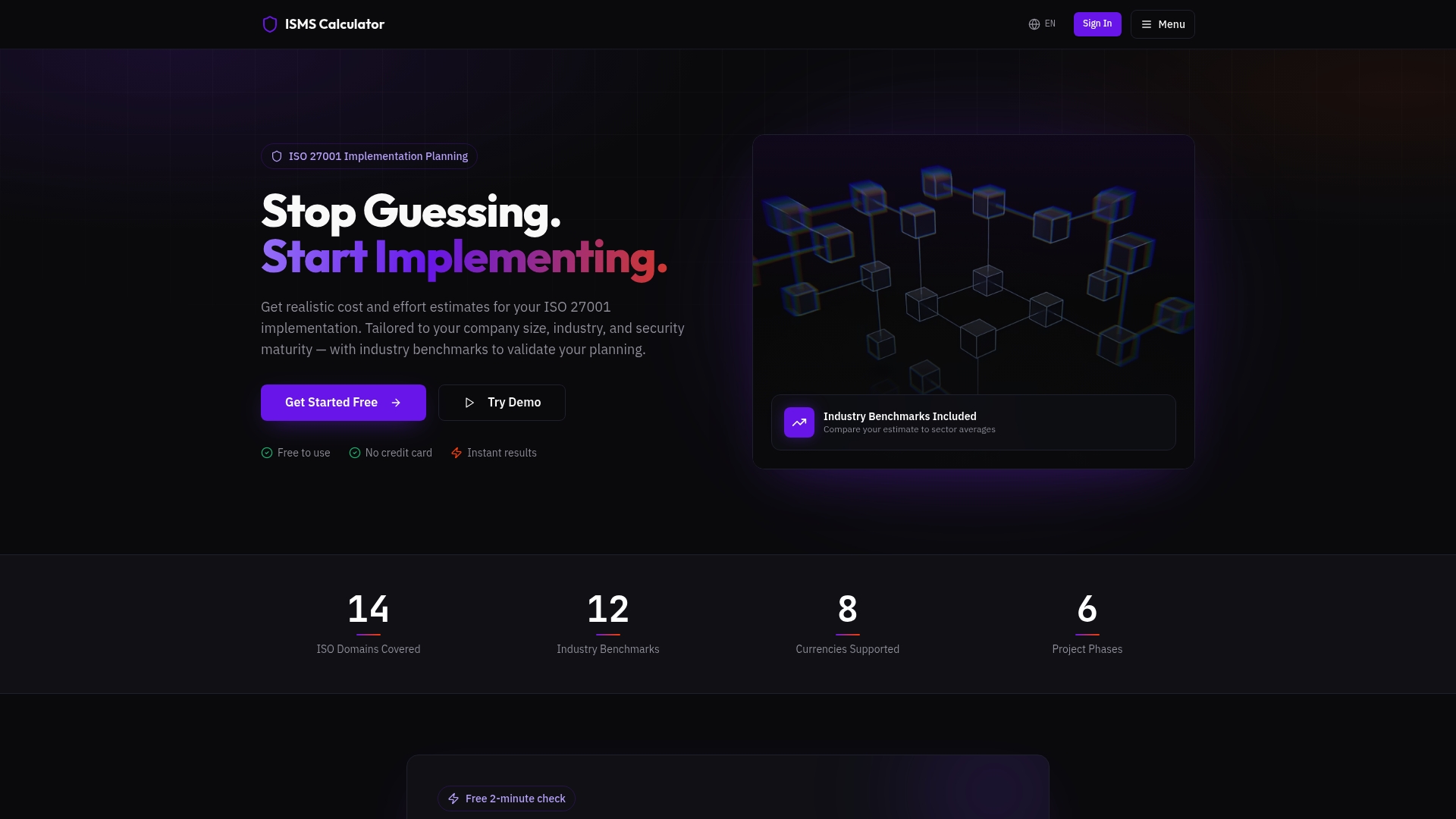
Ismscalculator gives you a real-time answer. The platform’s ISO 27001 readiness assessment maps your current control maturity across all four ISO/IEC 27001:2022 control themes against your appetite and target posture, then generates a tailored implementation cost and effort estimate based on your organization’s size, industry, and security maturity. You get model reference comparisons to validate your plan against that reference, a domain-by-domain gap analysis, and a customizable Gantt chart that turns your workshop outputs into a phased implementation timeline.
If you are not ready for the full assessment, the free 2-minute readiness check gives you an immediate baseline. Start there, then use the full estimator to build the business case for the controls your appetite position requires.
Sources
The sources below underpin the claims and frameworks in this article. Each serves a distinct purpose depending on where you are in the implementation process.