
ISO 27001 Zero Trust alignment is the deliberate integration of Zero Trust security principles into an ISO 27001 Information Security Management System to strengthen both security posture and audit readiness. The two frameworks are not competing approaches. They are complementary, and organizations that treat them as a unified system gain a measurable advantage. Integrated approaches save an average of $1.76 million per data breach compared to siloed security programs. With the ISO 27001:2013 transition period ending in october 2025, every organization now operates under ISO 27001:2022 Annex A controls, making these ISO 27001 Zero Trust alignment tips more relevant than ever.
1. What are the key Zero Trust principles for ISO 27001 alignment?
Zero Trust is built on three non-negotiable principles: never trust by default, always verify every access request, and assume a breach has already occurred. These are not abstract ideas. Each principle maps directly to ISO 27001:2022 controls and shapes how you design your ISMS.
The “never trust” principle drives identity-centric access. Every user, device, and service must authenticate explicitly before gaining access to any resource. ISO 27001 Annex A controls A.5.15 through A.5.18 cover access control and identity management, making them the natural home for this principle within your ISMS.

Least privilege is the operational expression of Zero Trust. Users and systems receive only the permissions they need for a specific task, and those permissions expire or shrink when the task ends. This directly supports A.5.18 on access rights management and reduces your attack surface in a way auditors can verify.
Continuous monitoring closes the loop. Zero Trust does not stop at authentication. It watches behavior after access is granted and revokes or restricts access when risk signals change. ISO 27001 Annex A controls A.8.15 and A.12.4 cover logging and monitoring, and they require exactly this kind of ongoing visibility.
Pro Tip: Map each Zero Trust principle to its corresponding Annex A control family before you write a single policy. This prevents duplicate documentation and gives auditors a clean thread to follow from principle to evidence.
2. Which ISO 27001:2022 Annex A controls align with Zero Trust?
Zero Trust pillars must map to specific Annex A controls rather than operate as a separate initiative. The table below shows the core mappings every compliance team needs.
| Zero Trust Domain | ISO 27001:2022 Annex A Controls |
|---|---|
| Identity and access management | A.5.15, A.5.16, A.5.17, A.5.18 |
| Network security and segmentation | A.8.20, A.13.1 |
| Continuous monitoring and logging | A.8.15, A.12.4 |
| Endpoint and device posture | A.8.1, A.8.7, A.8.9 |
| Application and API security | A.8.24, A.8.26 |
The identity and access controls (A.5.15 through A.5.18) are the most direct overlap. They require formal processes for granting, reviewing, and revoking access, which is exactly what Zero Trust enforces technically. If your Zero Trust tooling generates access review logs automatically, those logs become your Annex A evidence.
Network segmentation under A.8.20 and A.13.1 aligns with micro-segmentation, a core Zero Trust architecture technique. Micro-segmentation limits lateral movement inside your network by treating each segment as an untrusted zone. That design choice satisfies both the Zero Trust “assume breach” principle and the ISO 27001 requirement to protect network boundaries.
Application and API security controls (A.8.24, A.8.26) cover cryptography and secure application development. Zero Trust extends to APIs by requiring token-based authentication and encrypted transport for every call. Documenting these requirements in your ISMS gives auditors a clear line from policy to technical control. For a deeper look at the full Annex A control set, Ismscalculator has a detailed breakdown organized by domain.
Pro Tip: Use the mapping table above as a gap analysis tool. For each Zero Trust domain, check whether your current ISMS policy references the corresponding Annex A control. Gaps in that mapping are gaps in your audit evidence.
3. How to implement Zero Trust within an ISO 27001 ISMS efficiently
Implement Zero Trust as phased projects starting with identity management and VPN replacement. Each phase must deliver measurable risk reduction on its own. Poorly scoped projects that depend on later phases for justification create audit complications and budget risk.
A practical three-phase approach works as follows.
Phase 1: Identity and access foundation. Deploy multi-factor authentication, enforce least privilege across all systems, and replace legacy VPN access with identity-aware proxies. This phase directly satisfies A.5.15 through A.5.18 and gives you immediate audit evidence in the form of access logs and provisioning records.
Phase 2: Network segmentation and endpoint controls. Implement micro-segmentation across your most sensitive environments. Add endpoint posture checks that verify device health before granting access. This phase addresses A.8.20 and A.13.1 and reduces lateral movement risk in a way you can demonstrate to auditors with network diagrams and configuration records.
Phase 3: Continuous monitoring and automated enforcement. Connect your identity provider to your SIEM. Automate policy enforcement based on real-time risk signals. This phase satisfies A.8.15 and A.12.4 and moves your organization from static quarterly reviews to dynamic, continuous control. The ISO 27001 implementation timeline typically runs 6–18 months, so aligning your Zero Trust phases to that window keeps both programs synchronized.
Coordinate each phase with your risk treatment plan. Every Zero Trust control you deploy should trace back to a risk in your register. That traceability is what auditors check during Stage 2. Document the decision, the control, and the evidence in one place.
4. What are the best audit preparation tips under a Zero Trust model?
Auditors expect empirical evidence that traces risk register decisions through controls to their outputs. Static documentation does not satisfy a Stage 2 audit. You need tickets, logs, and test reports that show controls are operating, not just defined.
The most effective evidence collection practices for Zero Trust-aligned organizations include:
- Access review tickets. Export access review records from your identity provider or governance tool for every review cycle. These satisfy A.5.18 and show auditors that least privilege is enforced operationally, not just stated in policy.
- Penetration test reports. Security testing budgets must include penetration tests and API security assessments aligned with the OWASP Top 10. Test reports give auditors empirical evidence for access and encryption controls.
- Remediation logs. Every finding from a penetration test or vulnerability scan needs a remediation ticket with a close date. Open findings without remediation plans are a common audit failure point.
- Monitoring and alerting records. Export SIEM alert summaries and incident response logs covering the audit period. These satisfy A.8.15 and A.12.4 and demonstrate that your monitoring program is active.
- Incident response documentation. Maintain records of every security event, even minor ones. Zero Trust environments generate more telemetry, which means more events to document. That volume is an asset during audits, not a liability.
Auditors and boards prioritize outcome-based evidence over checklist compliance. A Zero Trust architecture that generates continuous, machine-readable evidence is inherently better positioned for both Stage 1 documentation review and Stage 2 operational audit than a traditional perimeter-based ISMS. For a structured approach to gathering the right proof, the types of evidence for ISO 27001 audits guide from Ismscalculator covers the full spectrum of what auditors actually request.
5. Which Zero Trust technologies deliver the best compliance value?
Dynamic policy automation connecting identity providers with SIEM and SOAR systems represents the highest-value technology investment for ISO 27001-aligned organizations. It replaces static quarterly access reviews with continuous, real-time enforcement. That shift directly satisfies ISO 27001 monitoring clauses and reduces the manual effort required to maintain audit evidence.
The technology categories that deliver the most compliance value are:
- Identity providers with conditional access. Platforms that enforce multi-factor authentication and device compliance checks at login generate access logs automatically. Those logs become your Annex A evidence without additional documentation effort.
- Micro-segmentation tools. Software-defined perimeters and network segmentation platforms enforce the “assume breach” principle at the network layer. Configuration exports and traffic logs serve as direct evidence for A.8.20 and A.13.1.
- Endpoint detection and response (EDR). EDR tools perform continuous posture checks and generate alerts when device health degrades. That telemetry supports A.8.7 and A.8.9 and gives auditors a live view of endpoint control effectiveness.
- Cloud security posture management (CSPM). For cloud-heavy organizations, CSPM tools monitor configuration drift and enforce shared responsibility boundaries. They align with ISO 27001’s supplier security controls and reduce the risk of misconfiguration findings during audits.
- Security awareness training platforms. Zero Trust requires users to understand why access requests are challenged. Regular training, with completion records, satisfies A.6.3 and supports the continuous evaluation mindset that auditors look for.
Pro Tip: Before purchasing any Zero Trust technology, confirm it exports audit-ready logs in a format your SIEM can ingest. A tool that cannot feed your monitoring pipeline creates a documentation gap, not a solution.
NIS2 and DORA regulatory regimes increasingly require frameworks that align with ISO 27001, and Zero Trust satisfies both mandates simultaneously. Organizations operating under multiple regulatory obligations get compounding value from a unified approach.
Key Takeaways
Aligning Zero Trust with ISO 27001:2022 Annex A controls, implemented in phased projects with continuous monitoring, produces the most defensible and audit-ready security posture in 2026.
| Point | Details |
|---|---|
| Map principles to controls | Link each Zero Trust principle to its specific Annex A control before writing policy. |
| Phase your implementation | Start with identity and VPN replacement; each phase must justify itself independently. |
| Collect operational evidence | Auditors need tickets, test reports, and logs, not static documentation. |
| Automate policy enforcement | Connect identity providers to SIEM for real-time risk response and continuous compliance. |
| Test and document findings | Include penetration tests and OWASP-aligned API assessments in every audit cycle budget. |
The engineering mindset is what separates certified from compliant
I have watched organizations spend months writing policies and building elaborate ISMS documentation, then fail their Stage 2 audit because they could not produce a single access review ticket. The paperwork looked perfect. The controls were not operating.
Zero Trust changes that dynamic, but only if you treat it as an engineering problem rather than a compliance exercise. ISO 27001 certification is a byproduct of engineering effective controls, not just paperwork. When your identity provider automatically logs every access decision and your SIEM flags anomalies in real time, you are generating audit evidence as a side effect of running your security program. That is the right way to build this.
My strongest advice: resist the urge to roll out Zero Trust all at once. I have seen that approach collapse under its own weight every time. A phased project that delivers independent risk reduction at each stage keeps leadership engaged, keeps budgets justified, and keeps your audit evidence clean. The ISO 27001 certification checklist is a useful anchor for sequencing those phases against your certification milestones.
The regulatory pressure from NIS2 and DORA is only increasing. Organizations that build Zero Trust into their ISMS now will not need to retrofit compliance later. That is a significant operational advantage, and it is one that shows up directly in audit outcomes.
— Martin
Ismscalculator tools for your Zero Trust readiness
Knowing where your organization stands before committing to a Zero Trust integration project saves time and prevents costly scope creep. Ismscalculator provides a free ISO 27001 readiness assessment that evaluates your current security maturity across all four ISO/IEC 27001:2022 control themes, including the identity, access, and monitoring controls most relevant to Zero Trust alignment.
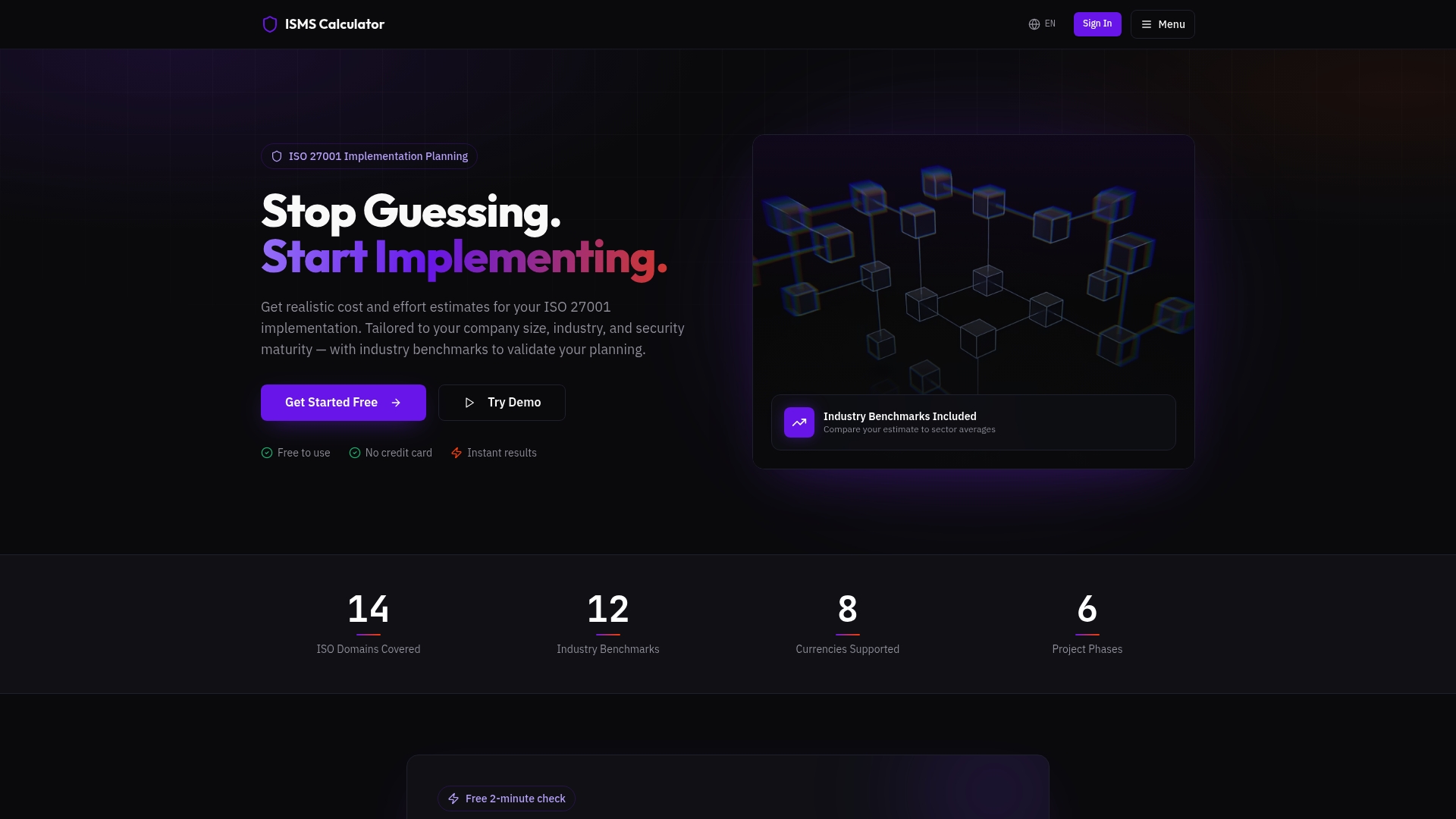
The platform also delivers real-time cost and effort estimates tailored to your organization’s size, industry, and current maturity level. You can use those estimates to build a business case for phased Zero Trust implementation and validate your plan against model reference comparisons. The 2-minute readiness check is the fastest way to identify your biggest gaps before your next audit cycle begins.
FAQ
What is ISO 27001 Zero Trust alignment?
ISO 27001 Zero Trust alignment is the integration of Zero Trust security principles, such as least privilege, continuous verification, and assume-breach design, directly into an ISO 27001 ISMS. The goal is to satisfy Annex A controls while simultaneously reducing real-world attack surface.
Which Annex A controls are most critical for Zero Trust?
Controls A.5.15 through A.5.18 (identity and access management), A.8.20 and A.13.1 (network security), and A.8.15 and A.12.4 (monitoring and logging) are the most direct mappings between Zero Trust architecture and ISO 27001:2022 requirements.
How long does ISO 27001 certification take with Zero Trust integration?
Certification typically takes 6–18 months depending on organizational maturity. Adding Zero Trust does not extend that timeline when implementation is phased to align with ISMS milestones rather than run as a separate project.
What evidence do auditors require for Zero Trust controls?
Stage 2 auditors require operational evidence including access review tickets, penetration test reports, remediation logs, and SIEM monitoring records. Static policy documents alone do not satisfy audit requirements.
Does Zero Trust help with NIS2 and DORA compliance?
Zero Trust aligns well with both NIS2 and DORA because those regimes require continuous monitoring, access control, and incident response capabilities that Zero Trust architectures deliver natively alongside ISO 27001 obligations.