
A security baseline is the documented, minimum set of testable configuration settings and controls that every system of a given type must meet before it is allowed to operate. Think of it as the floor, not the ceiling: every asset in scope must clear it, and anything that doesn’t is a known, tracked risk.
TL;DR:
- Who owns it: Security teams draft it; operations, IT, and leadership sign off through a governance process.
- How it’s enforced: Automated scanners, CI/CD gates, configuration management tools, and MDM policies check every asset against the baseline continuously.
- Success criteria: A usable baseline is measurable (each control is a pass/fail check), enforced (non-compliant assets are flagged or blocked), and versioned (every change is tracked with a date and approval record), with the minimum baseline controls carry the highest enforcement priority and have the shortest exception windows—no exceptions are permitted below the minimum baseline.
Authoritative sources anchor this work in the U.S.: the NIST security control baseline defines minimum controls by impact level, FIPS 200 ties those controls to federal systems, Microsoft publishes recommended configuration groups for Windows environments, and CIS Benchmarks cover OS and platform hardening across the stack.
Key Takeaways
A security baseline is the minimum set of testable, enforced controls for a given asset type, and it is only effective when it is versioned, continuously scanned, and governed through a formal review process.
| Point | Details |
|---|---|
| Definition | A baseline is a documented, minimum set of pass/fail controls tied to a specific asset type, not a policy statement. |
| Authoritative sources | Use NIST SP 800-53/FIPS 200 for federal systems, Microsoft baselines for Windows fleets, and CIS Benchmarks for cross-platform hardening. |
| First steps | Scope your asset inventory (including firmware versions), select controls from an authoritative benchmark, and pilot before enforcing. |
| Maintenance cadence | Review at least annually and after any major incident, OS update, or regulatory change; track compliance and remediation progress. |
| Ismscalculator | The free 2-minute readiness check maps your baseline maturity to ISO 27001 gaps and generates a cost and effort estimate for closing them. |
Table of Contents
- What does a security baseline actually contain?
- Why security baselines matter to your organization
- Which authoritative baseline sources should you use?
- How to create, approve, and roll out a security baseline
- How does a baseline differ from a standard or a policy?
- How do you maintain a baseline over time?
- Research-backed best practices and common pitfalls
- Where to find baseline templates and automation tooling
- The part most teams get wrong about baselines
- How Ismscalculator helps you move from baseline to ISO 27001 readiness
- Sources
What does a security baseline actually contain?
A baseline is not a policy document. It is a collection of specific, testable rules organized by asset type. When you open a baseline for a Linux server, you expect to see concrete items, not aspirational statements.
Common component categories:
- Configuration settings: Specific parameter values for OS, middleware, and application components (e.g., SSH root login disabled, TLS 1.2 minimum enforced).
- Required controls: Authentication requirements, patch levels, and access control settings tied to a control framework.
- Logging and monitoring rules: Which events must be logged, retention periods, and where logs must be forwarded.
- Hardening steps: Services to disable, ports to close, unnecessary software to remove.
- Allowed software and versions: Approved OS builds, approved package versions, and prohibited software lists.
- Exception rules: How deviations are documented, approved, and time-boxed.
Each item is expressed as a pass/fail testable rule so automated scanners and auditors produce unambiguous results. A rule like “EBS volumes encrypted with CMK” either passes or it doesn’t. “SSH root login disabled” returns a binary result. That specificity is what separates a baseline from a policy.
Here is what baseline rules look like mapped to asset types:
| Asset type | Example baseline rule |
|---|---|
| Linux OS host | SSH root login disabled; password authentication off |
| AWS cloud resource | EBS volumes encrypted with customer-managed key |
| Container image | No processes running as root; base image from approved registry |
| Windows endpoint | BitLocker enabled; SMBv1 disabled; Windows Defender ATP enrolled |
Pro Tip: Write every baseline rule as a question your scanner can answer with “yes” or “no.” If you cannot write an automated check for it, the rule is a policy statement, not a baseline item.
Why security baselines matter to your organization
Consistency is the first payoff. Without a baseline, two engineers provisioning the same type of server will produce two different configurations. Over time, that drift compounds into an attack surface no one fully understands.
Key operational and compliance benefits:
- Measurable compliance: Baselines convert vague policy intent into auditable evidence. When an assessor asks for proof of encryption at rest, you point to scan results, not a policy PDF.
- Faster onboarding and recovery: A new server built from a baselined image is secure by default. Incident recovery is faster when you have a known-good state to restore to.
- Reduced configuration drift: Continuous scanning catches deviations before they become vulnerabilities. Baseline scanning captures the known-good state at provisioning; ongoing configuration scanning detects drift from that point forward.
- Audit evidence: Version-controlled baseline artifacts and scan records satisfy auditors for frameworks like SOC 2, ISO 27001, and CMMC.
There is a real operational risk on the other side, though. Overly strict baselines fail in production. Microsoft’s guidance is explicit: enforce defaults only when they mitigate current threats without causing operational problems worse than the risk they address. A baseline that breaks a critical application will be bypassed, and a bypassed baseline is worse than no baseline at all because it creates a false sense of security.
Pro Tip: Run your draft baseline through a pilot group before enforcing it organization-wide. Collect operational exceptions during the pilot, resolve them, and only then promote the baseline to production enforcement. This consensus-driven approach, where security and operations both sign off, is what makes a baseline stick.
Which authoritative baseline sources should you use?
Three sources dominate U.S. practice. Each has a different scope, and choosing the right one for your asset type saves significant rework.
| Source | Scope | Best for |
|---|---|---|
| NIST SP 800-53 / FIPS 200 | Federal information systems; low/moderate/high impact tiers | Federal agencies, contractors, and organizations mapping to federal compliance requirements |
| Microsoft Security Baselines | Windows OS, Microsoft 365, Edge, and Intune-managed devices | Organizations running Windows fleets or managing endpoints through Intune |
| CIS Benchmarks | Cross-platform: Linux, Windows, macOS, cloud platforms, containers, network devices | Any organization needing vendor-neutral, community-vetted hardening guidance |
NIST and FIPS 200: The NIST security control baseline is the initial set of minimum controls assigned after security categorization under FIPS 199. FIPS 200 establishes the minimum security requirements for federal information systems, and NIST SP 800-39 provides the risk management framing used to select and tailor those controls. If your organization operates federal systems or holds federal contracts, this is your starting point.
Microsoft Security Baselines: Microsoft publishes preconfigured groups of Windows settings for Intune-managed devices, updated with each major Windows release. These are practical, deployable packages, not just reference documents. They are built on engineering feedback and reflect real-world threat data.
CIS Benchmarks: The Center for Internet Security publishes benchmarks for hundreds of platforms, from RHEL and Ubuntu to AWS, Azure, Kubernetes, and Docker. They are free for non-commercial use and widely accepted by auditors across frameworks. For cross-platform environments, CIS is often the most practical starting point.
Mapping advice: Use these authoritative benchmarks as your input, then tailor controls to your risk profile and operational constraints. No benchmark ships ready to enforce without review. The ISO 27001 vs NIST CSF comparison is useful context when deciding how your baseline maps to a broader governance framework.
How to create, approve, and roll out a security baseline
This is a sequential process. Skipping steps, especially testing, is where most baseline projects fail.
-
Scope your assets. Build or validate an asset inventory segmented by type: servers, endpoints, cloud resources, containers, network devices. For compliance audits like CMMC, inventory must include firmware versions for every in-scope device, including BIOS, RAID controllers, and NIC firmware.
-
Select your controls. Map your policy requirements to testable technical rules. Use NIST SP 800-53, CIS Benchmarks, or Microsoft baseline packages as your starting catalog. Tag each control to the policy or regulation it satisfies.
-
Build and test. Create a reference image or configuration script. Run it through a scanner (CIS-CAT, a cloud config rule set, or your MDM tool) in a non-production environment. Document every finding.
-
Pilot with a representative group. Deploy the baseline to a small, cross-functional pilot group. Collect operational exceptions. Resolve conflicts between security requirements and operational needs before broader rollout.
-
Formal approval and versioning. Get sign-off from security leadership, IT operations, and the relevant business owner. Tag the baseline with a version number, approval date, and the names of approvers. Store it in version control.
-
Deploy and automate enforcement. Push the baseline through your configuration management tool (Ansible, Puppet, Chef), MDM (Intune), or cloud config rules (AWS Config, Azure Policy). Gate CI/CD pipelines so non-compliant builds cannot reach production.
-
Exceptions process. Any asset that cannot meet the baseline needs a documented exception:
- Owner: Named individual accountable for the exception.
- Justification: Business or technical reason the control cannot be met.
- Compensating control: What mitigates the risk in the absence of the baseline control.
- Expiry date: No open-ended exceptions. Set a review date, typically 90 days.
- Approval: Security manager sign-off required.
How does a baseline differ from a standard or a policy?
These three terms are used interchangeably in many organizations, and that confusion produces documents that are too vague to enforce. They are distinct layers of a governance hierarchy.
| Document type | What it expresses | Example |
|---|---|---|
| Policy | Intent and ownership (“what we will do and who is responsible”) | “All data at rest must be encrypted.” |
| Standard | Required control set at the organizational level (“how we will do it”) | “Encryption at rest must use AES-256 or stronger.” |
| Baseline | Technical, testable rules tied to a specific asset type | “EBS volumes must be encrypted with a customer-managed KMS key; verified by AWS Config rule encrypted-volumes.” |
A security baseline is the machine-checkable layer: it translates policy intent into rules a scanner can evaluate. The policy says encrypt; the standard says AES-256; the baseline says exactly which AWS Config rule must pass on which resource type.
“Minimum security baseline” is a specific governance concept. It sets the floor below which no exception is permitted regardless of business justification. Controls in the minimum baseline carry the highest enforcement priority and the shortest exception windows. Everything above the minimum baseline can be subject to risk-based negotiation; the minimum cannot.
How do you maintain a baseline over time?
A baseline that isn’t updated becomes a liability. Threat actors know which old configurations are exploitable; if your baseline still permits TLS 1.0 because no one updated it after a vendor advisory, you have a documented permission to be insecure.
Recommended review cadence:
- Scheduled review: At least annually for most organizations; quarterly for high-impact or regulated systems.
- Event-driven review: Triggered immediately by a material incident, a major OS or platform update, a new regulatory requirement, or an audit finding that reveals a gap.
Triggers that force a baseline update:
- A new CVE or threat intelligence report affecting a baselined component.
- An OS or firmware version reaching end-of-life.
- A change in a mapped regulation or framework (NIST SP 800-53 revision, CIS Benchmark update).
- A failed audit finding tied to a baseline control.
Metrics to track baseline health:
- Percent of assets compliant with the current baseline version.
- Mean time to remediate baseline drift (from detection to resolution).
- Open exception count by owner and expiry date.
- Number of baseline versions released in the past 12 months (a proxy for governance activity).
Teams managing SOC 2 or ISO assessments typically maintain a 90-day continuous record of baseline scan results as audit evidence. Versioned artifacts and dated scan exports are what auditors actually examine.
Research-backed best practices and common pitfalls
The evidence from authoritative sources points in a consistent direction: baselines fail not because the controls are wrong, but because the process around them is broken.
Best practices backed by authoritative guidance:
- Consensus-driven design. Security baselines work best when security and operations build them together. A baseline that operations didn’t help write will generate workarounds that undermine it.
- Test before enforce. Never push a new baseline directly to production. A staging environment or pilot group catches conflicts that would otherwise become emergency exceptions.
- Incremental rollout. Start with the highest-risk or most homogeneous asset class. Build confidence and process before expanding scope.
- Continuous scanning. One-time compliance checks are not enough. Automated, continuous scanning is what catches drift between audits.
Common pitfalls:
- Too-strict defaults. Enforcing every CIS Level 2 recommendation on day one without testing will break things. Start with Level 1 and add controls incrementally.
- Incomplete inventory. Missing firmware versions is a frequent audit failure point. Assessors compare live device configurations against documented baselines and expect versioned evidence for every in-scope component.
- Treating the baseline as a one-time document. A baseline without a review schedule is outdated within months.
Pro Tip: Stand up a governance forum, even a lightweight monthly meeting, where security, IT operations, and a business representative review open exceptions, approve baseline changes, and track drift metrics. Without a forum, baselines decay silently.
Where to find baseline templates and automation tooling
You don’t need to build a baseline from scratch. Authoritative templates and tooling exist for every major platform.
Templates and reference publications:
- NIST SP 800-53 and FIPS 200 for federal and federally-adjacent systems.
- Microsoft Security Baseline packages, downloadable from the Microsoft Security Compliance Toolkit, for Windows and Microsoft 365 environments.
- CIS Benchmarks at cisecurity.org, covering Linux, Windows, macOS, AWS, Azure, GCP, Kubernetes, Docker, and more.
- OMB Circular A-130 for federal governance context.
Automation tooling by category:
- Configuration management: Ansible, Puppet, and Chef translate baseline rules into enforced system states at scale.
- MDM/endpoint management: Microsoft Intune security baselines deploy preconfigured Windows settings to managed devices with minimal manual effort.
- Cloud configuration: AWS Config rules, Azure Policy, and Google Cloud Security Command Center evaluate cloud resources continuously against defined baselines.
- CIS scanning: CIS-CAT Pro scans systems against CIS Benchmarks and produces scored reports with remediation guidance.
- Container image scanning: Tools like Trivy and Grype check container images against known vulnerabilities and configuration rules before they reach production.
Gate your CI/CD pipeline so a build that fails a baseline scan cannot be promoted to staging or production. That single automation step catches drift at the cheapest possible moment.
The part most teams get wrong about baselines
Most security teams treat a baseline project as a documentation exercise. They download a CIS Benchmark, map it to their policy, and declare the baseline “done.” Six months later, half their fleet has drifted, exceptions are undocumented, and the baseline document is already outdated.
The real work is governance, not documentation. A baseline is only as strong as the process that enforces it, reviews it, and retires exceptions on schedule. The technical controls are the easy part. Getting operations to co-own the baseline, building the exception workflow, and running the monthly governance forum are where most programs stall.
My practical recommendation: start with your highest-risk, most homogeneous asset class, pick one authoritative benchmark as your input, and automate enforcement before you expand scope. A narrow, enforced baseline beats a comprehensive, unenforced one every time. Then build the ISO 27001 Annex A controls mapping on top of that foundation once the baseline process is running.
Version control your baseline artifacts from day one. When an auditor asks for evidence, a Git history with dated commits and named approvers is far more convincing than a PDF with a “last reviewed” field someone typed manually.
How Ismscalculator helps you move from baseline to ISO 27001 readiness
Establishing a security baseline is often the first concrete step toward ISO 27001 certification, and that’s exactly where many teams hit a wall: they know what controls they need, but not how much it will cost or how long it will take to implement them across the four Annex A control themes.
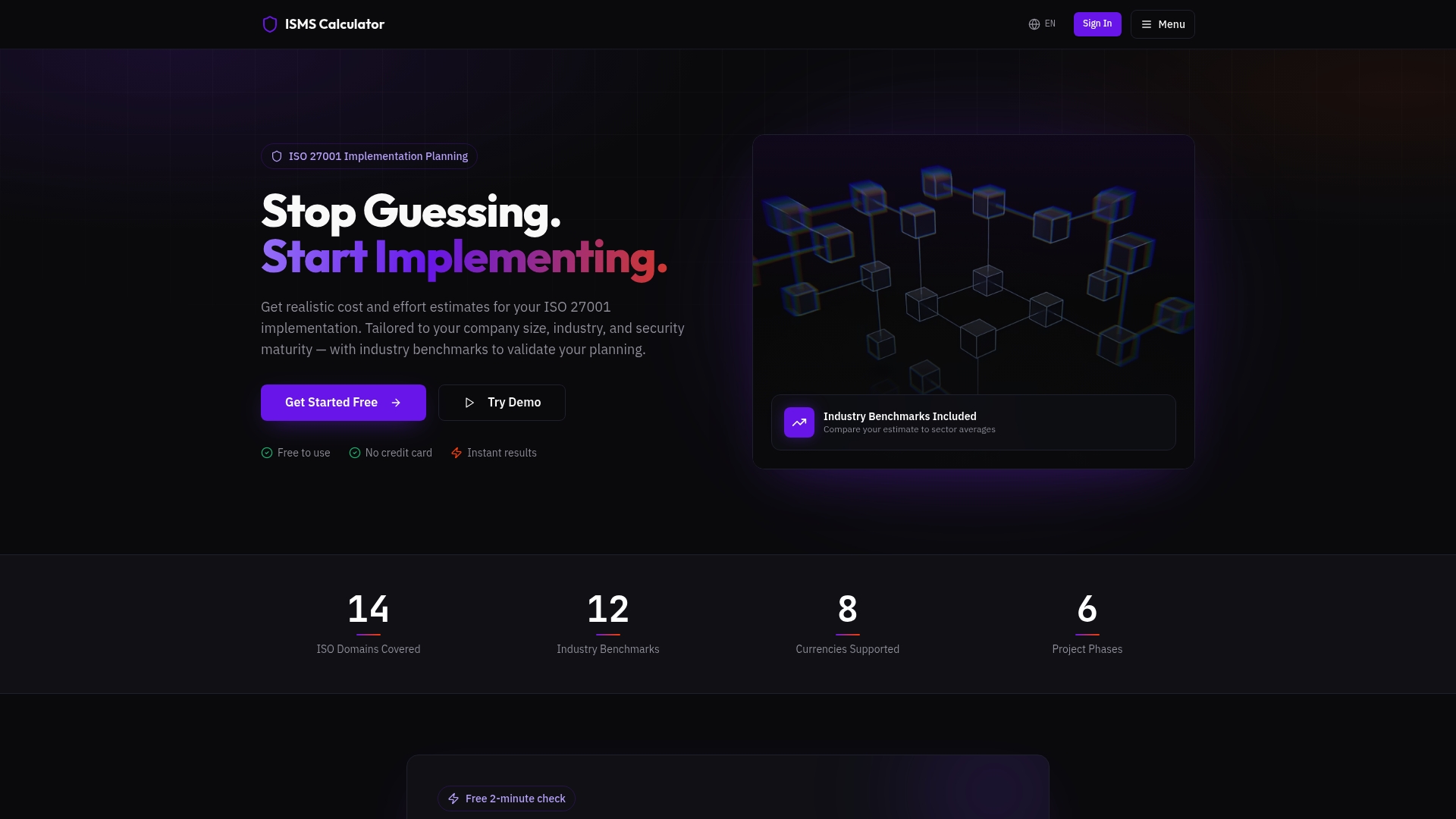
Ismscalculator gives you a real-time estimate of the cost and effort required to implement ISO 27001, tailored to your company size, industry, and current security maturity. The platform’s maturity assessment covers all four ISO/IEC 27001:2022 control themes, so you can see exactly where your existing baseline work already counts toward certification and where the gaps are. Model reference comparisons let you validate your plan against that reference rather than guessing. Customizable Gantt charts turn your baseline rollout into a structured implementation timeline with clear phases and milestones.
Run the free 2-minute readiness check to see how your current baseline maturity maps to ISO 27001 requirements, or use the full ISO 27001 readiness assessment to get a detailed, shareable estimate you can take to leadership for budget approval.
Sources
- security control baseline - Glossary | CSRC
- Windows security configuration framework and security baselines | Microsoft Learn
- Learn about Intune security baselines for Windows devices
- 3.4.1 Establish / Maintain Baseline Configurations
- What Is a Security Baseline? Definition & Examples
- Secure Baseline – What it is and Why it’s Important - Blog