
Cloud risk management in finance ISMS is the structured process of identifying, assessing, and controlling cloud-specific threats within an Information Security Management System, aligned to ISO 27001 and financial regulators’ expectations. For compliance officers at banks, insurers, and fintechs, this is not a theoretical exercise. Cloud outsourcing introduces concentration risk, data residency complications, shared-responsibility gaps, and fourth-party dependencies that standard IT risk frameworks were never designed to handle.
The core components you need to address:
- Cloud-specific risk identification: outsourcing dependency, vendor lock-in, data location, and subcontractor exposure
- Shared responsibility model: clear delineation of what your institution controls versus what the cloud service provider (CSP) controls
- Regulatory alignment: FFIEC guidance, ECB supervisory requirements under DORA, and SIFMA/ABA contractual frameworks
- ISO 27001 integration: mapping cloud risks to Annex A controls and embedding them in your risk treatment plan
- Continuous oversight: independent monitoring, audit rights, and incident response beyond CSP-provided tooling
The relationship between cloud risk and your ISMS is direct. ISO 27001 requires you to define the scope and context of your information security environment. Every cloud service your institution uses that touches regulated data or critical functions belongs inside that scope, with documented controls and evidence.
Table of Contents
- What regulatory requirements govern cloud risk in financial institutions?
- Why the shared responsibility model creates real oversight problems
- How cloud risk fits inside your ISO 27001 ISMS framework
- Best practices for cloud risk assessment and mitigation in finance
- How Ismscalculator supports cloud risk management in your ISO 27001 program
- Key Takeaways
What regulatory requirements govern cloud risk in financial institutions?
Financial regulators on both sides of the Atlantic have moved well past general third-party risk guidance. The ECB’s supervisory guide under DORA and the Capital Requirements Directive requires supervised entities to conduct a formal ex-ante risk assessment before entering any cloud outsourcing arrangement, covering concentration risk, resilience, data residency, and provider lock-in. Treating outsourced cloud services with the same diligence as in-house services is the explicit standard.
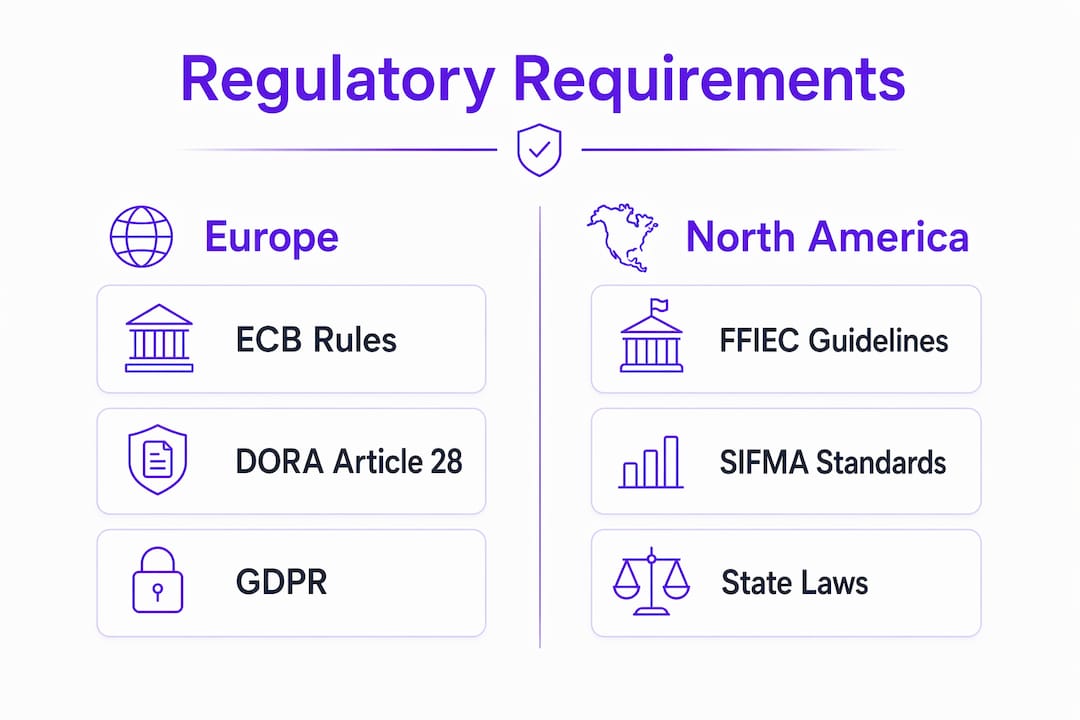
The FFIEC Joint Statement on cloud computing risk management sets parallel expectations for U.S. institutions: due diligence before selection, contractual protections, ongoing monitoring, and regular testing of controls. Misconfiguration of cloud resources is called out explicitly as a prevalent vulnerability that can expose customer data and trigger regulatory findings.
Key obligations across these frameworks:
- Ex-ante risk assessment covering concentration, resilience, and data residency before any new cloud arrangement
- ICT risk framework integration: cloud outsourcing risk treated as an integral component, not a separate workstream
- Business continuity measures specific to cloud solutions, including CSP disaster recovery plan assessment
- Audit and access rights secured contractually, with independent verification beyond CSP-provided reports
- Periodic reassessment of concentration risk as provider practices and service scopes evolve over time
The SIFMA and ABA whitepaper on cloud outsourcing adds a lifecycle lens: procurement planning, due diligence and contract negotiation, ongoing supplier monitoring, and relationship termination with a defined exit strategy. Regulators now expect all four stages to be documented and auditable.
Pro Tip: Map each regulatory obligation (DORA Article 28, FFIEC guidance, your applicable state requirements) to a specific ISMS control owner and review cadence. A single spreadsheet linking regulation to control to evidence owner prevents the most common audit gap: knowing the rule but not knowing who is responsible for proving it.
Why the shared responsibility model creates real oversight problems
FFIEC notes that management’s failure to clearly define and document responsibilities under the shared responsibility model is a direct driver of operational failures and security breaches. This is not a theoretical warning. Financial institutions routinely assume that because a CSP secures underlying infrastructure, workloads and applications running on that infrastructure are automatically protected. They are not.
The responsibility split changes depending on the service model. In IaaS, your institution manages the operating system, applications, and data. In SaaS, the CSP handles most of the stack, but identity, access configuration, and data classification remain yours. Misreading that boundary is where breaches happen.
SIFMA and ABA recommend that CSPs provide a shared responsibility matrix mapped to a common controls framework, updated regularly and within a defined timeframe whenever a service changes. Most CSPs do not do this automatically. You have to negotiate it into the contract.
Supply chain transparency compounds the problem. CSPs rely on subcontractors for portions of their service delivery, and those fourth-party dependencies are rarely visible to the financial institution. The ECB advises periodic reassessment of concentration risk precisely because provider practices change, and what looked like a manageable dependency at contract signing may look very different two years later.
Pro Tip: Request a completed shared responsibility matrix from every CSP before contract execution. If the CSP cannot provide one mapped to a recognized framework such as the Cyber Risk Institute’s Cloud Profile, treat that gap as a contractual risk item requiring compensating controls on your side.
How cloud risk fits inside your ISO 27001 ISMS framework
ISO 27001 requires you to define the context of your organization and the scope of your ISMS. Any cloud environment hosting regulated financial data or supporting a critical function belongs in that scope. The practical work is mapping cloud-specific risks to Annex A controls and building evidence that those controls are operating effectively.

Embedding cloud risks into your ISO 27001 risk treatment process means treating each cloud service as an asset with an owner, a data classification, and a set of applicable controls. A CSPM finding or vulnerability scan result is not risk management evidence on its own. The finding needs to be linked to the asset owner, the business service it supports, and the control obligation it affects before it qualifies as audit-ready evidence.
| Cloud risk domain | ISO 27001 Annex A control area | Key evidence requirement |
|---|---|---|
| Identity and access | — | MFA enforcement, role-based access review logs |
| Data residency and encryption | A.8.24 | Encryption policy, key management records |
| Concentration and vendor lock-in | A.5.19–A.5.22 | Supplier register, exit strategy documentation |
| Incident response | — | Cloud-specific incident playbooks, test records |
| Continuous monitoring | — | Independent monitoring tool outputs, review cadence |
| Business continuity | — | CSP DR plan assessment, RTO/RPO validation |
The ISO 27001 risk assessment methodology for cloud environments requires you to go beyond raw scanner output. Contextualizing security findings to business processes and asset owners is what separates compliance evidence from a pile of unresolved tickets.
Pro Tip: Run your cloud risk register through your ISMS scope definition annually. Cloud environments expand quietly, and a new SaaS tool adopted by one business unit can introduce a data residency or concentration risk that your last risk assessment never captured.
Best practices for cloud risk assessment and mitigation in finance
The lifecycle approach that regulators and industry bodies consistently endorse runs from procurement planning through exit strategy. Each stage has specific risk management obligations.
Procurement and due diligence: Assess concentration risk, data residency, and resilience capabilities before signing. Evaluate the CSP’s track record on service availability and security incidents. Negotiate audit rights, subcontractor notification requirements, and exit assistance into the contract before you need them.
Technical controls: Identity compromise is a leading cause of cloud breaches, making phishing-resistant multifactor authentication and zero-trust access frameworks the highest-priority technical investments for financial cloud environments. Permissive firewall rules, overprivileged IAM permissions, and inconsistent security policies across hybrid environments are among the most common misconfigurations that create regulatory exposure.
In the latter half of 2025, 44.5% of observed initial access vectors exploited in cloud environments were through third-party software-based entry, while weak or absent credentials accounted for 27.2%. Automated defenses, including identity-centric proxies, address both vectors more reliably than manual security triaging.
Vulnerability prioritization: Financial institutions often track vulnerability volume rather than vulnerability impact. The more useful approach ties each finding to the asset owner, the regulated workflow it affects, and the age of the evidence. A three-year-old finding on a production payment system is a different risk than a new finding on a sandbox environment, even if the raw severity score is identical.
Supply chain controls: Contractual protections for subcontractor oversight, notification of material changes, and the right to terminate if a subcontractor becomes prohibited by a regulator are not optional. The SIFMA/ABA framework covers audit rights, subcontracting, data and security, SLAs, notification, business continuity, and exit as the minimum contractual scope for any cloud outsourcing arrangement.
Continuous automated monitoring outperforms static annual audits, particularly for fourth-party subcontractor risks that change without notice. Staff expertise is also a genuine risk factor: skills developed for one CSP’s architecture do not transfer directly to another, which means your team’s ability to monitor and respond depends on which providers you are actually running.
Pro Tip: When reviewing financial data security controls, treat your cloud exit strategy as a live document, not a contract appendix. Test it. A lock-in risk you cannot exit is a concentration risk you cannot mitigate.
How Ismscalculator supports cloud risk management in your ISO 27001 program
Ismscalculator is built specifically for the compliance planning challenge that most financial institutions hit early: not knowing how much effort ISO 27001 implementation actually requires, or where cloud risk fits within the broader ISMS scope.
The platform’s real-time cost and effort estimator takes your organization’s size, industry, and current security maturity as inputs and returns tailored implementation estimates with model reference comparisons. For a compliance officer trying to build a business case for cloud risk controls, that benchmark data is the difference between a credible proposal and a number pulled from thin air.
Key capabilities relevant to cloud risk management:
- Maturity assessment across all four ISO/IEC 27001:2022 control themes, including supplier relationships (A.5.19–A.5.22) and cryptography (A.8.24), which directly cover cloud outsourcing and encryption controls
- Customizable Gantt charts for mapping implementation phases, including cloud-specific control rollouts and audit preparation timelines
- Free 2-minute readiness check to identify gaps before committing to a full implementation plan
- Saved and comparable estimates so you can model different cloud risk treatment scenarios against budget constraints
Martin’s 2026 compliance guides on the Ismscalculator platform address cloud-specific ISMS challenges directly, including how to scope cloud environments, build evidence trails that satisfy DORA and FFIEC expectations, and structure your ISO 27001 fintech compliance roadmap around real regulatory timelines rather than generic best-practice checklists.
If you are mapping cloud risk into your ISMS for the first time, or pressure-testing an existing program against 2026 regulatory expectations, the ISO 27001 readiness assessment on Ismscalculator gives you a structured starting point with output you can take directly into a risk treatment plan.
Key Takeaways
Cloud risk management in finance ISMS requires embedding cloud-specific threats into ISO 27001 scope, controls, and evidence trails, backed by contractual protections and continuous independent monitoring.
| Point | Details |
|---|---|
| Ex-ante risk assessment is mandatory | Conduct formal cloud risk assessment before any new outsourcing arrangement, covering concentration, resilience, and data residency. |
| Shared responsibility must be documented | Negotiate a CSP-provided control matrix mapped to a common framework before contract execution. |
| ISO 27001 scope must include cloud | Every cloud service touching regulated data or critical functions belongs in your ISMS scope with an asset owner and evidence trail. |
| Identity controls are the top technical priority | Phishing-resistant MFA and zero-trust access frameworks address the leading cause of cloud breaches in financial environments. |
| Continuous monitoring beats annual audits | Automated, ongoing monitoring is more effective than static reviews, especially for fourth-party subcontractor risks. |