
ISO 27001 supply chain risk management is defined as the systematic application of information security controls to identify, assess, and reduce risks that third-party suppliers introduce to an organization’s data, operations, and financial stability. For compliance professionals and finance managers, this is not an abstract security exercise. A single supplier breach can trigger regulatory penalties, insurance claims, and reputational damage that far exceed the cost of prevention. This article explains the ISO 27001 risk framework for supply chains, its direct financial implications, how it compares with standards like ISO 22301 and DORA, and what practical steps your team should take in 2026.
How does ISO 27001 approach supply chain risk management?
ISO 27001 addresses supply chain risk through a structured risk assessment process anchored in Annex A controls 5.19 through 5.23. These controls form the backbone of ISO 27001 supply chain management and require organizations to do more than screen vendors at onboarding.
The five controls cover:
- A.5.19 Information security in supplier relationships: Establishes the policy and contractual baseline for all supplier engagements.
- A.5.20 Addressing information security within supplier agreements: Requires specific security obligations written into contracts, including sub-outsourcing clauses and audit rights.
- A.5.21 Managing information security in the ICT supply chain: Focuses on technology providers and the risks embedded in software, hardware, and cloud services.
- A.5.22 Monitoring, review, and change management of supplier services: Mandates ongoing oversight, not just point-in-time assessments.
- A.5.23 Information security for use of cloud services: Specifically addresses cloud provider risk, which is a growing concentration risk in financial services.
The ISMS supplier register sits at the center of this framework. It is the primary document that links each supplier to a criticality rating, associated risks, control owners, and treatment plans. A static list of vendor names has no audit value. The register must connect directly to your risk treatment scenarios and control justifications to function as real evidence. Linking the supplier register to ICT risk management processes and control owners transforms it from a spreadsheet into a dynamic risk management tool.
Consider a practical scenario: a fintech firm uses a cloud-based payment processor classified as critical. The supplier register should document the criticality rating, the specific risks (data breach, service outage, regulatory non-compliance), the controls applied (contractual audit rights, encryption requirements, incident notification SLAs), and the control owner inside your organization. That level of detail is what regulators and auditors expect to see.
Third-party breaches account for 61% of data breaches, yet only 20% of vendors have proper security checks in place. That gap is exactly what Annex A 5.19–5.23 is designed to close.
What are the financial impacts of ISO 27001 supply chain risk management?
The financial case for ISO 27001 vendor risk management in finance is concrete and measurable. The most direct benefit is insurance cost reduction. Achieving maturity in supplier security management takes 12–18 months but delivers a 15–40% reduction in cyber insurance premiums. That range is significant for any finance manager building a business case.

The logic is straightforward. Insurers price cyber risk based on evidence of control maturity. An organization that can show a documented supplier register, active monitoring, and certified controls under ISO 27001 presents a lower risk profile than one relying on annual vendor questionnaires. The premium reduction alone can offset a substantial portion of implementation costs over a three-year period.
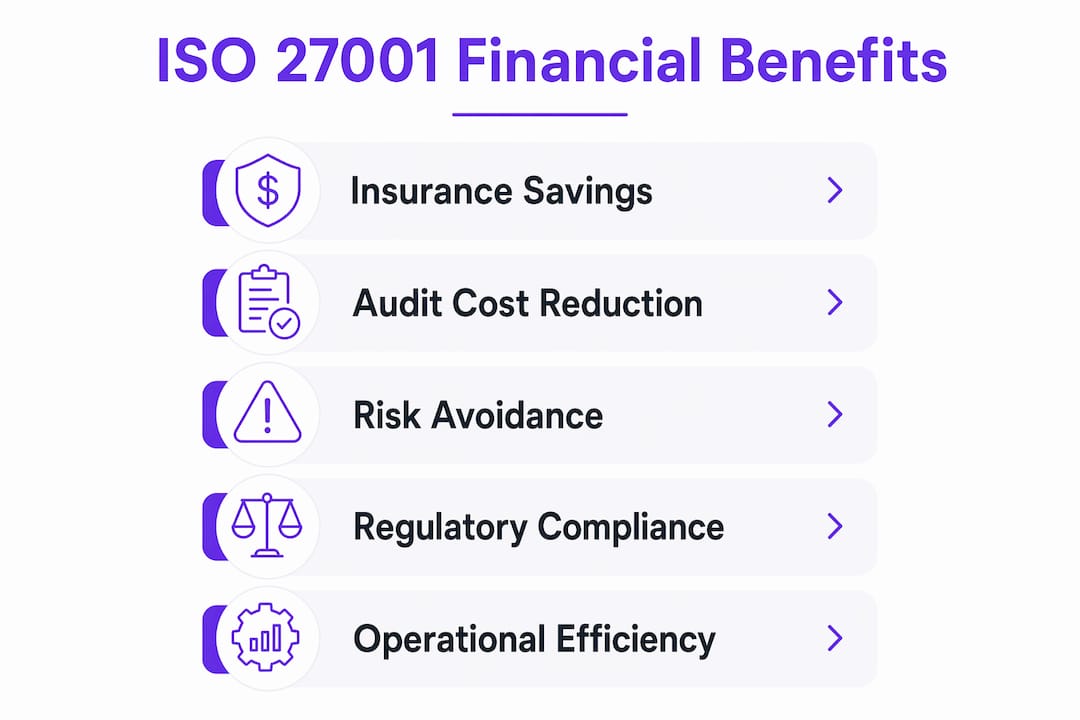
Beyond insurance, ISO 27001 compliance benefits include reduced audit preparation costs. Regulators and enterprise clients increasingly demand independently verified certification evidence rather than self-reported questionnaires. Organizations with active ISO 27001 certification spend less time and fewer resources responding to customer due diligence requests, security audits, and regulatory examinations.
There is also the cost-avoidance argument. A supplier-related data breach carries direct costs including forensic investigation, breach notification, regulatory fines, and legal fees. It also carries indirect costs including client attrition and reputational damage. ISO 27001 supply chain controls reduce the probability and severity of those events.
Pro Tip: When presenting the ISO 27001 investment to your CFO or board, frame the financial business case around three numbers: the estimated annual cost of a supplier-related breach in your sector, the projected insurance premium reduction over three years, and the reduction in audit preparation hours. That structure converts a compliance cost into a risk-adjusted return.
How does ISO 27001 compare with other standards and regulatory expectations?
ISO 27001 is the information security standard. It does not cover every dimension of supply chain risk that regulators in financial services require. Understanding where it ends and where other frameworks begin is critical for finance and compliance teams.
| Framework | Primary Focus | Supply Chain Scope | Financial Services Relevance |
|---|---|---|---|
| ISO 27001 | Information security controls | Supplier security requirements, Annex A 5.19–5.23 | Certification baseline, audit evidence |
| ISO 22301 | Business continuity and resilience | Supplier failure scenarios, recovery planning | Operational resilience, service continuity |
| DORA (EU) | ICT risk for financial entities | Register of information, concentration risk, exit strategies | Mandatory for EU-regulated financial firms |
| FINMA Circular 18/3 | Outsourcing governance (Switzerland) | Sub-outsourcing chains, audit rights, exit strategies | Mandatory for Swiss-regulated institutions |
ISO 22301 complements ISO 27001 by covering all disruptive threats, including supplier failures and natural disasters, not just information security incidents. A financial institution that holds ISO 27001 certification but has no business continuity plan for a critical cloud provider outage has a significant gap. ISO 27001 business continuity finance explained means understanding that security certification and operational resilience are two separate but connected requirements.
DORA, which became enforceable for EU financial entities in january 2025, requires a formal Register of Information covering all ICT third-party providers. That register must document concentration risk, contractual audit rights, and credible exit strategies. Regulatory frameworks like FINMA Circular 18/3 apply similar requirements in Switzerland, and concentration risk along with cloud provider exit strategies are the most common audit failure points.
The practical implication for fintechs and financial institutions is that ISO 27001 certification is necessary but not sufficient. You need the security controls of ISO 27001, the resilience planning of ISO 22301, and the governance documentation required by DORA or your national regulator. These frameworks are complementary, not competing.
What practical steps should compliance and finance teams take?
Implementing ISO 27001 supply chain risk management effectively requires a structured approach. Here is a practical sequence for compliance and finance professionals:
- Build a risk-based supplier register. Classify every supplier by criticality and data access level. Link each entry to specific risks, applicable controls from Annex A 5.19–5.23, a named control owner, and a risk treatment decision. A register without those linkages has limited audit value.
- Embed security requirements in contracts. Every supplier agreement for critical or high-risk vendors should include clauses covering sub-outsourcing approval, audit rights, incident notification timelines, and exit strategy obligations. Generic NDAs do not satisfy ISO 27001 or regulatory requirements.
- Implement continuous monitoring. Annual vendor questionnaires are no longer adequate. Regulators now demand formal risk management processes with ongoing surveillance and evidence of control implementation. Schedule periodic reviews tied to supplier criticality, with high-risk vendors reviewed at least quarterly.
- Document exit strategies for critical suppliers. This is the most commonly overlooked requirement. For every critical cloud provider or outsourced service, your ISMS should document a credible, tested exit plan. Regulators treat the absence of exit documentation as a concentration risk finding.
- Integrate with business continuity planning. Your supplier risk register should feed directly into your ISO 22301 business impact analysis. If a critical supplier fails, your continuity plan should already identify the recovery time objective and the alternative arrangement.
The ISMS supplier register is the key audit document for regulators like FINMA, assessing concentration risk, exit strategies, and sub-outsourcing governance. Treat it as a living document, not a compliance artifact filed after certification.
Pro Tip: Use a dedicated ISO 27001 readiness tool to benchmark your supplier risk maturity against model reference values before your next audit. Ismscalculator provides maturity assessments across all four ISO/IEC 27001:2022 control themes, including supplier relationships, so you can identify gaps before an auditor does.
Key takeaways
ISO 27001 supply chain risk management delivers measurable financial protection when implemented with a dynamic, risk-linked supplier register and integrated with business continuity and regulatory frameworks.
| Point | Details |
|---|---|
| Annex A 5.19–5.23 is the control set | These five controls define supplier security requirements, monitoring, and cloud-specific risk obligations. |
| Insurance savings are quantifiable | Mature supplier security management reduces cyber insurance premiums by 15–40% within 12–18 months. |
| Certification alone is not enough | ISO 27001 must be paired with ISO 22301 and DORA or FINMA requirements to satisfy financial regulators. |
| Supplier register quality determines audit outcomes | Registers must link to risk treatments, control owners, and exit strategies to serve as valid audit evidence. |
| Continuous monitoring replaces annual questionnaires | Regulators expect ongoing surveillance and independently verified certification, not self-reported vendor data. |
Where ISO 27001 supply chain risk management gets misunderstood
Most organizations I have worked with treat ISO 27001 certification as the finish line. It is not. Certification proves you have a functioning information security management system. It does not prove your critical cloud provider has a credible exit strategy, or that your sub-outsourcing chains are documented and governed.
The failure pattern I see most often in financial services is a well-maintained ISMS that completely ignores concentration risk. A firm certifies against ISO 27001, passes the audit, and then faces a FINMA or DORA examination that asks for the exit strategy on their primary cloud provider. The answer is usually a blank stare. That gap is not a security gap. It is a governance gap, and it sits squarely in the supplier register.
The second failure pattern is treating the supplier register as a static document. I have reviewed registers that were last updated at certification and never touched again. When a supplier changes ownership, migrates to a new data center, or adds a sub-processor, your register needs to reflect that. The DORA Register of Information requirement makes this explicit for EU financial entities, but the principle applies universally.
My honest recommendation for finance managers is to stop asking “are we certified?” and start asking “can we demonstrate our supplier risk posture to a regulator today?” Those are very different questions. The ISO 27001 audit prep guide from Ismscalculator covers exactly this distinction for finance companies, and it is worth reading before your next external audit.
The regulatory direction in 2026 is clear. DORA is live. FINMA is active. The UK FCA is tightening operational resilience requirements. Finance and compliance professionals who treat ISO 27001 as a living risk management program rather than a certification exercise will be far better positioned when the examiner arrives.
— Martin
How Ismscalculator supports your supply chain risk program
Supply chain risk management under ISO 27001 requires accurate scoping, gap identification, and cost planning before you commit resources. Ismscalculator gives compliance and finance teams the tools to do that work upfront.
Start with the free 2-minute readiness check to get an immediate view of your current ISO 27001 maturity across supplier relationship controls and all four ISO/IEC 27001:2022 control themes. For a deeper analysis, the full ISO 27001 readiness assessment benchmarks your program against model reference values and identifies the specific gaps that carry the highest audit risk. If you need specialist support for supplier contract requirements or DORA register preparation, Ismscalculator connects you with independent ISO 27001 consultants who specialize in financial services implementation.
FAQ
What is ISO 27001 supply chain risk management?
ISO 27001 supply chain risk management is the application of information security controls, specifically Annex A 5.19–5.23, to identify and reduce risks that third-party suppliers pose to an organization’s data and operations. It requires documented supplier registers, contractual security obligations, and ongoing monitoring.
How does ISO 27001 affect cyber insurance premiums?
Organizations that achieve maturity in supplier security management under ISO 27001 can reduce cyber insurance premiums by 15–40%. Insurers treat documented controls and independent certification as evidence of lower risk, which directly reduces premium pricing.
What is the difference between ISO 27001 and DORA for supply chain risk?
ISO 27001 covers information security controls for supplier relationships. DORA mandates a formal Register of Information covering all ICT third-party providers, concentration risk documentation, and credible exit strategies for EU-regulated financial entities. The two frameworks are complementary and both are required for EU financial firms.
Why is the ISMS supplier register so important for audits?
The supplier register is the primary audit document regulators use to assess concentration risk, sub-outsourcing governance, and exit strategy robustness. A register that links each supplier to risk treatments, control owners, and criticality ratings provides strong audit evidence. A static list of vendor names does not.
How long does it take to implement ISO 27001 supplier controls?
Achieving maturity in supplier security management typically takes 12–18 months. That timeline covers building the risk-based register, embedding contractual requirements, establishing monitoring processes, and completing the certification audit cycle.