
Asset inventory in an ISMS is defined as a documented, maintained register of every information asset an organization owns or operates, with named owners assigned to each entry. Without this register, an Information Security Management System has no reliable scope, no accountability chain, and no foundation for risk assessment. ISO/IEC 27001:2022, NIST CSF v2.0, and the CIS Critical Security Controls all treat asset inventory as a prerequisite, not an optional enhancement. The role of asset inventory in ISMS is straightforward: you cannot protect what you cannot see, and you cannot audit what you cannot name.
What is the role of asset inventory in ISMS compliance?
ISO/IEC 27001:2022 Annex A Control 5.9 requires a documented, maintained inventory of information and associated assets, with each asset assigned a named owner. The 2022 revision consolidated ownership and inventory into a single control, making accountability and current registers a formal audit requirement. This means your inventory is not a spreadsheet you update once a year. It is a living document that auditors will examine for completeness, accuracy, and ownership clarity.
Asset ownership under Control 5.9 goes beyond possession. Owners manage classification, security handling, and lifecycle decisions for each asset. That accountability structure is what allows an ISMS to function during audits, incidents, and control reviews. Without named owners, controls become unenforceable and audit trails collapse.

Compliance frameworks beyond ISO 27001 reinforce this requirement. The UAE Personal Data Protection Law (PDPL), DIFC, and ADGM data protection regulations all require organizations to demonstrate control over personal data assets. A complete, accurate inventory is the evidence base that satisfies those requirements. Regulators do not accept verbal assurances. They examine records.
Key requirements for a compliant asset inventory:
- Named owner for every asset, with documented responsibilities
- Asset classification reflecting sensitivity and criticality
- Coverage of all asset types: hardware, software, data, and supporting systems
- Regular review cycles with documented update dates
- Integration with risk assessment and access control processes
Pro Tip: During an ISO 27001 audit, auditors frequently sample 10–15 assets from your inventory and ask the named owner to confirm their responsibilities. Prepare owners in advance, not just the register itself.
What types of assets should be included in an ISMS asset inventory?
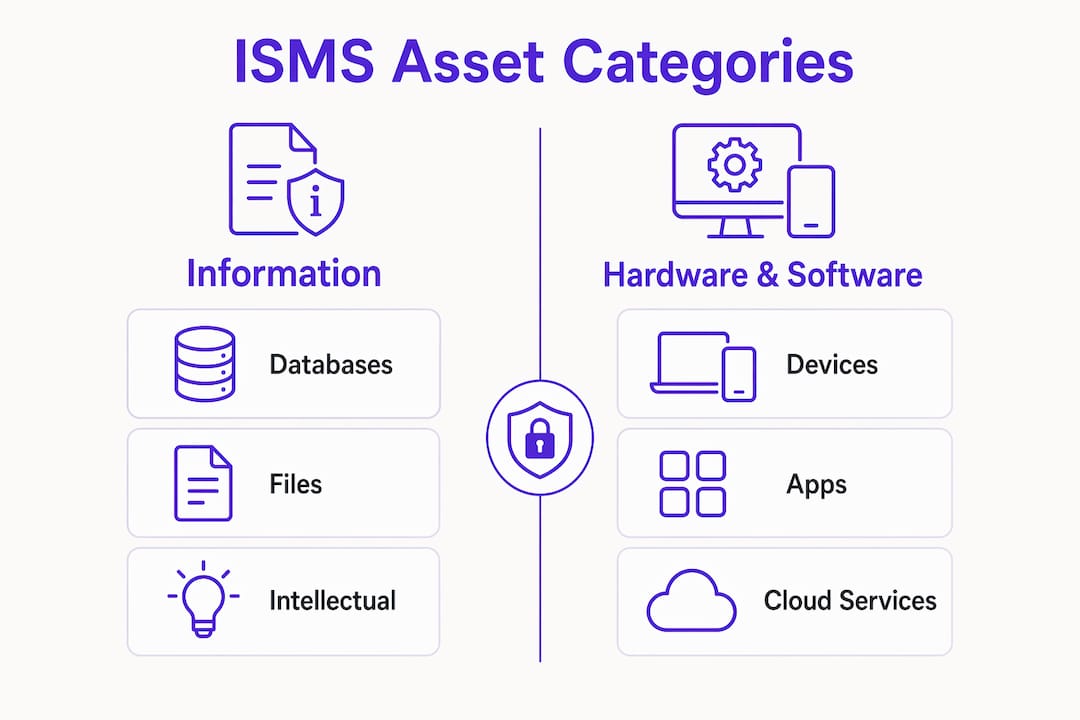
Asset management must cover hardware, software, services, and data, including data flows, because data is the ultimate target for most attacks. Narrow inventories that only track laptops and servers miss the assets attackers actually want. The table below maps the four primary categories compliance teams must address.
| Asset category | Examples | Common pitfall |
|---|---|---|
| Information assets | Databases, files, intellectual property, personal data | Omitting unstructured data stored in email or file shares |
| Physical assets | Laptops, servers, network hardware, IoT devices | Missing IoT devices and decommissioned hardware still on the network |
| Software assets | Licensed software, SaaS subscriptions, cloud services | Shadow SaaS applications not procured through IT |
| Supporting assets | Documentation, processes, physical locations, utilities | Treating these as out of scope when they underpin critical systems |
Shadow SaaS applications and ephemeral cloud instances are the two most common gaps in enterprise inventories today. A developer spins up a cloud instance for testing and never registers it. A department subscribes to a SaaS tool using a corporate card and never tells IT. Both scenarios create unmanaged assets with access to sensitive data.
Cloud and dynamic assets require a different approach than traditional hardware. Static spreadsheets cannot track resources that appear and disappear within hours. API integrations with cloud providers like AWS, Microsoft Azure, and Google Cloud are the only reliable method for capturing ephemeral resources in real time.
Pro Tip: Run a shadow IT discovery scan before your next ISO 27001 audit. Tools like Lansweeper or Axonius can surface unregistered devices and SaaS applications that your manual inventory missed entirely.
How is asset inventory maintained and updated effectively?
Automated discovery and API integrations are the only reliable way to maintain an accurate ISMS asset inventory in a dynamic environment. Manual inventories degrade within weeks as devices are added, software is installed, and cloud resources are provisioned. One-time efforts are not a maintenance strategy.
The CIS Critical Security Controls set a clear minimum standard for review frequency. CIS guidance recommends reviewing and updating inventory at least twice a year, with each entry including owner, authorization status, and network information. For organizations in fast-moving cloud environments, quarterly reviews are more appropriate.
A practical maintenance program follows four steps:
- Automated discovery: Deploy network scanning and cloud API integrations to detect new and changed assets continuously. Tools like Qualys, Tenable, or ServiceNow ITAM can feed discoveries directly into your asset register.
- Ownership reconciliation: When a new asset appears, assign an owner within a defined SLA, typically 48–72 hours. Unowned assets are a compliance gap and a security risk simultaneously.
- Classification review: Reassess asset classification whenever the asset’s function, data handling, or access scope changes. A server that begins processing personal data needs a higher classification than it had as a test system.
- Integration with risk assessments: Feed inventory changes into your risk assessment process. A new cloud service or a newly discovered IoT device may introduce risks that existing controls do not address.
Asset sprawl is the most common reason inventories fail. Organizations accumulate assets faster than they retire them, and without a formal decommissioning process, ghost assets persist in the register long after the physical device is gone. Ghost assets inflate your apparent attack surface and distort risk calculations.
Pro Tip: Tie asset decommissioning to your change management process. Every change ticket that retires a system should trigger an automatic inventory update. This single integration prevents the majority of ghost asset problems.
How does asset inventory support risk management and cybersecurity controls?
Asset inventory feeds directly into risk assessment by defining the attack surface an organization must defend. NIST CSF v2.0 identifies asset management as foundational, requiring inventories of hardware, software, services, and data to support risk assessment processes. The NIST ID.AM-07 subcategory specifically mandates inventories of data and metadata for designated data types. Without that inventory, risk assessments are guesses dressed up as analysis.
Prioritizing assets by classification and criticality enables focused risk treatment aligned with business objectives. Not every asset carries equal risk. A public-facing web server running customer transactions demands different controls than an internal printer. Asset classification, which flows directly from the inventory, is what makes that prioritization possible.
The security benefits of a complete inventory extend across multiple control domains:
- Access control: You cannot enforce least-privilege access on systems you do not know exist. Inventory completeness is a prerequisite for access control effectiveness.
- Incident response: During a breach, response teams need to know which systems are affected, what data they hold, and who owns them. An accurate inventory cuts response time significantly.
- Vulnerability management: Patch management programs only work on known assets. Unregistered systems never receive patches and become persistent entry points for attackers.
- Policy enforcement: Security policies apply to named assets with named owners. Policies without an inventory to anchor them are unenforceable.
Unauthorized assets on a network significantly increase risk exposure. CIS Control 1.2 establishes processes to detect, quarantine, or remove unauthorized hardware and accounts as a core security practice. An inventory that only tracks authorized assets is the baseline that makes unauthorized asset detection possible. Without it, you have no reference point for what should and should not be on your network.
The connection between asset inventory and ISMS maturity is direct. A mature, automated inventory gives you a stronger evidence base across all four ISO/IEC 27001:2022 control themes. The inventory is not one control among many. It is the data layer that makes every other control measurable.
Key Takeaways
A complete, maintained asset inventory is the single most foundational element of an effective ISMS, because every security control, risk assessment, and audit depends on knowing exactly what assets exist and who owns them.
| Point | Details |
|---|---|
| ISO 27001 Control 5.9 is mandatory | Every asset needs a named owner; auditors will verify ownership and classification accuracy. |
| Four asset categories must be covered | Hardware, software, data, and supporting assets all belong in the register, including shadow SaaS and cloud instances. |
| Automation prevents inventory decay | Manual inventories degrade within weeks; automated discovery and API integrations are required for accuracy. |
| Inventory drives risk prioritization | Asset classification and criticality ratings determine which risks receive treatment first. |
| Unauthorized assets are a measurable risk | Detecting and removing unregistered assets is only possible when an authorized baseline exists. |
Why asset inventory is the part most ISMS programs get wrong
Most compliance programs treat asset inventory as a checkbox. Teams build a spreadsheet before the audit, submit it, and move on. Six months later, that spreadsheet is wrong in ways nobody has counted.
What I have seen repeatedly is that organizations invest heavily in controls like encryption, access management, and logging, while the inventory feeding all of those controls quietly rots. The encryption policy applies to “all sensitive data assets.” But if the inventory does not include the cloud storage bucket a developer provisioned last quarter, that policy covers nothing. The control is real. The gap is invisible.
The shift to cloud infrastructure made this problem worse before it made it better. On-premises environments changed slowly. A server added in january was still there in december. Cloud environments change daily. An inventory that was accurate on monday may be missing three new resources by friday. That pace demands automation, not discipline.
The organizations that get this right share one trait: they treat the asset inventory as a product, not a project. They assign an owner to the inventory itself, set SLAs for updates, and integrate discovery tools into their CI/CD pipelines. The inventory is never “done.” It is always running.
For compliance teams preparing for ISO 27001 certification, the ISMS maturity assessment is the most honest way to see where your inventory program actually stands across all four ISO/IEC 27001:2022 control themes. The gap between where teams think they are and where the assessment places them is almost always largest in asset management.
— Martin
Ismscalculator tools for asset inventory and ISO 27001 readiness
Knowing your asset inventory gaps is the first step toward closing them. Ismscalculator gives compliance teams a structured way to assess exactly where their ISMS stands before an auditor does it for them.
The ISO 27001 readiness assessment maps your current asset management practices against Control 5.9 requirements, identifies ownership gaps, and benchmarks your program against model reference values. For teams that need a faster starting point, the 2-minute readiness check surfaces the highest-priority gaps in your inventory and overall ISMS posture. Ismscalculator also includes a cost and effort estimator that accounts for asset inventory complexity based on your organization’s size, industry, and current maturity level.
FAQ
What is asset inventory in an ISMS?
Asset inventory in an ISMS is a documented, maintained register of all information assets, including hardware, software, data, and supporting systems, with a named owner assigned to each entry. ISO/IEC 27001:2022 Annex A Control 5.9 makes this register a formal requirement for certification.
Why does asset inventory matter for ISO 27001 certification?
ISO 27001 auditors verify that every asset in scope has a named owner and an accurate classification. An incomplete or outdated inventory is one of the most common reasons organizations fail or receive major nonconformities during certification audits.
How often should an ISMS asset inventory be updated?
CIS Critical Security Controls recommend reviewing and updating the inventory at least twice a year. Organizations operating in cloud or high-change environments should conduct quarterly reviews and use automated discovery tools to capture changes in real time.
What assets are most commonly missed in ISMS inventories?
Shadow SaaS applications and ephemeral cloud instances are the two most frequently overlooked asset types. Both create unmanaged access to sensitive data and will not appear in a manual inventory without dedicated discovery tooling.
How does asset inventory connect to data classification in ISMS?
Asset inventory provides the list of assets that need classification. Data classification in ISMS assigns sensitivity and handling requirements to each asset, which then drives risk treatment priorities and control selection across the entire program.