
ISMS readiness is defined as the measurable maturity and completeness of your information security controls, documented evidence, and operational practices relative to ISO 27001:2022 certification requirements. Compliance managers and IT professionals who measure ISMS readiness before audit day avoid the most common failure mode: presenting controls that look complete on paper but cannot survive auditor scrutiny. ISO 27001:2022 covers 93 Annex A controls across four control themes, and certification bodies expect consistent evidence of those controls operating over at least three months before your Stage 2 audit. The industry term for this process is an ISMS readiness assessment, and it combines gap analysis, maturity scoring, and evidence validation into a single structured workflow.
What prerequisites and tools do you need to measure ISMS readiness before an audit?
Effective ISMS audit preparation starts with defining your audit scope precisely. Without a clear scope boundary, gap analysis produces noise rather than signal. Your scope document must name the organizational units, locations, assets, and processes covered by the ISMS.
Four documents are non-negotiable before any readiness measurement begins:
- Scope statement: Defines what is inside and outside the ISMS boundary.
- Information security policy: Demonstrates top management commitment and sets the governance framework.
- Risk register: Maps identified threats to assets and links each risk to a treatment decision.
- Statement of Applicability (SoA): Declares which of the 93 Annex A controls apply, which are excluded, and why.
Maturity scoring gives your gap analysis a numeric spine. A 0–5 maturity scale, where 0 means no control exists and 5 means the control is fully embedded and continuously improved, moves beyond tick-box compliance to informed audit preparation. Each control gets a score, and scores below 3 flag remediation priorities before the audit window opens.
Pro Tip: Map each control in your SoA to a named owner and a maturity score on the same spreadsheet. Auditors frequently ask who owns a control. If your team hesitates, that hesitation registers as a finding.

Evidence collection must start no later than three months before your target audit date. Auditors require records showing controls operating consistently throughout the audit cycle, not backdated logs created in the final weeks. Build a shared evidence repository organized by control reference so your team can locate records in seconds during the audit.
How do you conduct a step-by-step ISMS readiness assessment?
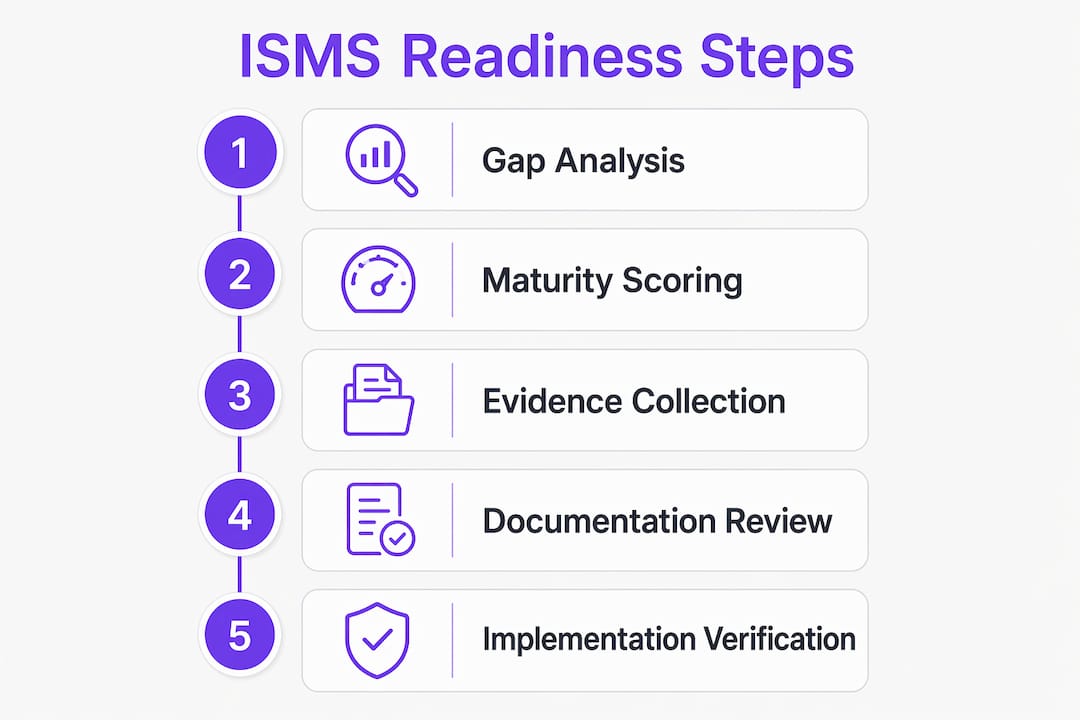
A structured readiness assessment follows six sequential steps. Skipping any step creates blind spots that auditors will find.
-
Run a full gap analysis across all 93 Annex A controls and the main ISO 27001 clauses (4 through 10). Score each control on the 0–5 maturity scale. Controls scoring 0 or 1 require immediate remediation plans with owners and deadlines assigned.
-
Classify evidence availability for every control. Separate controls into three buckets: evidence exists and is current, evidence exists but is stale, and evidence is missing. Stale or missing evidence is your remediation backlog.
-
Link each control to its risk treatment entry. Auditors verify that your controls address actual risks in your register, not generic threats. A control without a risk linkage reads as decorative compliance.
-
Schedule and complete your internal audit at least eight weeks before the Stage 2 external audit. This timeline prevents last-minute rushes and gives your team time to close findings before the certification body arrives. Internal audits are the most accurate predictor of Stage 2 outcomes.
-
Close all corrective actions by six weeks before Stage 2, then refresh your evidence pack at three weeks out. A backward-timed schedule, internal audit at T-8 weeks, corrective actions at T-6 weeks, evidence refresh at T-3 weeks, keeps the team focused and prevents the chaos that derails unprepared organizations.
-
Run a dry-run interview session at two weeks before Stage 2. Ask your control owners the same questions an auditor would ask. Gaps in their answers reveal training needs, not just documentation gaps.
Pro Tip: Assign a single “evidence custodian” per ISO domain. That person owns the completeness of records for their domain and reports status weekly in the eight weeks before Stage 2.
The ISO 27001 audit process itself includes a Stage 1 documentation review followed by a Stage 2 implementation verification. For organizations with 50–200 employees, Stage 2 audits typically last 3–8 days. That duration means auditors have time to probe deeply. Superficial preparation does not survive it.
| Assessment Step | Timing Before Stage 2 | Key Output |
|---|---|---|
| Gap analysis and maturity scoring | 12+ weeks | Prioritized remediation list |
| Internal audit | 8 weeks | Non-conformity report |
| Corrective actions closed | 6 weeks | Verified closure evidence |
| Evidence pack refreshed | 3 weeks | Current, dated records |
| Dry-run interviews | 2 weeks | Staff readiness confirmed |
For guidance on what types of records auditors actually examine, the ISO 27001 evidence guide from Ismscalculator covers operational records, configuration logs, and meeting minutes in practical detail.
What common pitfalls should you avoid when measuring ISMS readiness?
The most damaging mistake is confusing volume with quality. Certification bodies prioritize coherence between your documented policies, your operational controls, and what your staff actually do. A 400-page evidence pack full of contradictions fails faster than a concise, consistent 80-page pack.
Watch for these specific traps:
- Evidence clustering: Large volumes of records dated in the final two weeks before audit signal that controls are not embedded. Certification bodies monitor evidence timestamp patterns and treat clustering as a red flag that triggers extended scrutiny.
- Open major non-conformities from internal audits: Unresolved internal audit findings indicate systemic failure. Certification bodies treat them as severe issues that directly threaten certification.
- Delayed corrective actions: Closing findings on paper without verifying the fix in practice is the second most common cause of Stage 2 failures.
- Missing executive metrics: If your management review contains no ISMS performance data, auditors conclude that leadership is not engaged. Governance gaps are as damaging as technical control gaps.
Effective audit preparation requires a coherent story linking scope, risk, controls, evidence, and staff behavior. Voluminous documents without that coherence do not demonstrate a functioning ISMS. They demonstrate a documentation exercise.
The ISMS readiness evaluation process must produce a narrative that auditors can follow from your risk register to your controls to your evidence to your staff interviews. When those four elements align, certification follows naturally. When they contradict each other, no amount of documentation saves the outcome.
Which metrics best communicate ISMS readiness to leadership?
Translating technical readiness into governance metrics is the step most compliance managers skip. Executives cannot act on abstract maturity discussions. They need numbers tied to decisions.
Three quarterly metrics make ISMS maturity governable. These metrics provide actionable insight to leadership and convert technical status into board-level language:
- Open high-risk actions: The count of remediation items rated high or critical that remain unresolved. This number should trend toward zero as the audit date approaches.
- Mean time to close corrective actions: The average number of days between a finding being raised and its verified closure. A rising mean time signals a process problem, not just a resource problem.
- Percentage of controls with current evidence: The share of applicable controls backed by evidence dated within the last 90 days. This metric directly predicts audit readiness.
Link your maturity assessment scores to these three metrics in every management review. When a domain scores below 3 on the maturity scale, the corresponding high-risk action count should reflect that gap. Auditors review management review minutes, and minutes that show leadership tracking these numbers demonstrate a functioning governance cycle.
Pro Tip: Present your three readiness metrics as a one-page dashboard at each management review. A single page forces clarity and makes it impossible for leadership to claim they were not informed.
The ISMS maturity assessment guide from Ismscalculator maps these metrics to the four Annex A control themes and shows how to build the dashboard from your existing gap analysis data.
Key Takeaways
Measuring ISMS readiness before an audit requires a structured maturity assessment, consistent operational evidence collected over at least three months, and a backward-timed schedule that closes all findings before Stage 2.
| Point | Details |
|---|---|
| Start evidence collection early | Auditors require records showing controls operating consistently for at least 3 months before the audit. |
| Use a 0–5 maturity scale | Score every Annex A control to prioritize remediation and justify resource decisions. |
| Complete internal audits at T-8 weeks | Finishing internal audits 8 weeks before Stage 2 gives time to close findings and refresh evidence. |
| Avoid evidence clustering | Records dated in the final two weeks signal non-embedded controls and trigger deeper auditor scrutiny. |
| Report three governance metrics | Track open high-risk actions, mean time to close, and percentage of controls with current evidence quarterly. |
Why most ISMS audits fail in the final stretch
After working with compliance teams across multiple industries, the pattern I see most often is not a lack of effort. It is a lack of backward planning. Teams build their ISMS forward from implementation and then scramble to document what they built. Auditors do not experience your ISMS the way you built it. They experience it as a story told in reverse: they see the evidence first, then ask whether it matches the controls, then ask whether the controls match the risks.
The teams that pass cleanly are the ones who planned from the audit date backward. They knew their Stage 2 date, counted back eight weeks for the internal audit, six weeks for corrective action closure, and three weeks for the evidence refresh. Every week had a defined deliverable. That discipline is not glamorous, but it is the single biggest predictor of a clean certification outcome I have observed.
The other thing I would tell any compliance manager: do not wait for your internal audit to discover that staff cannot explain the controls they own. Run informal “explain it to me” sessions with control owners two months out. If a network administrator cannot explain the access control policy in plain language, that is a training gap you can fix before the auditor asks the same question.
The ISO 27001 implementation timeline resource from Ismscalculator helped me think through the scheduling logic more precisely than any spreadsheet I had built manually. The backward-timed view it provides is exactly the mental model that separates prepared teams from reactive ones.
— Martin
Ismscalculator’s readiness assessment tools for audit preparation
Compliance teams preparing for ISO 27001 certification need more than a checklist. They need a structured view of where their controls stand today and what gap remains before audit day.
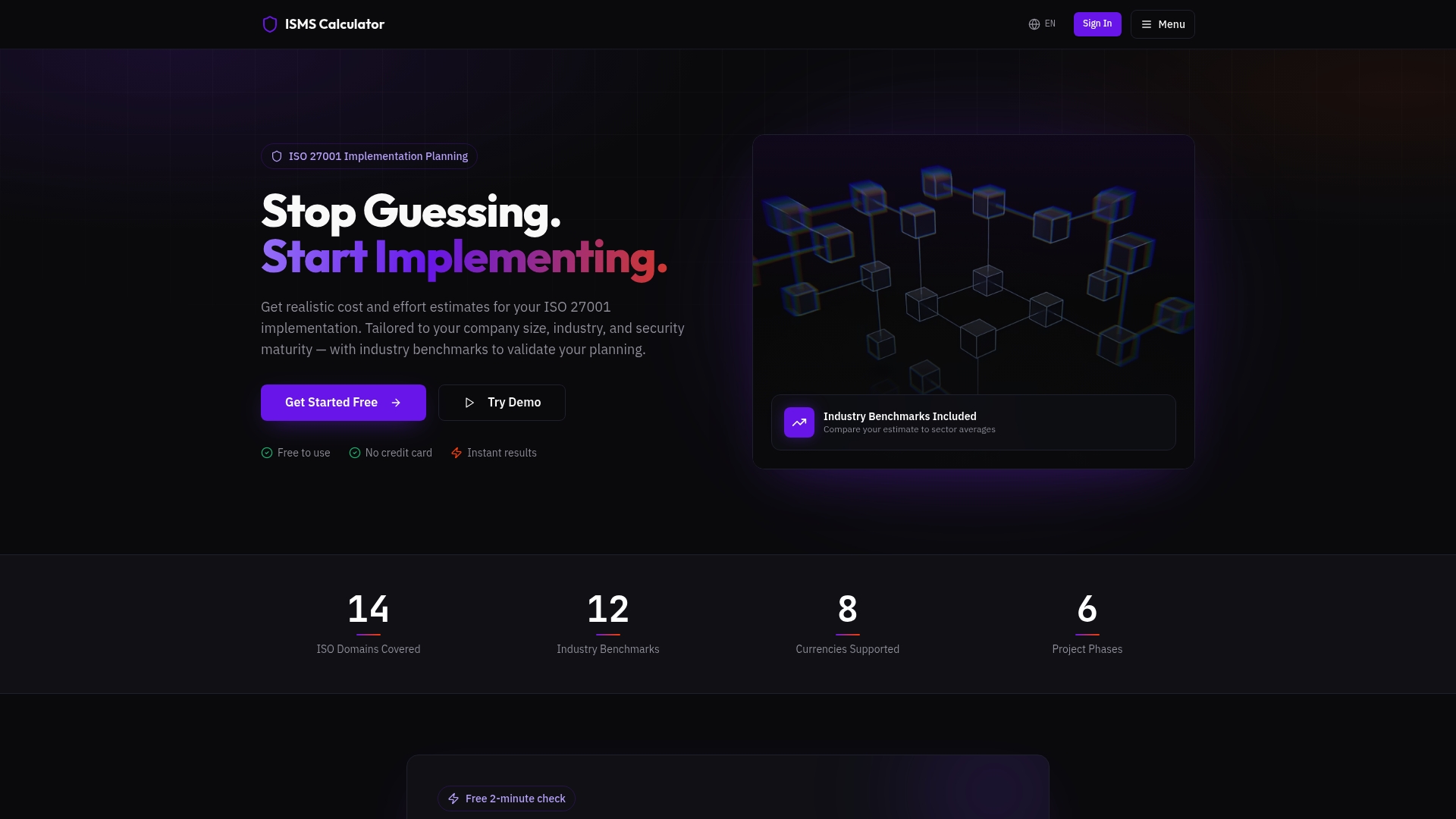
Ismscalculator provides a full readiness assessment that scores your ISMS across all four ISO/IEC 27001:2022 control themes, maps control maturity on a structured scale, and generates a prioritized remediation list tied to your audit timeline. The platform also offers a free 2-minute readiness check that gives compliance managers an immediate baseline before committing to a full assessment. Both tools align with 2026 ISO 27001 audit requirements and produce the governance metrics your management review needs.
FAQ
What does measuring ISMS readiness before an audit actually involve?
Measuring ISMS readiness means scoring the maturity of each ISO 27001 control, verifying that operational evidence exists and is current, and confirming that your documentation, controls, and staff behavior all tell the same story.
How far in advance should I start ISMS audit preparation?
Start your readiness assessment at least 12 weeks before your Stage 2 audit date. Internal audits must complete by 8 weeks out, with corrective actions closed by 6 weeks and evidence refreshed at 3 weeks.
What is evidence clustering and why does it matter?
Evidence clustering means submitting large volumes of records dated shortly before the audit. Certification bodies treat this pattern as a sign that controls are not genuinely embedded, which increases the risk of findings and extended audit scrutiny.
Which three metrics best communicate ISMS maturity to executives?
The three most useful metrics are the count of open high-risk actions, mean time to close corrective actions, and the percentage of controls backed by evidence dated within the last 90 days.
Can open internal audit findings affect ISO 27001 certification?
Yes. Unresolved major non-conformities from internal audits signal systemic failure to certification bodies and must be closed with verified evidence before Stage 2 begins.