
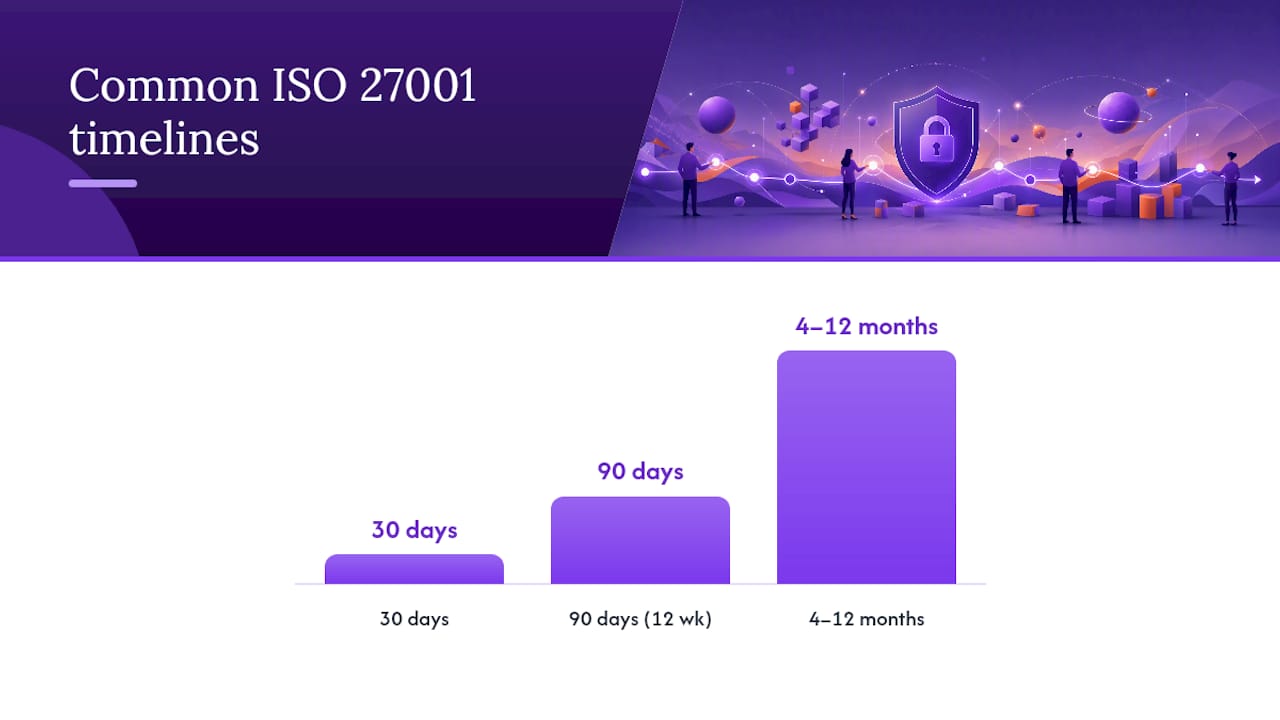
Adoptez un plan de projet sur 12 semaines en 30/60/90 jours lorsque vous disposez d'un sponsorship exécutif, d'un responsable SMSI dédié et de quelques mesures de sécurité de base déjà en place. Cette structure vous permet d'atteindre rapidement des livrables prêts pour l'audit (charte, analyse des écarts, évaluation des risques et Déclaration d'Applicabilité). Sans ces conditions, prévoyez plutôt un budget de 4 à 12 mois. Dans tous les cas, les premiers livrables ne changent jamais : une charte de projet signée, un périmètre documenté, une analyse des écarts clause par clause et un registre des risques initial.
En résumé :
- Les organisations disposant d'un responsable SMSI dédié à temps plein et d'un fort soutien de la direction peuvent obtenir la certification ISO 27001 en 12 semaines, à condition que les mesures de contrôle soient déjà en place.
- Pour les organisations qui partent de zéro ou dont les mesures de contrôle sont peu matures, le calendrier du projet s'étend de quatre à douze mois, avec un accent sur la mise en place des fondations et la sensibilisation.
- Les jalons clés comprennent une charte de projet signée, un périmètre documenté, une analyse des écarts clause par clause et une politique de sécurité de l'information approuvée, le tout à compléter dans les 30 premiers jours.
- L'évaluation des risques et la Déclaration d'Applicabilité nécessitent des méthodologies cohérentes et simples, une classification des actifs, une identification des menaces et une cartographie détaillée des mesures de contrôle, progressant au cours des semaines 31 à 60.
- Accélérer le processus risque de créer des lacunes dans les preuves et un glissement de périmètre ; un strict découpage en créneaux temporels, des modèles prêts à l'emploi et une exécution parallèle des tâches sont donc essentiels pour maintenir l'état de préparation à l'audit sans compromettre la qualité.
Sommaire
- Quel est le calendrier de plan de projet ISO 27001 adapté à votre organisation ?
- Prérequis et checklist de planification avant de démarrer le compte à rebours
- Jours 1 à 30 : la phase de fondation, semaine par semaine
- Jours 31 à 60 : évaluation des risques, DdA et procédures essentielles
- Jours 61 à 90 : mise en œuvre, formation et préparation à la certification
- Un calendrier sur 12 semaines à copier dans votre propre plan
- Ce que représentent réellement les effectifs et le budget
- Comment accélérer sans compromettre l'audit
- Ce qui fait échouer les projets ISO 27001 (et ce qu'il faut corriger en premier)
- Planifiez votre budget et votre calendrier avec de vrais chiffres, pas des estimations approximatives
- Sources
Quel est le calendrier de plan de projet ISO 27001 adapté à votre organisation ?
La réponse honnête dépend moins de la taille de l'entreprise que de trois facteurs : le temps dédié que votre responsable SMSI peut consacrer au projet, le niveau de soutien de la direction pour prendre des décisions rapidement, et la maturité de vos mesures de contrôle existantes. Les organisations disposant d'un responsable SMSI représentant 0,5 à 1,0 ETP, d'une réunion de pilotage hebdomadaire et d'une personne habilitée à approuver le traitement des risques sur-le-champ peuvent réalistement atteindre un état prêt à la certification en 90 jours. Toutes les autres devraient prévoir un délai plus long.
Un fast-track de 12 semaines ne fonctionne que si vous ne partez pas de zéro. Si vous disposez déjà de contrôles d'accès, d'un processus de gestion des correctifs et d'une forme d'inventaire des actifs, vous compressez le travail de documentation et de formalisation, et non la construction de la sécurité from scratch. Il s'agit d'un projet très différent de celui où vous déployez l'authentification multifacteur, la protection des postes de travail et la gestion des risques liés aux fournisseurs en même temps que vous rédigez une politique de sécurité de l'information.
La structure par phases elle-même ne change guère entre un sprint de 90 jours et un déploiement sur 9 mois. Vous progressez selon les mêmes trois étapes :
- Fondation — périmètre, gouvernance et analyse des écarts par rapport à ISO 27001:2022 et à l'Annex A
- Développement — évaluation des risques, cartographie des mesures de contrôle et Déclaration d'Applicabilité
- Mise en œuvre — déploiement des mesures de contrôle, formation du personnel, réalisation d'un audit interne et préparation à la certification
Ce qui change, c'est la part des tâches exécutées en parallèle par rapport à celles réalisées en séquence, ainsi que la marge que vous prévoyez pour les itérations.
Le principal facteur bloquant n'est pas technique, il est organisationnel. Les projets s'enlisent lorsque personne n'est propriétaire du registre des risques, lorsque le périmètre ne cesse de s'étendre en cours de projet parce que quelqu'un insiste pour inclure une nouvelle entité, ou lorsque les responsables de département traitent le SMSI comme une initiative informatique plutôt qu'organisationnelle. L'un ou l'autre de ces facteurs peut transformer un plan serré de 90 jours en un marathon de 6 mois pour la même quantité de travail effectif.
Prérequis et checklist de planification avant de démarrer le compte à rebours
Avant de rédiger une seule procédure ou de réaliser une analyse des écarts, verrouillez quatre éléments. Ignorer cette étape est la raison la plus fréquente pour laquelle les projets ISO 27001 dépassent leur calendrier.
- Obtenez le sponsorship exécutif par écrit. Une charte de projet doit désigner le sponsor exécutif, le responsable SMSI, l'autorité budgétaire et une matrice RACI précisant qui est Responsable, Accountable (imputable), Consulté et Informé pour chaque grand chantier. Définissez une cadence pour le comité de pilotage — hebdomadaire pour un fast-track, bimensuelle ou mensuelle pour un déploiement plus long.
- Définissez explicitement le périmètre et les exclusions. Consignez par écrit quelles entités, sites, systèmes et tiers se trouvent à l'intérieur du périmètre du SMSI — et tout aussi important, ceux qui n'y figurent pas. Un énoncé de périmètre vague est la source des dérapages lors des audits de certification des mois plus tard.
- Procurez-vous la norme et configurez votre espace documentaire. Achetez ISO 27001:2022 et ISO 27002:2022 directement plutôt que de vous fier à des résumés. Mettez en place un référentiel central (SharePoint, Confluence ou un outil GRC dédié) avant de commencer à produire des documents, et non après.
- Dispensez une formation de sensibilisation de base à l'équipe centrale. Tous les membres impliqués dans le projet — pas seulement le responsable SMSI — doivent comprendre la structure de l'Annex A et ce qu'est réellement une Déclaration d'Applicabilité avant le début de la semaine 1.
Le socle technique minimum pour un fast-track réaliste comprend des politiques de contrôle d'accès, une forme de journalisation, une cadence de gestion des correctifs et un inventaire des actifs — même incomplet. Si rien de tout cela n'existe encore, un calendrier de 12 semaines n'est pas réaliste. Prévoyez 6 à 12 mois et traitez les semaines 1 à 4 comme la phase durant laquelle vous construisez ce socle, plutôt que de le documenter.
Conseil de praticien : Configurez votre référentiel documentaire et les droits d'accès avant la réunion de lancement, et non pendant la semaine 1. Les équipes perdent des journées entières à régler des questions du type « qui peut modifier ce dossier » qui n'auraient jamais dû se poser.
Jours 1 à 30 : la phase de fondation, semaine par semaine
Les 30 premiers jours définissent la trajectoire de tout ce qui suit. Si cette phase est bâclée, vous passerez les semaines 5 à 12 à corriger des problèmes de périmètre et de gouvernance plutôt qu'à mettre en place des mesures de contrôle.
- Semaine 1 : lancement et gouvernance. Tenez le lancement officiel, finalisez la charte, attribuez la matrice RACI, configurez le référentiel documentaire et dispensez la formation de sensibilisation initiale à ISO 27001 à l'équipe centrale du projet.
- Semaine 2 : contexte et périmètre. Documentez le contexte organisationnel, identifiez les parties intéressées (régulateurs, clients, assureurs), rédigez l'énoncé formel du périmètre et commencez un premier inventaire des actifs couvrant les personnes, les systèmes et les données.
- Semaine 3 : analyse des écarts. Réalisez une évaluation clause par clause des clauses de management de ISO 27001:2022 et de chaque mesure de contrôle de l'Annex A. Une analyse des écarts structurée et délimitée dans le temps, avec une notation simple Rouge/Amber/Vert, évite que cela ne se transforme en un audit ouvert qui dévore un mois à lui seul.
- Semaine 4 : politique et validation par la direction. Rédigez la politique de sécurité de l'information, définissez les rôles et les responsabilités au sein du SMSI, fixez des objectifs de sécurité mesurables et obtenez la validation formelle de la direction sur l'ensemble de ces éléments.
Au bout de 30 jours, vous devriez avoir dans votre référentiel une charte signée, un énoncé de périmètre documenté, une analyse des écarts complète avec des conclusions notées RAG et une politique de sécurité de l'information approuvée. C'est la barre d'acceptation. Si l'un de ces quatre éléments est manquant ou encore en brouillon, ne passez pas encore à l'évaluation des risques. Consolidez d'abord les fondations.
Les feuilles de route construites autour d'une structure de 90 jours/12 semaines conviennent aux PME disposant de ressources dédiées et de mesures de contrôle de base existantes, mais les organisations plus grandes ou moins matures ont généralement besoin de 4 à 12 mois pour couvrir le même terrain correctement. Il n'y a aucune honte à opter pour ce calendrier plus long ; précipiter une analyse des écarts pour atteindre un objectif arbitraire de 30 jours ne fait que reporter les mêmes problèmes non résolus aux semaines 5 à 8, où ils sont plus difficiles à corriger.
Jours 31 à 60 : évaluation des risques, DdA et procédures essentielles
Cette phase est celle où se concentre l'essentiel du travail intellectuel, et là où les raccourcis bâclés sont le plus visibles lors de l'audit externe.
Commencez par concevoir une méthodologie de gestion des risques suffisamment simple pour que n'importe quel membre de l'équipe puisse l'appliquer de manière cohérente. Une matrice de vraisemblance/impact 5×5 avec des critères de notation clairement définis convient à la plupart des organisations. Compliquer inutilement cette étape est un piège courant : les auditeurs se soucient moins de la sophistication méthodologique que de la cohérence avec laquelle vous avez appliqué votre propre méthode.
Ensuite :
- Classifiez les actifs par sensibilité et criticité métier en utilisant le registre commencé à la semaine 2.
- Identifiez les menaces et les vulnérabilités réalistes par catégorie d'actifs — et non par actif individuel — pour maintenir le registre gérable.
- Évaluez chaque risque selon votre méthodologie et décidez d'une option de traitement : accepter, atténuer, transférer ou éviter.
- Associez chaque risque traité à une mesure de contrôle spécifique de l'Annex A (ou à une mesure personnalisée si aucune ne convient) et rédigez une justification en une ligne pour chaque mesure de l'Annex A que vous excluez.
Cet exercice de cartographie produit votre Déclaration d'Applicabilité, qui sert d'index principal permettant aux auditeurs de remonter chaque décision jusqu'à une justification documentée. La conception d'une méthodologie de gestion des risques documentée et la production d'une DdA qui associe les risques aux mesures de contrôle de l'Annex A se trouvent au cœur de tout le processus de certification — ce n'est pas un document généré en fin de parcours.
Une fois la DdA rédigée, priorisez les procédures pour les mesures de contrôle présentant les scores de risque les plus élevés : le contrôle d'accès, la réponse aux incidents et la sauvegarde/reprise figurent généralement en tête de liste. Rédigez chaque procédure en intégrant dès le premier jour la collecte des preuves. Si une procédure stipule que des revues d'accès trimestrielles sont effectuées, elle doit également préciser où est conservée la validation de ces revues.

Conseil de praticien : Rédigez les procédures et les modèles de preuves ensemble, et non séquentiellement. Une procédure sans modèle de preuve correspondant est une politique que personne ne pourra prouver avoir suivie six mois plus tard.
Jours 61 à 90 : mise en œuvre, formation et préparation à la certification
C'est la phase au cours de laquelle le SMSI passe de documenté à démontrable. Les auditeurs ne certifient pas des documents — ils certifient des preuves attestant que les documents reflètent la réalité.
Commencez à mettre en œuvre les mesures de contrôle dans l'ordre de priorité défini par votre plan de traitement des risques, et constituez la trace des preuves au fur et à mesure plutôt que de la reconstituer a posteriori :
- Déployez les mesures de contrôle techniques et procédurales issues du plan de traitement, en enregistrant les dates de réalisation et les responsables pour chacune.
- Mettez en place des dossiers de preuves ou un outil GRC structuré autour de votre DdA, de sorte que chaque mesure de contrôle corresponde à une preuve spécifique.
- Déployez une formation adaptée aux rôles — sensibilisation générale pour tous, formation technique approfondie pour les administrateurs et les développeurs — et conservez les feuilles de présence signées.
- Suivez le taux d'achèvement des formations par rapport à une échéance ; les dossiers de formation incomplets sont un constat récurrent lors des audits de Phase 1.
Une fois les mesures de contrôle opérationnelles et les preuves accumulées, passez à l'audit interne et à la revue de direction :
- Définissez le périmètre de l'audit interne couvrant chaque mesure de contrôle de l'Annex A déclarée dans la DdA — et non un échantillon.
- Élaborez un plan et un calendrier d'audit, idéalement avec une personne extérieure au département audité pour préserver l'indépendance.
- Consignez chaque non-conformité détectée, attribuez un responsable d'action corrective et fixez un délai de remédiation.
- Organisez une revue de direction formelle avec les éléments d'entrée comprenant les résultats d'audit, l'état du registre des risques et la performance par rapport aux objectifs, et documentez les décisions prises.
- Assemblez le dossier documentaire complet — politiques, registre des risques, DdA, procédures, dossiers de formation, rapports d'audit — pour la revue de l'auditeur externe.
La traçabilité des preuves importe plus aux auditeurs que la qualité rédactionnelle des politiques. Une politique de journalisation étayée par trois mois de validations réelles de revues d'accès l'emportera systématiquement sur une politique magnifiquement rédigée mais sans aucune pièce justificative.
Un calendrier sur 12 semaines à copier dans votre propre plan
Voici comment les trois phases se décomposent semaine par semaine, avec le livrable que chaque semaine doit produire.
| Semaine | Thème | Livrable clé |
|---|---|---|
| 1 | Lancement, charte, RACI, configuration du référentiel | Charte de projet signée |
| 2 | Contexte, parties intéressées, périmètre, inventaire des actifs (v1) | Énoncé de périmètre documenté |
| 3 | Analyse des écarts clause par clause par rapport à l'Annex A | Rapport d'analyse des écarts noté RAG |
| 4 | Rédaction de la politique, rôles, objectifs, validation par la direction | Politique de sécurité de l'information approuvée |
| 5 | Conception de la méthodologie de gestion des risques et classification des actifs | Méthodologie de gestion des risques documentée |
| 6 | Identification des menaces et cotation des risques | Registre des risques provisoire |
| 7 | Décisions de traitement des risques et cartographie des mesures de contrôle | Déclaration d'Applicabilité provisoire |
| 8 | Rédaction des procédures pour les mesures de contrôle prioritaires | Procédures de contrôle d'accès et de réponse aux incidents |
| 9 | Mise en œuvre des mesures de contrôle et modèles de preuves | Dispositif de collecte des preuves opérationnel |
| 10 | Déploiement de la formation (générale et par rôle) | Feuilles de présence aux formations signées |
| 11 | Réalisation de l'audit interne | Rapport d'audit interne avec constats |
| 12 | Revue de direction et dossier documentaire | Dossier de preuves prêt pour la certification |
Les semaines 3, 7 et 11 sont les jalons à traiter comme des points de décision go/no-go. Si l'analyse des écarts, le brouillon de DdA ou les constats d'audit interne semblent fragiles à l'un de ces stades, c'est le signal pour ajouter une marge avant d'avancer, et non après.
Ce que représentent réellement les effectifs et le budget
La plupart des plans de projet sous-estiment le temps nécessaire parce qu'ils traitent ISO 27001 comme un exercice de rédaction documentaire plutôt que comme un changement opérationnel. Or c'est les deux à la fois, et la partie opérationnelle prend plus de temps.
Pour un projet fast-track de 12 semaines, un modèle d'effectifs réaliste ressemble à :
- Responsable SMSI : 50 à 100 % de son temps sur les 12 semaines complètes ; ce rôle ne peut pas être une mission secondaire.
- Sponsor exécutif : 2 à 4 heures par semaine pour les réunions de pilotage et les décisions rapides en matière de traitement des risques.
- Responsable informatique : 25 à 40 % de son temps, le plus intensément durant les semaines 5 à 10 lors du déploiement des mesures de contrôle.
- Représentants RH et des services généraux : quelques heures par semaine pour le déploiement des formations et les mesures de sécurité physique.
- Représentants des directions métier : 2 à 5 heures par semaine chacun durant les phases d'analyse des écarts et d'évaluation des risques.
Les petites organisations (moins de 50 employés) peuvent souvent mener ce projet presque entièrement avec des ressources internes, complétées par un consultant à temps partiel pour la méthodologie initiale de gestion des risques et l'audit interne. Les organisations de taille moyenne et plus grande combinent généralement le pilotage interne avec un consultant externe pour l'analyse des écarts et un auditeur principal certifié pour la préparation à la Phase 1, car un auditeur interne qui examine les mesures de contrôle de son propre département pose un problème d'indépendance.
Les postes de coûts à surveiller : les tarifs journaliers des consultants pour l'analyse des écarts et le soutien à l'audit, les honoraires d'audit de l'organisme de certification (généralement répartis entre la Phase 1 et la Phase 2), ainsi que les coûts éventuels d'un outil GRC. Une décomposition des responsabilités ISO 27001 par rôle mérite d'être examinée avant de finaliser vos hypothèses d'effectifs, car la sous-estimation du temps du responsable informatique est l'une des erreurs budgétaires les plus fréquentes.
Conseil de praticien : Dans votre plan de projet, budgétisez séparément les jours de consultant et les jours de ressources internes. Les mélanger masque le vrai coût du soutien externe jusqu'à la réception de la facture.
Comment accélérer sans compromettre l'audit
La compression est possible, mais seulement dans certaines limites, et chaque raccourci implique un compromis qu'il vaut mieux nommer explicitement avant de le prendre.
- Délimitez strictement l'analyse des écarts à une fenêtre de 2 à 3 semaines et imposez une priorisation RAG plutôt qu'une documentation exhaustive de chaque constat. C'est la tactique de compression au meilleur rapport efficacité/effort disponible.
- Utilisez des modèles de DdA prêts à l'emploi et des bibliothèques de cartographie des mesures de contrôle plutôt que de rédiger des justifications depuis une page blanche pour les 93 mesures de contrôle de l'Annex A.
- Exécutez en parallèle l'évaluation des risques et la rédaction des procédures plutôt qu'en séquence, une fois votre méthodologie de gestion des risques verrouillée.
- Utilisez des outils de collecte automatisée des preuves (capture automatique de journaux, exports depuis les systèmes de ticketing) plutôt que la compilation manuelle de captures d'écran.
Le compromis est réel : comprimer trop agressivement fait basculer le risque d'audit vers l'avant — les lacunes dans les preuves apparaissent lors de la Phase 1 plutôt que d'être détectées en interne. Une dépendance accrue envers des consultants externes pour tenir un délai serré augmente aussi le coût par semaine, même si elle raccourcit le calendrier. Traitez l'accélération comme quelque chose que vous vous gagnez grâce à une maturité existante, et non quelque chose que vous imposez par la seule force du pilotage de projet.
Ce qui fait échouer les projets ISO 27001 (et ce qu'il faut corriger en premier)
Les projets qui s'enlisent n'échouent presque jamais pour des raisons techniques. Ils échouent parce que les preuves sont incohérentes, parce que le périmètre s'étend discrètement trois semaines après le début, ou parce que personne n'est plus en mesure d'indiquer qui est réellement propriétaire du registre des risques une fois que l'enthousiasme initial du lancement est retombé. J'ai vu des équipes rédiger de superbes politiques, puis découvrir, deux semaines avant la Phase 1, que personne n'avait conservé les feuilles de présence aux formations que ces politiques promettaient d'avoir.
Si vous ne retenez qu'une seule règle de priorisation de tout ce plan, que ce soit celle-ci : construisez la traçabilité de la DdA et des preuves démontrant l'effectivité des mesures de contrôle avant de peaufiner quoi que ce soit d'autre. Une politique sommaire étayée par six mois de véritables journaux de revues d'accès réussira un audit qu'une politique irréprochable sans aucune trace de preuve ne passera pas. Les auditeurs sont formés pour tirer sur les fils, et un fil qui se déroule sur une mesure de contrôle les incite à tirer encore plus fort sur la suivante.
Avant la Phase 1, assurez-vous de pouvoir remettre à un auditeur les éléments suivants sans vous précipiter : une DdA à jour avec chaque exclusion justifiée, un registre des risques indiquant les décisions de traitement et les dates, des dossiers de formation correspondant à la périodicité stipulée par votre politique, et au moins un cycle d'audit interne complet avec des actions correctives clôturées. Tout le reste de votre dossier documentaire importe moins que ces quatre éléments.
— Martin
Planifiez votre budget et votre calendrier avec de vrais chiffres, pas des estimations approximatives
La plupart des plans de projet ISO 27001 s'effondrent au stade de la budgétisation — et non à celui de l'exécution — parce que la direction a validé un calendrier basé sur un modèle générique plutôt que sur des chiffres spécifiques à la taille de votre entreprise, à votre secteur et à votre maturité en matière de sécurité.
L'évaluation de maturité d'Ismscalculator génère en quelques minutes une estimation personnalisée des coûts et des efforts, étalonnée par rapport aux entreprises de votre taille et de votre secteur — de sorte que vous ne défendez pas un calendrier de 12 semaines devant votre DAF avec pour seul appui un article de blog. Réalisez un bilan de maturité sur l'ensemble des quatre thèmes de mesures de contrôle ISO/IEC 27001:2022, exportez le calendrier résultant sous forme de diagramme de Gantt personnalisable que votre comité de pilotage peut réellement examiner, et enregistrez plusieurs scénarios si vous évaluez un fast-track par rapport à un déploiement par phases. Si vous avez simplement besoin d'une vérification rapide avant d'engager des ressources projet, le bilan de maturité en 2 minutes donne aux dirigeants un signal suffisamment rapide pour approuver une charte sans attendre le résultat d'une mission de conseil complète. Commencez par l'évaluation de maturité, enregistrez votre estimation et apportez-la à votre première réunion de comité de pilotage comme base de référence commune.
Sources
La feuille de route de mise en œuvre ISO 27001 de GLOCERT International décrit la structure 30/60/90 sur laquelle s'appuie cet article, y compris les variantes de calendrier réalistes selon la taille de l'organisation. Le guide de feuille de route de mise en œuvre de Copla traite plus en détail de l'analyse des écarts délimitée dans le temps et de la notation RAG. L'article de l'ISACA sur la planification et la mise en œuvre d'ISO 27001 reste l'une des explications les plus claires sur la manière dont l'évaluation des risques se connecte à la DdA. Pour la préparation des preuves en particulier, la checklist d'évaluation des risques de tekRESCUE propose un cadre pratique en huit étapes qu'il vaut la peine de croiser avec votre propre méthodologie. Si vous souhaitez une vue d'ensemble de ce à quoi ressemble un calendrier complet de bout en bout, le calendrier de mise en œuvre d'Ismscalculator et sa checklist de certification en 80 étapes sont tous deux conçus pour s'utiliser directement en complément du plan ci-dessus.
- Feuille de route de mise en œuvre ISO 27001 : plan 30-60-90 jours et 12 semaines
- Planification et mise en œuvre d'ISO 27001